Articles 7 & 8: ‘All children have the right to a registered name, a nationality, an identity’

Article 7 (Registration, name, nationality, care): All children have the right to a legally registered name, recognised by the government. Children have the right to a nationality (to belong to a country). Children also have a right to know and, as far as possible, to be cared for by their parents.

Article 8 (Preservation of identity): Children have the right to an identity – an official record of who they are.  Governments should recognise their right to a name, a nationality and family ties.

How easy it is to take these rights for granted.  Most children, whether living with their birth parents, other relatives, in foster or adoptive families, or even in an informal care situation, enjoy these rights.  Their identity and the right to belong to their community and country is secure.  But what about children who, because of intolerable conflict situations in their country of birth, are removed to another, safe country, perhaps on another continent?  War has firstly violated their right to be cared for by their own parents, but they retain their identity as a citizen of that country, right?

A report by The Independent has the headline: ‘Hundreds of Afghans who grew up in UK face deportation to a country they “barely remember”.’  This refers to children who were sent to the UK to live with British foster parents; they went to school here, took GCSEs and A Levels and became active members of their communities. Sadly, they mostly had little or no contact with their country of birth. But as these young people reach the age of 18 they face deportation ‘to a country that they barely now remember’.  Under international law, the UK can’t send unaccompanied asylum-seeking minors back to their home country, instead it issues temporary leave to remain, which ends of course, on reaching adulthood.  It then becomes much harder for them to apply for permanent asylum in their adopted country.

What awaits them when they return to Afghanistan?  Often, they can’t trace their birth families, not having had contact whilst living in the UK. The article says: ‘Their Westernised mannerisms and accents also mean they are often regarded with suspicion…..and some…..have been left homeless, chased by the Taliban, kidnapped, ransomed and beaten.’  Those who remain in the UK, waiting for their application to be considered, are in limbo.  They can’t get a job, they can’t go to university.  The article doesn’t say whether they can remain living with their foster families, but in any case, this isn’t their country any more.  So, while these young adults have a registered name and they have ties to a ‘temporary’ family, they don’t ‘belong to a country’, surely a huge part of anyone’s identity.  Needless to say, both the UNHCR and the UK’s Children’s Commissioner’s office have criticised The Home Office’s policy towards asylum-seeking children.  You can read the full article here.

Yet another example of the trauma, devastation, even the ruination of young people’s lives caused by war.

Image result for we are all born free book

‘We all have the right to belong to a country’

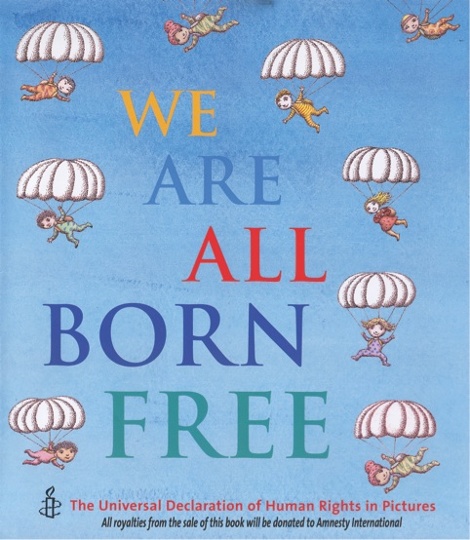
We are all born free: The Universal Declaration of Human Rights in Pictures

Published by Frances Lincoln Children’s Books www.franceslincoln.com in association with Amnesty International.

A
Article 6 (Survival and development): Children have the right to live. Governments should ensure that children survive and develop healthily.

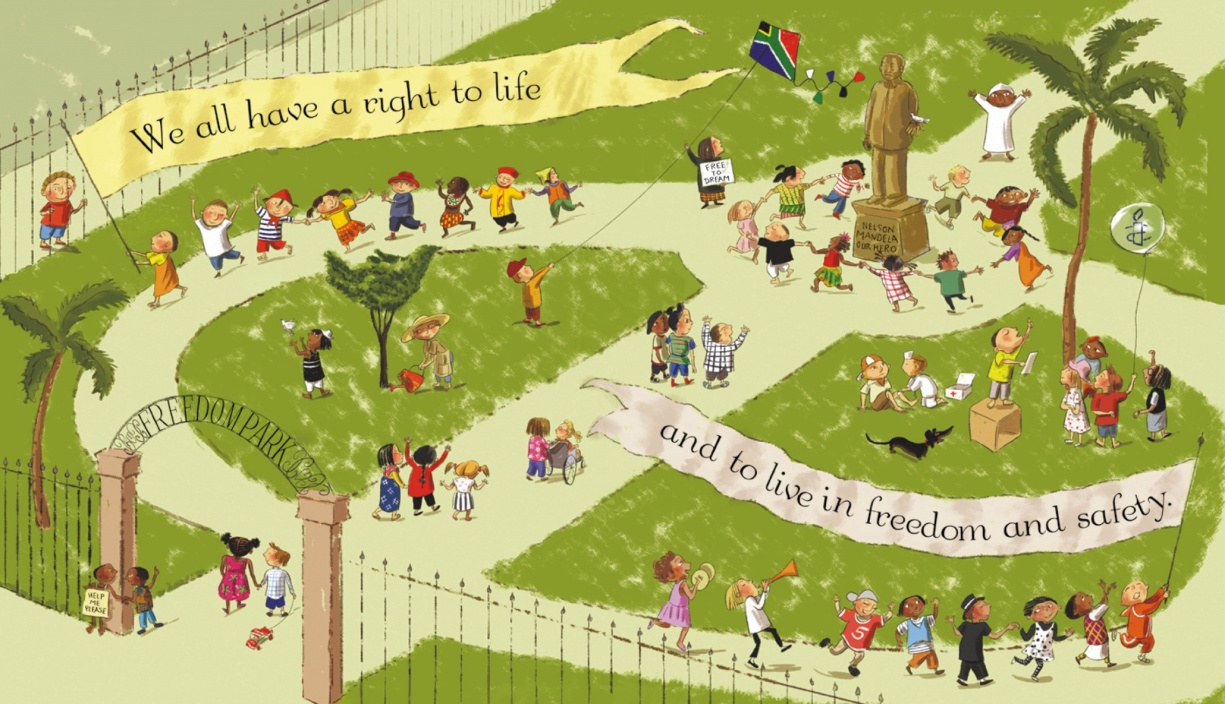
Article 6 reflects Article 3 of The Universal Declaration of Human Rights which states: ‘We all have the right to life, and to live in freedom and safety.’  I’ve got a beautiful book called ‘We are all born free: The Universal Declaration of Human Rights in Pictures.’* Each ‘Right’ is colourfully illustrated by a different artist.  The illustration for Article 3 is a picture of ‘Freedom Park’, a garden with children of all nationalities running, playing, parading with instruments, one is flying a kite, another watering a plant, others join hands dancing round a statue of Nelson Mandela.  The feeling is of enjoyment, being with your friends, in the uninhibited way that children do things.  I mean of course, children who are lucky enough to live in freedom, without daily fear for their lives and those of their families.

So the right to life isn’t just simply to stay alive, it’s about mental and physical health and emotional well being (as a Christian I would add spiritual well being).  On a training course recently I learned that by the age of two years, 75% of a child’s brain growth has occurred and that the experiences of the child up to that age physically affect brain structure.  A child who has experienced fear, pain, confusion, separation and loss of loved ones as a result of living with conflict will actually grow and develop differently than if they had not had those experiences.  Most children, whatever their environment will grow up loved and cared for to the best of their parents’ ability, which will give them a certain amount of resilience, but this will not, in the long term, protect them from the ‘risk factor’ of war.  This is a sobering thought, isn’t it?  Is any war worth that?

A video clip I was sent shows children aged about 8 to 12 in Syria talking about no longer being able to go to school, playing in the war damaged street, the deaths of friends and family.  Suddenly there was the sound of gunfire.  The children stood up unhurriedly and started to go inside.  One boy said calmly to the interviewer, ‘It’s a sniper, it’s normal’.  This was obviously an everyday occurrence, just an inconvenient interruption, not a cause for panic or fear.  Perhaps it once was, but now these children are desensitized.  In a few years’ time will they be wielding the guns?

I’m sorry this is such depressing reading, I have been deciding how, and even whether, to approach writing about this Article for some weeks.  But ultimately, it needs to be said, for the sake of the children.  And can I mention again the brilliant ongoing work by UNICEF, Save the Children, Tearfund, Christian Aid and many other organisations, to increase resilience and decrease some of the damage which war inflicts on the youngest, least powerful members of society.

34f23d50-e466-4e8a-af56-cc83ae38248c-470x540 823327fd-ed3a-42be-8136-008dde4cad54-2060x1185

*Published by Frances Lincoln Children’s Books www.franceslincoln.com in association with Amnesty International. One of my favourite books!