Did you know there are at least six cathedrals in the capital? I say at least, because there were 4 I knew about, then I discovered a fifth, then a sixth! Who knows how many more there are? Of the five I’ve visited, three are Catholic, two are Church of England, three are North of the River, two are South. You probably know at least one of them….
Before I start, some facts about cathedrals. They differ from abbeys and priories in that they provide a place of worship but are not religious communities occupied by monks or nuns. The word Cathedral is from Latin: cathedra, meaning chair and it’s where the Bishop has his seat or throne. Most cathedrals were either formerly churches or built on the site of a church and some have histories of over 1,000 years.
South of River, right next to London Bridge is Southwark Cathedral. There has been a religious building here since AD606: firstly, a convent, then in 1106, a priory, in 1540 a parish church, and finally in 1905 it was consecrated as a cathedral. The current building is in the Gothic style (the 12th Century bits) and Gothic Revival (the 19th Century bits). The original church was called St Saviour and then St Mary Overie, which means Over the River. The reason for the third name change is that it’s the Anglican Mother church of the Diocese of Southwark (which covers Sutton, incidentally). The cathedral is used by King’s College for its medical degree ceremonies because the nearby St Thomas teaching hospital used to be an infirmary attached to the building when it was a priory, 900 years ago. What a great tradition and heritage!


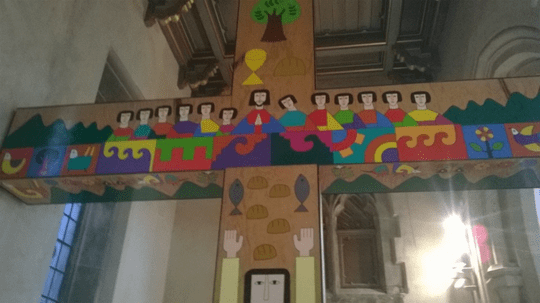
Also South of the River is the Roman Catholic St Georges Cathedral, situated close to the Imperial War Museum, well worth a visit even if you’re not a fan of war. The cathedral is a relative newbie, built in 1848. It was severely damaged by incendiary bombs in World War II and there’s a wonderful picture of a priest walking through the bombed-out shell of the building on Wikipedia (I can’t show it because I’d need permission, but you can look it up yourselves.) The cathedral was redesigned and rebuilt by the brilliantly named Romilly Craze in a 20th Century Gothic Revival style (of course, what else?) There is a Spanish Mass to serve the large Latin American community and the cathedral is involved with several projects in South America and Africa. The Southbank University holds its graduation ceremonies here. I love the modern smooth stone look of the interior, there’s probably a technical word for this.
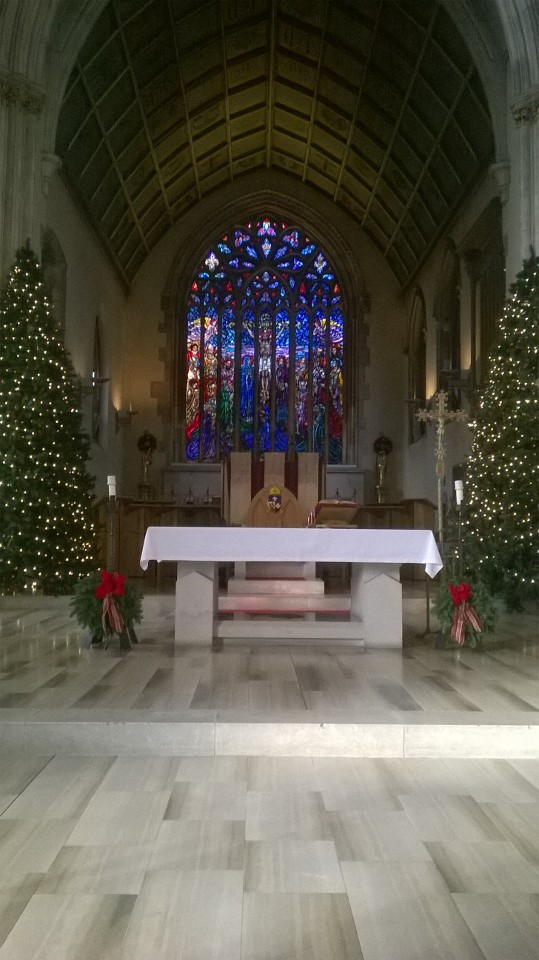
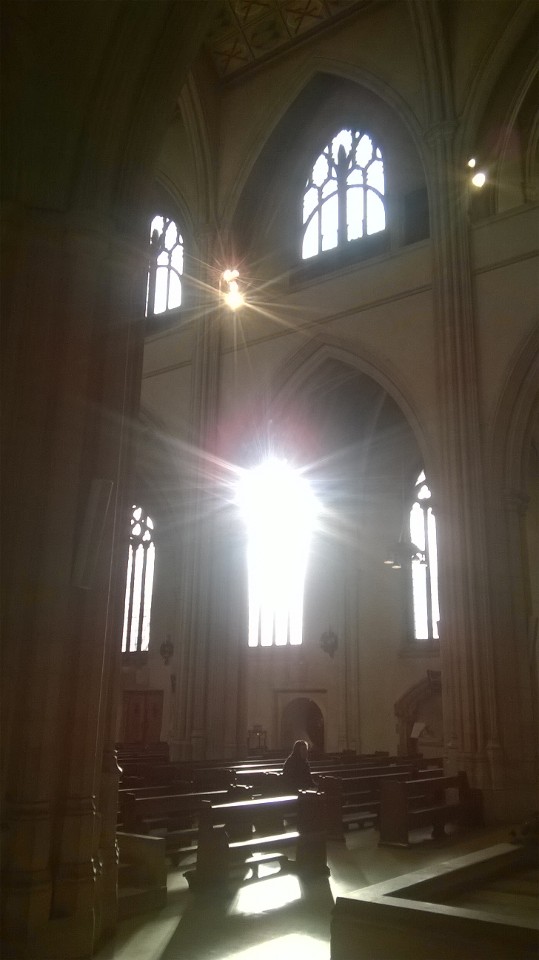
I visited just before Christmas last year on a beautiful sunny day
The iconic, instantly recognisable St Paul’s Cathedral is situated at the highest point of the City of London, Ludgate Hill. The present building dates from the late 17th Century and was designed and built by Sir Christopher Wren in the English Baroque style. The earlier 1087 Gothic cathedral was destroyed in the Great Fire, and interestingly, before the Fire, Wren was commissioned to simply repair Old St Paul’s which had been damaged in the English Civil Wars. But he ended up building a whole new one, to a completely new design! The cathedral escaped major damage in World War II while other buildings around it were reduced to rubble. and there is another atmospheric photo of the dome shrouded in smoke but still standing, which you can find on Google Images. A church dedicated to St Paul was built on or near the site in AD604 as the seat of the new Bishops of London. Bishop’s seat, cathedra, remember? A personal connection – when I was eight, my Dad took me and my sister to visit St Paul’s and I climbed a vertical ladder right into the gold cross at the very top. That hasn’t been allowed for years!


This shows the contrast between the ultra-modern Salvation Army Headquarters and the centuries-old cathedral.
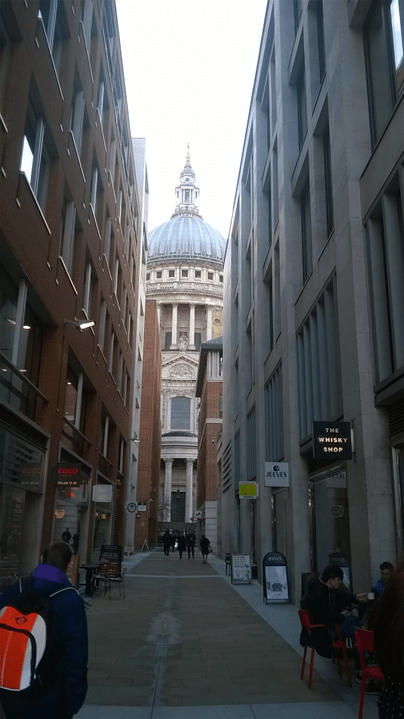
I took this photo of the Cathedral at the end of an alley because this might not be too far from how it would have looked in the crowded narrow streets of the 17th Century (minus the coffee shop and The Whiskey Shop….or perhaps with the coffee shop and The Whiskey Shop!)
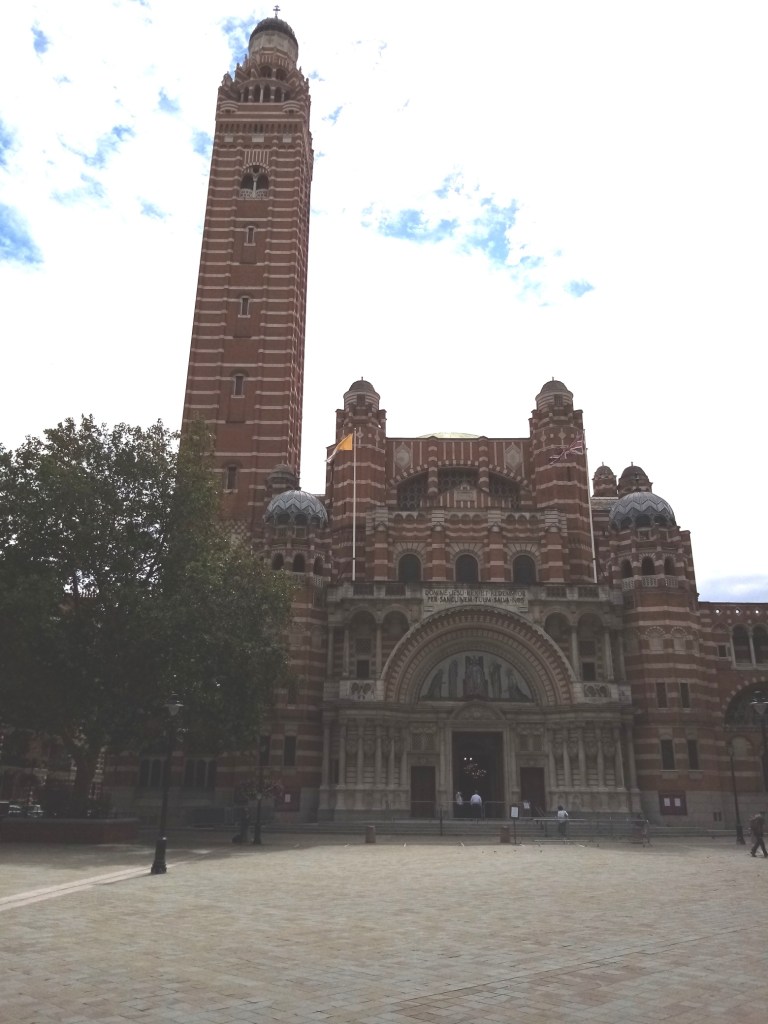
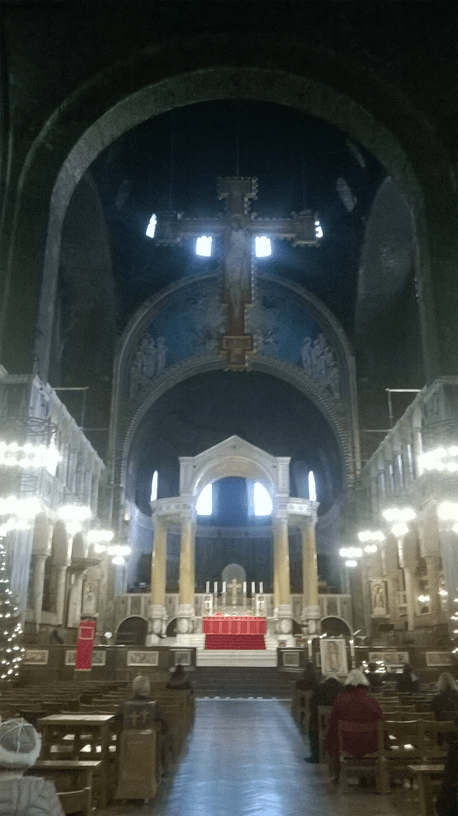
Just a stone’s throw from Victoria Station is Westminster Cathedral. Tourists (and Londoners) confuse this Roman Catholic Cathedral with the much older and larger Westminster Abbey. The cathedral was constructed between 1895 and 1903 and was built roughly on the footprint of the former New Bridewell Prison. The large site allows for a spacious Cathedral Piazza and the cathedral is the largest Roman Catholic in England, the seat of the RC Archbishop of Westminster. It was built in the Neo-Byzantine Style and is very striking, inside and out. You can pay £6 to travel by lift to the top of the 87m (284ft) tower, for great views over London but there’s no charge to visit the main building. The interior is striking because the decoration only goes halfway up the walls. Apparently for reasons of economy, the decoration had hardly been started before the cathedral was consecrated in 1910 and a lack of funds meant it was never finished. The outside is striking because of the dramatic frontage and because it’s beautifully stripy!
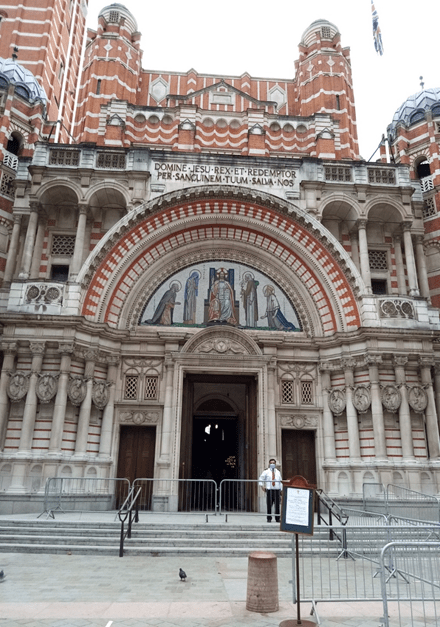
The inscription translates ‘Lord Jesus, King and Redeemer, heal us through your blood’.
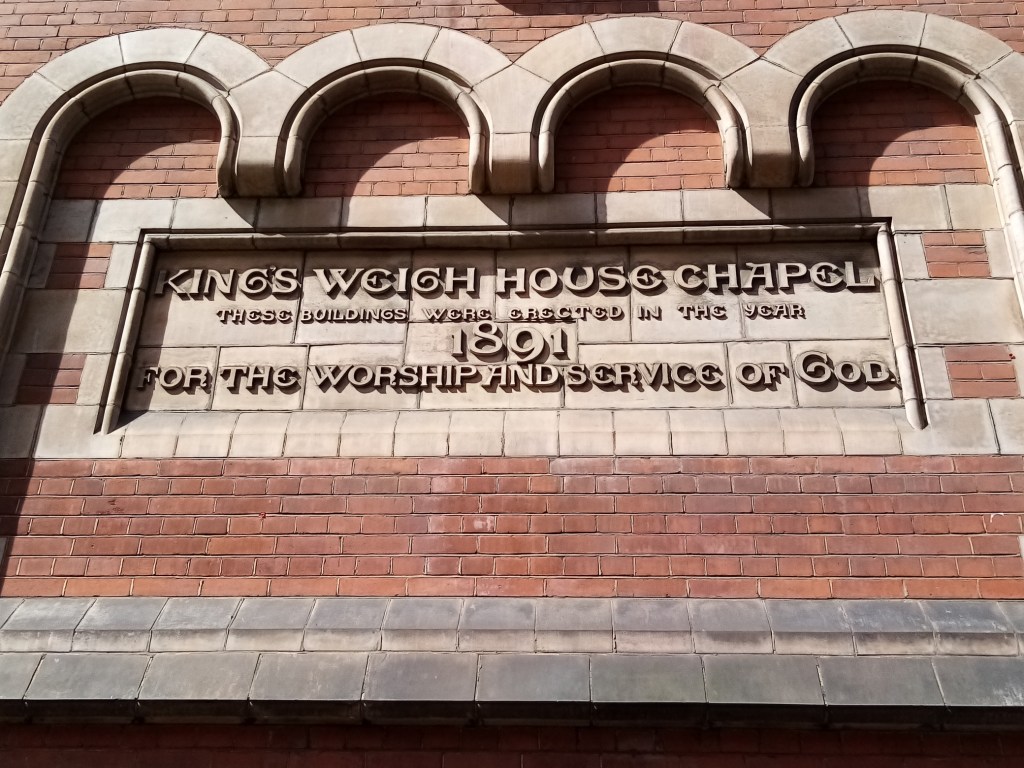
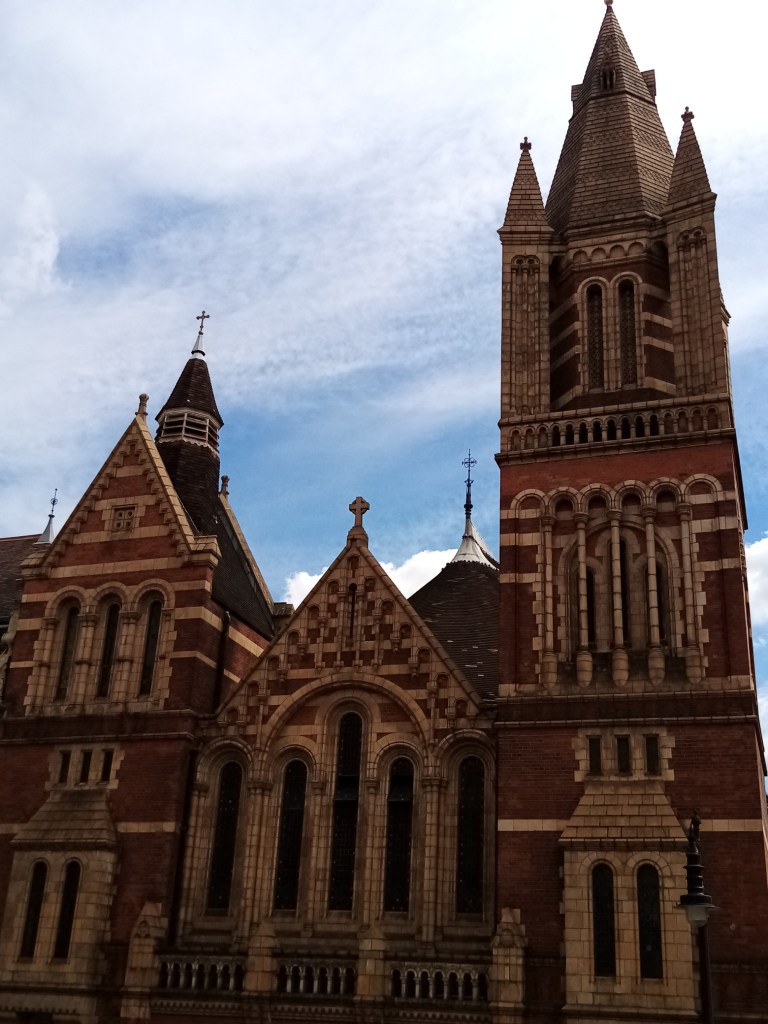
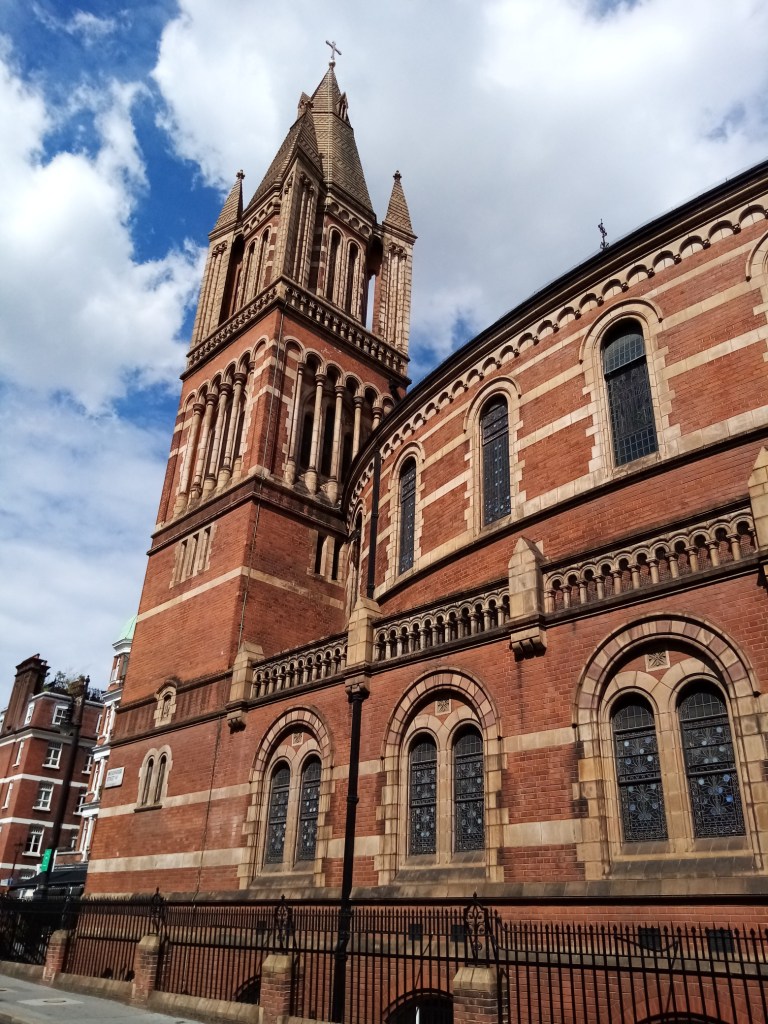
The Ukrainian Holy Family Catholic Cathedral is located just behind Oxford Street, I wonder how many shoppers realise it’s there! It was built in 1891 by architect Alfred Waterhouse in the Romanesque Revival style and was formerly the Congregational King’s Weigh House Chapel. The Congregationalists sold it to the Ukrainian Catholics in 1967 and it became their headquarters. It might seem too large a building for one immigrant nationality group but there are have been large Ukrainian communities in London and Manchester since the late 19th Century. The curious thing about the building is that there is absolutely nothing to indicate what the building is used for: no notice board, posters, signs on the doors. Behind the locked iron gates were the familiar Covid-19 H &S notices, in English and Ukrainian, but nothing about services or activities. The other interesting thing is its strong resemblance to Westminster, a similar stripyness! (Spellcheck doesn’t know that word, by the way.)
 claresimons1