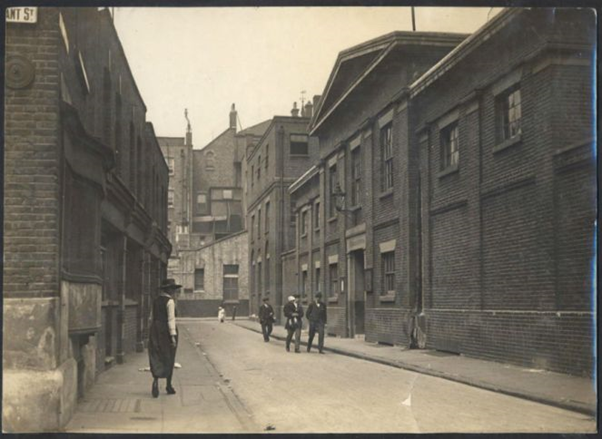
October – Unusual Things found in London Churches

These are some rather unusual and interesting things I’ve found on my travels around the capital. One is a temporary installation, but I’ve included it because its spectacular! I’ll save that till last, meanwhile, here’s

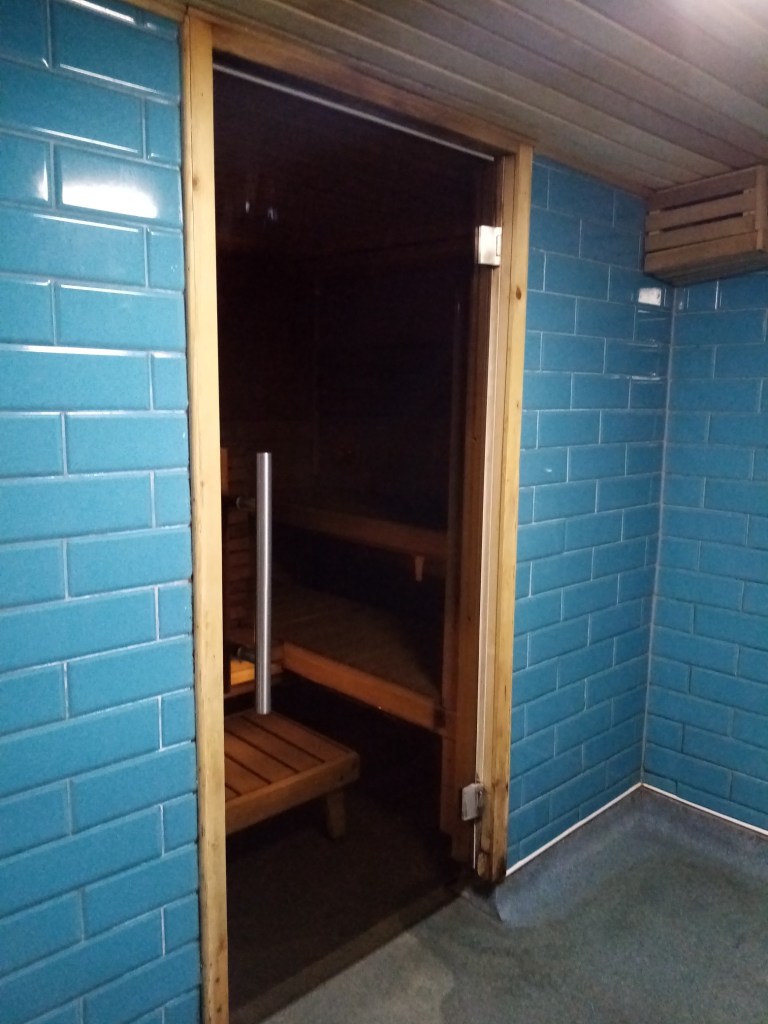
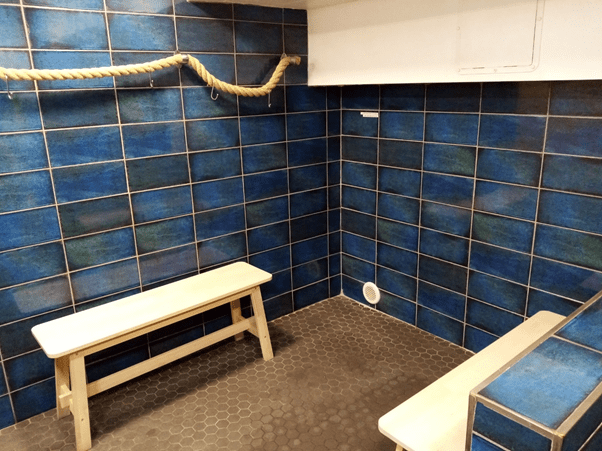
A Sauna in a Church

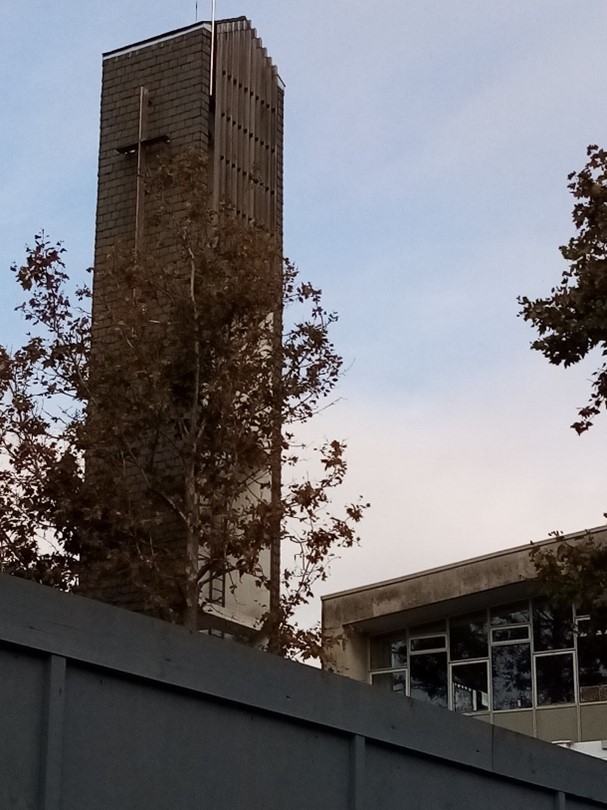
Yes, really! The Finnish Church in Rotherhithe, South London is ‘a welcoming church and community for all the Finns who live in Great Britain and Ireland (either permanently or temporarily), as well as their friends and family – and all friends of Finland!’ As well as a sauna in the basement, there’s also a café and a shop selling Finnish delicacies and a hostel offering accommodation to tourists and backpackers. The church has a long history of pastoral care, having been established as the UK branch of the Finnish Seamen’s Mission in 1882 and continuing today as a community hub. All info from the church website: lontoo.merimieskirkko.fi, which I think translates as: Londonseamanschurch.fi!
St Magnus the Martyr

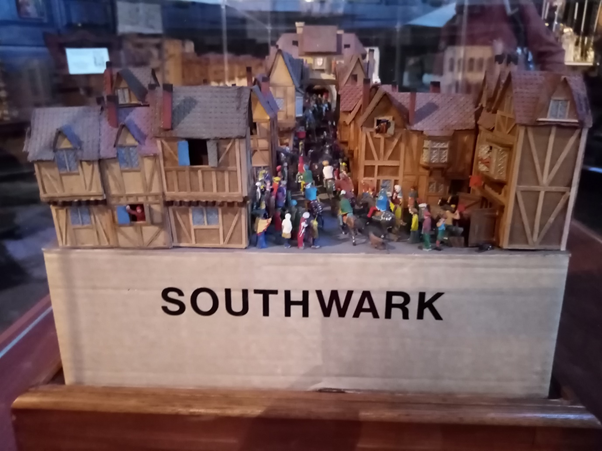
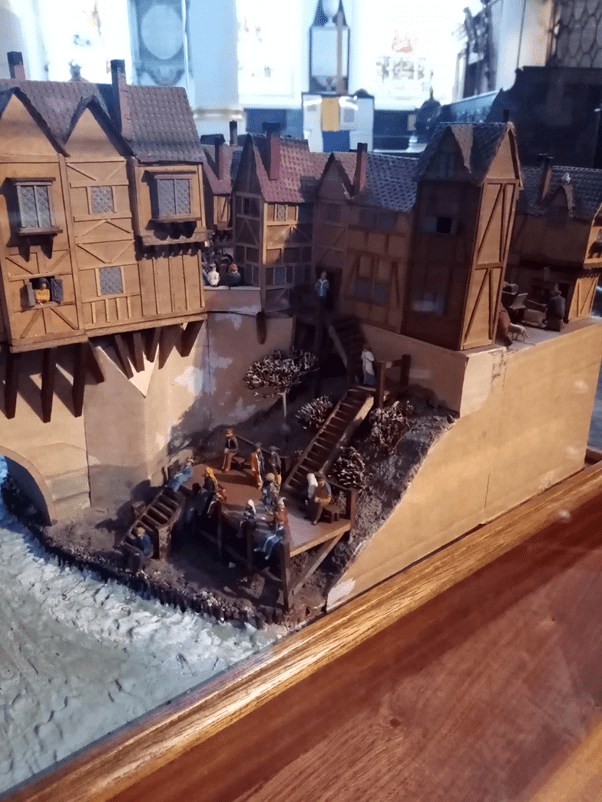
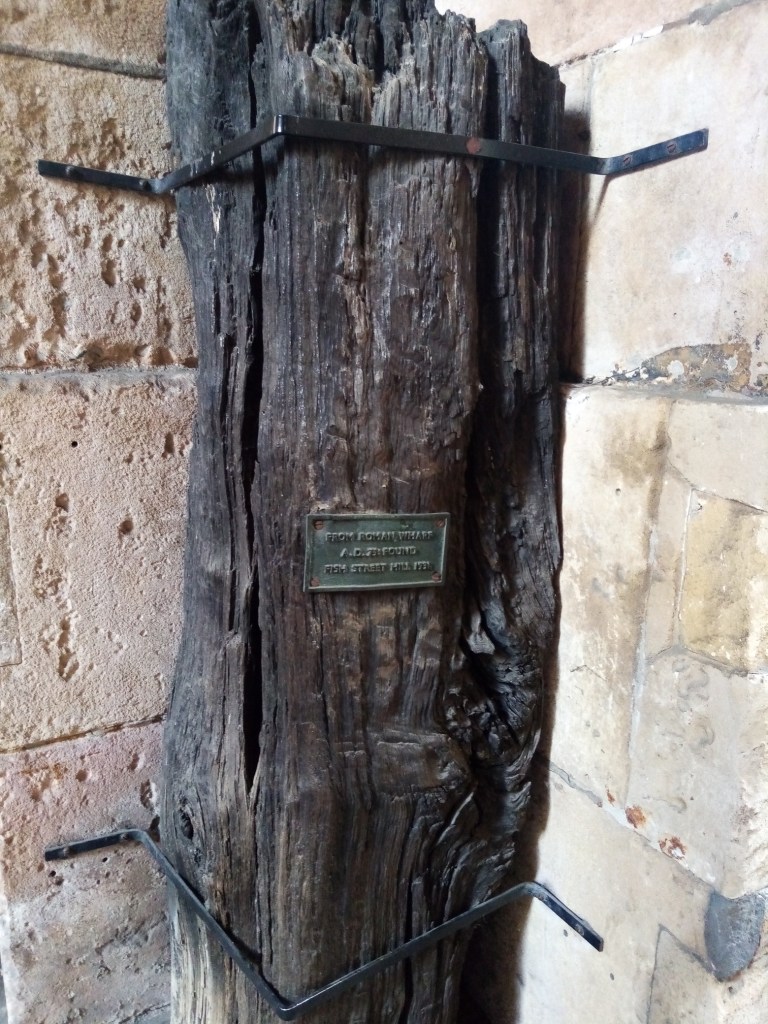
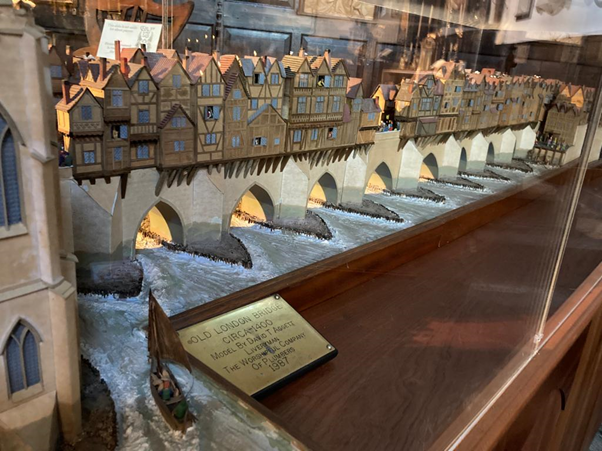
This church, now on Lower Thames Street, used to be right on the North bank of the River Thames and was the gateway to the bridge that spanned the River there from 1176 to 1831, old London Bridge. People had to pass through the churchyard to set foot on the bridge, consequently, it got very crowded, as this was London’s only bridge. When a new bridge was commissioned in the 1830s it was built further upriver from where a succession of bridges had spanned the Thames since Roman times. In 1987 a liveryman from the Worshipful Company of Plumbers decided to make a scale model of the old London Bridge to display in the church, a must-see if you’re in the area. David Aggett’s wonderful model has over 900 tiny people crammed onto the bridge and dozens of buildings including shops, houses and a chapel in the middle. The model also captures the 20 arches that would have held its weight, and which created the narrow channels of swirling water, where brave boatmen would try to ‘shoot the rapids’, and some lost their lives. You can see a boat just coming up to the first arch.

Information from http://www.london-walking-tours.co.uk/old-london-bridge
St Margaret Pattens

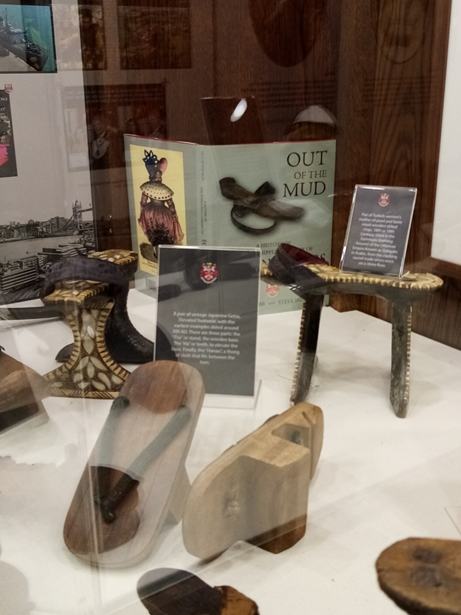
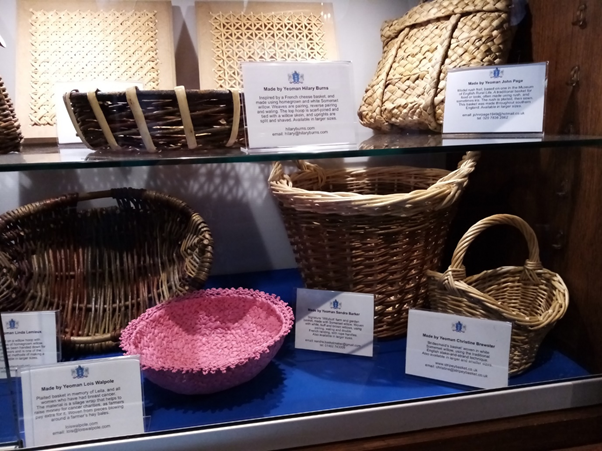
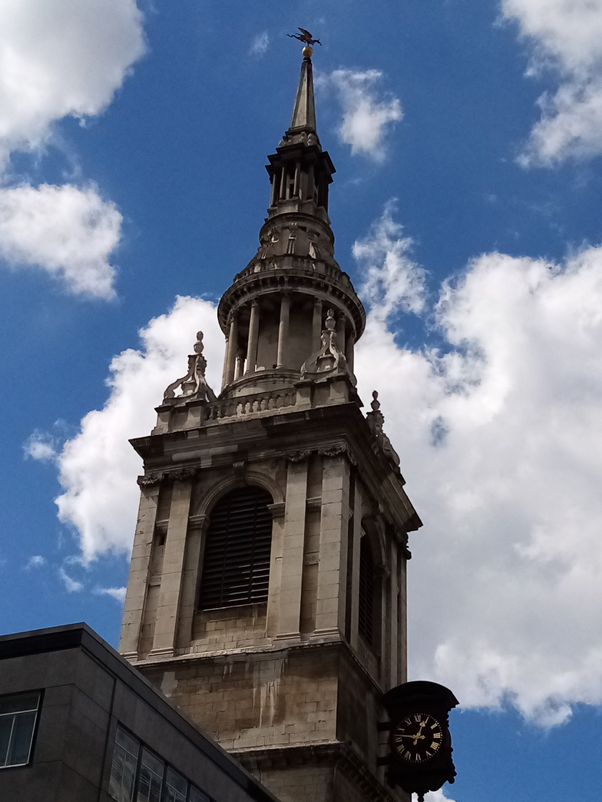
This church on Cheapside is dwarfed by its near neighbours, including the giant Walkie Talkie building. It changed from a parish church to a Guild Church in 1954, due to falling church attendances in City churches (because fewer people lived in the City). Guild churches hold midweek lunchtime services serving a regular congregation of office and shop workers in the area. The Interesting Thing about St Margaret is its association with The Worshipful Company of Pattenmakers since the 15th Century. Pattens are raised wooden soles which fit onto shoes to keep the wearer’s shoes and skirts out of the mud of the unpaved streets. The trade and manufacture of pattens was carried out in and around Rood Lane, where the church now stands, and St Margaret’s adopted ‘Pattens’ as there were several churches dedicated to the saint at the time. The practice of wearing pattens went out of fashion in the 19th Century as streets gradually became paved. The WC of Basketmakers is also associated with the church, because, you guessed it, their trade was carried out in the vicinity. Must have been a very different street scene, now it’s just endless coffee shops (I spotted Greggs, Pret, Starbucks and Black Sheep Coffee.) These are the display cabinets of pattens and baskets. My favourites are the pair on stilts! Information from Church leaflet and display boards
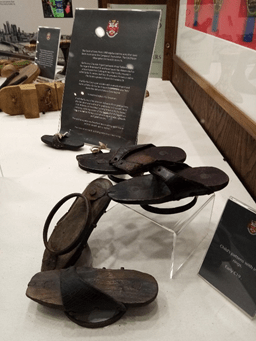
Can you spot the stilt pattens?

St John the Baptist, Shepherd’s Bush

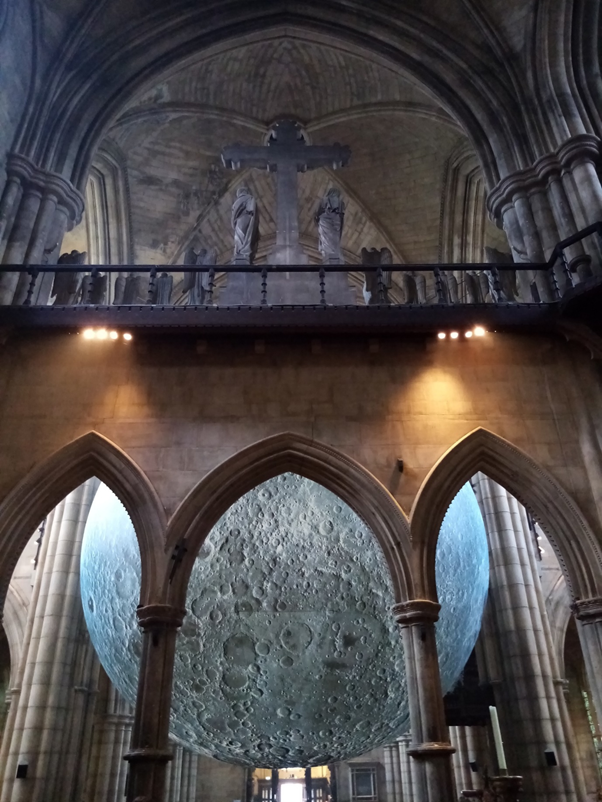
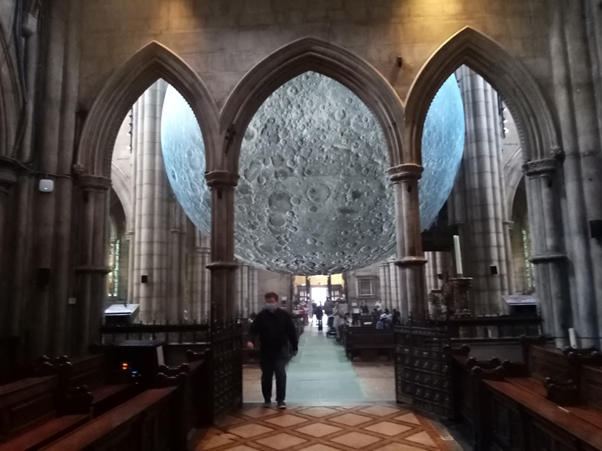
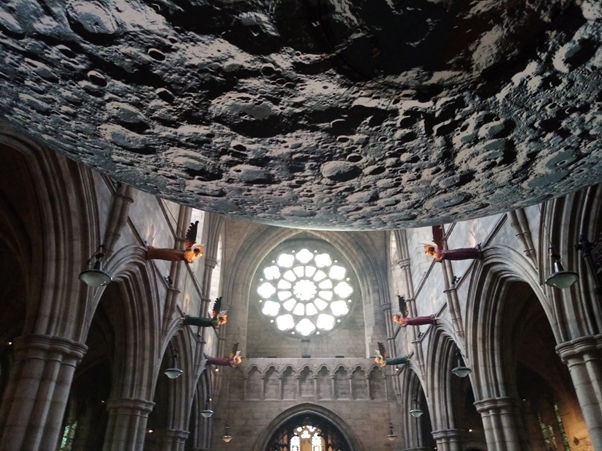
This church hosted the Museum of the Moon in August, I was so pleased to be able to visit, it’s just so beautiful. ‘Measuring 7 metres in diameter, the moon features detailed NASA imagery of the lunar surface. At an approximate scale of 1:500,000, each centimetre of the internally lit spherical sculpture represents 5km of the moon’s surface.’ The moon sounds like a rock star; its website (my-moon.org) gives its Tour Dates! These include Durham, Chichester and Wells Cathedrals and Bath Abbey and it also appears in USA, Canada and Europe The website says ‘there are several moons touring simultaneously’, which I found very funny for some reason. This church is an excellent showcase for the moon, being in the Gothic style and very atmospheric. It’s a Victorian, Grade 1 Listed building, which means it can’t be altered in any way, inside or out. Mesmerising!
September – Churches where famous people were married

I got married in the month of September on a beautiful late summer’s day, so this month I thought I’d look at some London churches where famous people got married. Royal weddings take place in Westminster Abbey and St Paul’s Cathedral, but there are other beautiful and interesting churches where lesser mortals have tied the knot.  Believe it or not, two US presidents were married in London: John Quincy Adams at All Hallows by the Tower, and Theodore Roosevelt at St Georges, Hanover Square.

All Hallows – John Quincy Adams

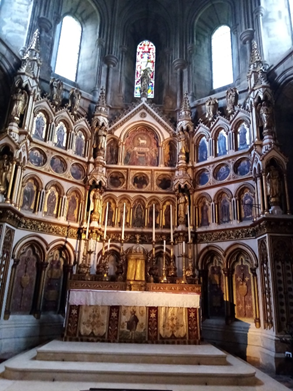
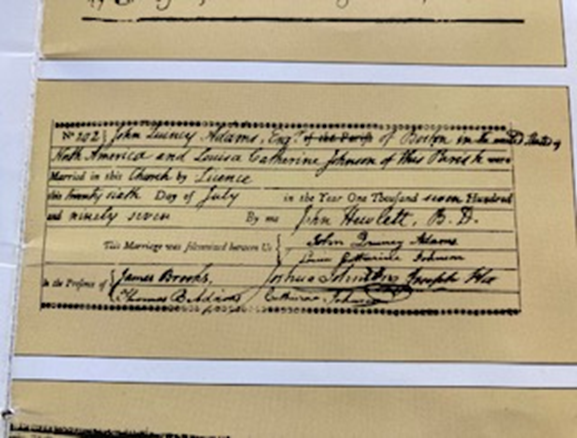
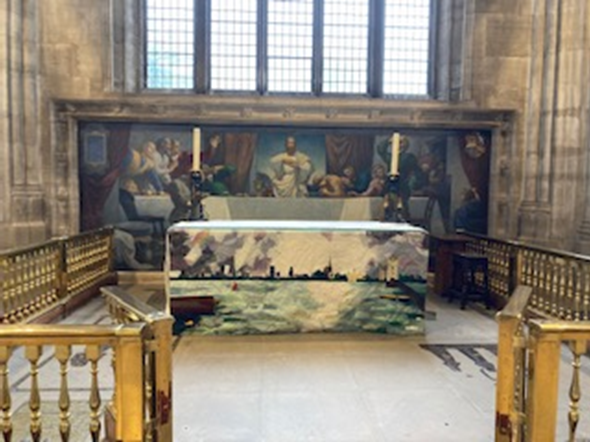
The 6th president of the United States from 1825 to 1829, John Quincy Adams married London-born Louisa Johnson in July 1797. Louisa’s father had been appointed US Consul General, and Adams (serving as a US diplomat at the time) visited him and his family in 1795 at their house in Cooper’s Row, Tower Hill, where he took a shine to the youngest daughter.  Louisa was the first ‘First Lady’ born outside the US, ‘a distinction that would not be shared until 192 years later by Melania Trump’ (Wiki). All Hallows has another American connection: William Penn, the founder of Pennsylvania, was baptised at the church. And his father, Admiral William Penn, Commissioner of the Navy Office, actually saved All Hallows from the Great Fire in 1666 by ordering several buildings nearby to be blown up with gunpowder, thus creating a fire break. With a history stretching back to AD675, All Hallows is one of the most interesting City churches, well worth a visit.

John and Louisa’s Marriage Certificate

John Quincy Adams                                                        Louisa Johnson

By John Singleton Copley – Derived from Museum of Fine Arts, Boston, Public Domain, https://commons.wikimedia.org/w/index.php?curid=58348536

By Gilbert Stuart – The White House Historical Association, Public Domain, https://commons.wikimedia.org/w/index.php?curid=9406679

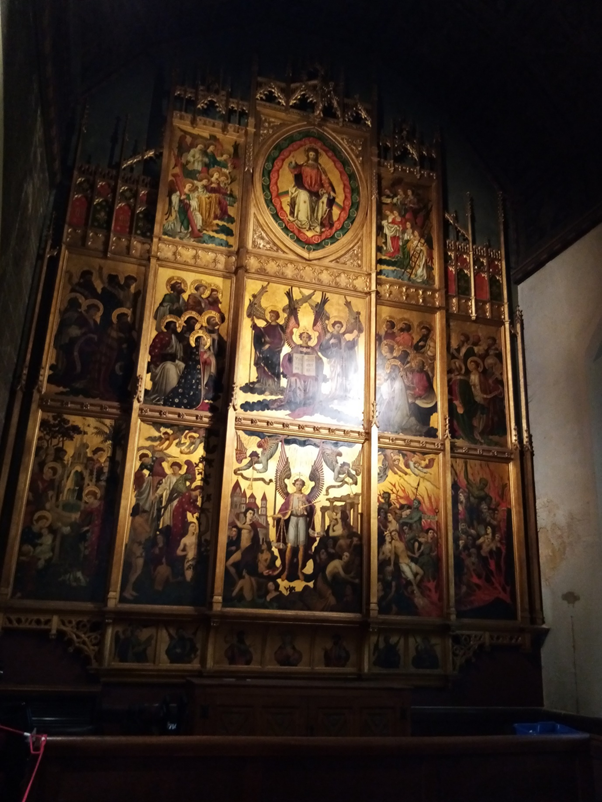
Altar of All Hallows by the Tower

St George’s, Hanover Square – Theodore Roosevelt

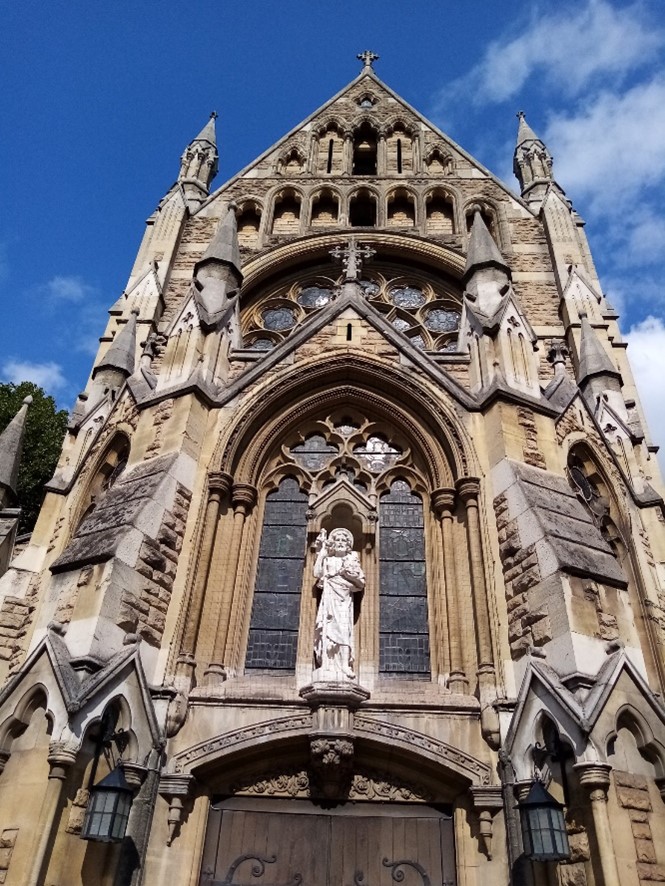
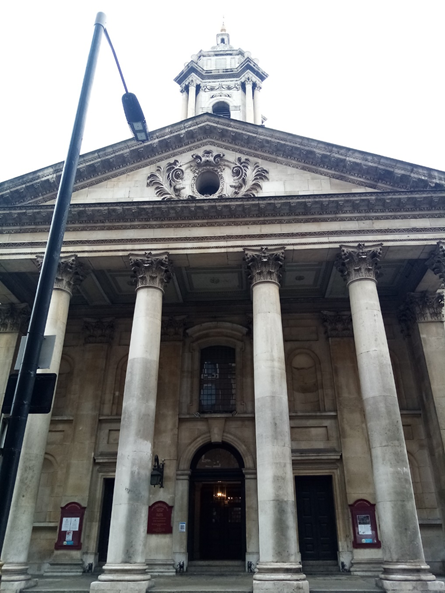
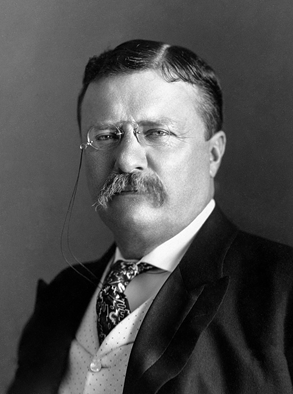
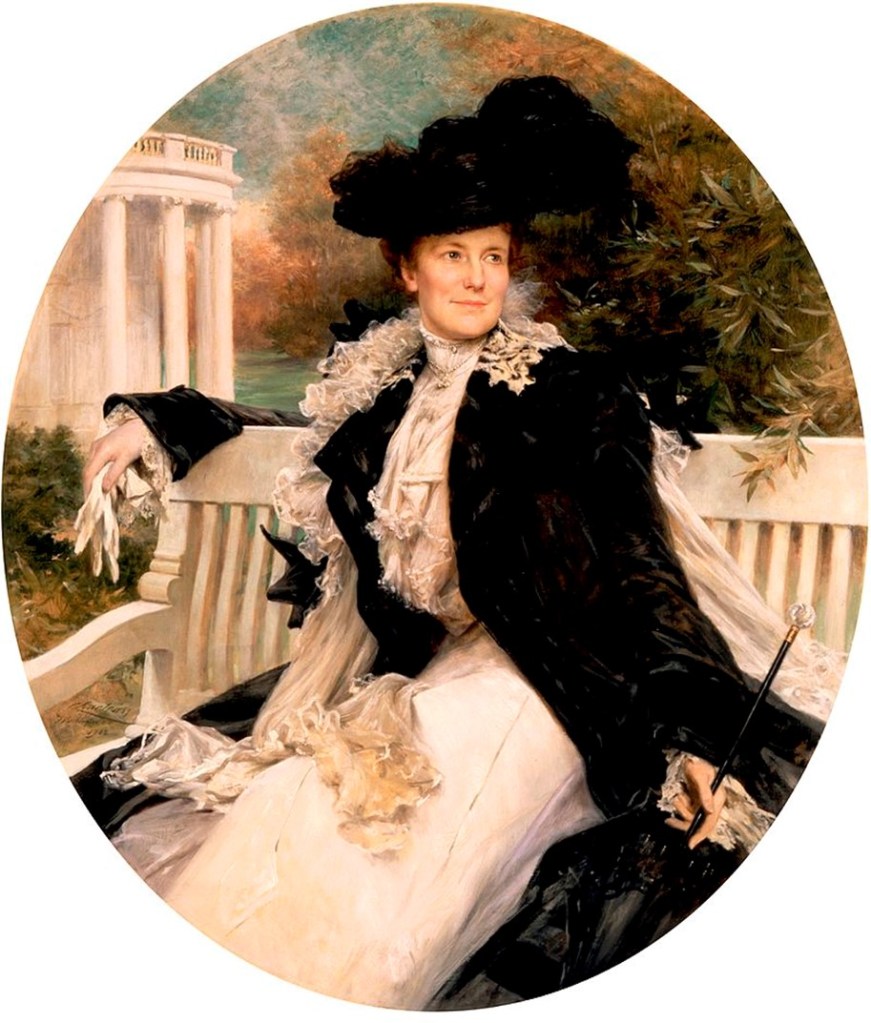
Often referred to as Teddy, Theodore Roosevelt, soon to be the 26th President of the US, married fellow-American, Edith Carow in December 1886. He became President in 1901, having previously been Vice-president. His first marriage to Alice had tragically ended with her death days after giving birth to their first child in 1884, and although he was still grieving, he married childhood friend Edith two and a half years later. Roosevelt’s two sisters were surprised and initially against the marriage, but it proved to be a happy relationship and the couple went on to have five children and also raised Roosevelt’s daughter from his first marriage. St George’s is less than half a mile from Grosvenor Square, site of the American Embassy until 2017, and many US servicemen worshipped here during the Second World War. Roosevelt’s wedding inspired other Americans to be married at St George’s and it is also the setting for several fictional weddings: in the musical My Fair Lady, the church in the song Get me to the Church on Time, is St George’s!  The church also features in the film The Lady Vanishes and in the Sherlock Holmes story The Adventures of the Noble Bachelor, and has been a popular venue for society weddings since the 17th century.
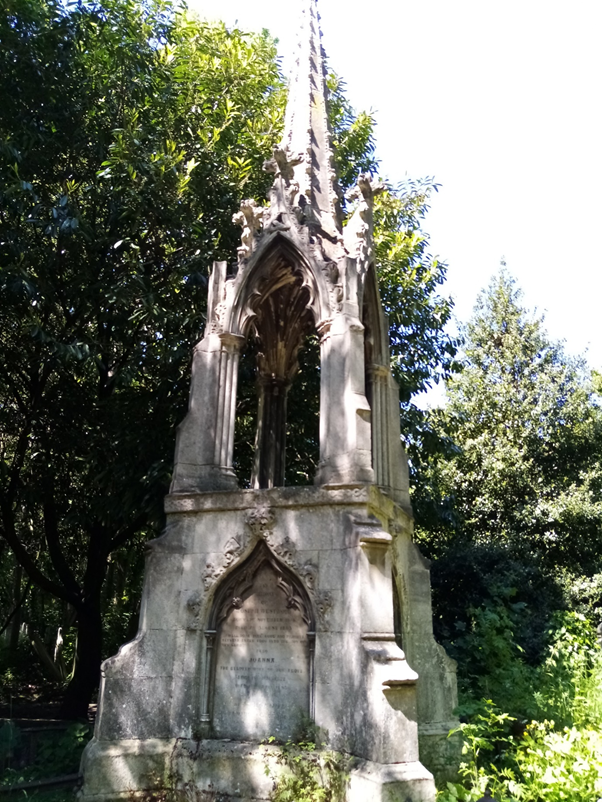
Imposing frontage of St George’s (sorry about the lamppost!)

Theodore Roosevelt                                                                        Official portrait of Edith Carow

Public Domain, https://commons.wikimedia.org/w/index.php?curid=104163429

By Théobald Chartran – http://www.whitehouseresearch.org/assetbank-whha/action/viewHome, Public Domain, https://commons.wikimedia.org/w/index.php?curid=20180330

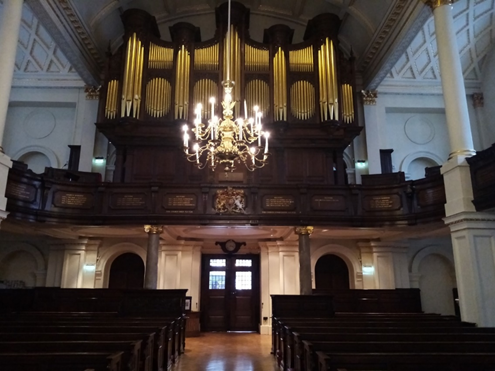
Interior of St George’s

St Luke’s Chelsea – Charles Dickens

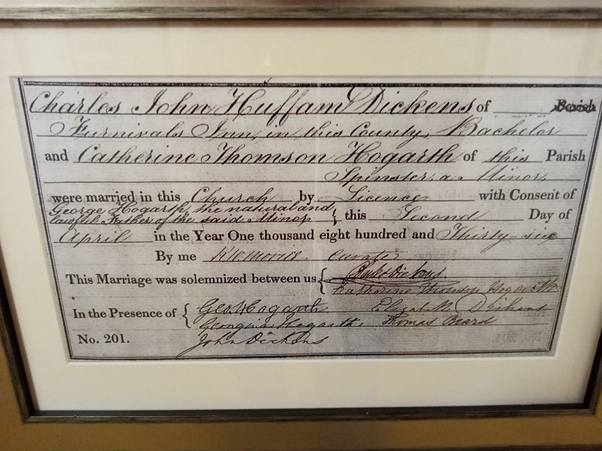
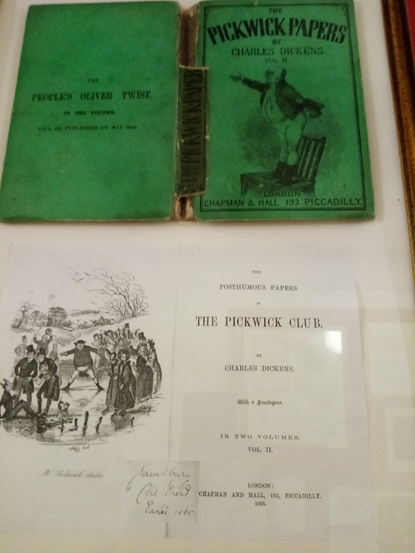
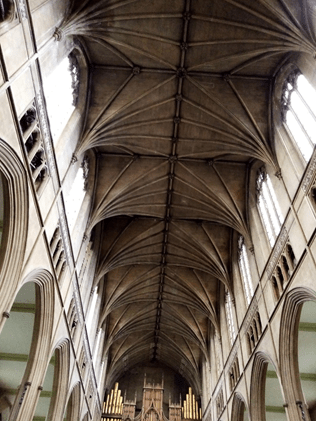
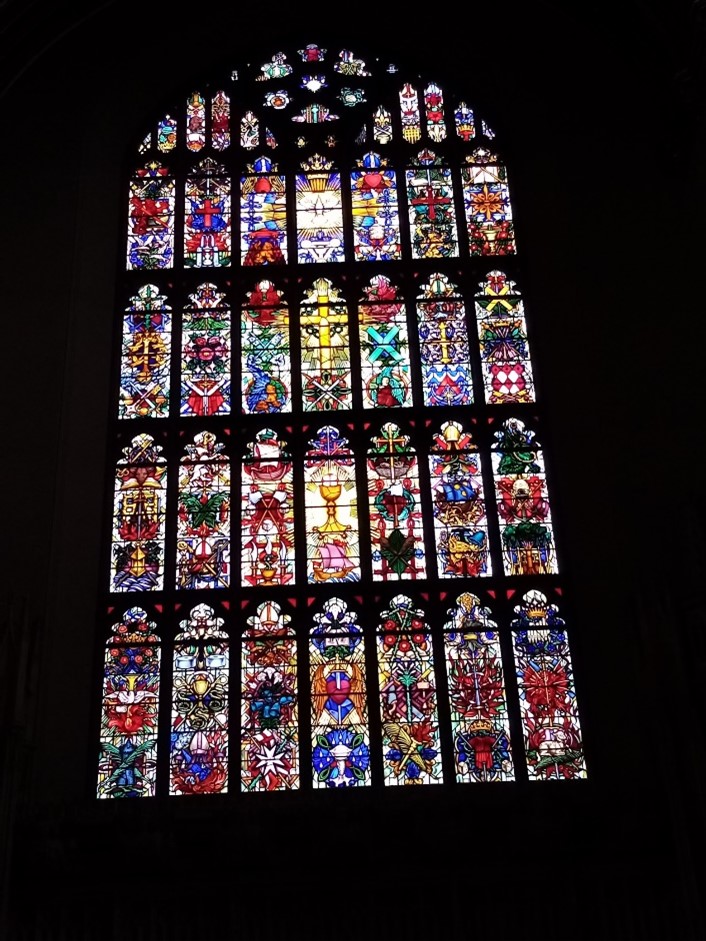
I featured the churchyard of St Luke’s last month, now let’s look inside the church where one of London’s famous authors was married. Charles Dickens and Catherine Hogarth were married here on 2nd April 1836, two days after the publication of Pickwick Papers, Dickens’ first full length novel. The marriage certificate (on display in the crypt of the church) shows that Catherine was underage, married by special licence with the consent of her ‘natural and lawful father’, George Hogarth. The couple had been engaged for less than a year and had not intended to marry quite so soon, but the success of the publication of his first novel and its promised financial rewards, caused Charles to aspire to the status of ‘respectable married man’, very important in Victorian times. I picked up the church’s Summer Newsletter which contained photos of the couples married this Summer, and I wondered if any of them thought about the marriage that had taken place there 185 years earlier! St Luke’s is an imposing building inside and out; there’s a majestic high vaulted ceiling and a huge stained-glass window, more reminiscent of a cathedral. A relatively new church, being built in 1824 not long before the Dickens’ marriage.

Charles and Catherine’s Marriage Certificate
From the Exhibition in the Crypt

St Margaret’s Westminster – Samuel Pepys and Others

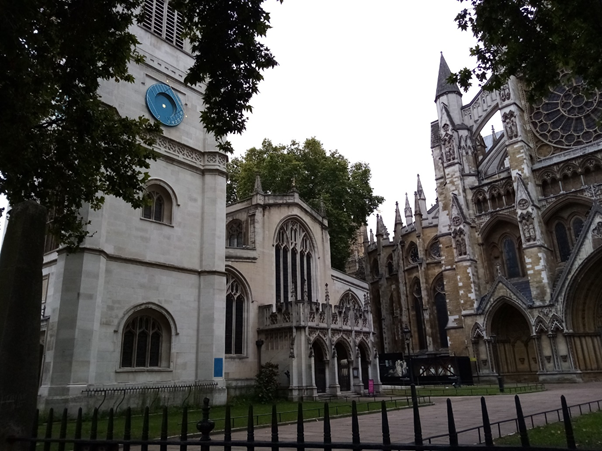
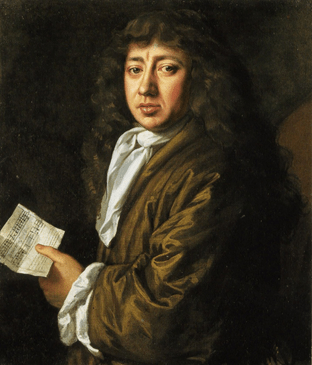
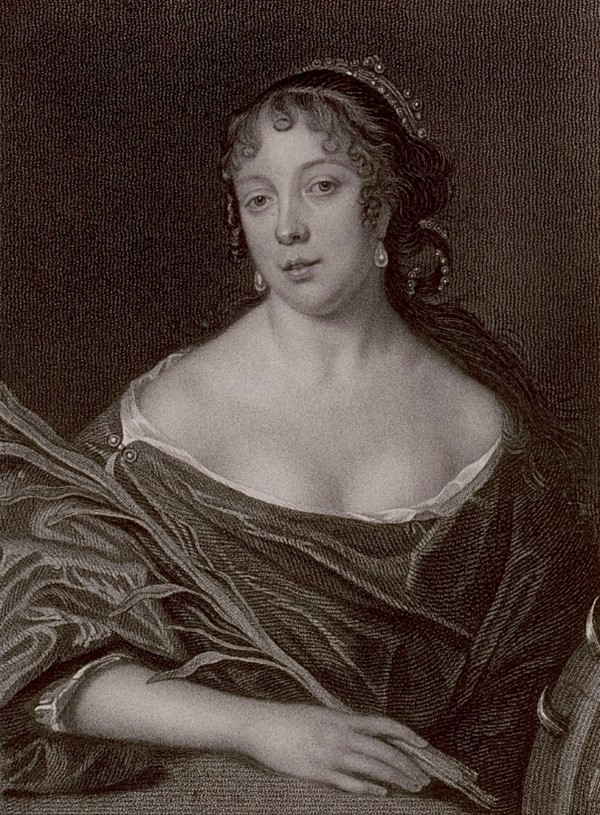
I must have walked past St Margaret’s so many times and simply not registered it! Known as ‘The Church on Parliament Square’ it’s absolutely dwarfed by Westminster Abbey. Sadly, the church isn’t yet open following Covid 19 closures, so I couldn’t see inside. Like its larger neighbour, St Margaret’s was founded in the 12th Century by Benedictine Monks; this is the third church on the site. In 1614 St Margaret’s became the Parish Church of Westminster when the Puritans chose to hold their Parliamentary Services there, preferring the simpler style of both the building and the worship to that of the Abbey. To this day the church is also known as ‘The Parish Church of the House of Commons’; Members of Parliament and Officers of the Houses of Lords and Commons can choose to be married here. Samuel Pepys married Elisabeth de St Michel here in December 1655; she was only 15 years old. They had a somewhat turbulent married life, Pepys had several affairs which he made no secret of, but he claimed he loved his wife first and foremost! Elisabeth died aged 29 of typhoid fever and Pepys never remarried.

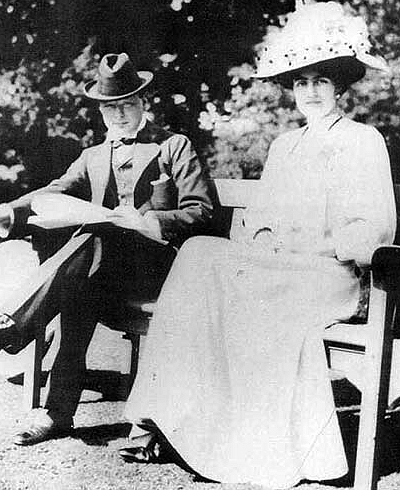
Also married here, among others:  Poet John Milton and Katherine Woodcock in November 1656; Winston Churchill and Clementine Hozier in September 1908; Lord Louis Mountbatten and Edwina Ashley in July 1922; Prime Minister Harold MacMillan and Lady Dorothy Cavendish in April 1920.

St Margaret’s with Westminster Abbey right next door

wikimedia.org/wikipedia/commons/2/21/Samuel_Pepys.jpg

commons.wikimedia.org/wiki/File:Elizabeth Pepys.jpg

I really like this picture of Winston and Clementine just before their wedding, an Edwardian socialite couple!

wikipedia.org/wiki/Clementine_Churchill#/media/File:Winston_Churchill_(1874-1965)_with_fiancée_Clementine_Hozier_(1885-1977)_shortly_before_their_marriage_in_1908.jpg

Credits: Wikipedia and Wikipedia Commons for the pictures; Information boards at All Hallows; Newsletter of St Luke’s

August – Garden Churches lll

I make no apology for posting yet another selection of delightful London churchyards, each with its own unique charm. These four all belong to churches outside the City, and all coincidentally, are named after male saints. August is a lovely month to wander through London’s green spaces; churchyards are tiny oases of calm and peace surrounded by the busy streets.

St John’s, Waterloo

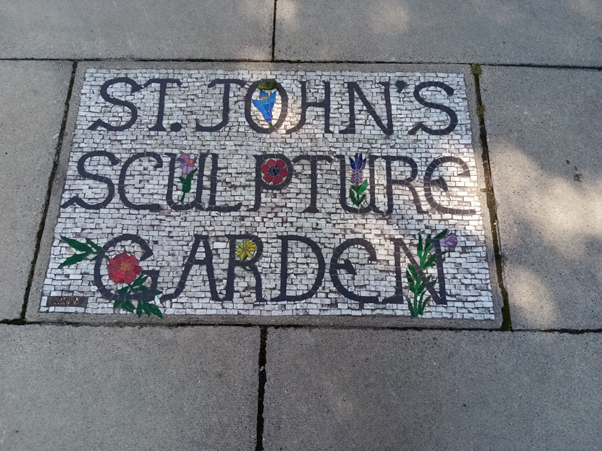
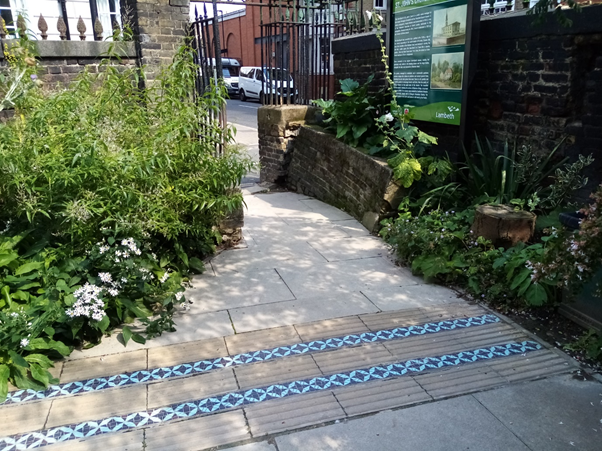
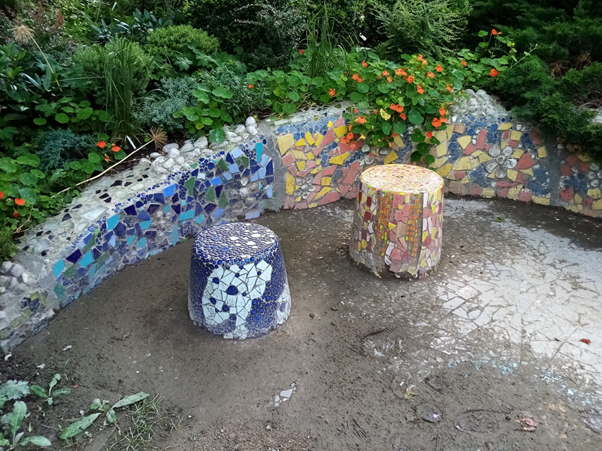
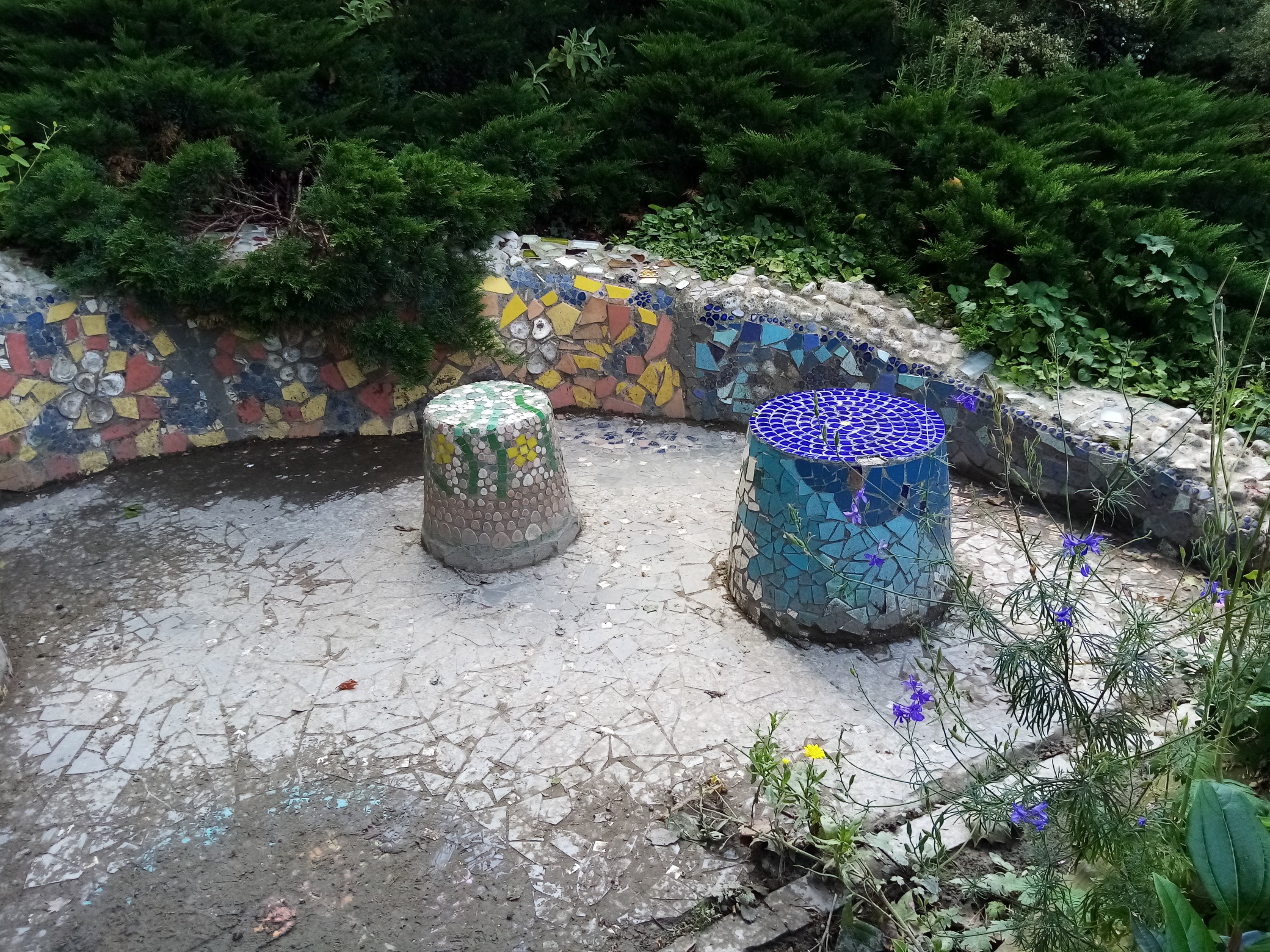
Located just off the Imax roundabout opposite Waterloo Station, St John’s is a large church which has connections with the Southbank Centre.  The churchyard was converted into a garden in the 1870s by a forward-thinking Parochial Church Council, as a response to the social needs of the area (at that time, a run-down, overcrowded district.) Octavia Hill, one of the founders of the National Trust, was involved in creating the garden, and described it as ‘More like a country garden….than any other I have seen.’ I’m assuming she was referring to gardens in London, not those in the countryside! The garden is managed by volunteers and a professional community gardener and contains hedges that reduce air pollution and a wildlife garden. But what’s special about the garden is its mosaics, created by Southbank Mosaics in a community project with St Mungo’s Homeless Charity. All this information I got from the notice board in the picture. Unfortunately, some of the mosaics near the church were behind hoardings as work is being carried out on the building, but here are a few:

St James’, Piccadilly

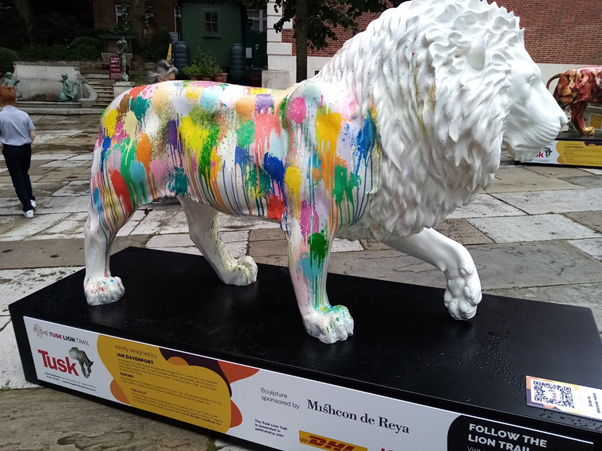
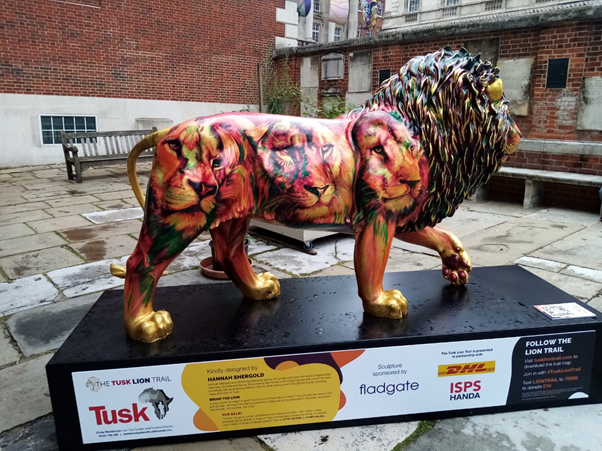
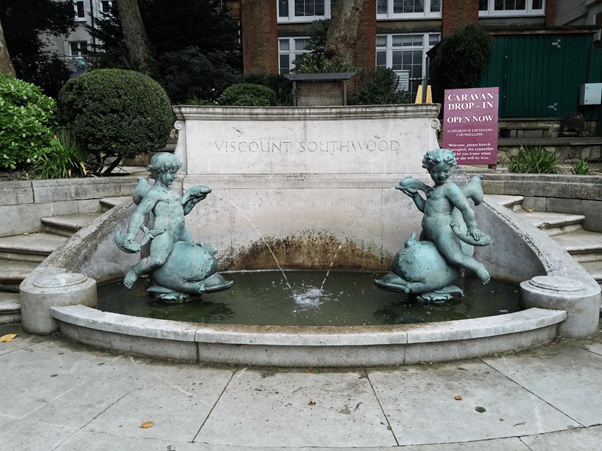
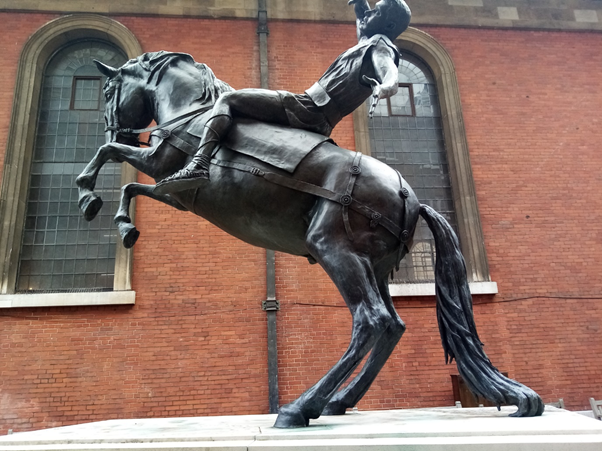
Stroll along Piccadilly from Green Park tube station, past the Ritz and the elegant 19th Century Arcades, and you reach St James’ Church.  The churchyard was the home of Piccadilly Market from the 1980s until December 2020, when it was forced to close because of Coronavirus.  The paved part of the churchyard now hosts art installations, currently there are four lions, part of a ‘pride’ of 27 in various locations around London. (A map showing the location of all the Lions is available from tuskliontrail.com). The Tusk Lion Trail features lion sculptures decorated by artists, musicians and comedians to raise awareness of the importance of conservation of African wildlife. The area at the side of the church was used as a burial ground for 200 years until just after the Second World War when philanthropist Viscount Southwood paid for a garden to be laid. It’s a lovely relaxing space just metres away from the hustle and bustle of Piccadilly.  There’s a statue of ‘Peace’ and a stone memorial to Viscount and Lady Southwood decorated with bronze dolphins and cherubs. Again, all info is from a helpful notice board.

Two of the four lions in the churchyard

St Paul’s, Covent Garden

This church has been featured previously as the Actors’ Church (October 2020) but now I’m focusing on the churchyard.  Just off one of the piazzas of Covent Garden, one minute you’re in a crowd watching a street performer, then suddenly the loud voices and the applause of the crowd fades as you step into this peaceful, compact garden. There’s a paved area surrounding the church displaying some interesting art and a garden with flowerbeds and lawns at the front of the church. The churchyard’s connection with Covent Garden as a space for open-air performance began in May 1662 when the diarist Samuel Pepys noted that the first ‘Italian Puppet Play’ took place under the portico of the church; the church has continued to host an international Punch and Judy show every year in May. Today the churchyard can be hired for all kinds of open-air events: music festivals, youth and schools events, theatre and opera concerts. Information from Wiki and from actorschurch.org.


Conversion of Saul. The inscription reads: I saw a bright light from heaven, brighter than the sun, blazing about me and my companions. We fell to the ground and I heard a voice saying to me, ‘Saul, Saul, why are you persecuting me?’ Then I asked, ‘Who are you Lord?’ and he said, ‘I am Jesus whom you persecute.’ Acts 26 v12-15
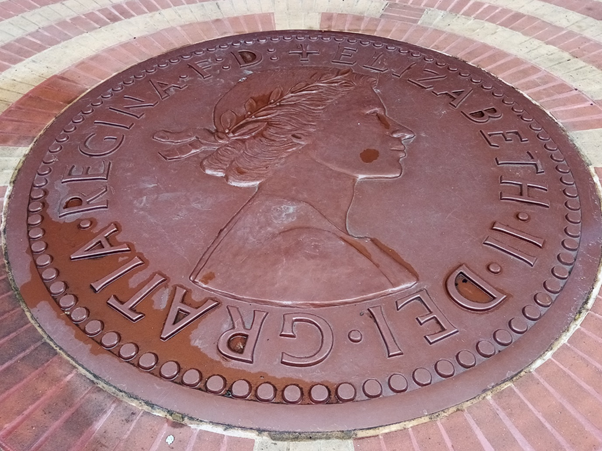
This giant 1953 (old) penny is the centrepiece of a maze laid in the churchyard to celebrate the Queen’s Diamond Jubilee. The accompanying plaque reads: The wording reminds us that Elizabeth is Queen by the Grace of God and Defender of the Faith. The Queen holds a special position as Supreme Governor of the Church of England.

St Luke’s, Chelsea

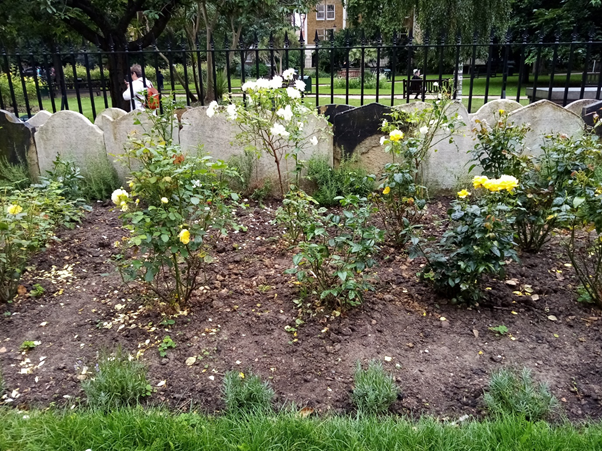
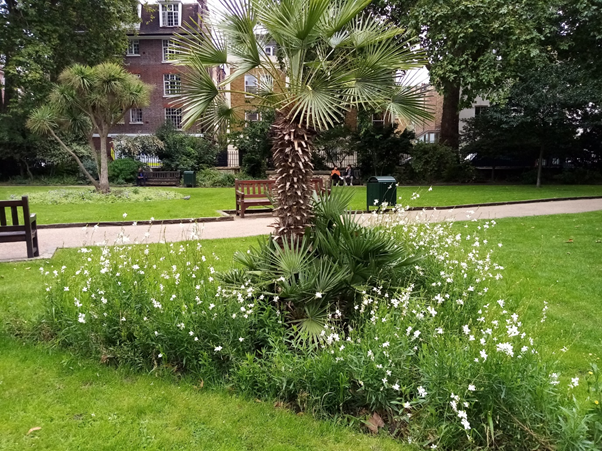
Opposite the Brompton Hospital is the magnificent St Luke’s church and its English Heritage Grade ll listed garden. St Luke’s Gardens is on the Register of ‘Parks and Gardens of Special Historic Interest in England.’ Formerly the graveyard of the church, it ceased to be a burial ground around 1857 and was converted to a public garden in 1881. The gravestones were moved to form a boundary wall of the garden and hundreds of them still remain in place. The garden was created with a grant from the London County Council and continues to be managed and maintained by the Royal Borough of Kensington and Chelsea. It’s more like a park than a churchyard, when I visited there were families having picnics, people exercising and walking dogs, and office workers buying lunch in the church’s café and eating in the garden. It’s also a quiet, contemplative place for people to come after visiting relatives in the Brompton across the road. Information from the noticeboard and from rbkc.gov.uk.

Rose Garden with headstones placed along the railings
The beautiful neo-Gothic church of St Luke, from St Luke’s Gardens

July – London Cemeteries ll

Here are four more delightful London cemeteries, now closed for burials and carefully maintained by devoted ‘friends’ as wildlife havens and/or green spaces for the public to enjoy.

Tower Hamlets Cemetery Park

Created as one of the so-called ‘Magnificent Seven’ Victorian London cemeteries, Tower Hamlets Cemetery was closed to burials in 1966 and the site was designated a park by an Act of Parliament. The Friends of Tower Hamlets Cemetery Park is an independent charity which manages the site and ‘offers everyone a breathing space in the heart of East London’. There’s certainly a lot going on: Summer fairs, local history talks, concerts, guided walks, forest schools, a wildlife club and the intriguing sounding foraging courses! Above all, this is a beautiful place to stroll around, listening to birds singing and examining the interesting gravestones.

Reference: Friends of Tower Hamlets Cemetery Park

Bunhill Fields, City Road

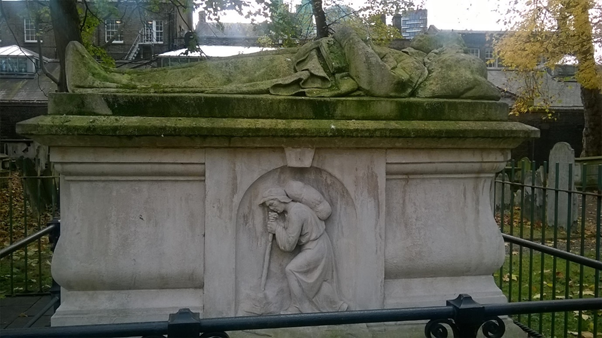
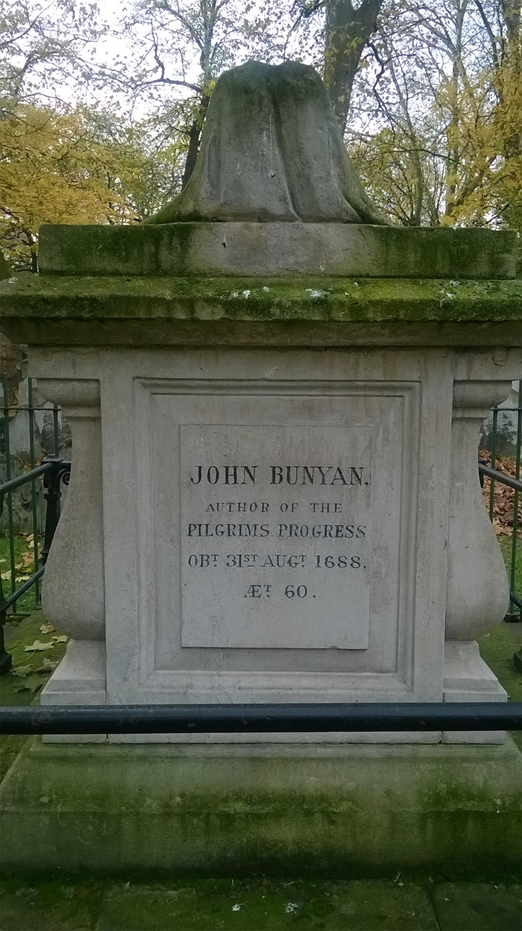
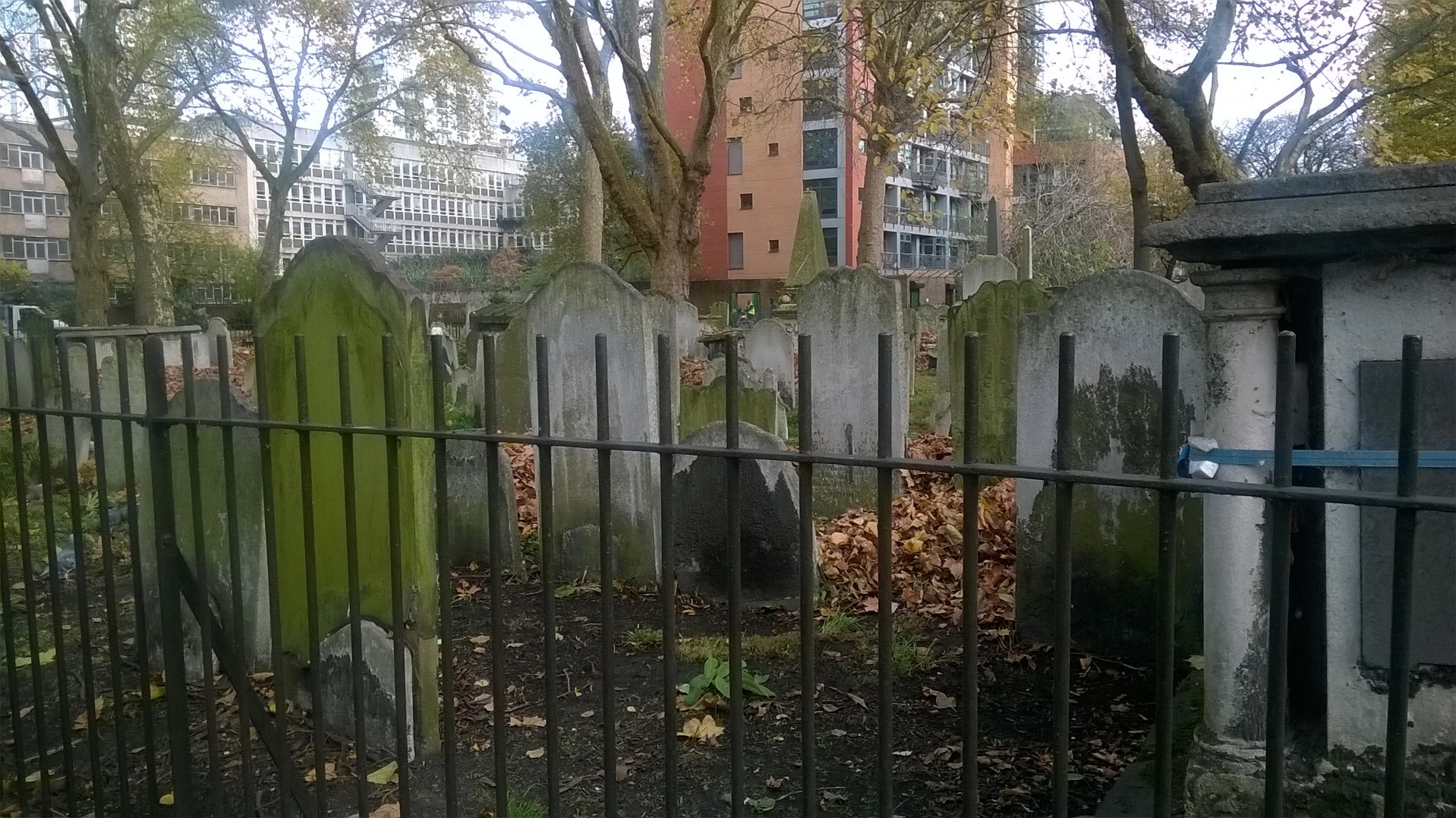
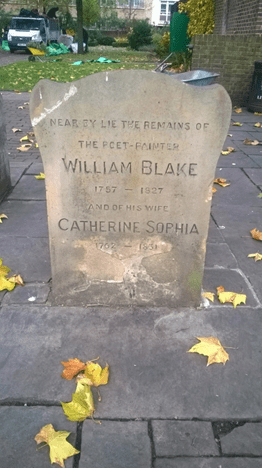
Situated opposite John Wesley’s home and the Museum of Methodism (featured in March 2020), this is a non-conformist former burial ground; if you remember, non-conformists were Christians who didn’t ‘conform’ to the practices of the mainstream church. Only about 4 acres is left of a once much larger site, and it was used as a burial site from 1665 to 1854. The name ‘Bunhill’ (originally ‘Bone Hill’) has two possible derivations; firstly, that it has been used as a ritual burial site since Saxon times, but more likely is reference to its use as a mass deposit of human bones in 1549. The macabre story is that 1,000 cartloads of bones were brought from St Paul’s charnel house when it was demolished, and the dried bones were covered with soil, forming a Hill of Bones! Let’s move away from that image and move onto the famous people buried there: authors John Bunyan (Pilgrim’s Progress) and Daniel Defoe (Robinson Crusoe) and poet William Blake (Songs of Innocence and Experience.)

Reference: Wikipedia

Barnes Old Cemetery

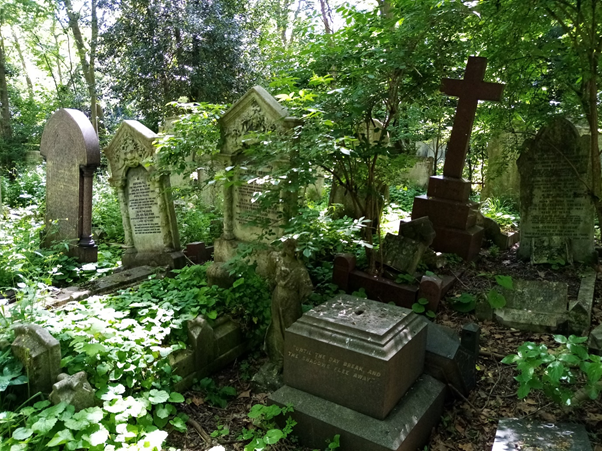
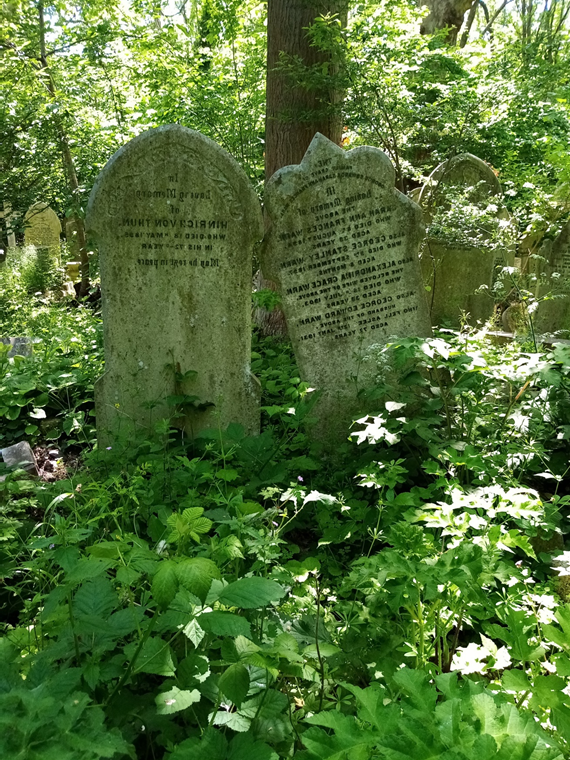
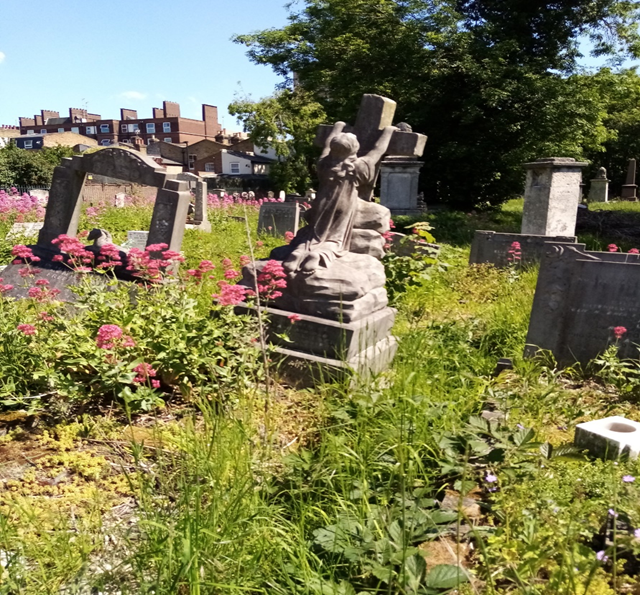
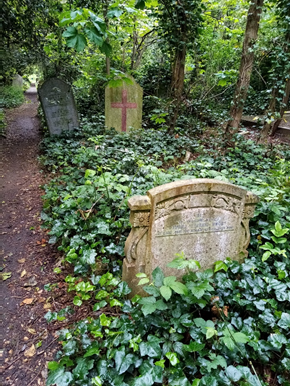
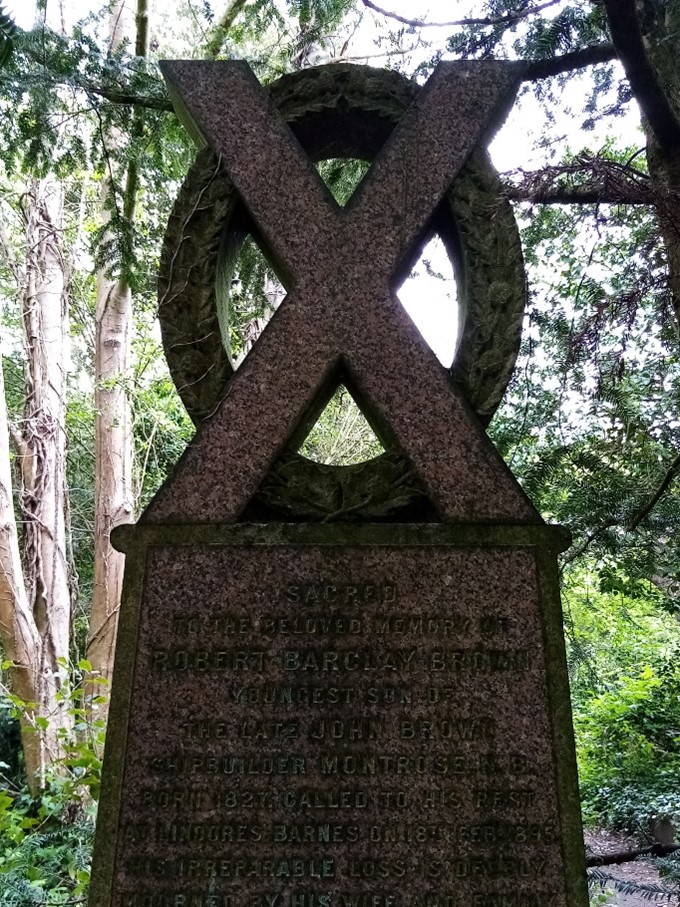
If you’re walking along the Beverley Brook path to the River Thames or wandering around Barnes Common, you may come across this cemetery, which is unique in that there are no boundary walls or railings, suddenly the gravestones appear! The cemetery began as a plot of land  to provide an additional burial ground for St Mary’s Church, Barnes. It was landscaped and laid out with paths; a chapel and lodge were built and it was used until the mid 1950s. After it closed to burials it was taken over by Richmond Council in 1966, who removed the railings and demolished the chapel and lodge, with the intention of transforming it into a ‘lawn’ cemetery, i.e., monuments removed and replaced with flat gravestones. The Council abandoned these plans and the cemetery was neglected and subject to considerable vandalism to its monuments over the next 30 years.  However, in the last decade or so, the site has gradually been reclaimed by Richmond Council and is now carefully managed to maintain its ‘neglected Gothic charm’. Selected thinning of vegetation has provided meandering paths and atmospheric light levels, and keeping the area mostly overgrown provides a secluded haven for wildlife. The sounds of the birds singing, the shafts of light coming through the trees and coming across half hidden, ivy-clad gravestones is a magical experience.

Reference: Wikipedia

Old St Pancras Churchyard

Not a cemetery as such but this old North London Churchyard has a fascinating history. The site of St Pancras Old Church is believed to be one of Europe’s oldest sites of Christian worship dating back to the 4th Century. The present church is picturesque and worth a visit, but it’s the churchyard and its interesting monuments that I’ll be talking about. Here’s three of the most interesting:

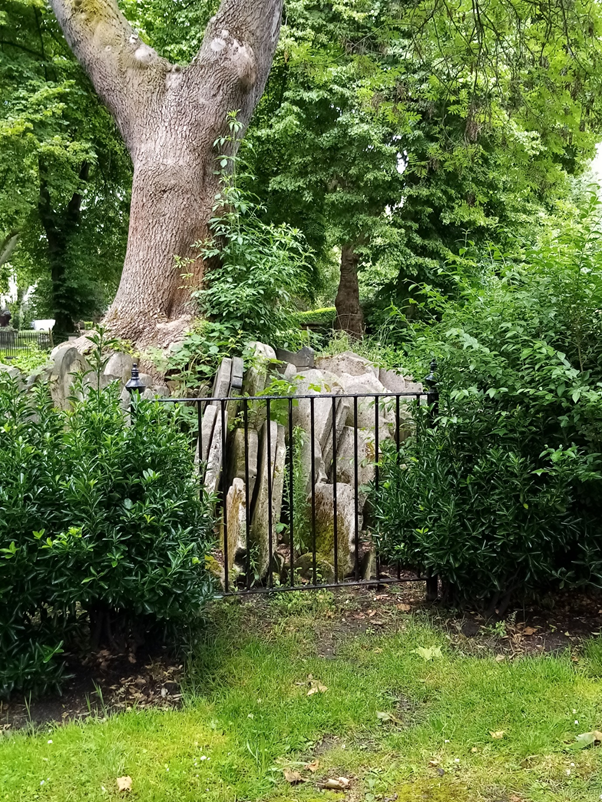
The Hardy Tree: In the 1860s, railway tracks cutting through the churchyard meant that the graves and their human remains in that part had to be exhumed and reburied, and the headstones removed.  The task of relocating the headstones was given to the as yet unknown author, Thomas Hardy (Tess of the D’Urbervilles, Jude the Obscure, etc) who had associations with the church and was a trained land surveyor. The story goes that he, or an underling, stacked them around the base of this tree, now known as the Hardy Tree! Note: much better photos are available, a wire fence has been put up 3 metres from the Tree, so this is best angle, and as near, as I could get!

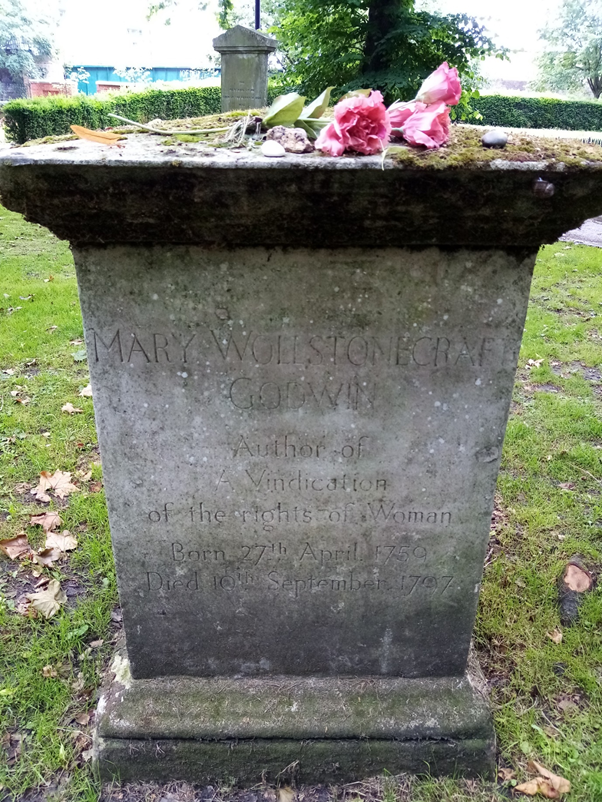
Secondly, there is a monument to Mary Wollstonecraft, a famous advocate of women’s rights and author of ‘A Vindication of the Rights of Women.’ Her more famous daughter, Mary Shelley, was the author of ‘Frankenstein.’ Mary Junior had her mother’s remains removed to Bournemouth when the new railway tracks disrupted the churchyard, but the monument remained.  The fresh flowers placed on top of the gravestone show that 200 years after her death, she is still remembered with respect.

Lastly, this is the elaborate and ornate monument to the architect Sir John Soane, most famous for designing the Bank of England building. Interesting fact: this monument was one of the inspirations Sir Giles Scott took for his Telephone Box design, despite 100 years’ difference between them! Gilbert Scott was a trustee of the Soane Museum so he probably would have seen sketches of the monument in the Museum’s collection. I can definitely see it, can you?

Reference: lookup.london/old-st-pancras-churchyard

‘Mary’ Churches for June

A little late with the blog post this month as I’ve spent the last three weeks travelling around England exploring its wonderful history further afield. Here are a few more Mary churches, two of them are among the 14 City churches named for the Virgin Mary, one is in the City of Westminster and the fourth is my ‘local’, St Mary’s Beddington.

St Mary Woolnoth

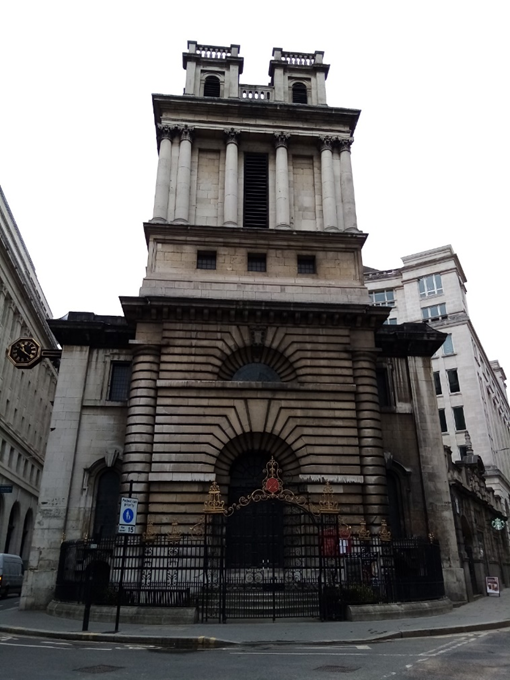
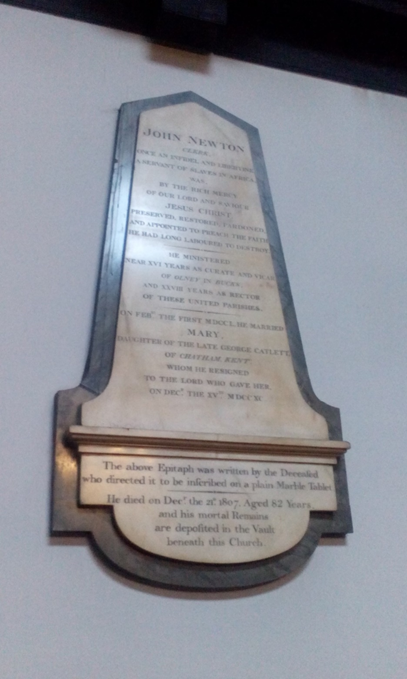
The site of this church has been used for worship for at least 2,000 years: Roman and Pagan religious buildings were discovered under the current church’s foundations, and an Anglo-Saxon church structure was recorded in 1191 on the site. The name of the church probably refers to Wulfnoth Cild, a Saxon nobleman, possibly a beneficiary. The current building was designed by Nicholas Hawksmoor, another giant of architecture commissioned to build replacement churches for those destroyed in the 1666 Great Fire. The church was completed in 1727 in the Baroque style, and is located on Lombard Street, close to the Bank of England and Bank Underground Station.  I’ve only got an outside shot of the church; the website says it is open but the gates have been locked when I’ve visited. Inside there’s a plaque commemorating John Newton and his wife, Mary.  Newton was a former slave owner who, following his dramatic conversion to Christianity, became an ardent abolitionist and famously wrote the hymn Amazing Grace about his salvation through belief in JesusChrist: ‘Amazing grace, how sweet the sound, that saved a wretch like me; I once was lost but now am found, was blind but now I see’.

Personally, I don’t think Hawksmoor’s design looks like a church
Credit: St Mary Woolnoth – Wikipedia
The inscription reads: …. preserved, restored, pardoned, and appointed to preach the faith he had long laboured to destroy. Credit: File: JohnNewtonStMaryWoolnoth.jpg. Wikimedia commons

St Mary Somerset

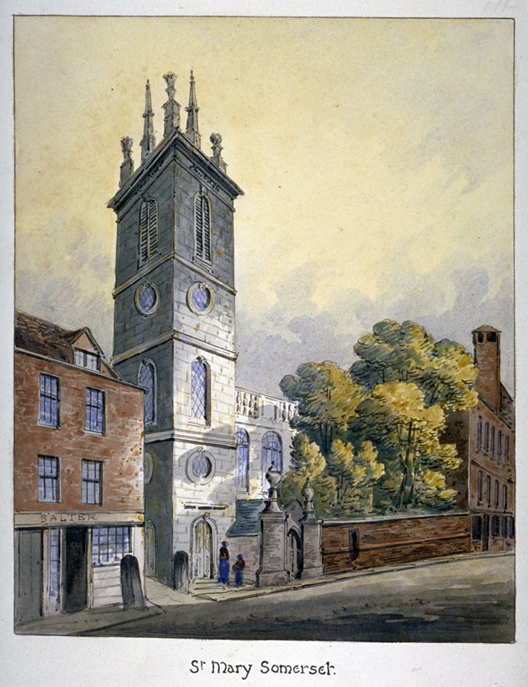
Situated in Lower Thames Street, this one is interesting because all that’s left of the church is the tower, in common with several other City churches. The name has nothing to do with the county of Somerset; it has links to Ralph de Somery, who is mentioned in contemporary records, or after Summer’s Hithe, a small haven on the Thames (the banks of the River were closer when the church was built in the 12th century).  The original church was destroyed in the Great Fire and the new church was one of the 51 rebuilt by Sir Christopher Wren. However, in the late 1800s there was a movement of the City’s population to the new outer London suburbs leaving the City churches almost empty. St Mary Somerset was one of the churches selected for demolition as it had a congregation of about 70. The church tower was preserved as a building of interest and before the Second World War it was used as a ladies’ restroom and later a small public garden was added. It is currently being refurbished and extended into a private family home, I hope a lift is being installed! One unique feature of the church is the eight Baroque pinnacles on the top, probably designed by Nicholas Hawksmoor. That famous double-act, Wren and Hawksmoor!

The Tower of St Mary Somerset with added garden, soon to be someone’s home.
Credit: Commons.wikimedia.org
Almost unrecognisable, the original church in the 18th century
Credit: Magnoliabox.com Church of St Mary Somerset, William Pearson

St Marylebone Parish Church

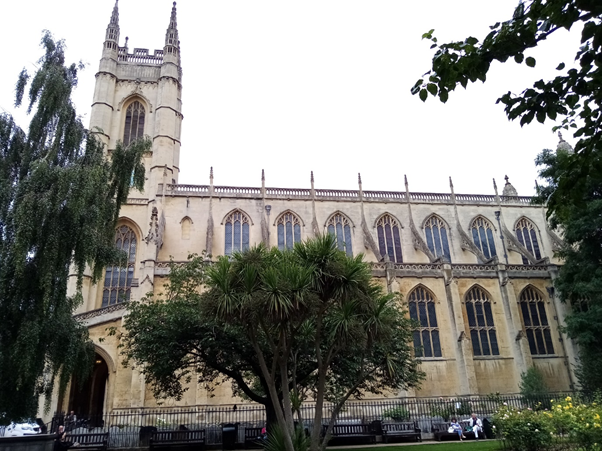
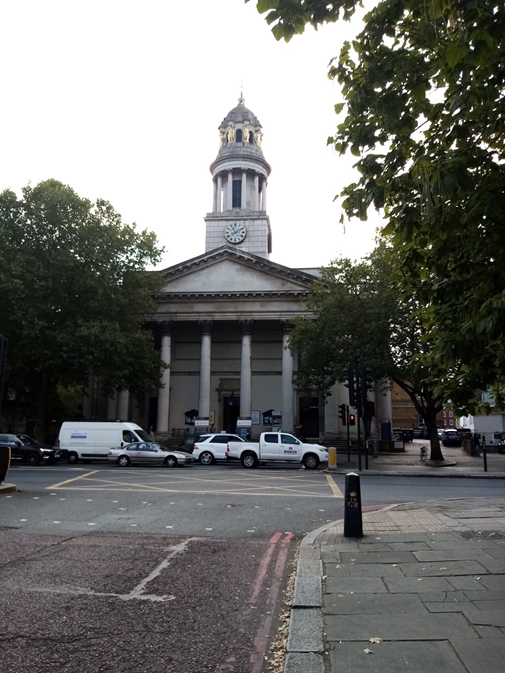
The area of Marylebone (pronounced ‘Marly-bon’) in NW1 takes its name from the Church. This is another church dedicated to the Virgin Mary and it’s been suggested that the name derives from the French ‘Marie le Bonne’; ‘Mary the Good’, but this is not correct. The original church was situated on the bank of a stream, or bourne, the Tyburn, near present-day Oxford Street, so the church became known as ‘Marybourne’. In the 17th century it became fashionable to add the French ‘le’ to place names, hence, Marylebone.  The parish church of Marylebone has been in existence since at least the 12th Century and surprisingly, has been rebuilt several times in different locations. The present building was built in 1813 to the designs of Thomas Hardwick. There are several famous people connected with the church: Charles Dickens lived along the road at the corner of Devonshire Terrace; Robert Browning and Elizabeth Browning were married here in 1846; and Charles and Sarah Wesley are buried here. The area was once famous for its pleasure gardens and music halls along Marylebone Road, now it’s the home of the famous Madame Tussauds, and the Royal College of Music Museum is right opposite the church (interesting history of music and free if you want to visit.) The beautiful Regent’s Park is a short stroll away.

It was difficult to get a good shot, I guess I could have stood in the middle of the yellow box!
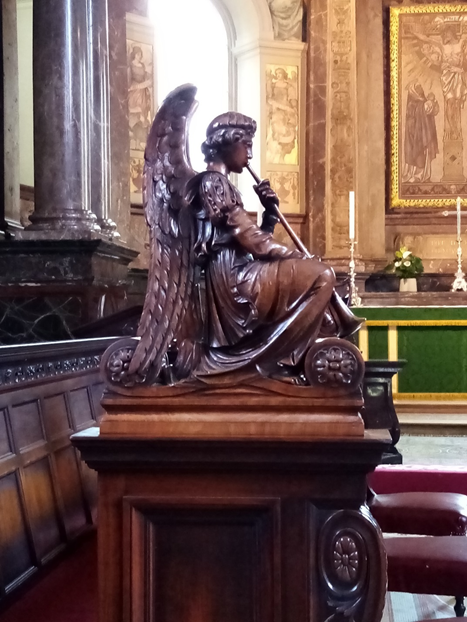
There are several of these angels at the pew-ends all playing a different instrument.
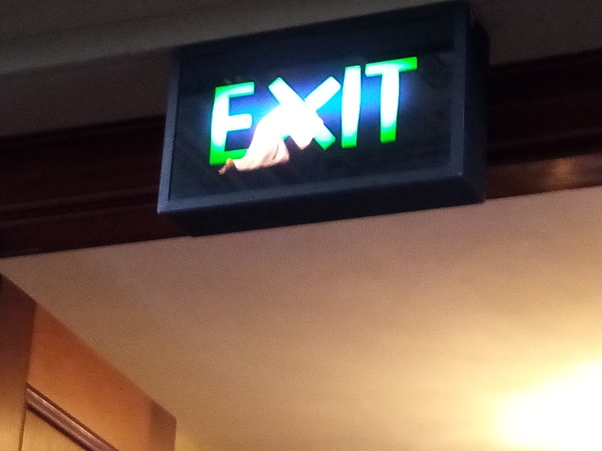
I love this Exit sign: Jesus carrying the Cross

St Mary’s Beddington

I’m really pleased that I’ve been able to include my ‘local’, the Parish Church of Beddington. The present church was built in the late 14th century and there’s evidence of a church structure on the site in 1085 when the Domesday Survey was taken. The church is situated in Beddington Park which in Tudor times was part of a deer park attached to Carew Manor (now a school) which was a major country house, home of the Carew family. Inside the church there is a striking hammer-beam roof and painted murals on the walls and ceilings. The organ screen was designed by William Morris and the church tower houses a ‘peal’ (yes, that’s the collective noun) of ten bells. There’s also a font made of Purbeck marble in the 12th century. Lovely to think of the font being used down the centuries; the church building changed but the font was preserved for future generations. The Carew chapel commemorates many of the family; there are also some brasses in the floor which are not visible, being covered over in the early 20th century for protection. The oldest commemorates Philippa Carew (1520) who died as a teenager, and 13 of her brothers and sisters who died in infancy; what a sad story. I’ll finish by modestly mentioning that I took part in an amateur production of Macbeth in the church in 2018, and watched the same company preform Hamlet there the following year. The perfect atmospheric venue for Shakespearian tragedies!

Pic Fest coming up…..

Beautiful photo if I do say so myself….

‘Mary’ Churches for May

Many of London’s churches are 1,000 years or even older, and as England was a Catholic country until Henry Vlll broke with the Church of Rome, it’s not surprising that so many of them are dedicated to St Mary, the mother of Jesus. Here are four from the City of London:

St Mary-le-Bow

Situated in Bow Lane, off Cheapside, the original church was built in 1080 by William the Conqueror’s Archbishop of Canterbury, Lanfranc. However, this Norman church may have replaced a Saxon one, so it’s possible that there’s been a church on this site for well over 1,000 years! The church tower was badly damaged in 1271 after it collapsed into the street, must have been terrifying for the people that would have been there; ‘Cheap’ actually means Market, so there would have been crowds of people buying and selling. Further damage in the Great Fire gave Christopher Wren the opportunity to achieve his ambition to make it his second tallest structure, after St Paul’s. He originally constructed a viewing balcony on the building attached to the tower, as a nod to when Cheapside held jousting tournaments and posh people looked down on the street from the original tower. Sadly, this adjacent building was destroyed by WW2 bombing and has been replaced by an ugly office block. St Mary-le-Bow had the principal Curfew Bell, rung at 9pm each day since 1363, and it’s said that if you were born within the sound of Bow Bells, you are a true cockney. Not to be confused with the area of East London called Bow!


The beautiful Wren-designed Tower, with just a glimpse of the modern office block attached.

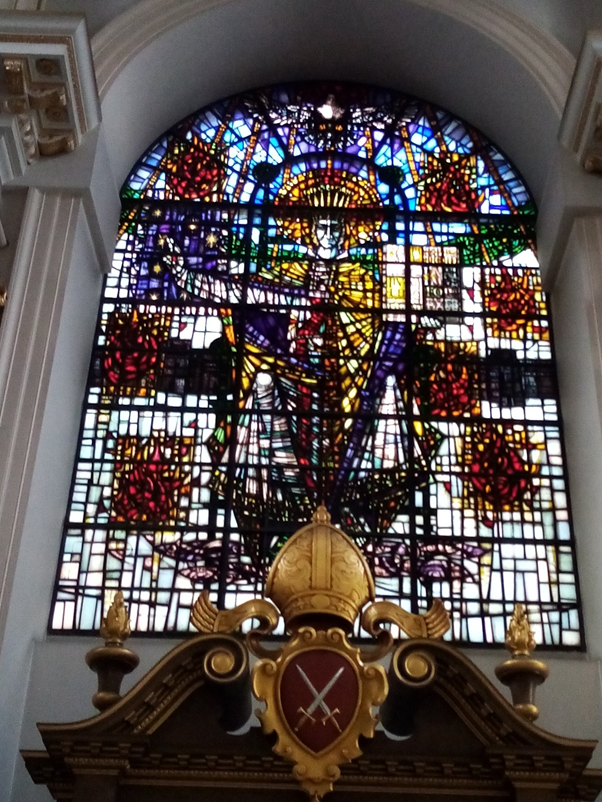
This window is a representation of Jesus and the seven Gifts of the Holy Spirit, they look like fiery red blobs to me! But a beautiful window, I think.

St Mary-at-Hill

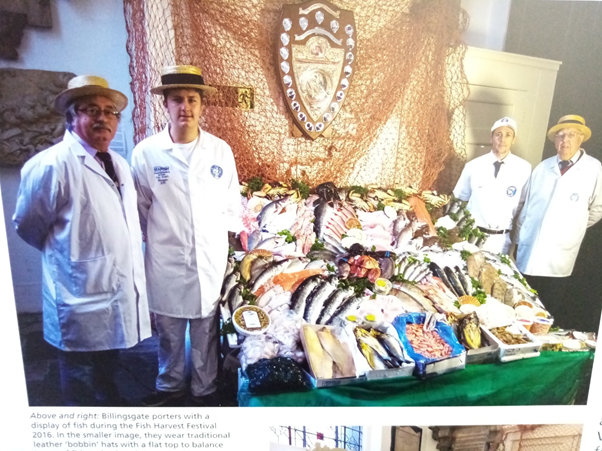
This small church, tucked away down a narrow ally, is historically linked with Billingsgate Fish Market, which was formerly situated on the banks of the Thames. The market was established in the 1500s and 300 years later it was the largest fish market in the world. The church has an annual Fish Harvest Festival, a unique slant on the traditional Harvest Festival. Despite the relocation of the Market to Poplar, East London, the Billingsgate fishmongers still donate all the fish, and a thanksgiving service is held for the Harvest of the Sea. After the service, the congregation has the opportunity to buy the fish, and a substantial amount is also donated to the Queen Victoria’s Seamans Rest for the residents to enjoy. I hope the fish aren’t displayed in the church for too long, it could get rather smelly! St Mary-at-Hill is another church redesigned by Sir Christopher Wren following the Great Fire in 1666; he became known as the ‘architect who redesigned London’. All his church designs appear to be different, clearly he was a very creative man.

Mary-at-Hill is also the name of the street, which used to run down to the riverside and Billingsgate Fishmarket
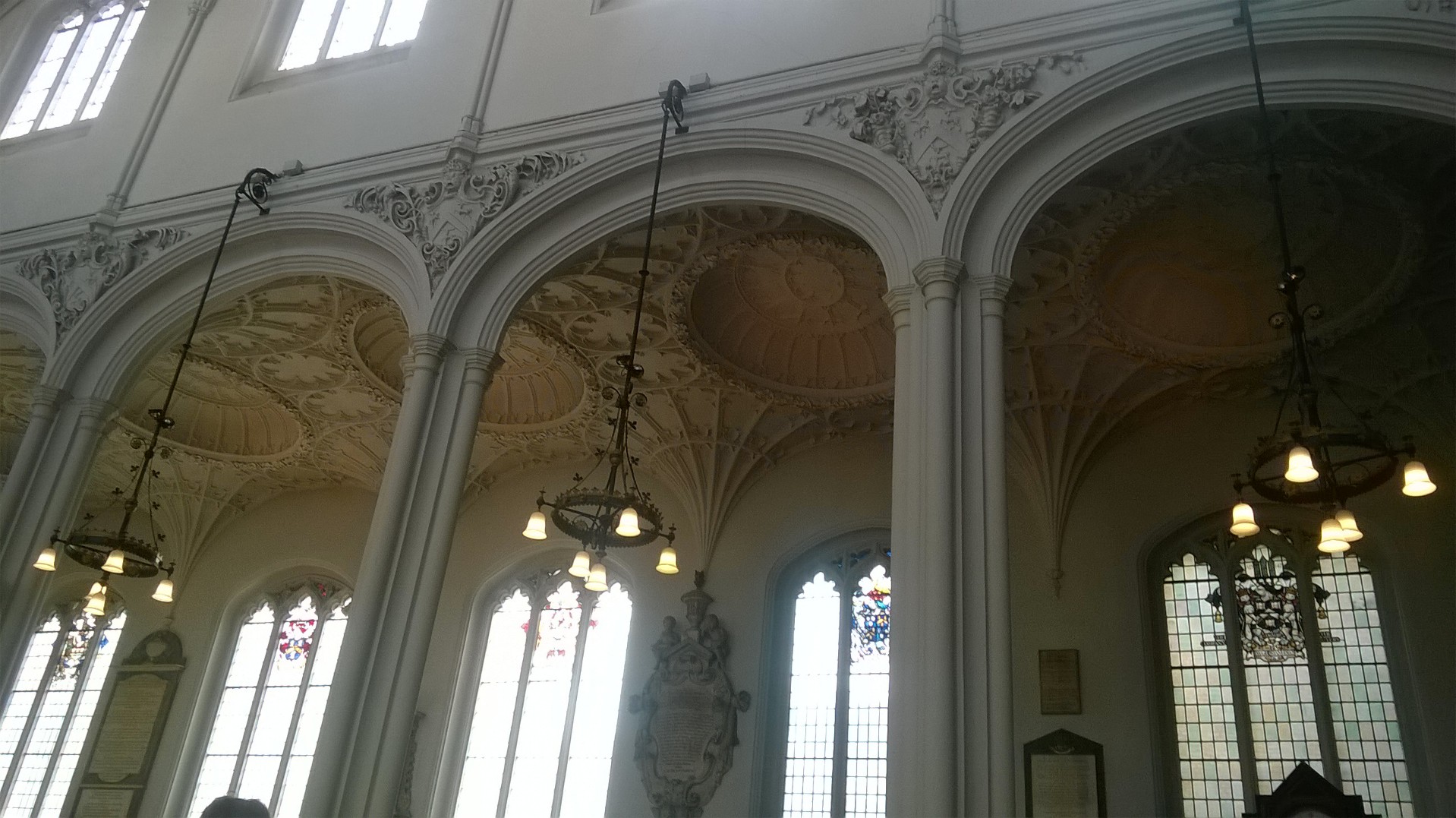
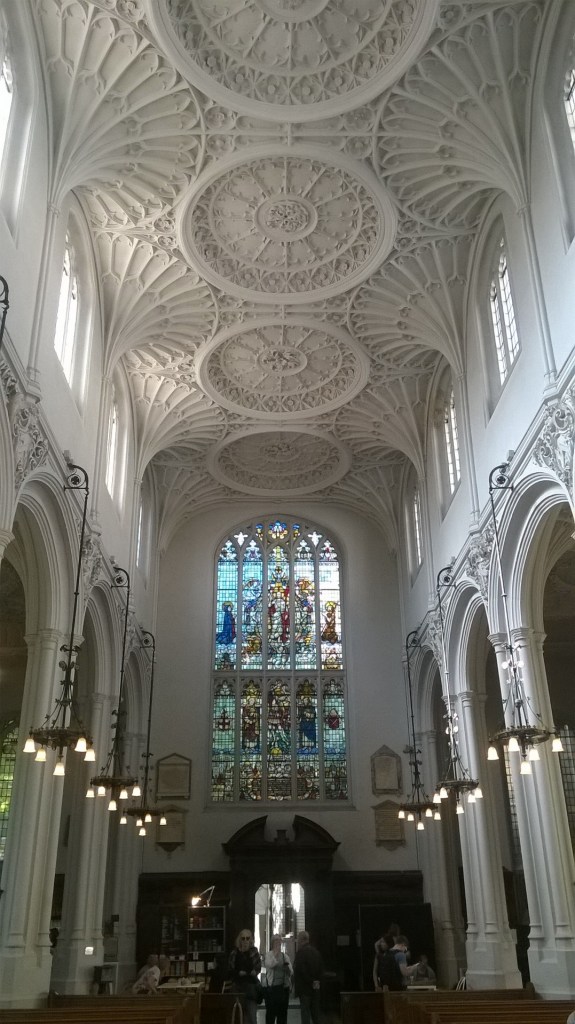
Beautiful ceiling designed by Wren
Loving that display of seafood!

St Mary Aldermary  

Situated in the Roman road, Watling Street, the name of this church means ‘Older Mary’, which implies that this is the first local church dedicated to Mary, probably having Saxon roots. The earliest record of a church on this site is 11th Century. The church was yet another casualty of the Great Fire, but unusually, not rebuilt by Wren. It was actually rebuilt in the Gothic style, which went against the City authority’s plans, but a wealthy businessman, Henry Rogers, stumped up the cash (£5,000) for the ‘rebuilding of a church in London where there was most need.’ I don’t know why this particular church was chosen, in this area you can’t move for churches, but anyway, the parishioners wanted it rebuilt in the ‘old style’, hence, these beautiful ceilings, arches and all-round gothicness. The Brief History and Guide states: ‘St Mary Aldermary may be the most important 17th Century Gothic church in England.’ The church is the home of Moot ‘a welcoming contemplative community who explore our relationship with God, with the world around us and with one another by seeking their inspiration from monastic wisdom’. The Host Café at the rear of the church offers tea, coffee, cakes and sandwiches for hungry City workers.

Side Aisle

Centre Aisle …………………………………………………………And I’m sure who these figures are

St Mary Abchurch

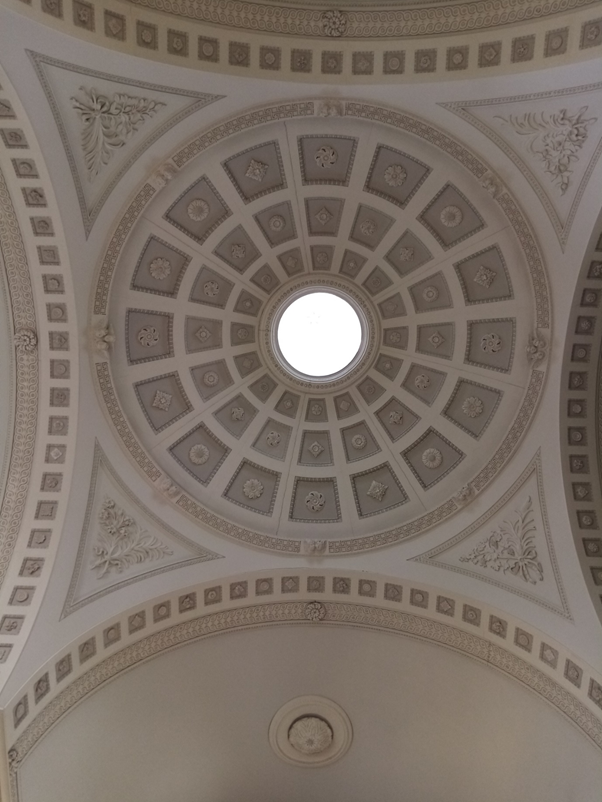
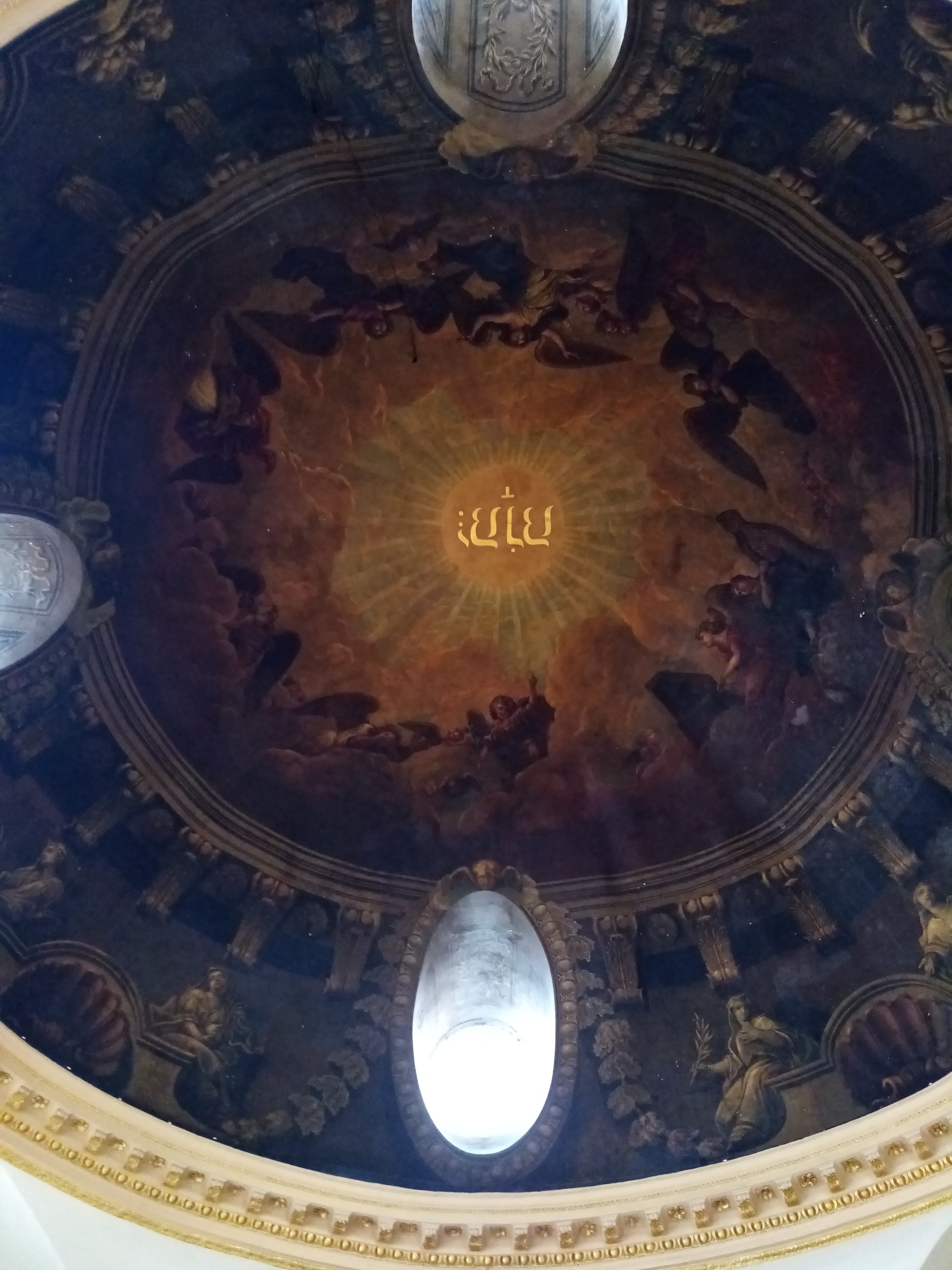
Another City church squeezed into an impossibly small space down Abchurch Lane, with tall office blocks on one side and hoardings hiding work being done on Bank Station on the other. Actually, the hoardings are a useful source of information about the Church and the surrounding area. For instance, I learned that ‘Abchurch’ means ‘Upchurch’ and the church may have originally been a Priory and Convent founded ‘up the hill across the river’ in the 12th century. The original mediaeval church was totally destroyed in the 1666 Fire, and in 1681, work was begun on the present building, designed by our old friend Sir Christopher Wren. The church has an amazing dome ceiling painting which was added in 1708. It was painted by a parishioner, William Snow, Citizen and Painter Stainer, who received £170 for his work. ‘It depicts the worship of Heaven; in the centre is the Devine Name in Hebrew characters surrounded by rays of glory with worshipping figures of angels and cherubs beneath.’* My photo doesn’t do it justice; the light wasn’t good and I can never take a good photo looking straight up! I liked that the gravestones in the centre aisle give the person’s occupation as well as their name and also the word Citizen (of London I suppose). E.g., Citizen and Mercer, Citizen and Draper. Also liked the Lion and the Unicorn on the two front pews.

*From the leaflet about St Mary Abchurch, published by The Friends of the City Churches.

April – Churchyards ll

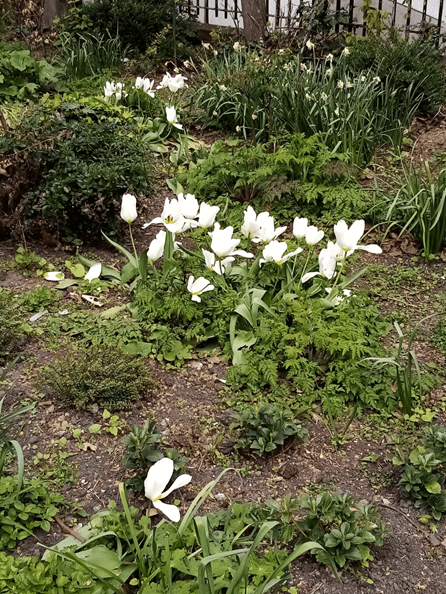
The weather is getting warmer, Spring blossom and flowers are everywhere, so I thought I’d continue with the gardens theme (and of course, I still can’t visit churches and other buildings yet.) Here are four more churchyard gardens, all with a church still standing.

Christchurch Garden Southwark

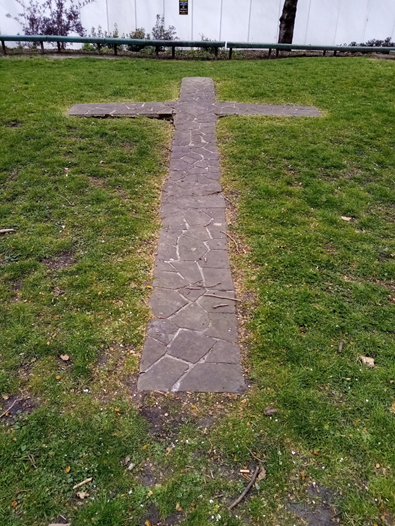
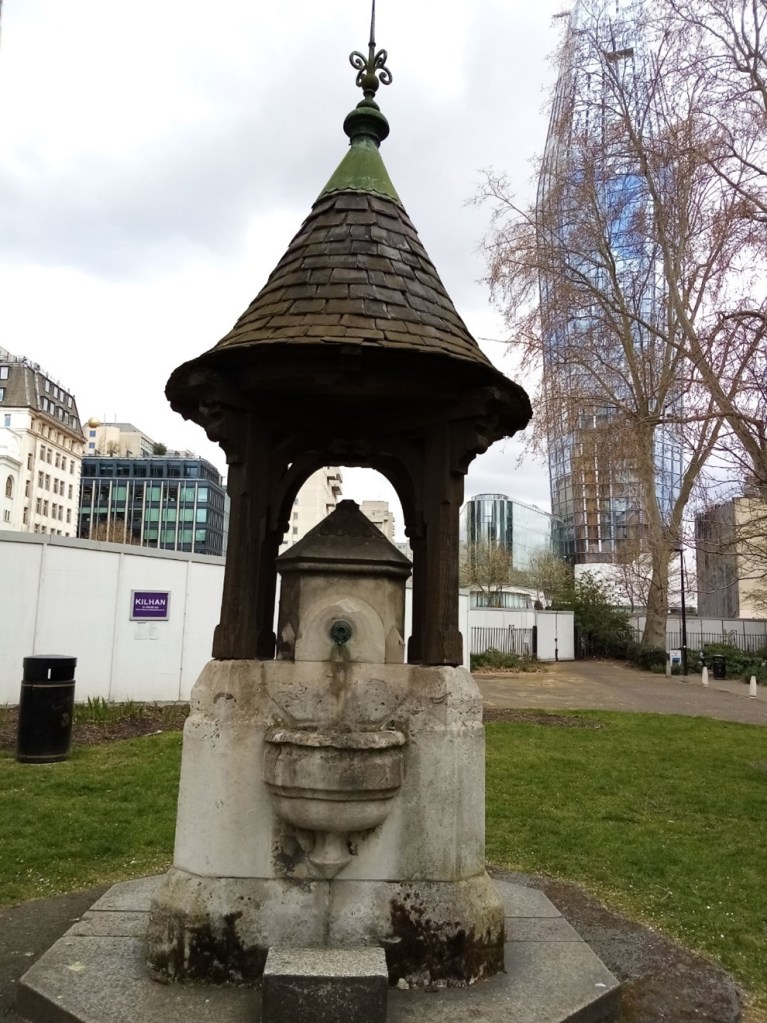
This small garden is the remains of the much larger Medieval Paris Garden mentioned in Shakespeare’s play Henry Vlll. The original Christ Church was built in 1671 but it began to sink into the boggy ground near the riverbank and had to be rebuilt in 1738. That one was destroyed by World War 2 bombing and the current church dates from 1960. The churchyard was closed to burials in 1856 and converted to a public garden in 1900. The most interesting thing about the churchyard is that when the church was bombed in April 1941, the cross on its roof caught fire and fell onto the grass, scorching the grass. Stones have been placed to mark the place where the burning cross fell. Dramatic!

Trinity Church Square

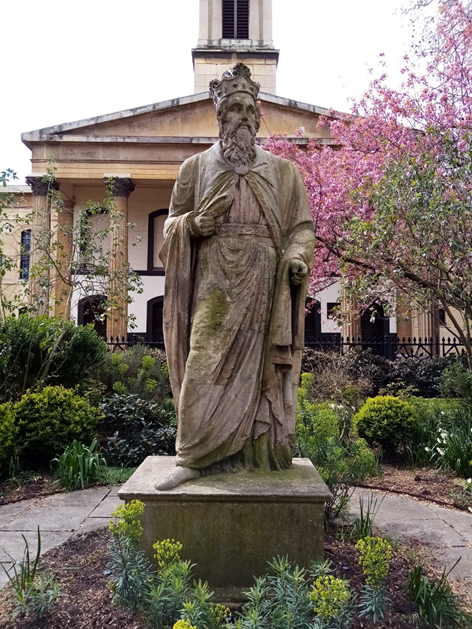
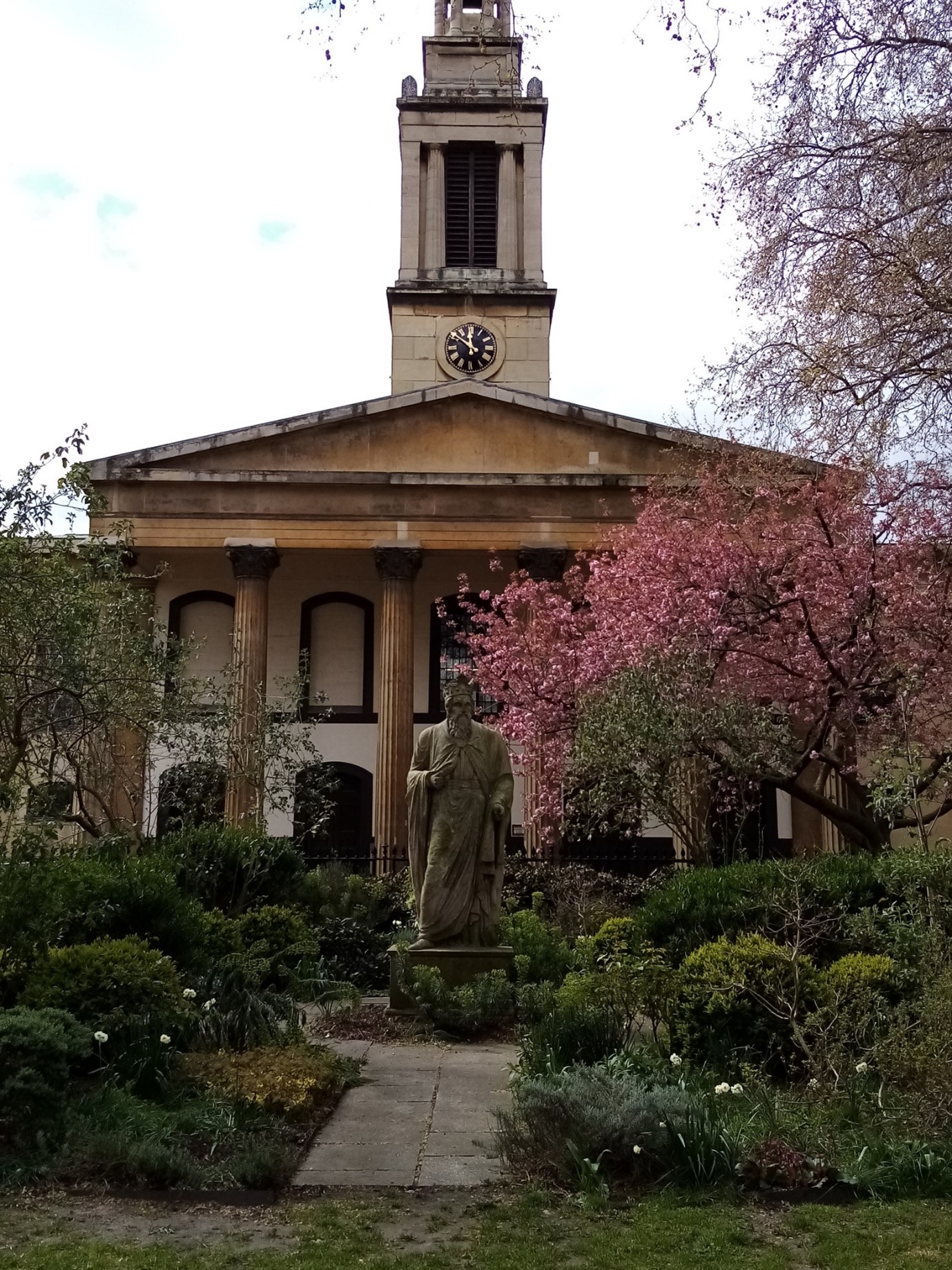
I was surprised to find that this is a private garden, one of those ones where local residents have a key to get in and the riff raff are kept out. I can appreciate why people without their own garden should have their own private recreational space, but it was frustrating that I had to take my photos through the locked gate! The building here was originally Holy Trinity Church built in 1823, with the gardens being laid out between 1824 and 1832 and the church converted to the Henry Wood Hall for music recitals in 1975.  In the middle of the garden is a statue of King Alfred the Great on a stone pedestal which may once have stood in Westminster Hall.

Zoom lens photo taken through railings. Not bad for a cheap phone!


The large former church building rather dominates the small, compact residential square

St George the Martyr Churchyard and St George’s Gardens

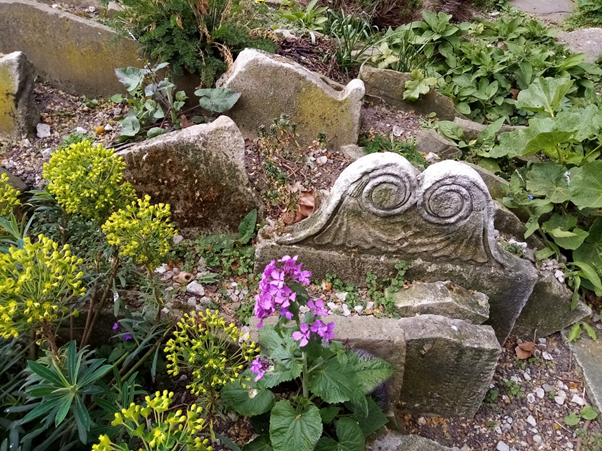
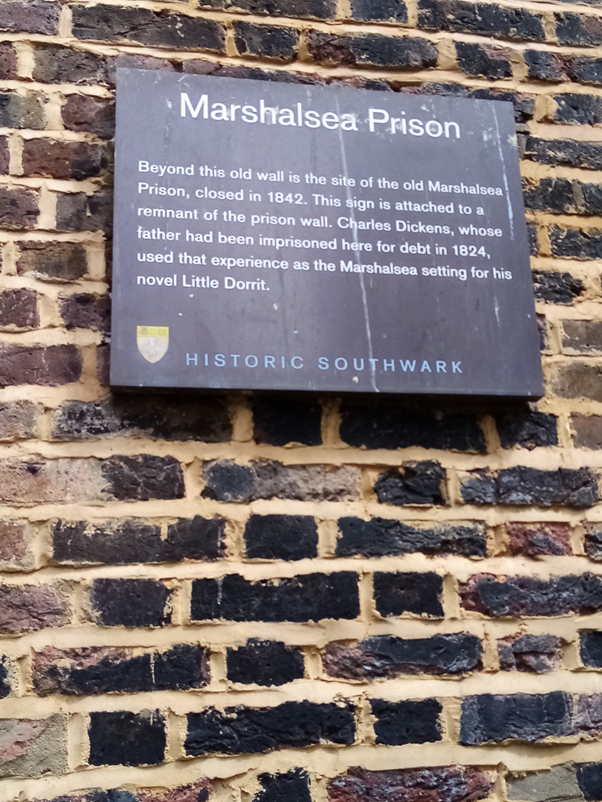
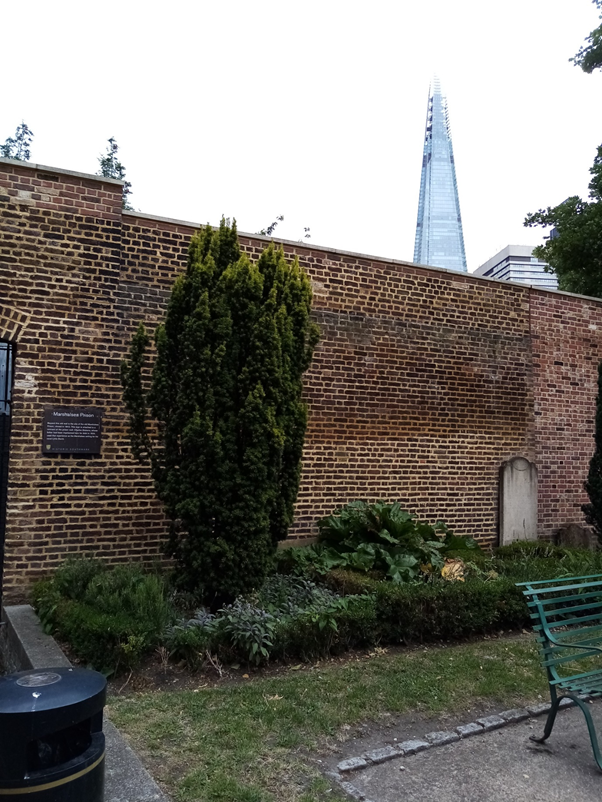
The churchyard surrounding St George the Martyr was once a much larger, single space but was split in two in 1902 by a road connecting to Borough High Street, Tabard Street (now pedestrianised). Hence there are now two separate gardens, the small one with the church in it and the larger, prettier, St George’s Gardens. There’s been a church on this site since the 12th Century and the present church dates from the 18th. Another Dickens connection: the Church is known as ‘Little Dorritt’s Church’ because the Dickens’ character was married here. A closer connection for Charles is that Marshalsea Prison, where his father was incarcerated, was situated behind the Northern boundary wall of St George’s Gardens. An unusual feature of the garden is the way some of the ancient gravestones have been made into an attractive rockery!

Unusual rockery made of headstones
I always try to get a newbuild in the background!

St Olave’s Hart Street Churchyard

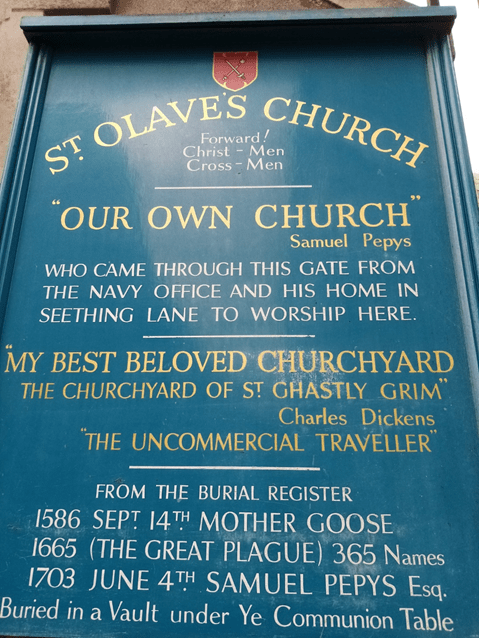
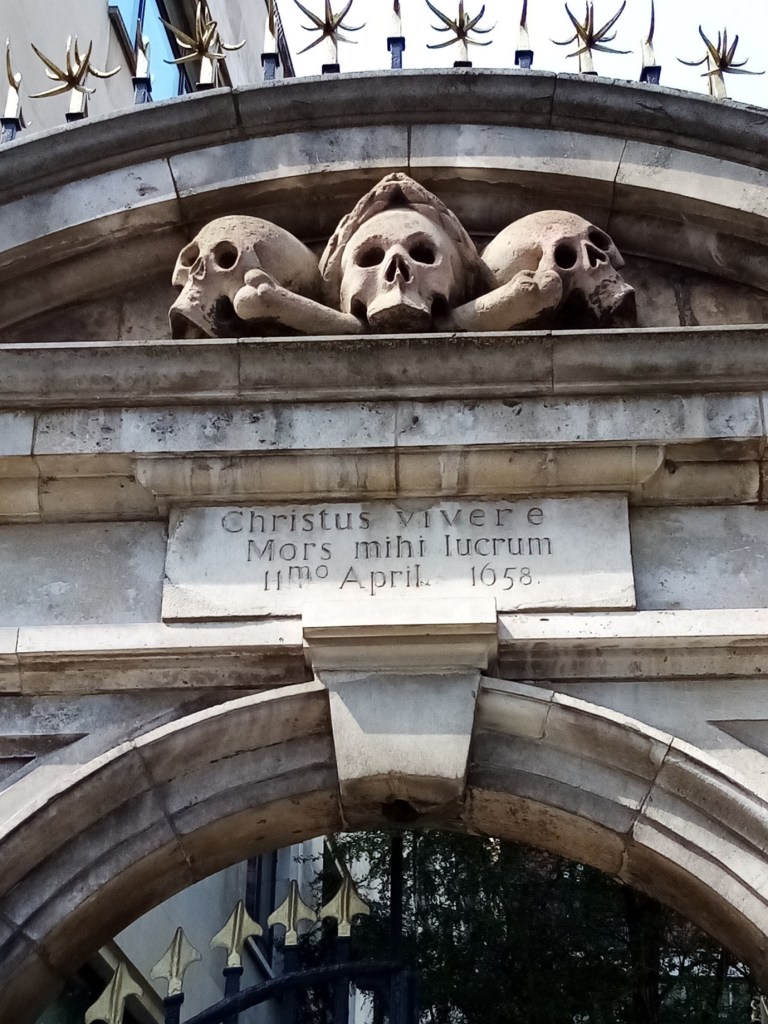
St Olave’s Church is the smallest intact medieval church in the city of London, the first building dating from the 12th Century and the current building from the 15th. St Olave’s has associations with Samuel Pepys (the Navy Office where he worked was nearby and his house was in adjacent Seething Lane) and Charles Dickens, who used the churchyard in one of his lesser-known works – with a somewhat different name! (see pic of noticeboard). Pepys was buried here in 1703, also 365 plague victims, and in 1586, Mother Goose! Who was she, I must Google that! The entrance to the churchyard is under an arch of skulls and bones, rather morbid to us today but signifying Life after Death. Seven years after the skulls were carved, the devasting Black Death gave a new significance to the sculpture.  Another year of devastation followed, with the Great Fire of September 1666 destroying most of the City and surrounding area. St Olave’s survived, partly due to the ingenuity of Pepys who had many of the wooden structures surrounding it removed.

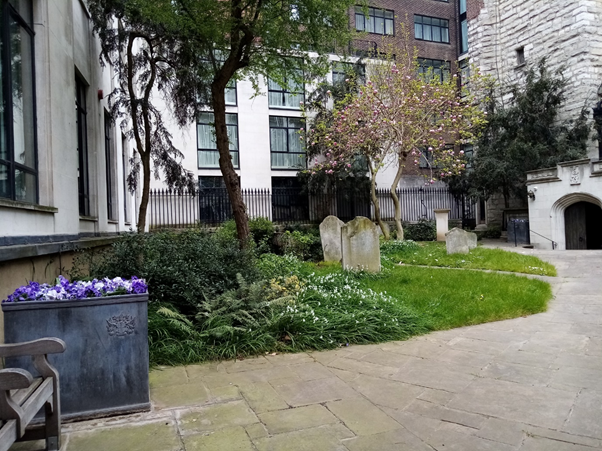
Churchyard surrounded by 20th Century buildings

March – Cemeteries around London

Another month has gone by in which I was not able to visit places in London, however I thought you might be interested in some spectacular cemeteries in the outer London boroughs, which I’ve visited over the years. They are all very ‘Instagram-able’ if you fancy exploring any of them.  These four are some of the ‘Magnificent Seven’ burial grounds established in Victorian times when central London graveyards ran out of space as the population increased and land in ‘urban parishes’ was approved for burial (the Burial Act 1852.) The three I haven’t visited are:  Kensal Green Cemetery (the oldest at 1833), Highgate Cemetery (the famous one; Karl Marx is buried there, and most of the movies featuring English cemeteries are filmed there) and Tower Hamlets Cemetery (closed for burials in 1966 and is now a picturesque park). So they are all worth a visit when restrictions on travel are lifted.

These are the four I have visited:

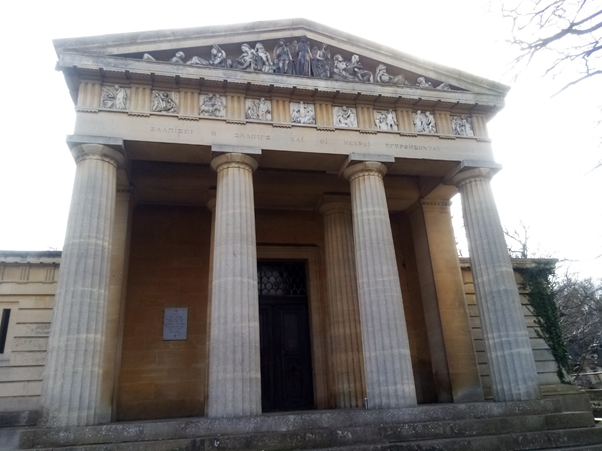
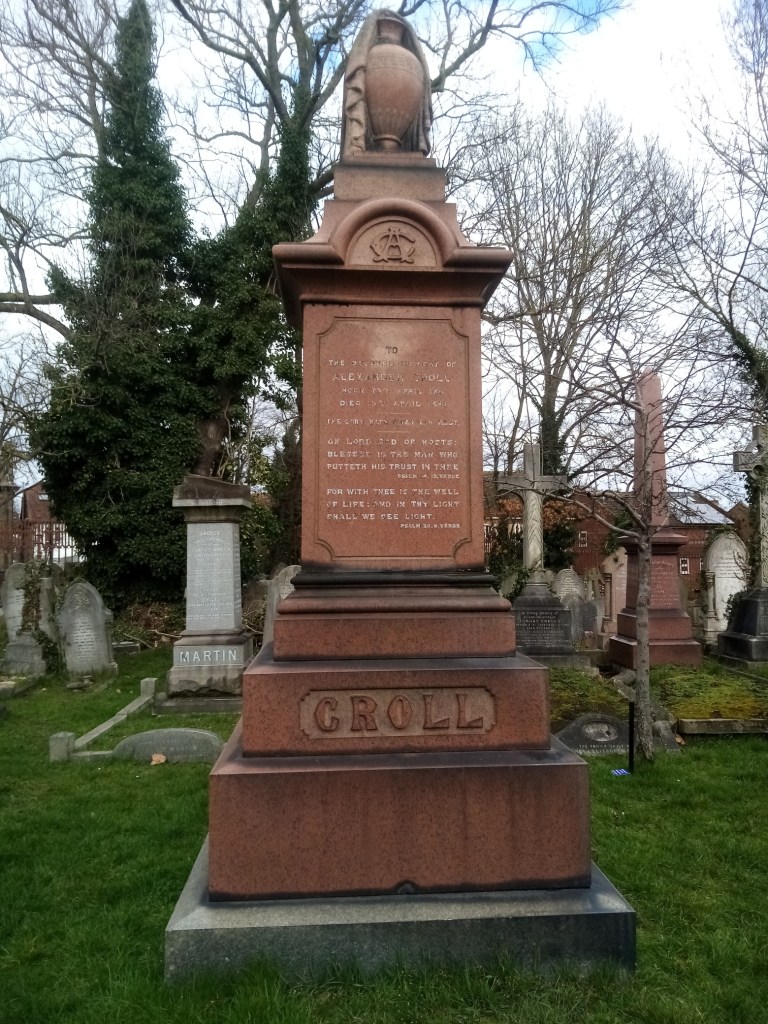
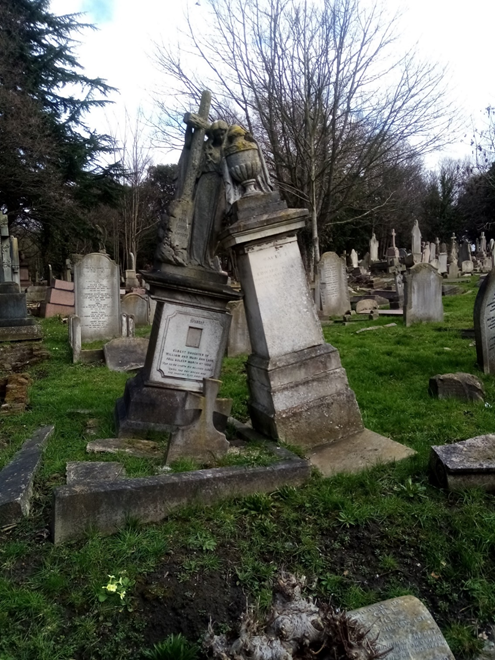
West Norwood Cemetery: opened in 1837, 40 acres, and the first cemetery in the world to use the Gothic style, and one of the first landscaped cemeteries in London. It certainly is beautifully laid out, ‘a mixture of historic monumental cemetery and modern lawn cemetery’ (Wiki). It features a Greek Orthodox section and 69 Grade ll listed buildings and is also recognised by Lambeth Council as a site of nature conservation value. Famous people buried here: Hiram Maxim (inventor of a type of machine gun – nice!), Mrs Beeton (Cookery writer of the 1950s) and Henry Tate of (Tate and Lyle Sugar).

This is a magnificent Greek Temple replica in the Greek Orthodox section
I love these memorials fallen against each other

Abney Park Cemetery

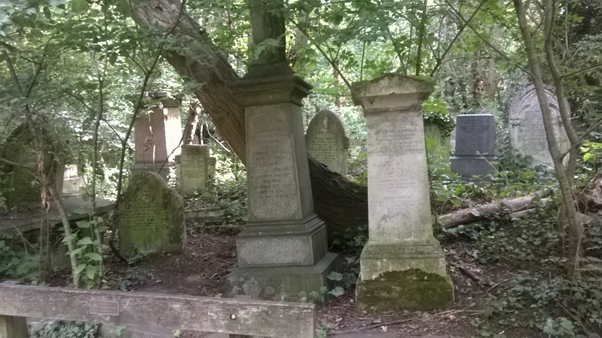
Opened in 1840, 32 acres, originally an area of parkland laid out by Lady Mary Abney in the 18th Century and converted to a cemetery under the Burial Act 1852. It became the main burial place of English nonconformists when Bunhill Fields in the City closed.  (I’ve mentioned nonconformists before, they were Protestant Christians who separated from the Church of England in the 17th and 18th Centuries because they disagreed with state intervention in religious matters.) Wiki says: ‘It stands today as the most important burial place in the UK of 19th century Congregational, Baptist, Methodist and Salvation Army ministers and educationalists’. Indeed, William and Catherine Booth, founders of the SA are buried here, along with their son Branwell and other SA commissioners. There’s a real sense of wilderness in this cemetery; it’s been used as a backdrop for Amy Winehouse’s music video for Back to Black, and interestingly, was used to represent Highgate Cemetery in Waking the Dead series 2. Why didn’t they just use Highgate…..?

Brompton Cemetery

Opened in 1840 in the Royal Borough of Kensington and Chelsea, this is the only cemetery owned by the Crown and managed by the Royal Parks. Its 40-acre site is ‘one of Britain’s oldest and most distinguished garden cemeteries’ according to Wiki. It’s still open for burials and has a Visitor Centre! It is Grade 1 listed in the English Heritage Register of Parks and Gardens of Special Historic Interest. The location has been used for the following films: Sherlock Holmes, Stormbreaker, Goldeneye and Johnny English. Famous people buried here include: Henry Cole, Founder of the Victoria and Albert Museum, the Royal Albert Hall and the Royal College of Music. Emmeline Pankhurst, prominent suffragette. John Snow, epidemiologist and anaesthetist who discovered the link between cholera and infected water. Sir Thomas Spencer Wells, President of the Royal College of Surgeons.

Nunhead Cemetery

Opened in 1840, originally known as All Saints Cemetery, this is somewhat larger than the others at 52 acres and known for its ‘meandering paths’ according to Wiki. The cemetery had become overgrown with wild vegetation until the Friends of Nunhead Cemetery was formed to renovate and protect the monuments. With the help of Heritage Lottery funding paths were cleared and monuments were restored to make it the delightful place to wander in today. It’s now a local nature reserve and is an important habitat for birds and animals, retaining a woodland feel while being completely accessible. The cemetery has several interesting structures, including an octagonal Gothic chapel. (Gothic was a fashionable look in Victorian times, wasn’t it?) An episode of the BBC series Spooks was filmed here, but as with Abney Park, it was supposed to represent Highgate!

Thanks, as always, to Wikipedia, also to Tired of London, Tired of Life, Tom Jones, Virgin Books

Blue Plaques Part ll: recognising the contribution of Christians in London’s History

These are some more Blue Plaques found on buildings in central London, commemorating Christians who have lived out their Christian faith in obedience to God and for the benefit of others. Three of them are relatively unknown. In alphabetical order:

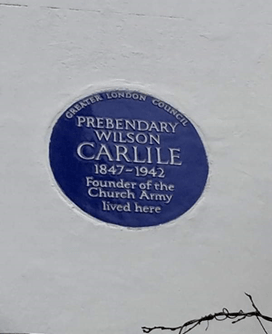
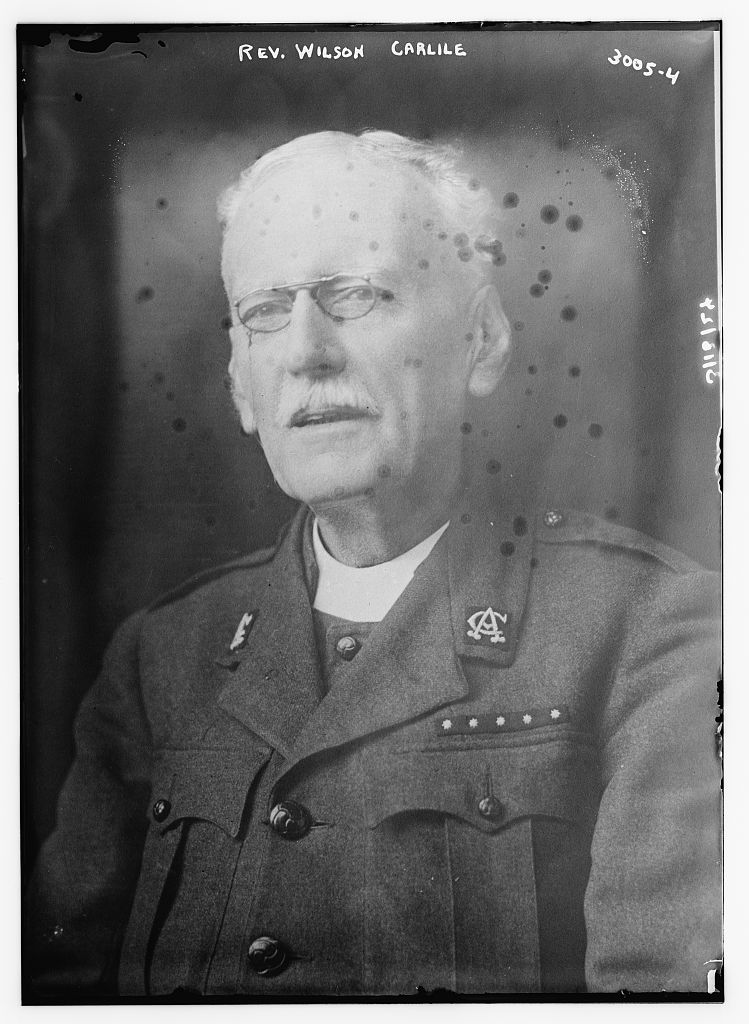
Wilson Carlile 1847 – 1942


image: churcharmy.org

Wilson Carlile was something of a child prodigy, being gifted musically and at learning languages. He joined his grandfather’s business and by the age of 18, had almost total control, due to his grandfather’s failing health. He determined to be a successful, ambitious businessman, and by 25 he had made his first million in today’s money. But a great depression which began in 1873 meant that he lost almost all the wealth he had acquired, leading to a mental and physical breakdown. Confined to bed, he began to question the purpose and meaning of his life and the chance reading of an evangelical work, Mackay’s Grace and Truth, caused him to turn his life around as he began to believe in ‘the crucified and risen Lord…..He touched my heart, and old desires and hopes left it. In their place came the new thought that I might serve Him and His poor and suffering brethren.’ (Wiki).  Fast forward 9 years, during which time Carlile worked with evangelist DL Moody, musical director Ira Sankey, and the Salvation Army, and gained an understanding of mission and evangelism, to 1882, when he formed the Church Army. As a curate in wealthy Kensington, Carlile wanted to break down the barriers between the rich and poor, so he resigned his curacy to work in slum areas, ‘to share the Gospel with people who wouldn’t dream of setting foot inside a church’. (Wiki). He had the idea of using ordinary, non-ordained men (and controversially, women) to train as evangelists to work among the poor and marginalised. The idea of a spiritual ‘army’ was popular at the time as a metaphor for the fight against spiritual forces of evil, so the Church Army was born. Carlile always worked under the authority of the Church of England, ensuring that evangelism carried out in a community always had the approval of the parish priest, and in a prison or other institution, by invitation of the chaplain. Carlile met with resistance from top level Church of England officials because of his unorthodox methods, but gradually the Church Army gained the respect of the Church, partly because of Carlile’s great respect for the Church! By 1925, the Church Army was the C of E’s largest home mission society.

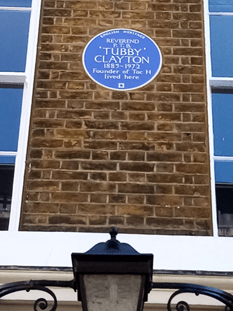
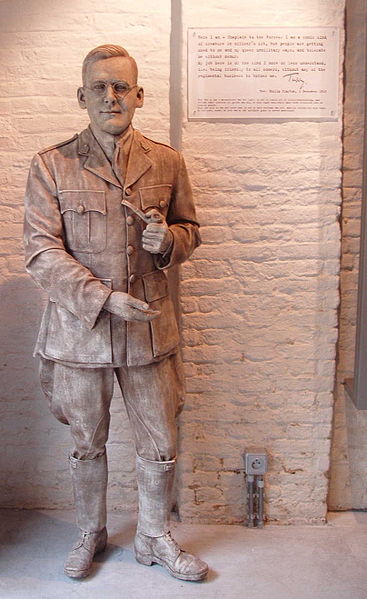
Reverend Philip ‘Tubby’ Clayton 1885 – 1972

Tubby Clayton was a Church of England ordained priest and served as an army chaplain in World War 1 in France. He and another chaplain, Rev. Neville Talbot, opened a rest home for wounded soldiers at Poperinge, Belgium in 1915 called Talbot House (named for Neville’s younger brother Gilbert, who was killed earlier in 1915).  Poperinge was a transfer station where soldiers were billeted on their way to and from the battlefields of Flanders, and the chaplains’ idea was to provide an ‘Everyman’s Club’, where all soldiers would be welcome, regardless of rank.  It became known as Toc Aitch, this being signal terminology (a sort of NATO phonetic alphabet) for TH. In 1920 Clayton and his fellow leaders were inspired to set out The Four Points of the Toc H Compass:

  1. Friendship – ‘To love widely’
  2. Service – ‘To build bravely’
  3. Fair-mindedness – ‘To think fairly’
  4. The Kingdom of God – ‘To witness humbly’

 At first I thought these four ‘compass points’ were a bit random, but now I think they make sense, these are things that all Christians should aspire to, aren’t they? After the war, other Toc H houses were established in Kensington, Manchester and Southampton, and later, a women’s league. From 1922 to 1962, Clayton was vicar of All Hallows-by-the-Tower (one of my favourite churches) and began working with the East End poor. Following the Blitz in 1940, he played a primary role in fundraising for the restoration of the badly damaged All Hallows and for the devasted East End. He was also chaplain to the British Petroleum Company. The Toc H legacy lives on today in Christian facilities and activities: youth centres, residential holidays for special groups, entertainment for care home residents, and reconciliation work with disparate groups in society.

Elizabeth Fry 1780 – 1845

Mandatory Credit: Photo by Nils Jorgensen/Shutterstock (382483d) THE NEW £5 NOTE FEATURING PRISON REFORMER ELIZABETH FRY ANNA WING LAUNCHING THE NEW FIVE POUND NOTE, LONDON, BRITAIN – 21 MAY 2002

Let’s go back in time one hundred years to the inspiring Elizabeth Fry. Born into a wealthy Quaker family, she married Joseph Fry, also a Quaker and a banker. In her teenage years, Elizabeth was inspired by William Savery, an American preacher, abolitionist and an advocate of social justice. She felt that God was calling her to devote her life to working for the poor and socially excluded, an unusual ambition at the time for a wealthy married woman, who would have been expected to spend her days in leisure pursuits and the raising of children. Elizabeth actually did have 11 children, presumably cared for by an army of nannies! Invited to visit Newgate Prison in the City of London when she was 33 years old, she was horrified by the conditions and particularly the overcrowded, filthy cells of women and their children. She was also struck by the injustice of their situation; many of the women were being held without trial. Elizabeth returned to the prison the following day bringing food and clean clothes for some of the prisoners, but she knew she had the means to do more.  Despite financial difficulties in the Fry bank, she funded a school for prison children and offered their mothers opportunities to learn needlework, knitting and cooking so that they could earn their own living on release from prison, thus ending the cycle of imprisonment for non-payment of debts (Newgate was a Debtors’ Prison where Charles Dickens’ father was incarcerated.) Elizabeth set up the ‘Association for the Reformation of Female Prisoners in Newgate; a Nursery School; and the ‘Brighton District Visiting Society’, a forerunner to the Health Visitor scheme. She believed that education was a route out of poverty and that people did not choose to beg or steal to survive but needed support to improve their lives. Queen Victoria was impressed by Elizabeth’s concern and determination and provided funding for several of her causes.

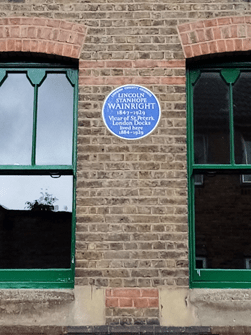
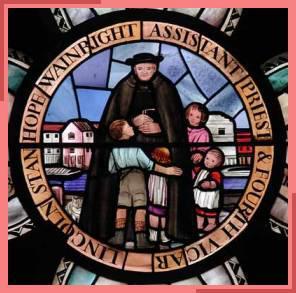
Lincoln Stanhope Wainwright 1847 – 1929

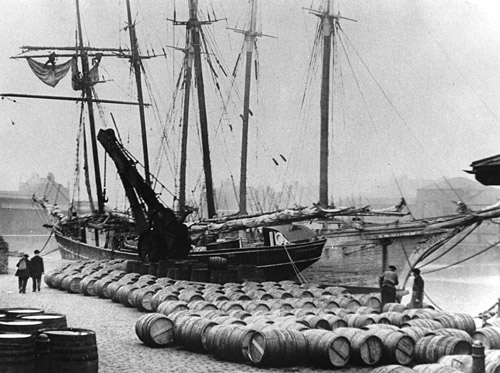
Photo: London Docks c1909.jpg – Wikimedia commons

Lincoln Wainwright was the Assistant Priest and then Vicar of St Peter’s Church at London Docks for 56 years. Being privately educated at Radley and Wadham Colleges Oxford, he could have taken the ‘living’ at any wealthy parish in England but chose to live among the poorest Londoners in the Dockland slums. Wainwright devoted himself to providing the local people with ‘ragged schools’, working men’s clubs and medical facilities, at a time when there was no Welfare State, and education and medical care had to be paid for. He frequently gave his own food to poor parishioners, and on one occasion, his own clothes and shoes. Working on the docks was a precarious lifestyle, particularly for unskilled labourers who would wait each day to be chosen for the most arduous jobs of unloading from the ships, for a pittance of a wage. Only the strongest and fittest would be offered work and families could literally starve to death if Father didn’t get regular work. In the 1880s there was a dock strike and Wainwright supported destitute families financially and emotionally as best he could. When he died in February 1929 one of his parishioners wrote: ‘Dockland was washed with tears because this tiny but indomitable figure, shabby, untiring, spendthrift of love, would not serve them on Earth anymore’.   I think it’s a sad legacy that his name is misspelt both on the Blue Plaque and the stained-glass window in the church, but there are many tributes to his life of selfless devotion to the poor.

I think my favourite of these Blue Plaque People has got to be Lincoln Wainwright; he wasn’t the founder of an organisation, he wasn’t a catalyst for change, he wasn’t a major fund raider for some big social project, his name doesn’t appear on any building. But he faithfully served the poorest of communities his whole life, not asking for, or expecting recognition. That was his legacy.

Thanks as always to Wikipedia for information on Carlile, Clayton and Fry, and to the delightfully-named stchrysotoms.wordpress.com for Wainwright.

All photos and images are in the public domain.    

January: Churchyards without a church!

Many of London’s churches are over one thousand years old, and with the capital’s history of fire and war, not many have escaped unscathed, in fact several have been completely destroyed. Having been unable to get into any city churches for a while, fortunately I did get to visit some gardens and churchyards in November/early December where there used to be a church which has long since gone. The information about the gardens is mainly sourced from The London Gardens Trust website (londongardenstrust.org) which has an inventory of every public garden in every London Borough. Lots more for me to visit when circumstances allow!

St Alphage Gardens, London Wall

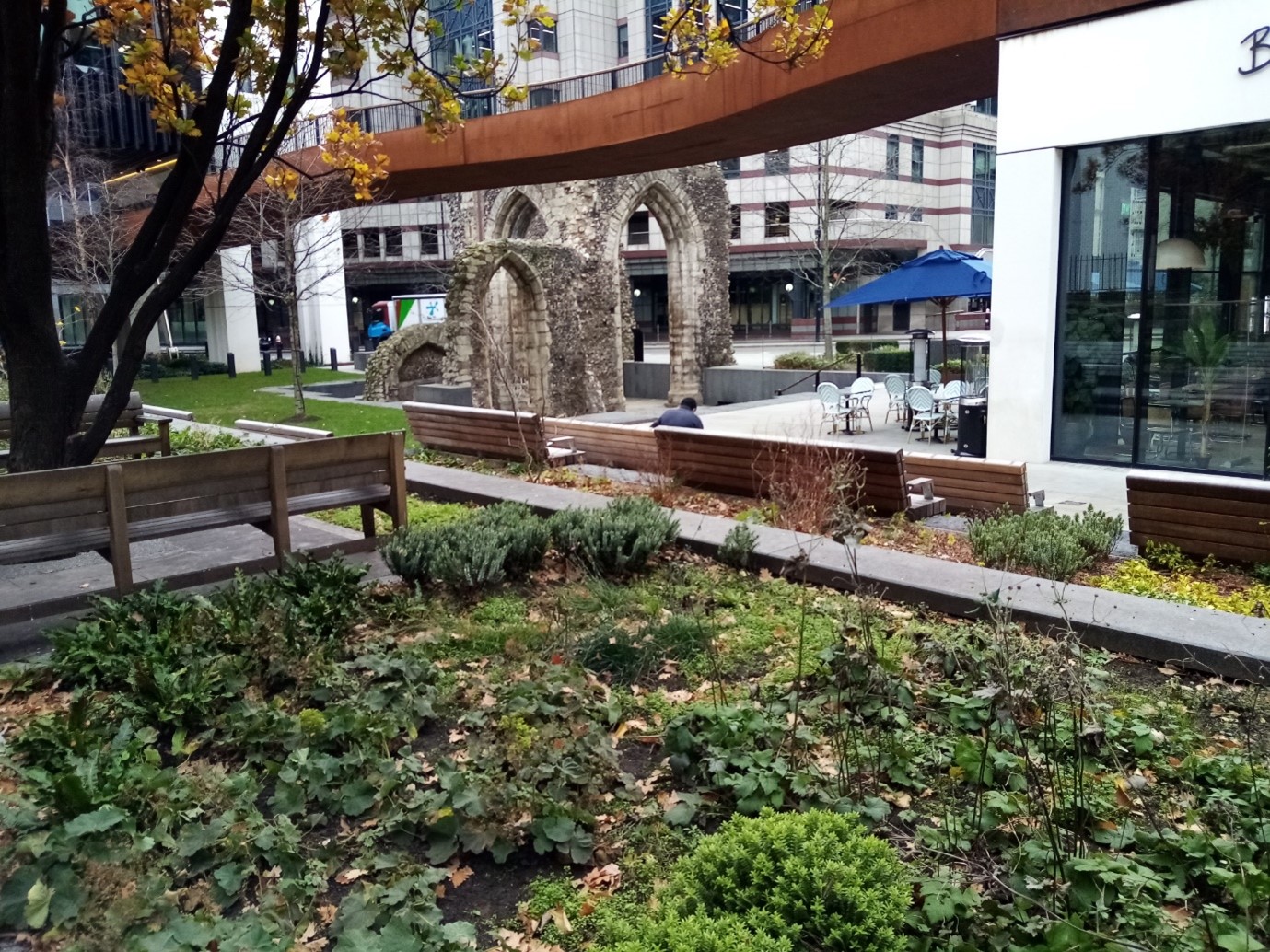
In February last year, in Romantic Ruins, I wrote about the beautiful remains of the tower of St Alphage church. The church fell into disrepair and was actually completely demolished in 1540 and the site was made into a public garden in 1872. One century later, the Barbican and London Wall areas were completely redeveloped, being the most heavily bombed sites of the City in WWll. The Corporation of London scheme created a new business and housing district and as part of the landscaping, a fragment of the old Roman Wall and the tower were retained and are now carefully maintained, to my eternal joy!  This pic shows one of the famous Barbican Highwalks, the ‘pavements in the sky’. The garden isn’t very impressive in the pic, but it was November!

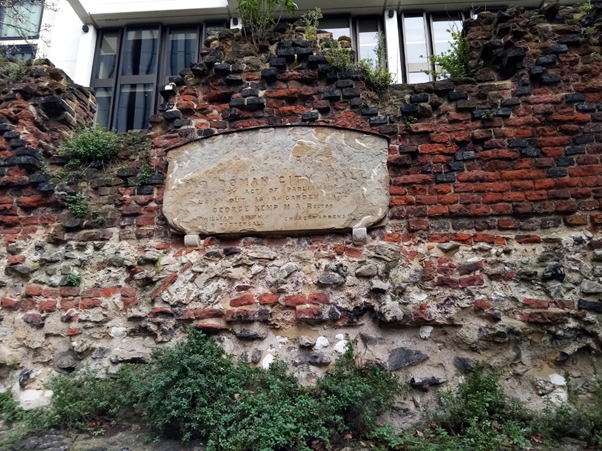
Part of the old Roman Wall

The tower suffered extensive bomb damage but has been carefully preserved and (I think) sits well with the later architecture, which dates from 1970 to brand new office blocks. I love that at one time the tower was used as a hospital for the blind and disabled, at a time when care for the poor and sick was inextricably linked with the Church and Christian service.

St Mary Aldermanbury

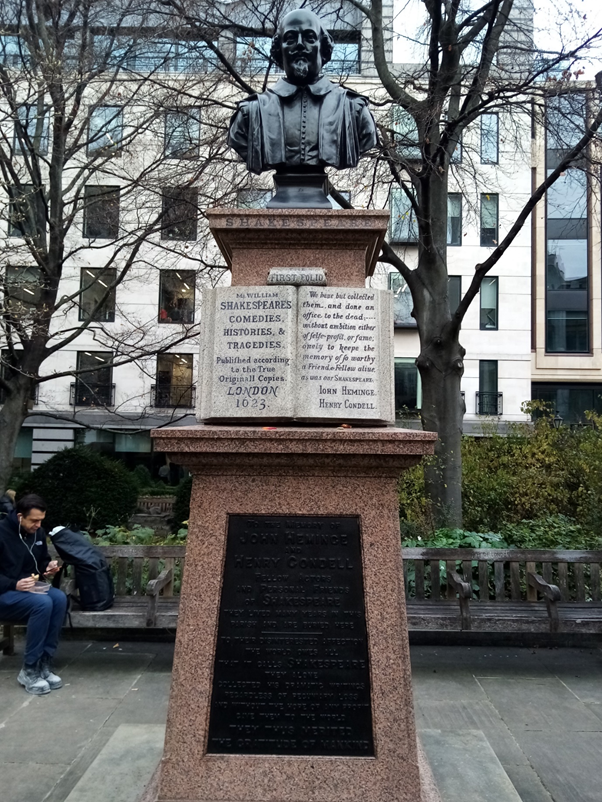
Just across the road from St Alphage (although it’s a very wide road, London Wall) is the garden of St Mary Aldermanbury. Probably named from the Aldermans’ ‘Berry’ or Court Hall, which stood nearby, there was a church here by 1181 and a churchyard by 1250.  Interesting things about this site: this statue of Shakespeare is actually a monument to fellow actors John Heminge and Henry Condell, who, after the playwright’s death in 1616, collected his works and published them at their own expense. Shame there’s not a statue of the two of them, we all know what Shakespeare looks like!

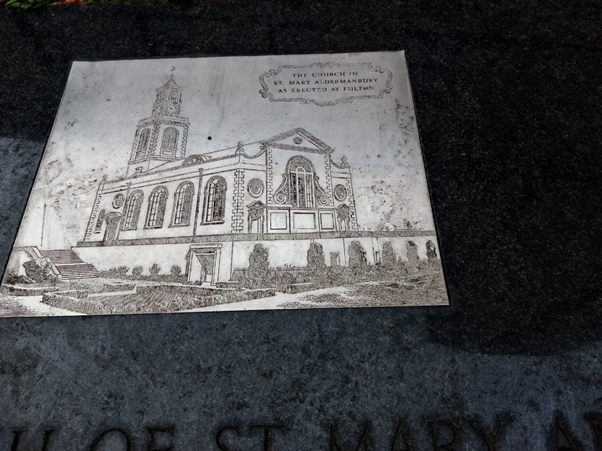
And now to the fate of the church that was once here.  The plaque on the site reads: ‘Site of the church of St Mary Aldermanbury. First mentioned in 1181. Destroyed by the Great Fire in 1666. Rebuilt by Wren, destroyed by bombing in 1944. The remaining fabric was removed to Westminster College, Fulton Missouri, USA 1966 and restored as a memorial to Sir Winston Churchill’.  So a somewhat different fate to most demolished City churches! There’s an engraving of the church in situ in Fulton, Missouri, above the plaque:

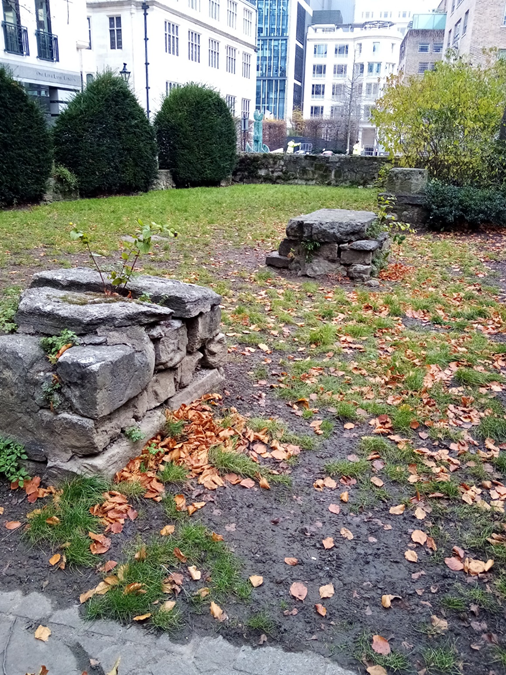
And lastly, some footings of the church in the garden:

Interesting that these footings are left, if the whole church was dismantled and rebuilt!

St Mary Staining

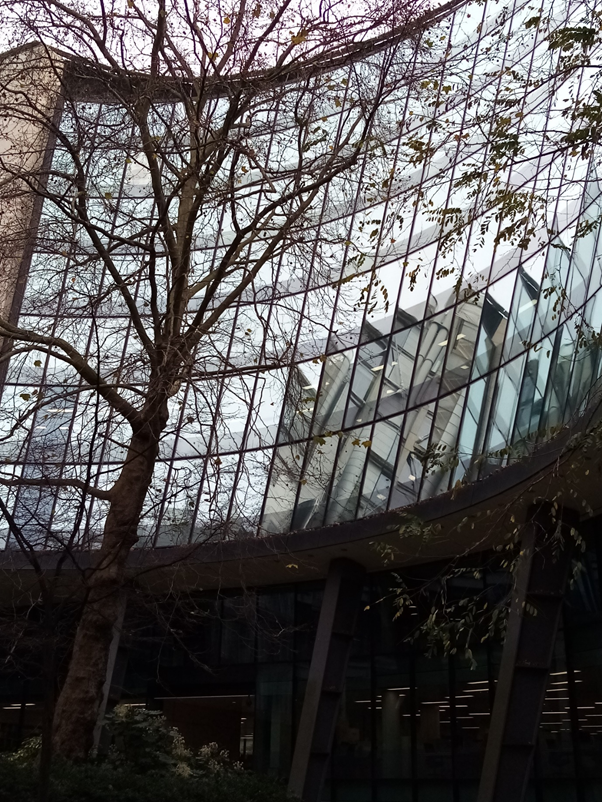
A hop skip and jump from St Mary A is St Mary S. There’s been a church on this site since 1189 and ‘Staining’ probably refers to a family living in Staines who held the land. The church was destroyed in the Great Fire and not restored. In 1965 the Corporation of London took over maintenance of the open space created on the site of the church and churchyard. I visited this site (and St Mary Aldermanbury) as part of a London Walks tour in December 2019, these are brilliant walks covering different areas and different themes around London. There are two interesting things about this site: firstly, the building next to the site was built sloping backwards to ensure that the London plane tree in the garden would receive enough light. Hope you get a sense of this from the pic.

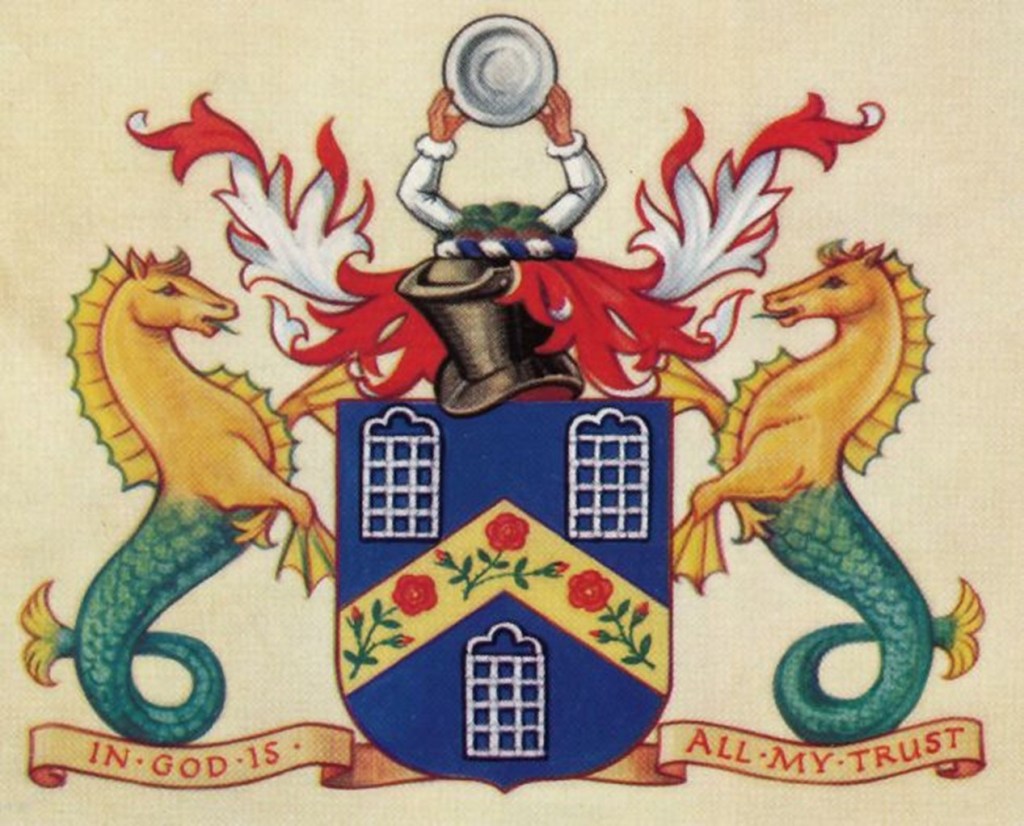
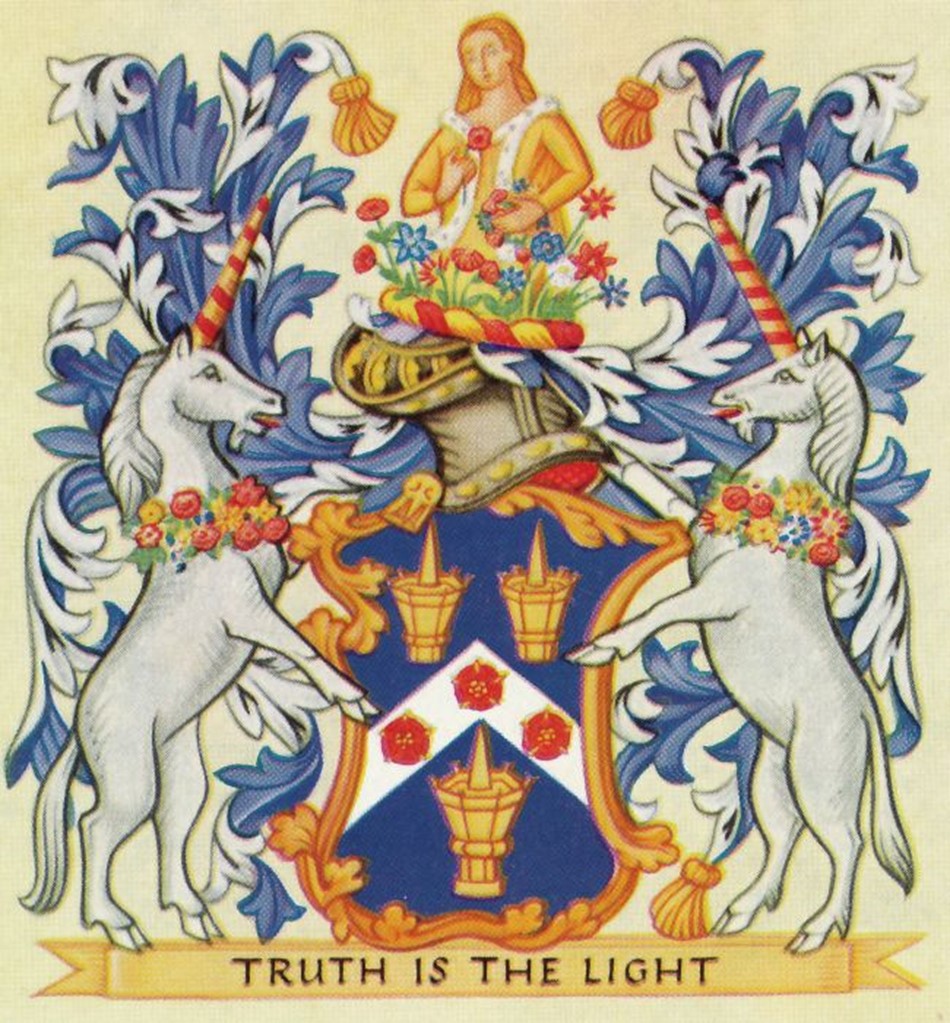
Secondly, around this area there are lots of Livery Company Halls, these started out in the 1300s clubs or guilds to protect the different trades or professions; you can look them up on Wikipedia if you’re interested. Each one has a Hall as its headquarters, e.g., the Worshipful Company of Ironmongers, Waxchandlers (they made candles), Saddlemakers, etc, and all are within a few streets of each other. The one closest to this site is the Pewterers Hall which was rebuilt here in 1961 following demolition of the original Hall. Here are the Coats of Arms of the Pewterers Company and the Waxchandlers Company, beautiful, aren’t they? I like their mottoes too.

All Hallows, Southwark

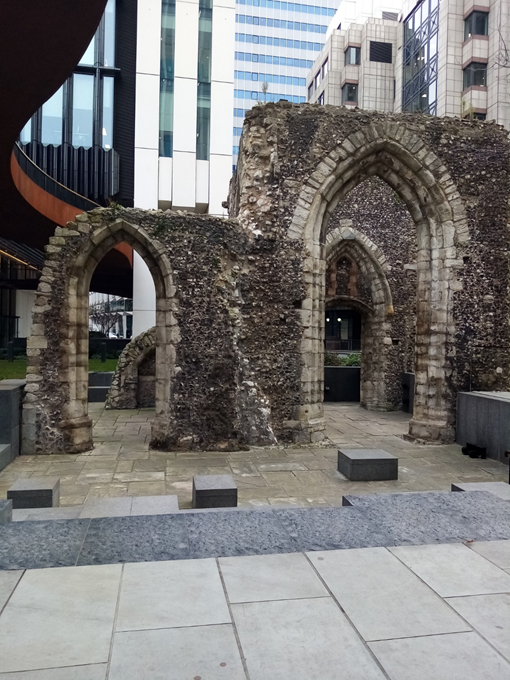
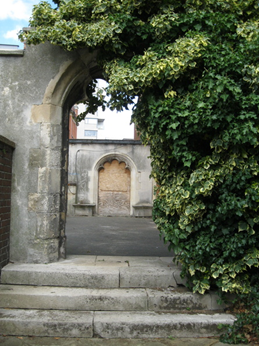
This was quite a recently built church (1880 by George Gilbert Scott Jnr) but was bombed twice in WW11, rendering it completely unusable and demolished in 1957. The only remains of the church are two stone arches and a chapel, now in residential use – great place to live! This pic is from The London Gardens Trust because when I visited, there was a lot of rubbish strewn around this area and I couldn’t take a good photo. The garden itself was well maintained.

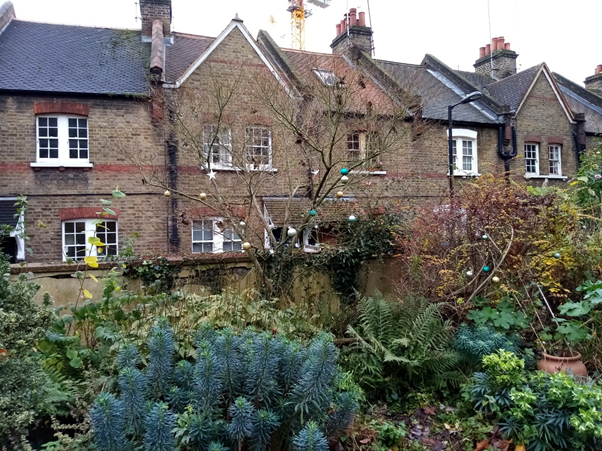
I visited this garden in early December, hence the baubles on the tree. A pretty garden whatever the season.

This garden, in Copper Street, is a couple of streets away from the St Saviour’s Union Workhouse at Mint Street, which is thought to have provided Charles Dickens with the model for the workhouse in Oliver Twist.  When Dickens was young, he was in lodgings nearby and would have passed the workhouse on his way to work, seeing the pauper residents going to work in nearby factories and workshops. He revisited the area much later as a journalist on one of his fact-finding missions to schools, factories and workhouses in poor areas and more than likely would have visited St Saviour’s.*  I wish I’d explored the surrounding streets and got a sense of how the area would have looked in Dickens’ time. Another time, maybe!

Mint Street Workhouse 1920*

* Info and picture from Southwarkheritage.wordpress.com