Yet again, Lockdown has thwarted my plans this month – but last year I visited some beautiful and diverse Nativity scenes in churches and shop windows, both in central London and locally. Doesn’t everyone just love a Nativity scene? Part I are the local ones, Part II, Central London, next month.
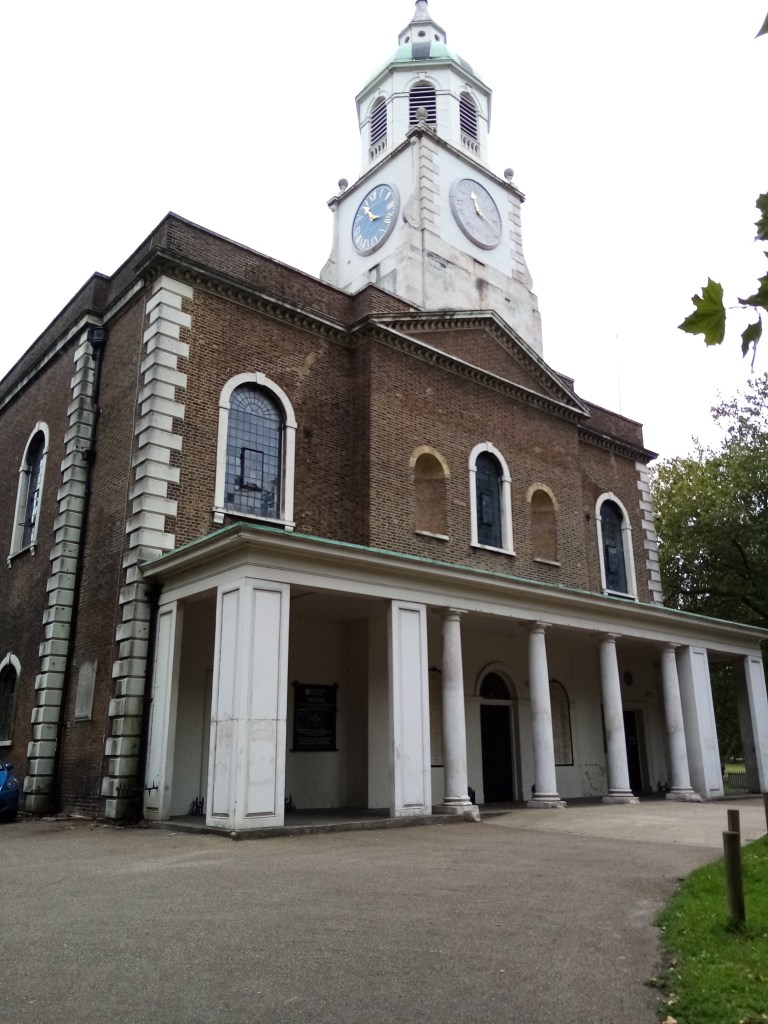
Some churches only put baby Jesus in the manger on Christmas Day, which makes sense, but in this scene, only a cow and a few shepherds are there at the moment. This is because Mary and Joseph are still on their way to Bethlehem (but hang on a minute, the shepherds shouldn’t be there either, they only got there after Jesus was born!) The sign just out of the picture says ‘They’ve not arrived at the crib yet – have a look round the church and see if you can find them on their journey.’ This is at the beautiful All Saints, Carshalton, which I visited again in September in the ‘Open House London’ weekend. By the way. I did look around….and found M and J high up on a shelf!
This is the Nativity in the Oasis Christian Bookshop in Wallington. The shop is a precious local resource as it’s the only independent retailer of its type in the area. The staff are helpful and welcoming, always available for a chat.
The Entertainer is a chain of toyshops which follow Christian principles by not opening on Sundays and giving 10% of their profits to children’s charities around the world. Great to see a Christian retail chain in the UK.
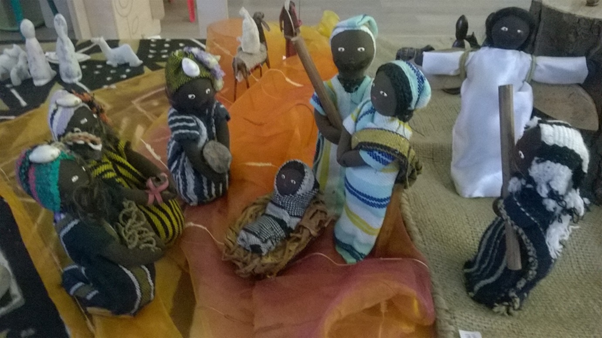
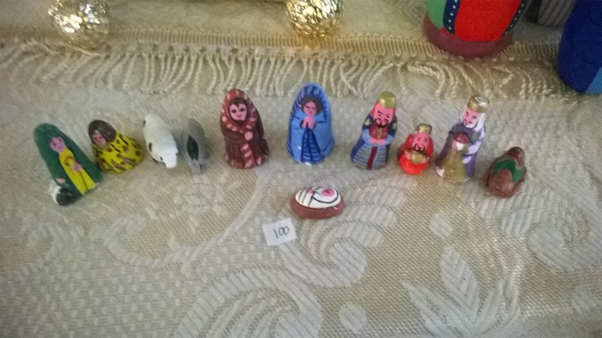
These last pics are from The Salvation Army Church in Carshalton. Just before Christmas they held an Exhibition of more than 100 Nativities from all over the world. Apparently, the church hosts this wonderful display alternate years, I’m so glad it was in 2019 and not this year! Almost impossible to choose my favourites, here are a few…..
Knitted Nativity!
Ceramic Nativity
Russian Doll Nativity
African Nativity
Two tiny Nativities! ‘
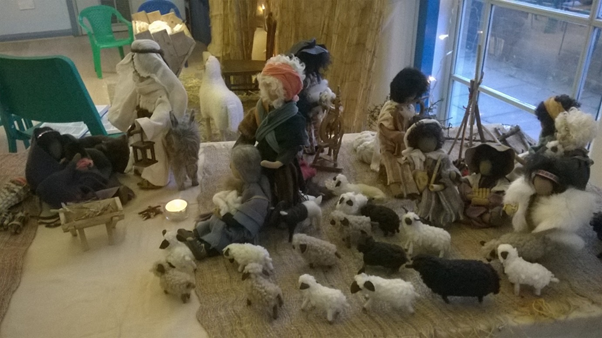
These last two pics are of a Nativity completely hand made by one of the Minister’s Grandparents in Switzerland. Apparently, handmade Nativities are a big thing there! It’s beautifully detailed; there are flocks of sheep, shepherds huddled round a fire and some holding lambs, a king on a camel and some kneeling kings. It would look amazing in any church!
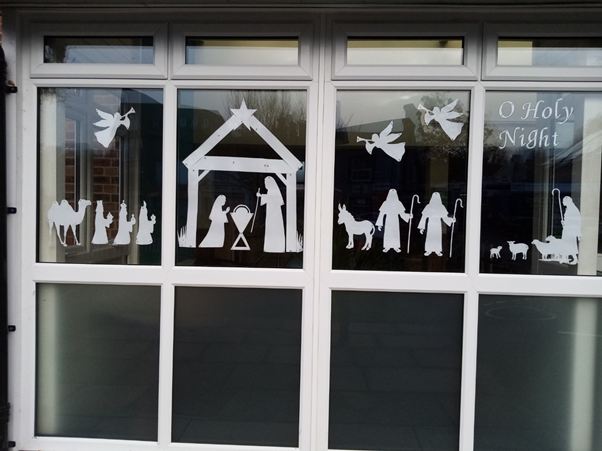
Stop Press, just one more! This paper cut out nativity is on the windows of the Salvation Army in Sutton. The photo was taken on 27th November 2020, I just had to have one from this year!
This month I’ll be looking at London Churches which are traditionally connected with the Arts in one way or another. I’ve visited some beautiful buildings and discovered things about their histories, as well as what they’ve got going on today. Just as well I completed all this before Tier 2 came into force!
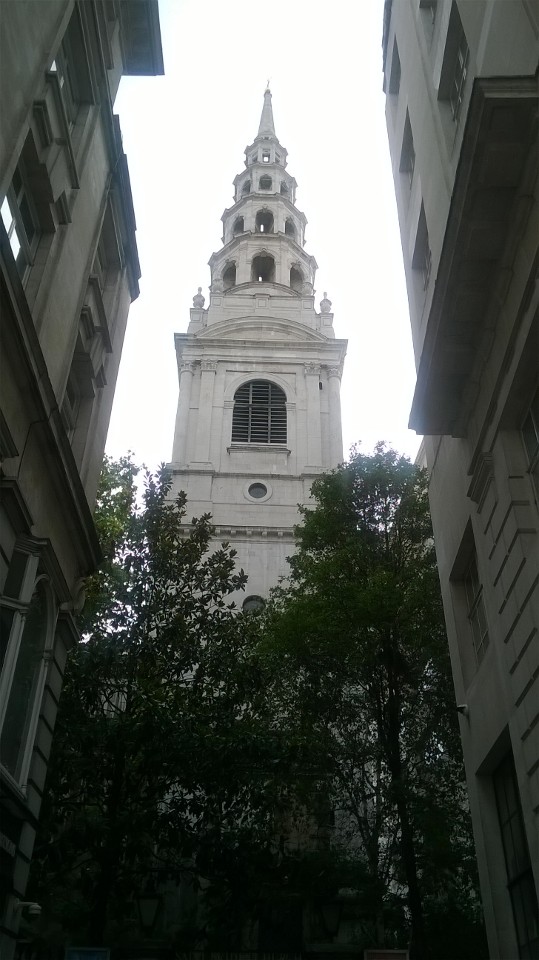
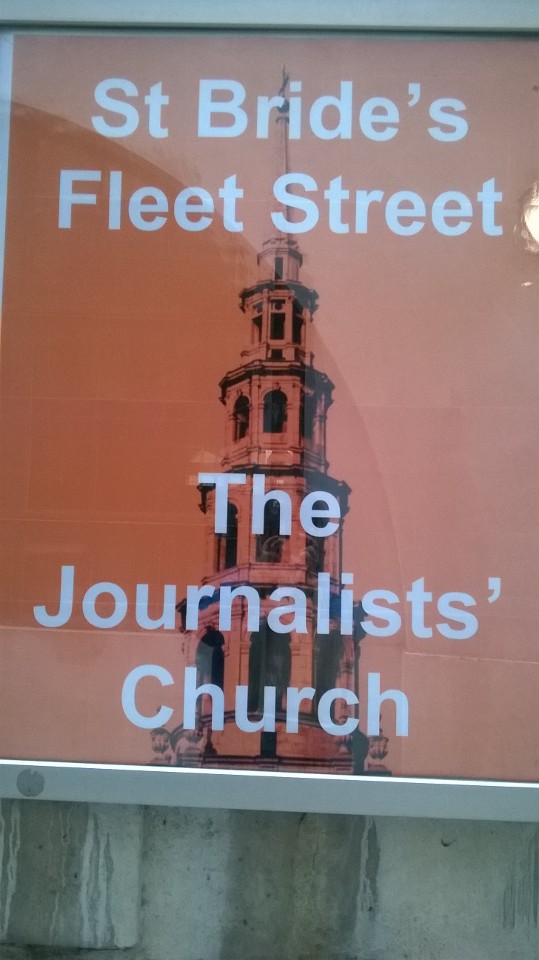
The Journalists’ Church. Situated in Fleet Street, the home of the newspaper and other publications, is St Bride’s Fleet Street. A plaque on the church wall tells us that the brilliantly named Wynkyn de Worde was the first printer on Fleet Street (apparently this was a pseudonym, but it’s pretty good, isn’t it?) Two more interesting things about this church: the present steeple was based on designs of Sir Christopher Wren and constructed in 1703. It’s said to have inspired designs for wedding cakes and is known as the ‘Wedding Cake’ Spire. Thirdly, the current church was built over previous buildings and has passages underneath it going back to the 6th Century. Following an outbreak of cholera in 1854, the tombs in the crypt beneath were sealed up, and when they were reopened after World War 2, a Roman pavement and tombs dating back to Saxon times were discovered. I haven’t done the tour of the crypt, another one for post lockdown!
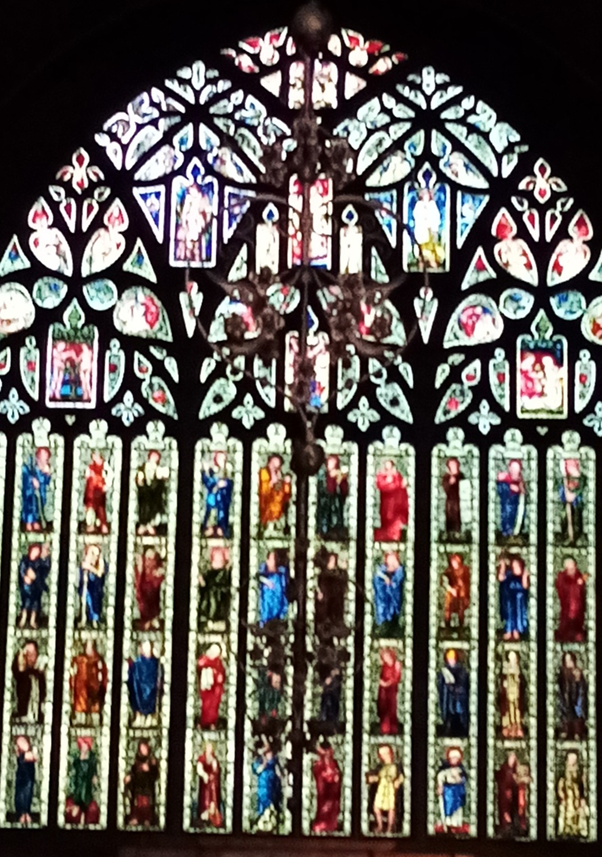
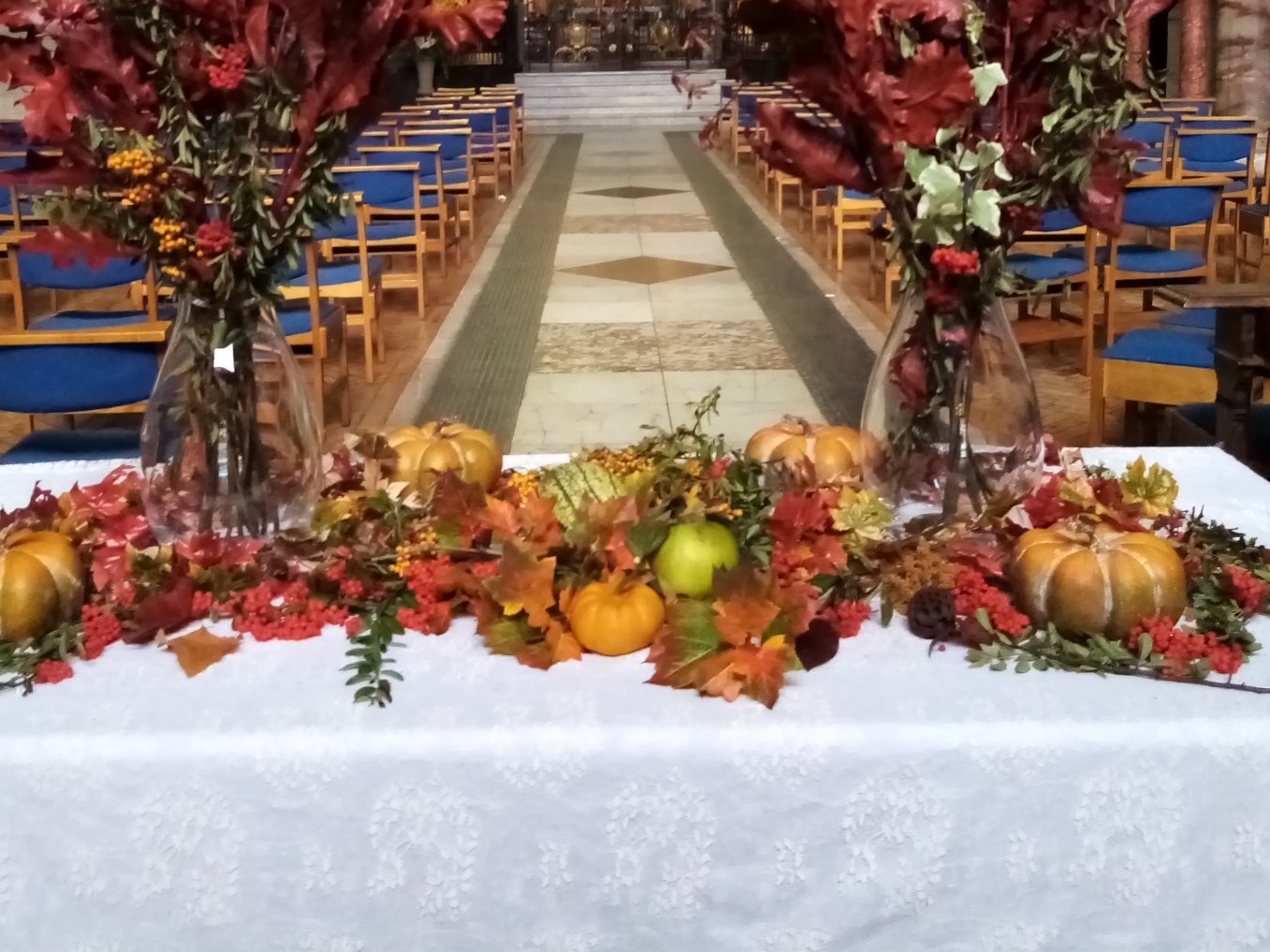
The Arts and Crafts Church – Holy Trinity Sloane Street is so called because of its association with the Arts and Crafts movement of the 1800s. The church was built between 1888 and 1890 in the ‘Arts and Crafts Gothic’ style and has a spectacular stained-glass window designed by William Morris and Edward Burne-Jones, who were creative types: you’ve probably heard of Mr Morris, who was a textile designer, poet, novelist and social activist. Mr Burne-Jones was an artist and designer who designed stained-glass windows in several other cathedrals and churches in England. The window at Holy Trinity is spectacular, comprising Bible characters, Saints, and Bible ‘events’. But my favourites are the panels representing Matthew 25: Visiting the sick, feeding the hungry, giving drink to the thirsty, clothing the naked, visiting the prisoners. Unfortunately, I wasn’t able to get a good photo because visitors to the church were not allowed into the aisles, so I couldn’t get close to the window which was right at the end of the building. But I did get a nice photo of their Harvest display!
My not very good photo!
Jolly Harvest Display
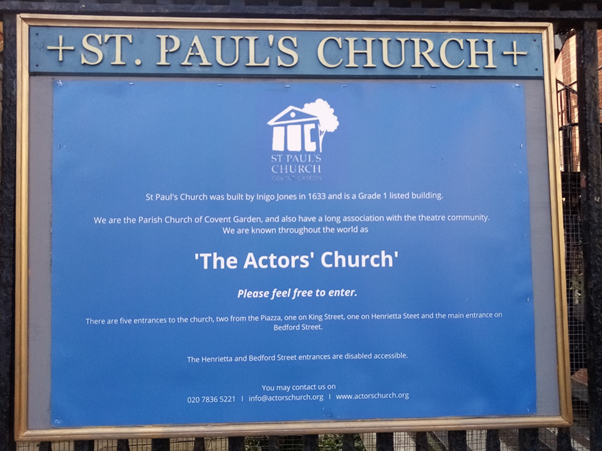
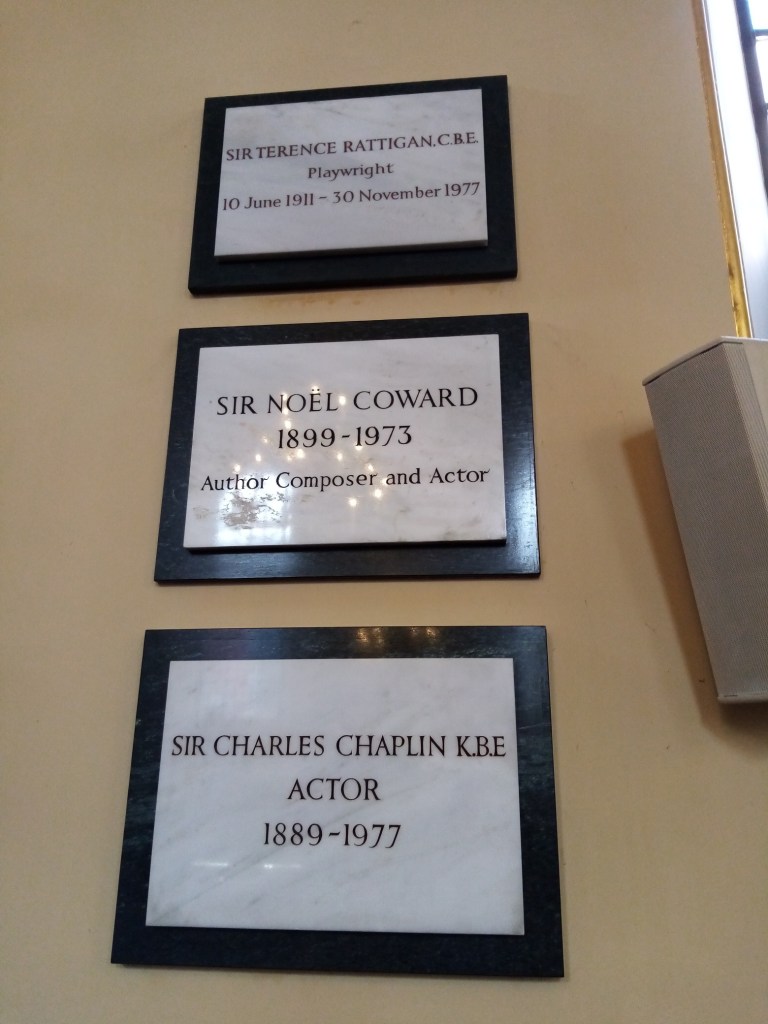
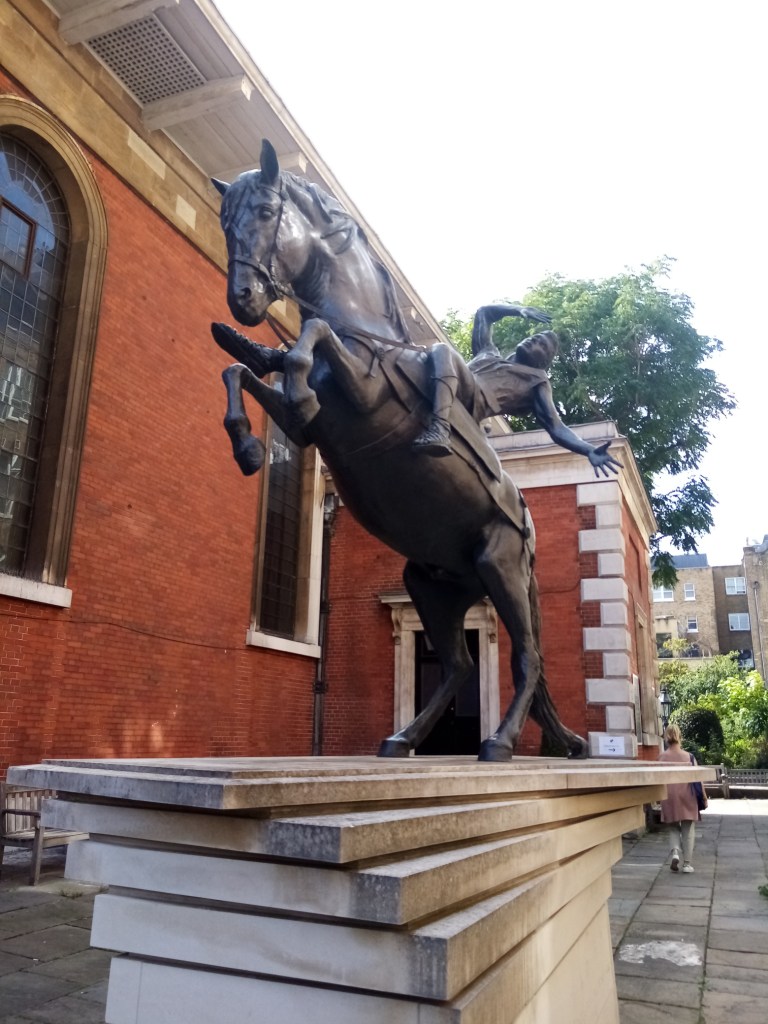
The Actors’ Church. In bustling Covent Garden, home of market stalls, street theatre and outdoor eateries is peaceful St Paul’s churchyard. St Paul’s Covent Garden was designed and built by Inigo Jones, as was the rest of the Covent Garden Piazza, and completed in 1633. It is known as the Actors’ Church because of its long association with the theatrical community. Before you even set foot inside the church, there’s a striking statue of St Paul falling off his horse, having been struck blind by God on his journey to Damascus. The churchyard is beautifully laid out with flowerbeds and trees and is a peaceful place for a lunch break. In pre-Covid times the church runs up to 400 events a year – classical concerts, musical theatre showcases and an outdoor theatre programme in the summer season. Alas, not this year! Inside the church there are dozens of plaques celebrating actors, musicians and other performers, dating back to Marie Lloyd ‘from 1884 the beloved Queen of the British Music Halls.’
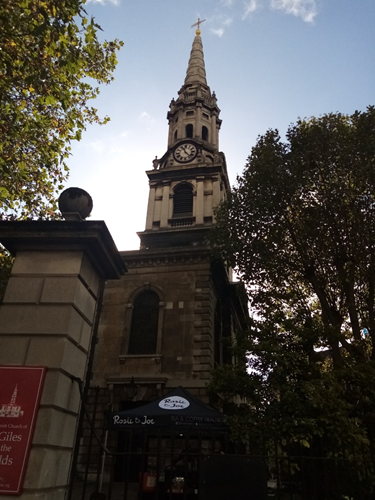
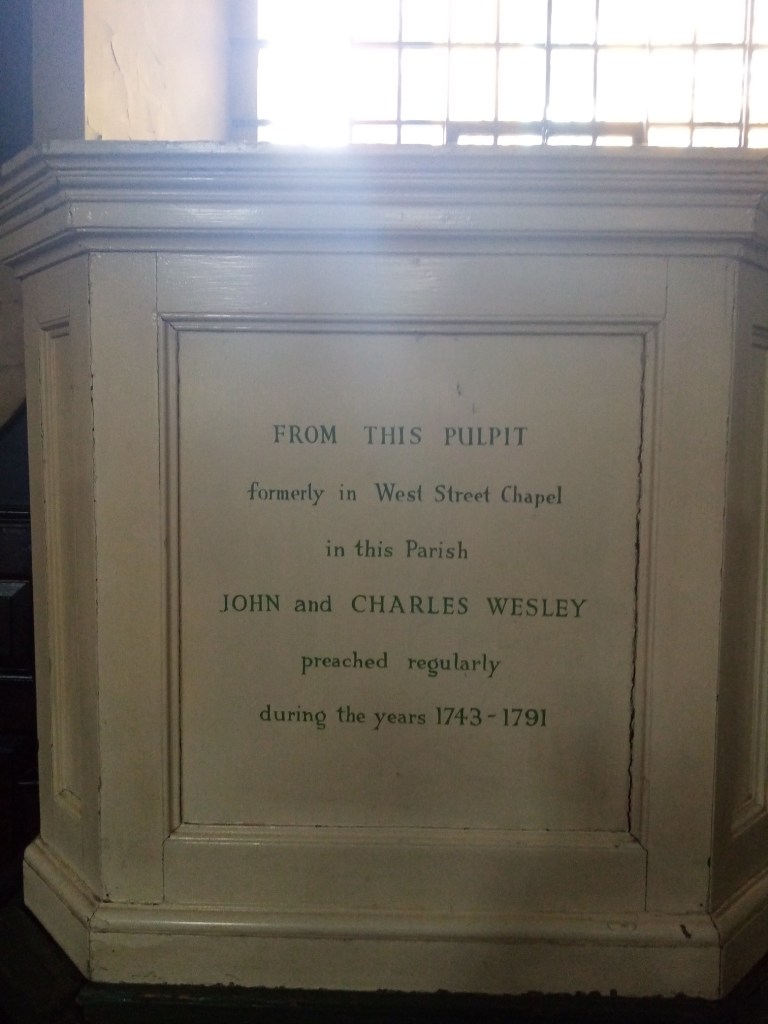
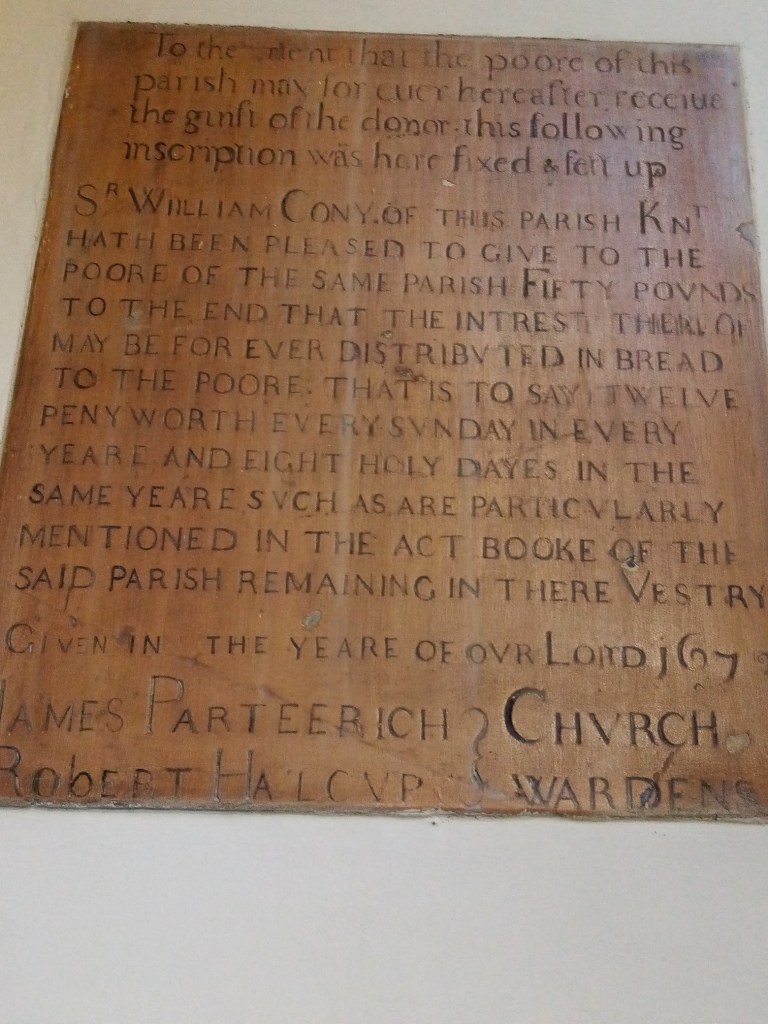
The Poet’s Church, St Giles-in-the-Fields at Tottenham Court Road, is so called because of its poetic links: the wedding of Victorian poets Elizabeth Barrett and Robert Browning, the baptism of John Milton’s daughter Mary, and the joint baptism of the children of Byron and Shelley. There’s also a monument to Metaphysical poet Andrew Marvell, who is buried in the churchyard. (I did the Met poets for A Level English Lit, never really understood them!) And a pulpit used by John and Charles, the Wesley brothers, said to have been rescued from nearby West Street Chapel. The church has a tragic history: the first victims of the 1665 Great Plague are buried here. By the end of the year there were 3,216 listed plague deaths in the church’s parish, out of fewer than 2,000 households. Every home must have had at least one family member who had died. Devastating. The church has a tradition of giving ‘to the poor of this parish’ and this continues to this day, with several projects for homeless people (including a facility for them to store their possessions – what a good idea!), grants for people experiencing hardship and educational grants. Their mission statement says ‘Worship is inseparable from compassion, and prayer, from involvement in the lives of others.’
Incidentally, I found out about the Actors’ Church and the Poet’s Church from Tom Jones’ (not the singer!) book London: the Weekends start here.
This ornate tower is built in the 1730s Palladian style. The pop-up café is more recent!
I don’t know if you’ve noticed the English Heritage Blue Plaques on buildings in London (and elsewhere), commemorating someone’s life or work at that place. I’m going to look at four I’ve found, you will have heard of one of these people, the others probably won’t be familiar, but they were all Christians who changed many peoples’ lives for the better, and hopefully changed the opinions of the politicians and authorities of their day. You might notice that all these people had very posh addresses, but in the 17 and 1800s anyone who had any influence usually had family wealth which enabled them to pursue their Christian/socialist ideals. Admirable, considering many wealthy people just spent their lives in idle luxury, not caring about the plight of those around them or elsewhere in the world.
So, in alphabetical order:
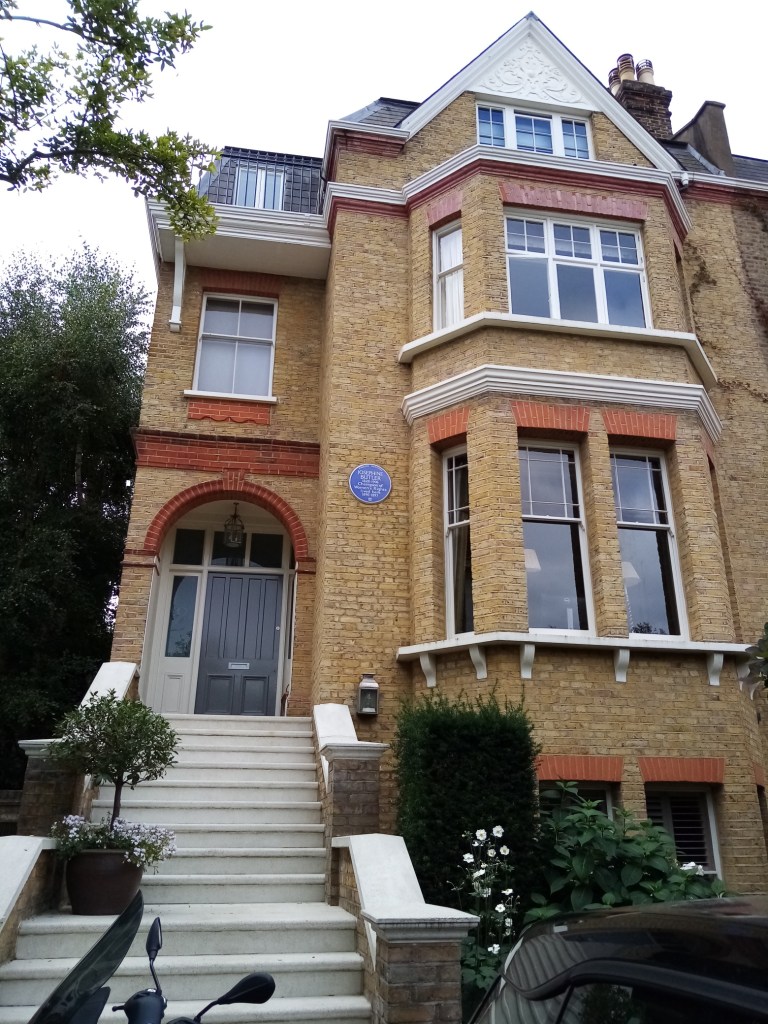
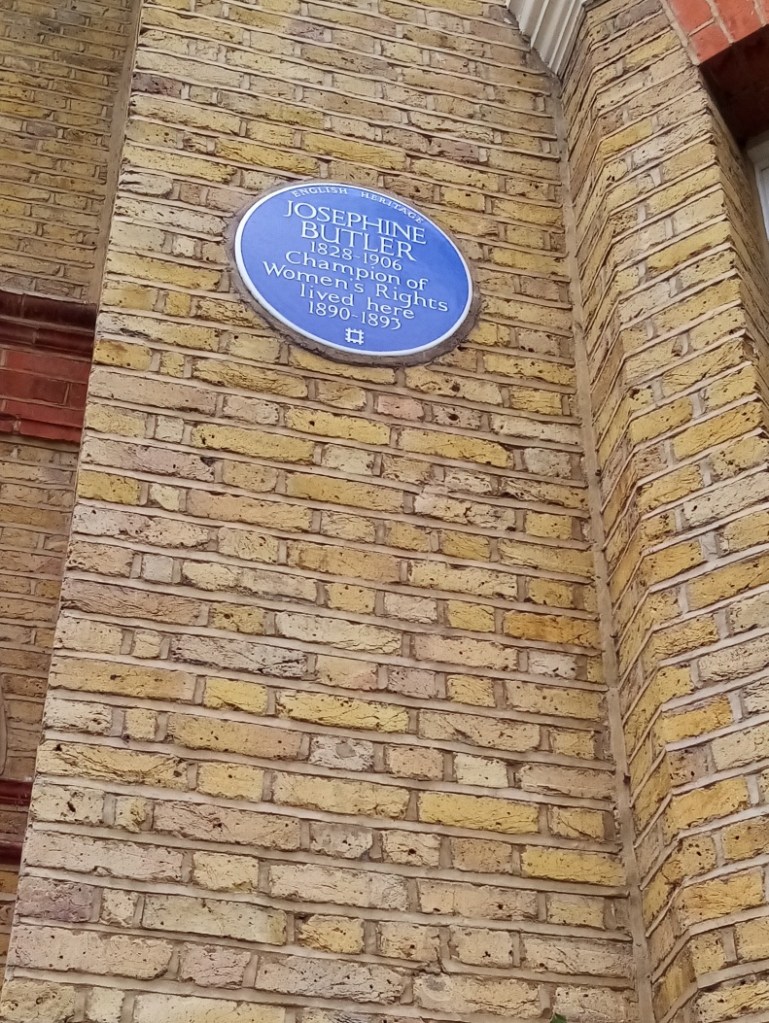
Josephine Butler (1828 – 1906) is described on her Blue Plaque in Wimbledon as a ‘Champion of Women’s Rights’ but she was much more than this. She was a devout Christian and at the same time, a passionate feminist, two things that did not go together in Victorian times! Brought up to a sheltered, privileged lifestyle, she turned her back on a life free from cares and responsibilities to bring the hidden underworld of the Victorian sex trade into the light. She was appalled that teenage girls and young women were kidnapped and sold to brothels, and questioned the double standards of the time, that men seeking sex from prostitutes were ‘sowing wild oats’ or ‘gaining experience’, but the young women they paid for were considered unclean, immoral and denigrated to the lowest station in life. The concept of consent didn’t exist; females were bought and sold as chattels. Josephine helped hundreds of girls and women escape prostitution, being instrumental in the passing of the Criminal Law Amendment Act 1885, which addressed sexual offences against women and minors and fixed the age of consent to 16 years old. Despite her pioneering work for women, Josephine Butler has been criticised by secular feminists for being too ‘Christian’, but for Christian historians she’s too feminist! I think it’s more important to remember her momentous achievements rather than how she’s identified by others. Premier Christianity Magazine comments: ‘she was the most distinguished woman of the 19th Century, but she has vanished from the pages of history.’ Well, now you know!
Josephine Butler’s posh address off Wimbledon Common
I love this portrait of Josephine, it looks so modern. Portrait by George Richmond 1809-1896 Wikimedia Commons File: Josephine Butler.jpg
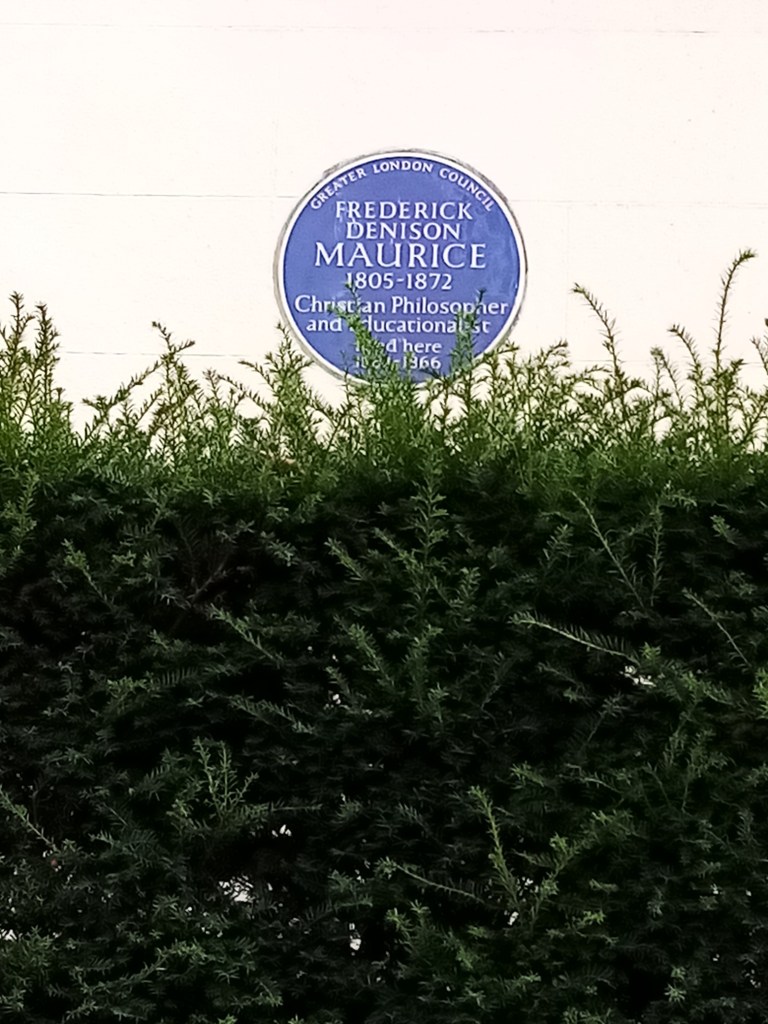
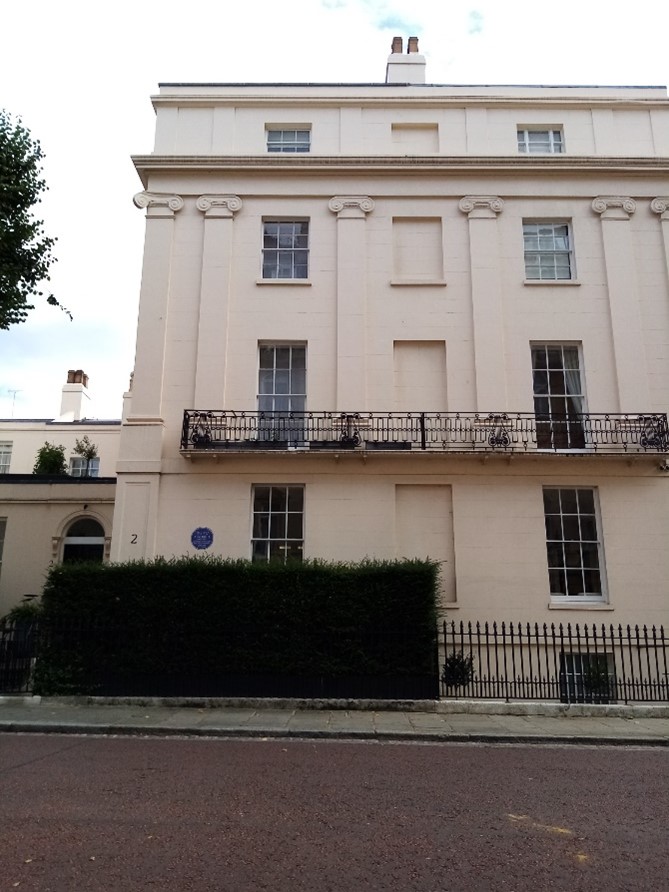
Frederick Denison Maurice (1805 – 1872) His plaque says ‘Christian Philosopher and Educationalist’ and he was prominent in Christian Socialism. He was an Anglican priest, ordained in 1835, and in 1838 he wrote ‘The Kingdom of Christ’, a book about how God’s Kingdom should be here on Earth now, not a Heaven that we go to when we die. A Rob Bell (‘Love Wins’) of his day! Living in London, he said ‘the condition of the poor pressed upon me with consuming force’. Working class men trusted him when they distrusted other clergymen and the church, because of his social action approach. He believed that ‘Christianity rather than secular doctrines were the only sound foundation for social reconstruction.’ From 1848 to 1854, FD was Leader of the Christian Socialists, and he was characterised as their spiritual leader because he was interested in theological aspects rather than just social action. In other words, he wanted to put the Words of Jesus into action. I would have loved to have met him and discussed his work!
FD’s posh address just off Regent’s Park. Nice!
Very early, but very clear, photograph of FD. Photogragh from 1865, original edited in Photoshop CS2, Author Acabasi. Wikimedia Commons File: Frederick Denison Maurice Portrait c1865.jpg
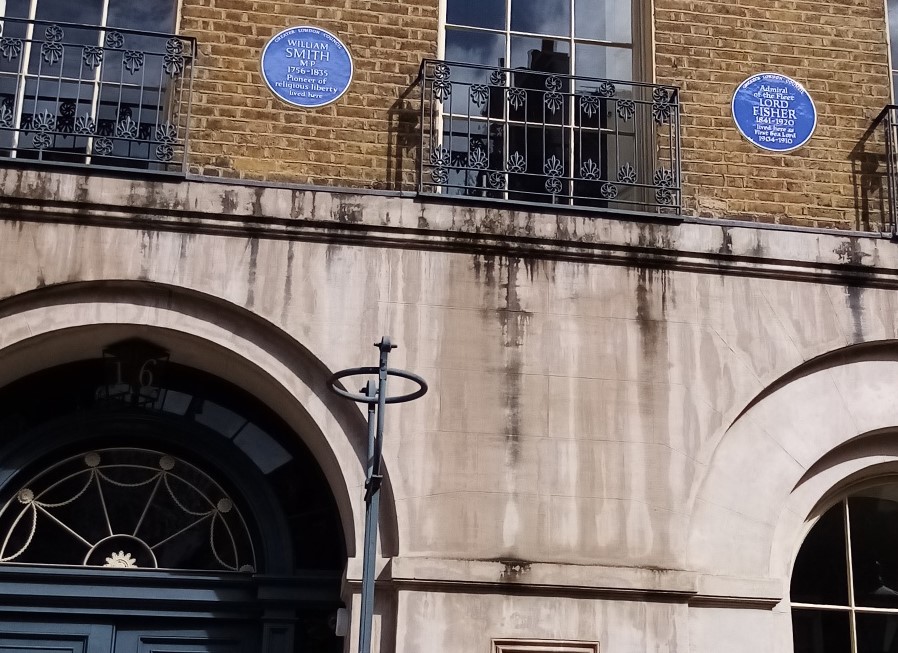
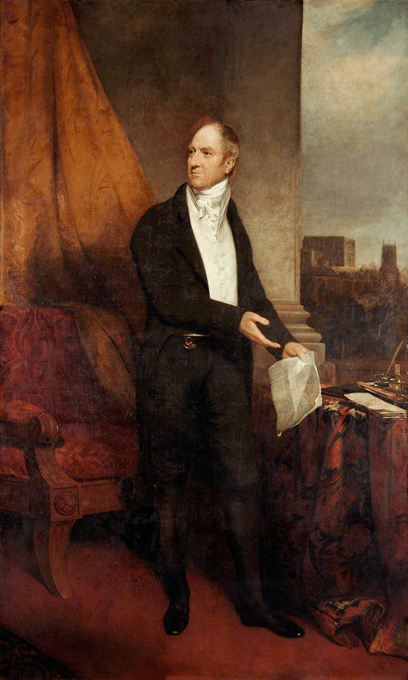
William Smith (1756 – 1835) His plaque says ‘Pioneer of Religious Freedom’, Wiki says ‘William Smith (abolitionist.)’ So which was he? The answer is both: he was an English Dissenter; they were Protestant Christians who separated from the Church of England in the 17th and 18th Centuries because they disagreed with state intervention in religious matters. William was instrumental in bringing political rights to dissenters, imagine not being able to vote because of your religion, that’s so wrong! He was also a friend of William Wilberforce (more of him later) and a member of the Evangelical group, the Clapham Sect, with Wilberforce. This was a multi-denominational group of church leaders and influential, prominent individuals who saw the slave trade as immoral and were in a position to be able to do something about it. The two Williams joined with other Christians of different denominations to campaign for the abolition of slavery in the Americas. Smith was also at the forefront of campaigns for social justice and prison reform, and he also co-founded the London Society for the Abolition of Slavery in our Colonies. Ending the transatlantic slavery trade was just the beginning, the fight would continue to free the slaves in the Southern States of America and the West Indies. Interesting fact: William Smith was the grandfather of Florence Nightingale. She turned out to be considerably more famous than him!
William shares his posh address in Queen Anne’s Gate, St James Park, with Admiral of the Fleet, Lord Fisher.
Portrait looks very posed, but I suppose that’s how he wanted it! Portrait by Henry Thompson, English Portrait painter 1773-1845 Wikimedia Commons File: William Smith Thompson.jpg
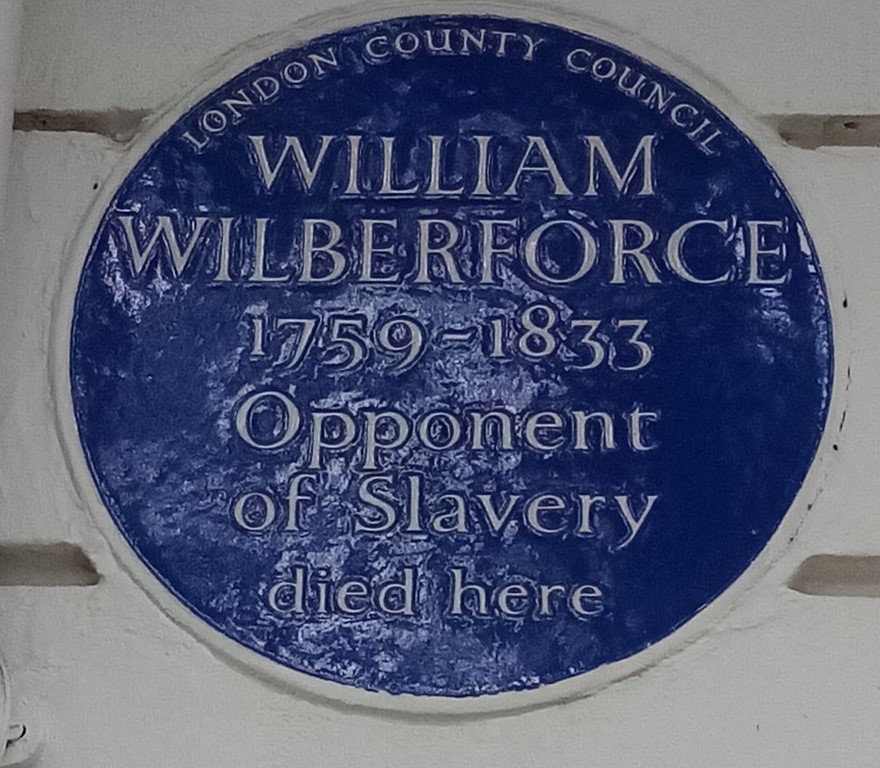
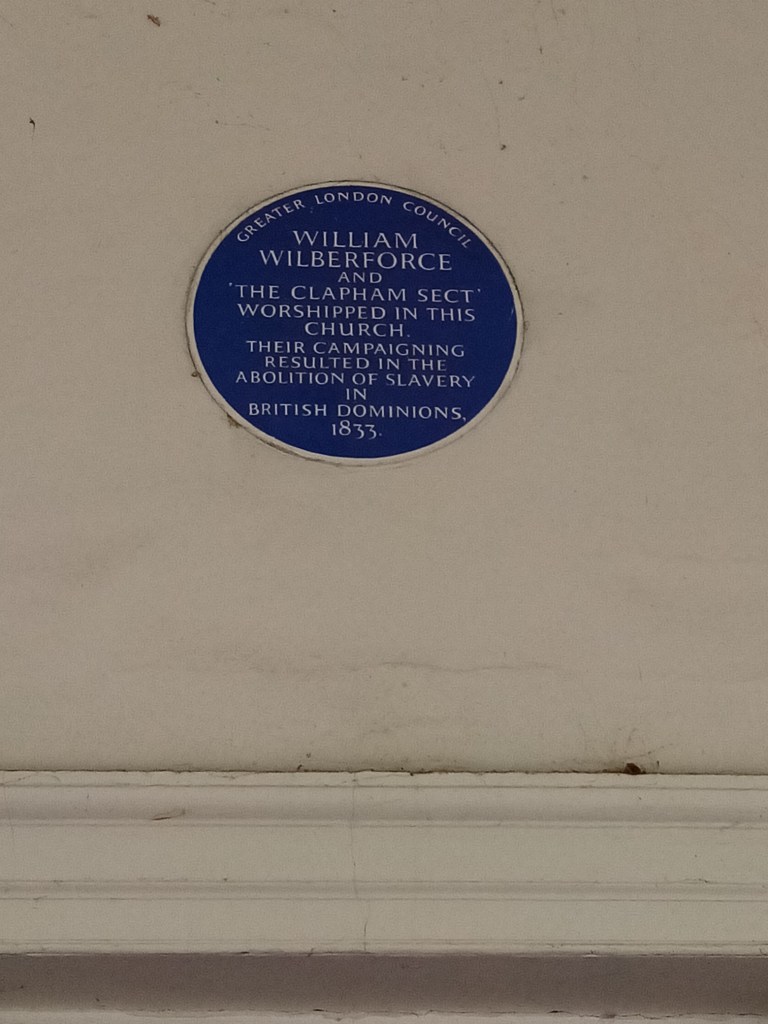
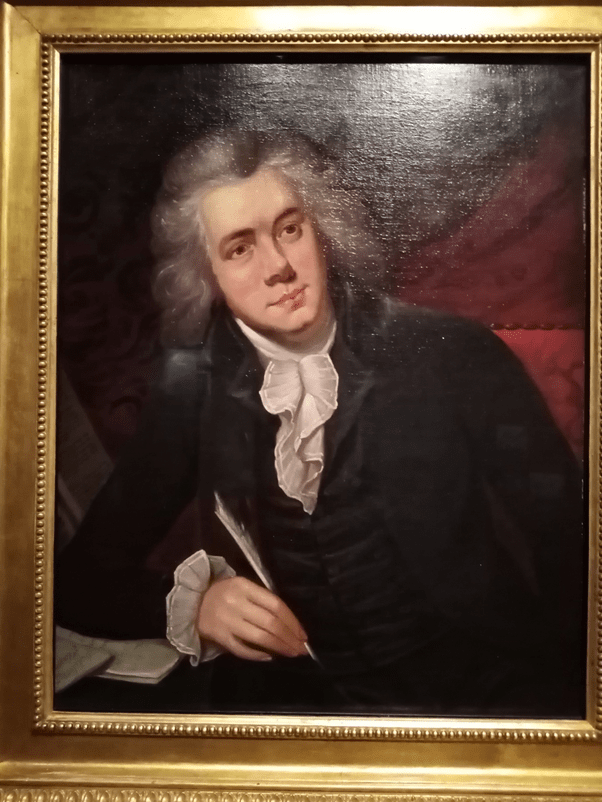
William Wilberforce (1759 – 1833) entered politics as an Independent candidate in 1784 and following a dramatic Christian conversion in 1785, decided to dedicate the rest of his life to the service of God. He initially thought of leaving politics and taking up church ministry but was counselled by friends John Newton and William Pitt (the future Prime Minister) to remain, arguing that he could have more influence as an MP. They got that right! Wilberforce became involved in the Abolition of the Slave Trade following a meeting with some influential activists who were horrified by the cruel treatment of African slaves by colonial plantation owners in America and the West Indies. They encouraged him to bring the case for abolition to Parliament, but Wilberforce felt he was ‘unequal to the task allotted to him,’ there being massive opposition from slave owners and British businessmen. As we’ve lately become more aware, so much of Britain’s wealth was built on the slave trade, and many people in the 17 and 1800s had a vested interest in continuing the slavery industry. Wilberforce gets all the credit, but it’s important to remember that a diverse group of hundreds of people were involved in the movement: Quakers, Anglicans, Evangelicals, like minded businessmen, titled men and women, and former slaves – and even former slave owners! Wilberforce’s poor health forced him to hand over the leadership of the campaign to the even more radical Thomas Fowell Buxton in 1825. On 26th July 1833 Wilberforce heard that passing of the Bill for the Abolition of Slavery was guaranteed; he died three days later. The actual Act was passed into law one month later in August 1833. At least he lived long enough to know!
Posh address: Cadogan Place, Chelsea, and Plaque at Holy Trinity, Clapham
Portrait of Wilberforce in the Museum of London Docklands, and Holy Trinity Clapham
Did you know there are at least six cathedrals in the capital? I say at least, because there were 4 I knew about, then I discovered a fifth, then a sixth! Who knows how many more there are? Of the five I’ve visited, three are Catholic, two are Church of England, three are North of the River, two are South. You probably know at least one of them….
Before I start, some facts about cathedrals. They differ from abbeys and priories in that they provide a place of worship but are not religious communities occupied by monks or nuns. The word Cathedral is from Latin: cathedra, meaning chair and it’s where the Bishop has his seat or throne. Most cathedrals were either formerly churches or built on the site of a church and some have histories of over 1,000 years.
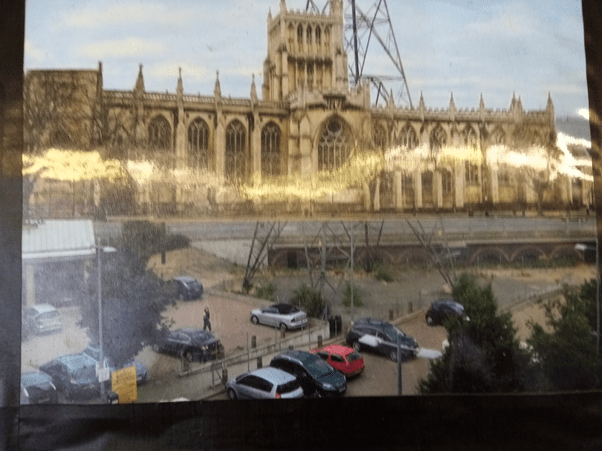
South of River, right next to London Bridge is Southwark Cathedral. There has been a religious building here since AD606: firstly, a convent, then in 1106, a priory, in 1540 a parish church, and finally in 1905 it was consecrated as a cathedral. The current building is in the Gothic style (the 12th Century bits) and Gothic Revival (the 19th Century bits). The original church was called St Saviour and then St Mary Overie, which means Over the River. The reason for the third name change is that it’s the Anglican Mother church of the Diocese of Southwark (which covers Sutton, incidentally). The cathedral is used by King’s College for its medical degree ceremonies because the nearby St Thomas teaching hospital used to be an infirmary attached to the building when it was a priory, 900 years ago. What a great tradition and heritage!
I had to get the Shard in the background!
This is genuine Medieval Graffiti
Showing its Gothic side
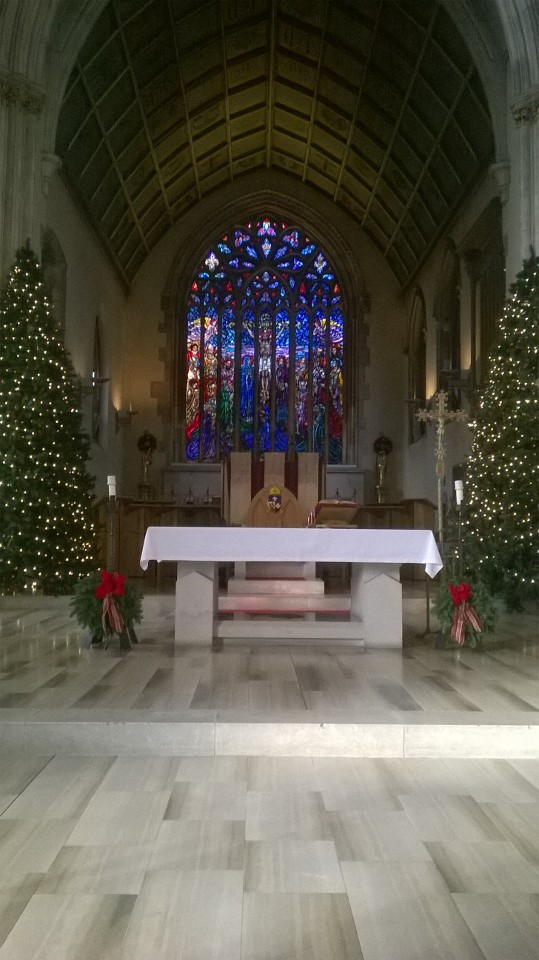
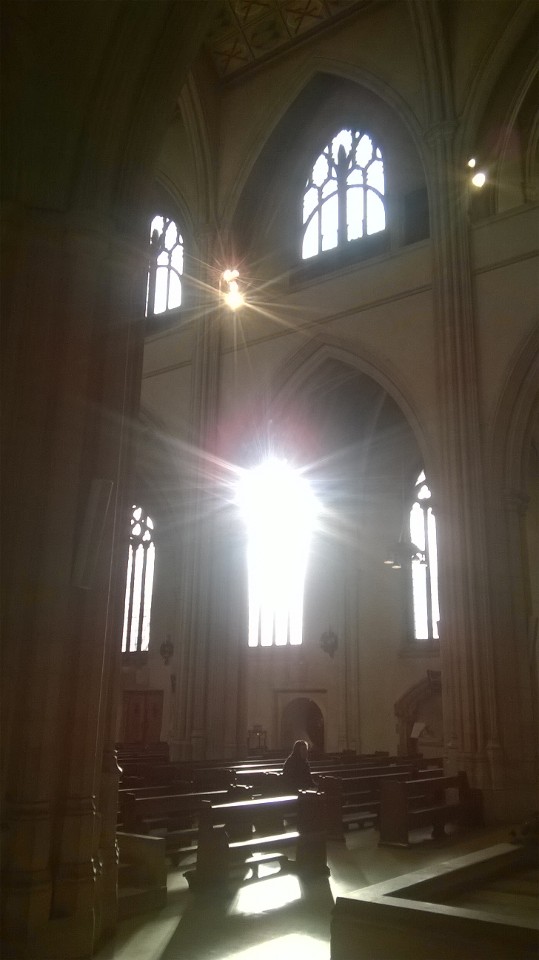
Also South of the River is the Roman Catholic St Georges Cathedral, situated close to the Imperial War Museum, well worth a visit even if you’re not a fan of war. The cathedral is a relative newbie, built in 1848. It was severely damaged by incendiary bombs in World War II and there’s a wonderful picture of a priest walking through the bombed-out shell of the building on Wikipedia (I can’t show it because I’d need permission, but you can look it up yourselves.) The cathedral was redesigned and rebuilt by the brilliantly named Romilly Craze in a 20th Century Gothic Revival style (of course, what else?) There is a Spanish Mass to serve the large Latin American community and the cathedral is involved with several projects in South America and Africa. The Southbank University holds its graduation ceremonies here. I love the modern smooth stone look of the interior, there’s probably a technical word for this.
I visited just before Christmas last year on a beautiful sunny day
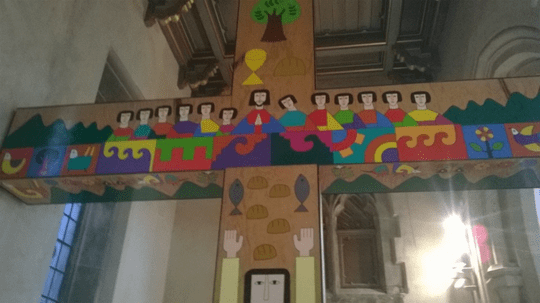
And I love this cross
The iconic, instantly recognisable St Paul’s Cathedral is situated at the highest point of the City of London, Ludgate Hill. The present building dates from the late 17th Century and was designed and built by Sir Christopher Wren in the English Baroque style. The earlier 1087 Gothic cathedral was destroyed in the Great Fire, and interestingly, before the Fire, Wren was commissioned to simply repair Old St Paul’s which had been damaged in the English Civil Wars. But he ended up building a whole new one, to a completely new design! The cathedral escaped major damage in World War II while other buildings around it were reduced to rubble. and there is another atmospheric photo of the dome shrouded in smoke but still standing, which you can find on Google Images. A church dedicated to St Paul was built on or near the site in AD604 as the seat of the new Bishops of London. Bishop’s seat, cathedra, remember? A personal connection – when I was eight, my Dad took me and my sister to visit St Paul’s and I climbed a vertical ladder right into the gold cross at the very top. That hasn’t been allowed for years!
From the Millennium Bridge, an optical illusion because the Cathedral doesn’t look like it’s on a hill
This shows the contrast between the ultra-modern Salvation Army Headquarters and the centuries-old cathedral.
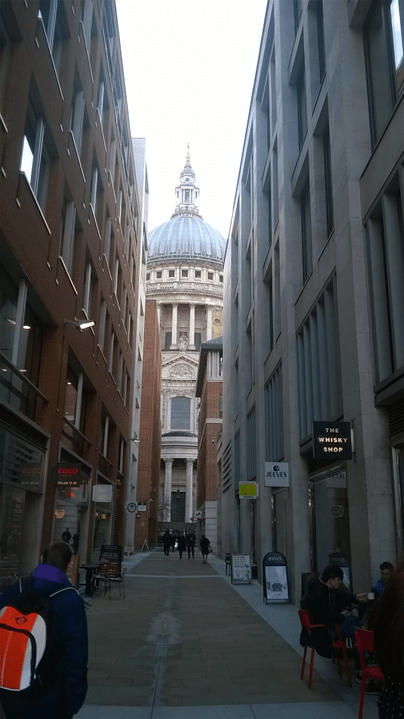
I took this photo of the Cathedral at the end of an alley because this might not be too far from how it would have looked in the crowded narrow streets of the 17th Century (minus the coffee shop and The Whiskey Shop….or perhaps with the coffee shop and The Whiskey Shop!)
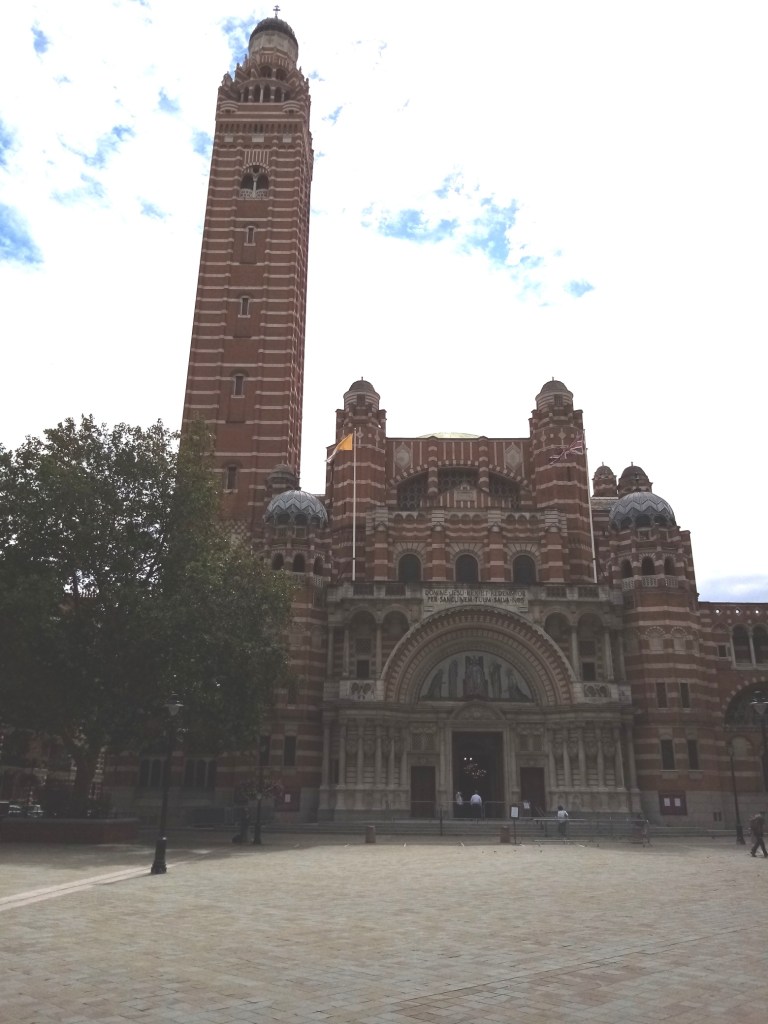
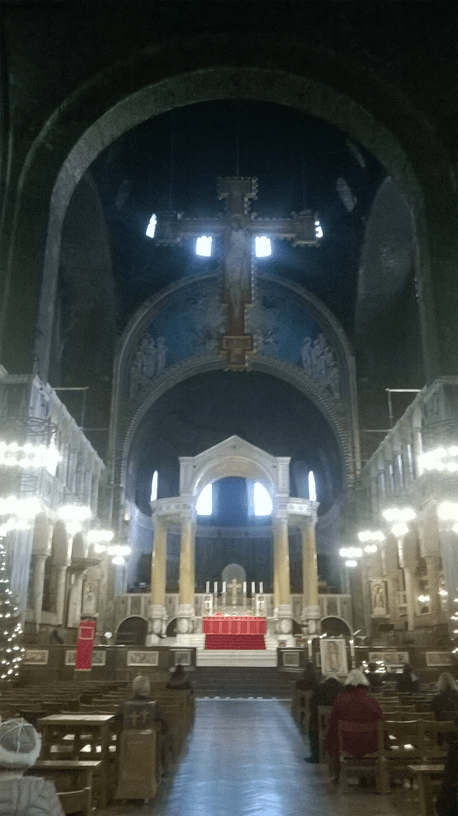
Just a stone’s throw from Victoria Station is Westminster Cathedral. Tourists (and Londoners) confuse this Roman Catholic Cathedral with the much older and larger Westminster Abbey. The cathedral was constructed between 1895 and 1903 and was built roughly on the footprint of the former New Bridewell Prison. The large site allows for a spacious Cathedral Piazza and the cathedral is the largest Roman Catholic in England, the seat of the RC Archbishop of Westminster. It was built in the Neo-Byzantine Style and is very striking, inside and out. You can pay £6 to travel by lift to the top of the 87m (284ft) tower, for great views over London but there’s no charge to visit the main building. The interior is striking because the decoration only goes halfway up the walls. Apparently for reasons of economy, the decoration had hardly been started before the cathedral was consecrated in 1910 and a lack of funds meant it was never finished. The outside is striking because of the dramatic frontage and because it’s beautifully stripy!
The impressive frontage with stripy tower
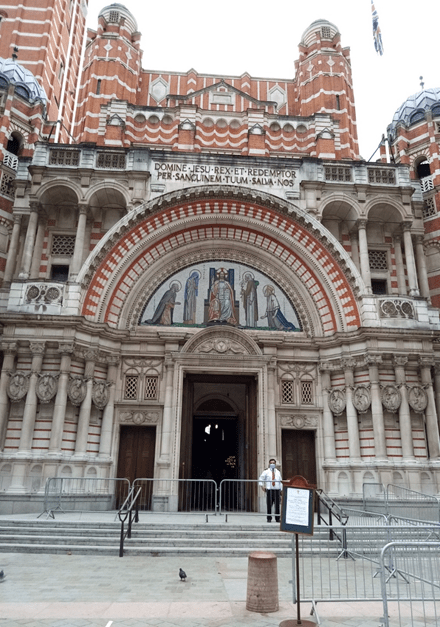
The inscription translates ‘Lord Jesus, King and Redeemer, heal us through your blood’.
The High Altar. You can just make out the black top half of the walls
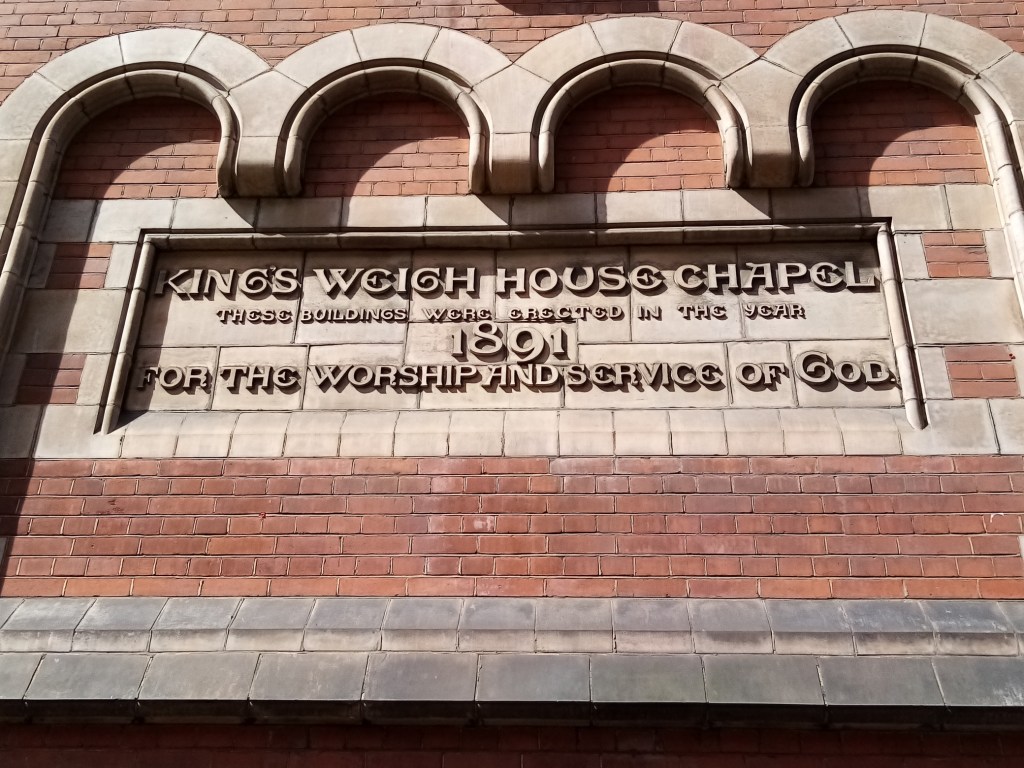
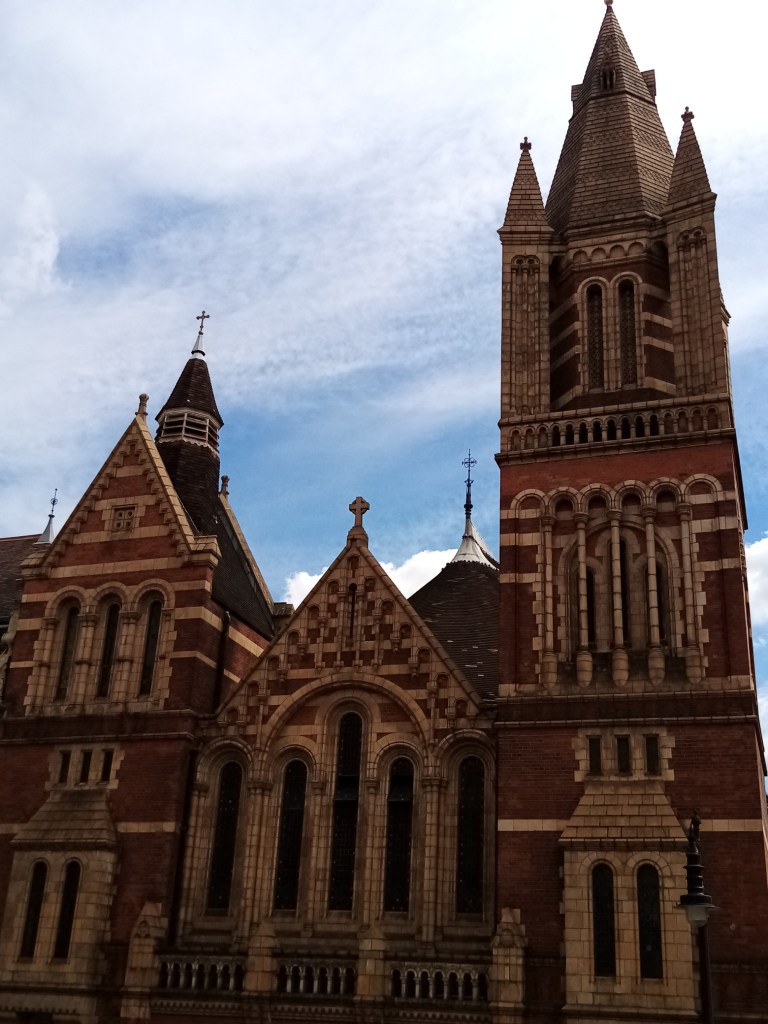
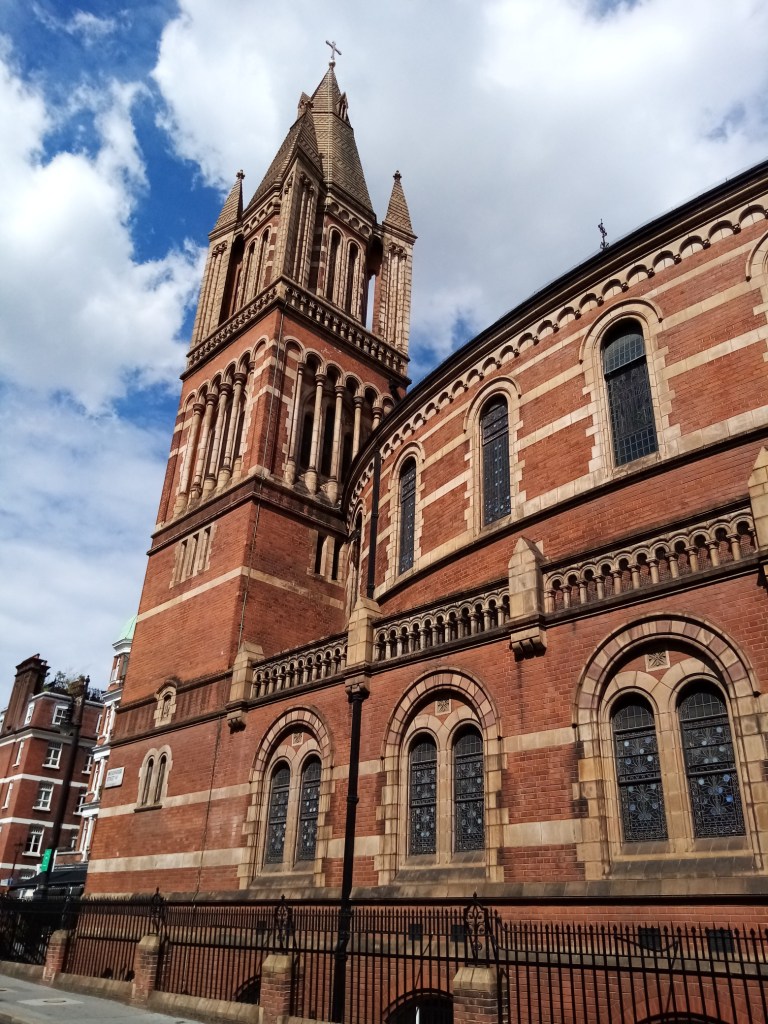
The Ukrainian Holy Family Catholic Cathedral is located just behind Oxford Street, I wonder how many shoppers realise it’s there! It was built in 1891 by architect Alfred Waterhouse in the Romanesque Revival style and was formerly the Congregational King’s Weigh House Chapel. The Congregationalists sold it to the Ukrainian Catholics in 1967 and it became their headquarters. It might seem too large a building for one immigrant nationality group but there are have been large Ukrainian communities in London and Manchester since the late 19th Century. The curious thing about the building is that there is absolutely nothing to indicate what the building is used for: no notice board, posters, signs on the doors. Behind the locked iron gates were the familiar Covid-19 H &S notices, in English and Ukrainian, but nothing about services or activities. The other interesting thing is its strong resemblance to Westminster, a similar stripyness! (Spellcheck doesn’t know that word, by the way.)
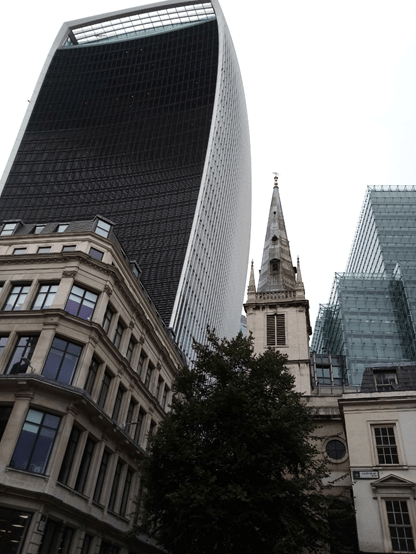
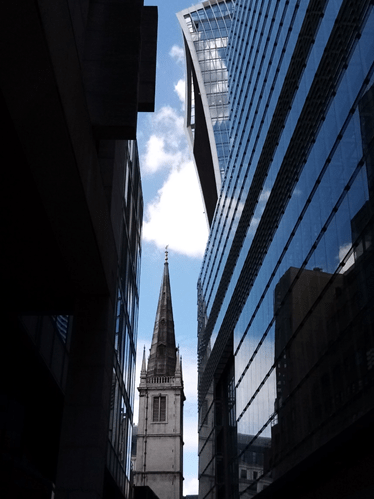
These might not be popular with everyone, but I love these buildings! And most of all, I love the stark contrast between their 21st Century looks and the medieval and classical designs of the city churches. As mentioned in previous posts, I love the way the Walkie Talkie (the squarish one) peeps into my pictures, so, as I still can’t go inside churches yet, I thought I’d try to get some photos of churches with these big boys lurking in the background. It was quite a challenge to get the right shots. Here are four for July, plus a couple of other interesting ones. Information about all the buildings mostly obtained from Wikipedia*
St Margaret Pattens and the Walkie Talkie
Hard to believe that 100 years ago the church would have been the tallest building!
St Margaret Pattens: Founded 1067, rebuilt by Sir Christopher Wren 1686 – 1688. The original church was destroyed in the Great Fire, but this one was not damaged in the Blitz. The name is probably derived from pattens, wooden-soled overshoes which people wore in the muddy London streets. But why name a church after shoes? Because it has associations with the Livery Company, the Worshipful Company of Pattenmakers. The church is designated a Grade 1 listed building as are all the City churches, meaning that they can’t be demolished or altered in any way, inside or out.
The Walkie-talkie: 20 Fenchurch Street, completed 2014, Architect: Rafael Vinoly. Architectural Style: Neo-futurism. Floor Count: 35, plus the 3 storey ‘Sky Garden’ which is free to visit, but you have to book in advance. There’s a restaurant and coffee bars and a lovely garden of tropical plants, plus panoramic views of London. The building was originally proposed to be 200m tall (it’s actually 160m) but there were concerns about its visual impact on St Paul’s and the Tower of London. Even after its height reduction there were complaints from heritage groups, resulting in a public inquiry but this ruled in the developers’ favour and in 2007, full planning permission was granted. In 2015, the Walkie Talkie was awarded the Carbuncle Cup for the worst new building in the previous 12 months. What do you think?
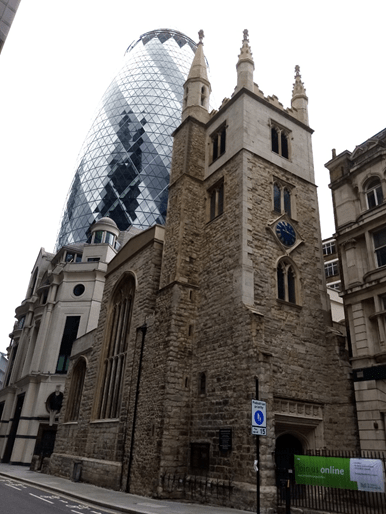
No 1 St Andrew Undershaft and The Gherkin
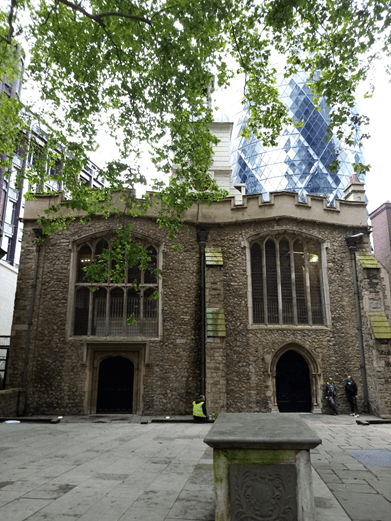
No 2 St Helen Bishopsgate and The Gherkin
St Andrew Undershaft: founded in 1147, survived both the Great Fire and the 1940s Blitz. The current church was built in 1532, I would LOVE to have seen the surrounding streets in those days! Its name comes from the shaft of the maypole which was set up in Spring each year opposite the church for Mayday revels. It was removed and destroyed in 1547 by a mob who saw it as a ‘pagan idol’.
St Helen Bishopsgate: founded in 1210 as a nunnery, St Helen of the Benedictine Order. The church also survived the Fire and the Blitz but in both 1992 and 1993 the church was badly damaged by IRA bombs set off nearby, including the destruction of all the stained-glass windows. Since then the church has been restored and improved: ‘a more flexible, open space, lighter than ever before and yet retaining all its ancient grandeur.’ So it says on their website, I’ll have to go inside when we’re allowed again!
The Gherkin: 30 St Mary Axe was the former site of the Baltic Exchange which was completely destroyed by that IRA bomb in 1992. Completed in 2003, Architect: Foster + Partners, Architectural style: Neo-futurism. Floor count: 41 storeys. Originally the London Millennium Tower was to occupy the site, which would have been the tallest building in Europe, but Heathrow Airport objected to the disruption that such a tall building would have on their flight paths. A word about the street name: St Mary Axe was a church demolished in 1561 and the name derives from the being associated with the Worshipful Company of Skinners who used axes in their trade. The sign of the Axe was said to have been present over the church. Further interesting fact: true Londoners pronounce the street name ‘Simmery Axe.’!
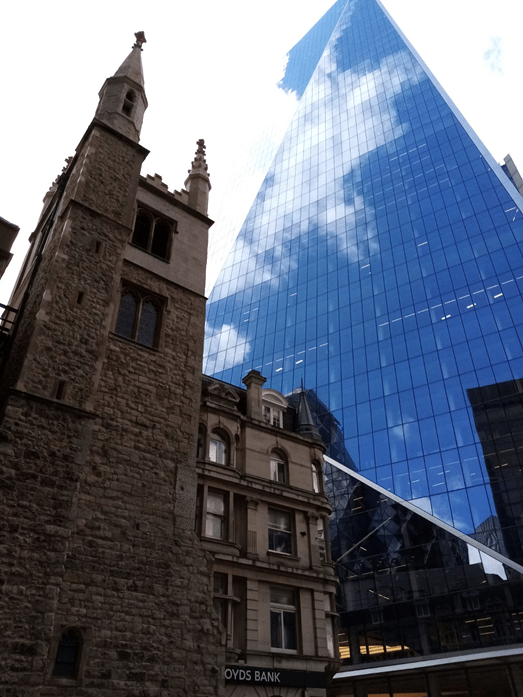
I like this picture of St Andrew Undershaft and the Scalpel. The Gherkin can just be seen reflected in its windows
The Scalpel: 52 Lime Street, is built on a site formerly occupied by Prudential House and Alianz Cornhill House. Completed in 2018, the architect was Kohn Pedersen Fox and the floor count is 38. No architectural style cited but I’m guessing neo-futurism. The name ‘Scalpel’ was coined by the Financial Times due to the building’s ‘distinctive angular design’. This building has a pointed top but also a dark triangular roof lower down, which if seen from the train on a sunny day, looks like a ‘play’ button! Lime Street is also home to the distinctive Lloyds of London building (and also it appears, a local Lloyds branch!)
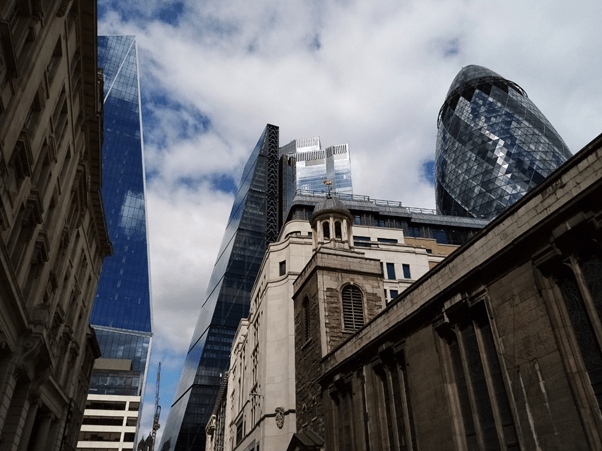
St Katherine Cree (in the foreground) has the distinction of being photo-bombed by three modern skyscrapers!
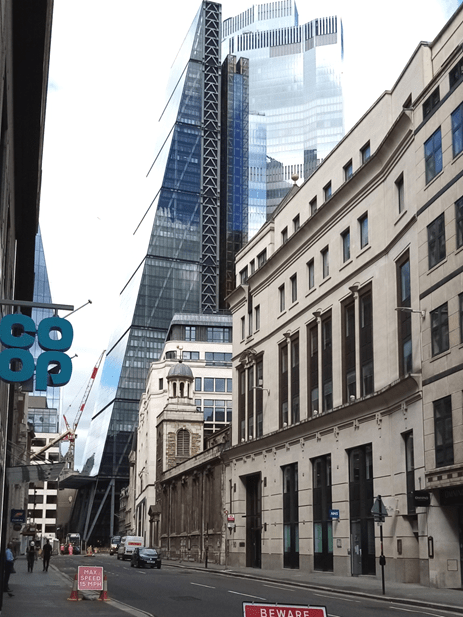
St Katherine Cree and the Cheesegrater
St Katherine Cree: Founded in 1280, replaced by this Jacobean building in 1628, the name derives from ‘Crichurch’, an abbreviation of Christchurch. This is a guild church, rather than a parish church, designated by an Act of Parliament, no less, to ‘serve and minister to the non-resident, daytime population of the City’. There are several of these churches and this one is the Guild Church to Finance, Commerce and Industry, not surprising really. In practice, this means that the church is open on weekdays offering on different days, Holy Communion and prayer for healing, Bible study, talks with church wardens, a ‘Not on a Sunday’ service, and Lloyd’s choir practices. At the present time, some off this is being offered online, according to the notice board.
The Cheesegrater: 122 Leadenhall Street, also known as The Leadenhall Building. I walked right underneath this without realising what it was, easily done. Completed in 2013, architect Rogers Stirk Harbour + Partners. The floor count is 48 and the architectural style is post-modern structural expressionism, looks neo-futurism to me. It is said that the City of London’s Chief Planning Officer, Peter Rees, on seeing a model of the concept ‘told Richard Rogers I could imagine his wife using it to grate parmesan’. Not ordinary cheddar, mind. As the Gherkin and the Shard had already been given nicknames, The Cheesegrater continued the trend. It makes Tower 42 sound boring, doesn’t it?
2 Extras:
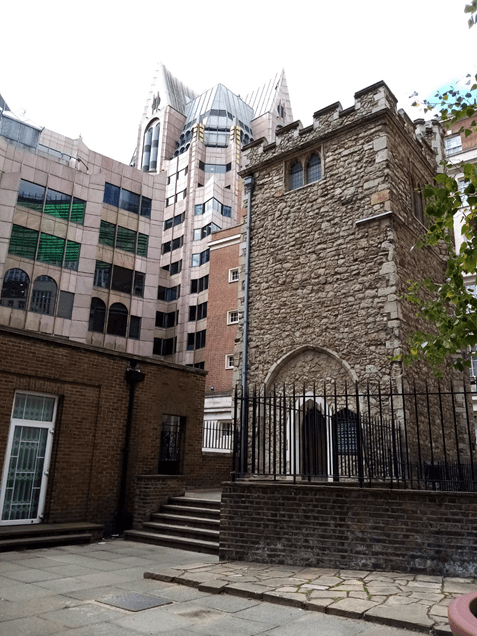
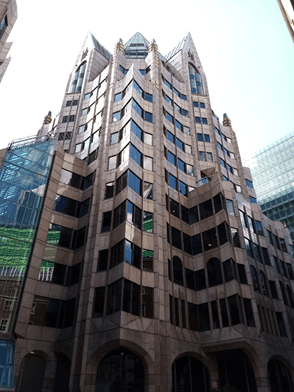
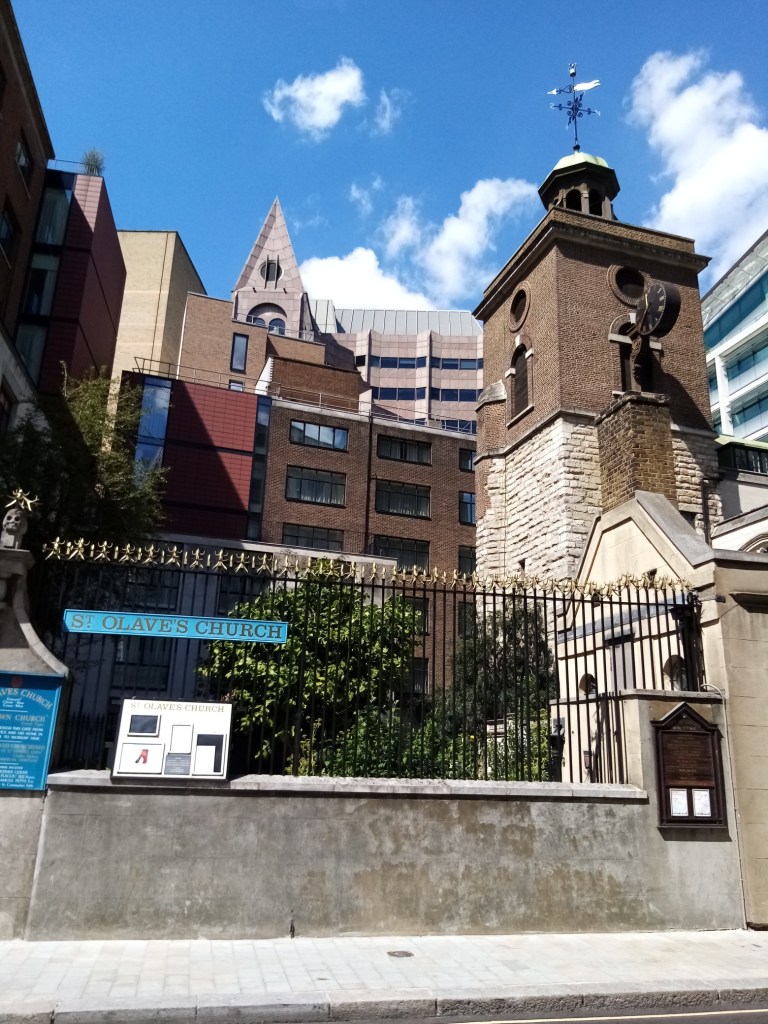
St Olave’s and Minster Court
Better views of Minster Court and St Olave’s Church
Minster Court: Three buildings onMincing Lane and Mark Lane. Completed in 1992 and designed by architects GMW Partnership, it has been described as post-modern gothic. Personally, I don’t like it, but it certainly has a dramatic, Gotham City look to it. The exterior was used as Cruella De Vil’s haute couture fashion house in Disney’s 1996 live action remake of 101 Dalmatians, and No 3 Minster Court is the offices of the London Underwriting Centre.
St Olave’s Hart Street: This little church has a literary history, being the burial place of diarist Samuel Pepys and his wife, who worshipped here, and named by Dickens as ‘one of my best beloved churchyards.’ The poet John Betjeman described St Olave’s as ‘a country church in the world of Seething Lane’ (a nearby street.) The present building is 1450 and described as ‘Perpendicular Gothic’, although it doesn’t seem to bear any resemblance to post-modern gothic!
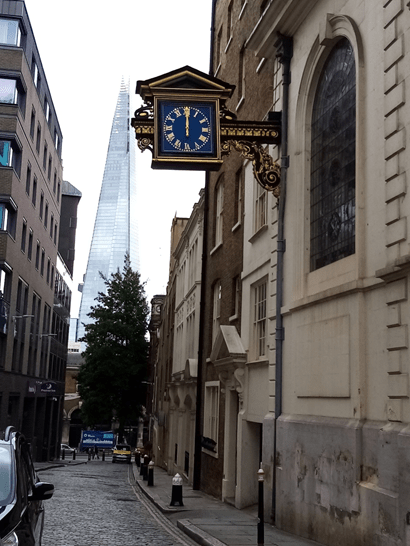
St Mary-at-Hill and the Shard
St Mary-at-Hill: Founded in 1336, but there is evidence of a church on the site in 1177, according to ancient documents. The church was severely damaged in the Great Fire, not surprising as the starting point of the Fire was Pudding Lane, two streets away. It was skilfully rebuilt by Christopher Wren who managed to retain the medieval walls. The church serves the Parish of Billingsgate and has strong links with the famous Fish Market, formally situated at Billingsgate Quay down the hill at the waterside. A Fish Harvest Festival is still held annually at the church!
The Shard: Also known as The Shard of Glass and formerly, London Bridge Tower. Situated on the Southbank, it is the tallest building in the UK at 95 floors and was completed in 2012. The architect was Renzo Piano and the style is neo-futurism. The story goes that entrepreneur Irvine Sellar wanted to redevelop the Southwark area and met the Italian architect for lunch in Berlin, to discuss plans for a new building. Piano expressed contempt for conventional tall buildings and sketched a spire-like sculpture emerging from the Thames on the back of a menu. I wonder how many other buildings started as a doodle on a random piece of paper? Probably most of them!
*A Final Word: I’ve loved doing this month’s blog; the challenge of getting the right photos, walking the lately almost deserted streets of the City and marvelling at the contrast of ancient stone and modern glass and steel. Today I donated £10 to Wikipedia, I couldn’t do this without the vast knowledge, seemingly on absolutely every subject, on their site. It’s been fascinating, hope you enjoyed reading it too.
Yet again, the lockdown has caused me to be creative about the boundaries of our capital. This month I’m looking at four of the abbeys and priories around Surrey, and one beyond. It’s amazing to think that these huge structures once dominated the English landscape, before their demolition in the 1530s and 40s, as part of the dissolution of the monasteries by Henry III. This happened when Henry created the new Church of England (of which he was head, of course) and confiscated land, property and money belonging to the Catholic monastic orders, of which there were hundreds. In the 1100s, 1 in 50 men and women took holy orders and lived a simple, secluded life in one of these establishments, so when they were seized by Henry and demolished, the upheaval must have impacted many people. Although the abbeys were extraordinarily rich establishments, owning vast amounts of land and valuables, their lowly inhabitants wouldn’t have benefited from this wealth. However, these buildings were safe havens for the poor, sick, destitute and persecuted; an early version of the Welfare State perhaps?
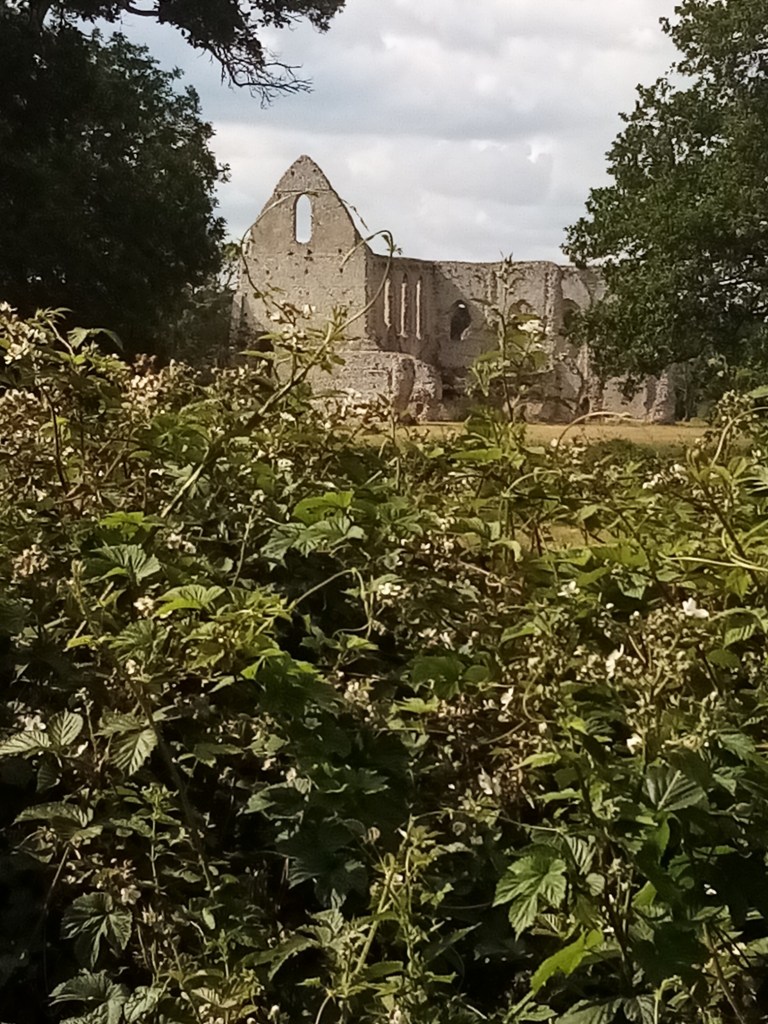
The abbeys and priories that remain fall into 3 categories (in my opinion): Completely intact – smaller priories that were not demolished but were saved and converted to parish churches, mansion houses or places of learning. Partially intact – usually with the valuable lead roof removed, but some of the walls standing, including my favourite, Rievaulx Abbey in Yorkshire (pictured). Yes, I do realise that North Yorkshire is stretching it a bit for London!
Unusually for N Yorkshire, the temperature last July when this was taken was 35 degrees!
And thirdly, there are several, like Merton Priory below, which are basically just a footprint!
Merton Priory
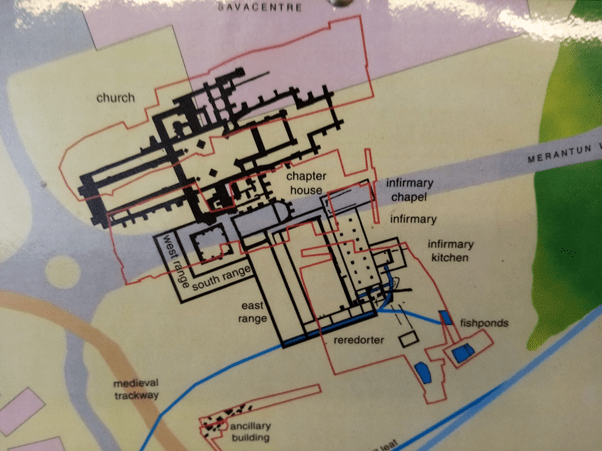
When plans were made to build the Savacentre (now Sainsburys) in Merton, the extensive foundations of Merton Priory were discovered. The rooms of the Chapter House are now permanently preserved in the pedestrian tunnel under Merantun Way in a small museum. In normal times you can view the protected foundations, but because of Coronavirus, it’s closed to the public at the moment. Founded in 1117, Merton Priory was one of the greatest monastic houses of the Middle Ages. It was demolished in 1538 and its materials were taken away to build Nonsuch Palace in Cheam (ironically, also demolished.) The foundations became buried and forgotten, until 1986, when they were uncovered. I like the fact that the Priory was founded in 1117, demolished in 1538, 421 years later, then rediscovered in 1986, 448 years after that. I think there’s some sort of poetic justice there.
This is a photograph of some of what you can see in the Museum
If you know this area, you can see from the footprint how big the whole complex would have been. Amazing, and somehow sad to think that the rest of it is buried under a Sainsburys superstore, a KFC, a Pizza Hut and a carpark; and Merton Abbey Mills by the Wandle.
I think this is my favourite picture, a CGI of the Abbey in situ, with pylon behind. Imagine seeing that on your way to the shops!
Waverley Abbey
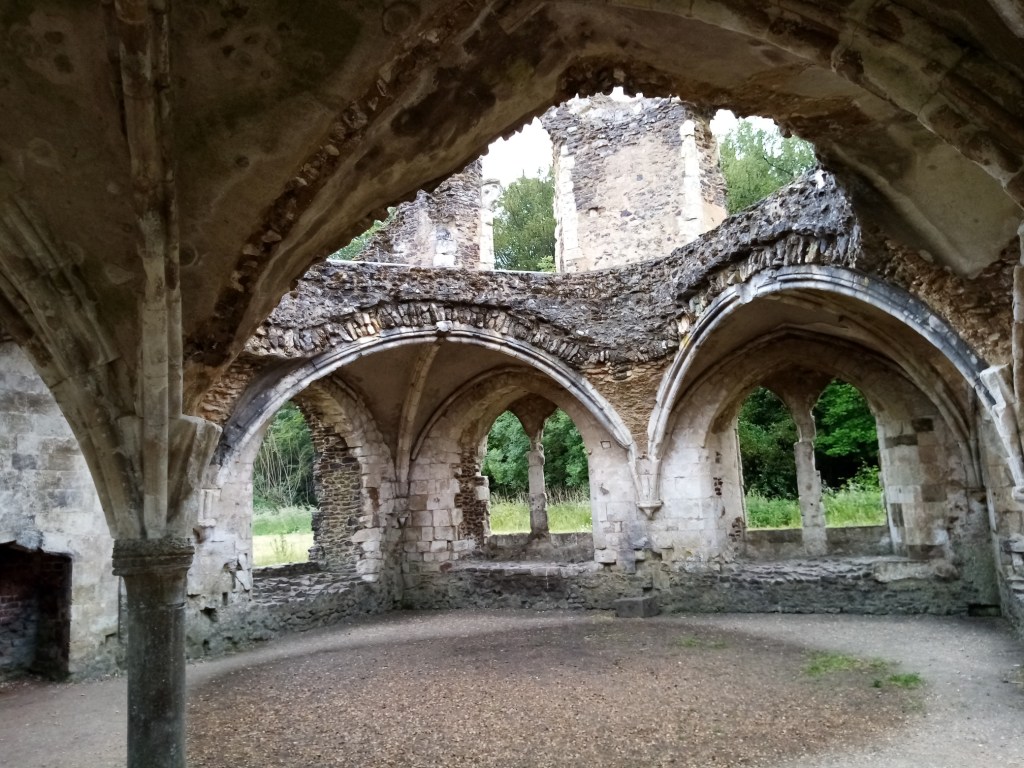
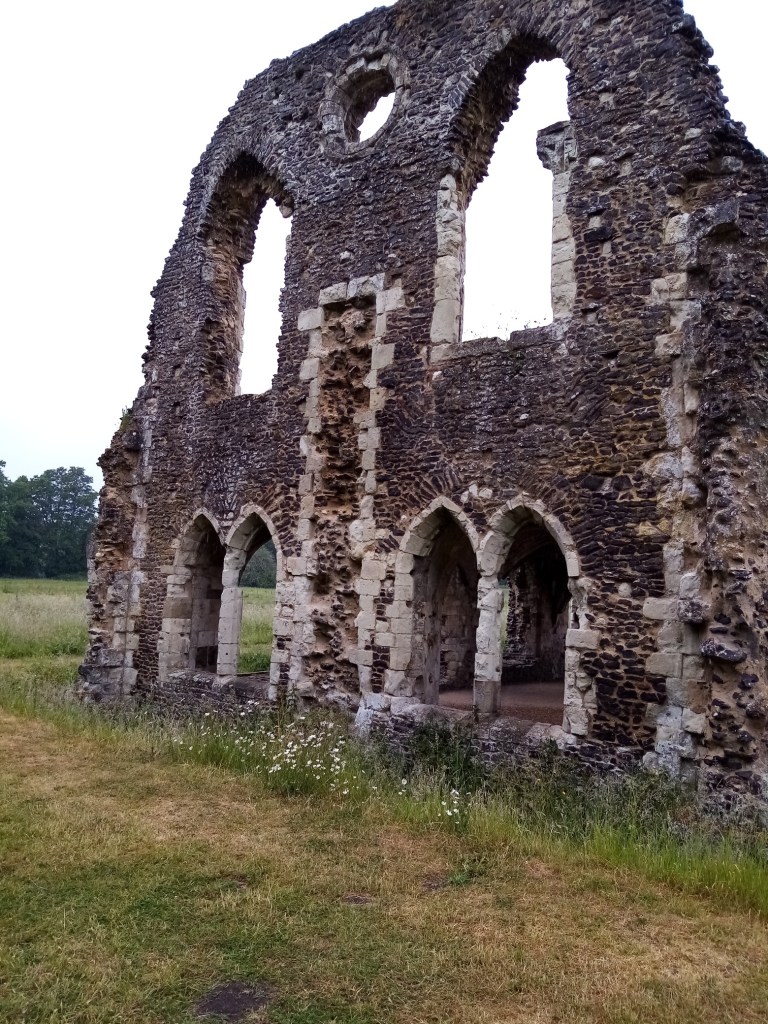
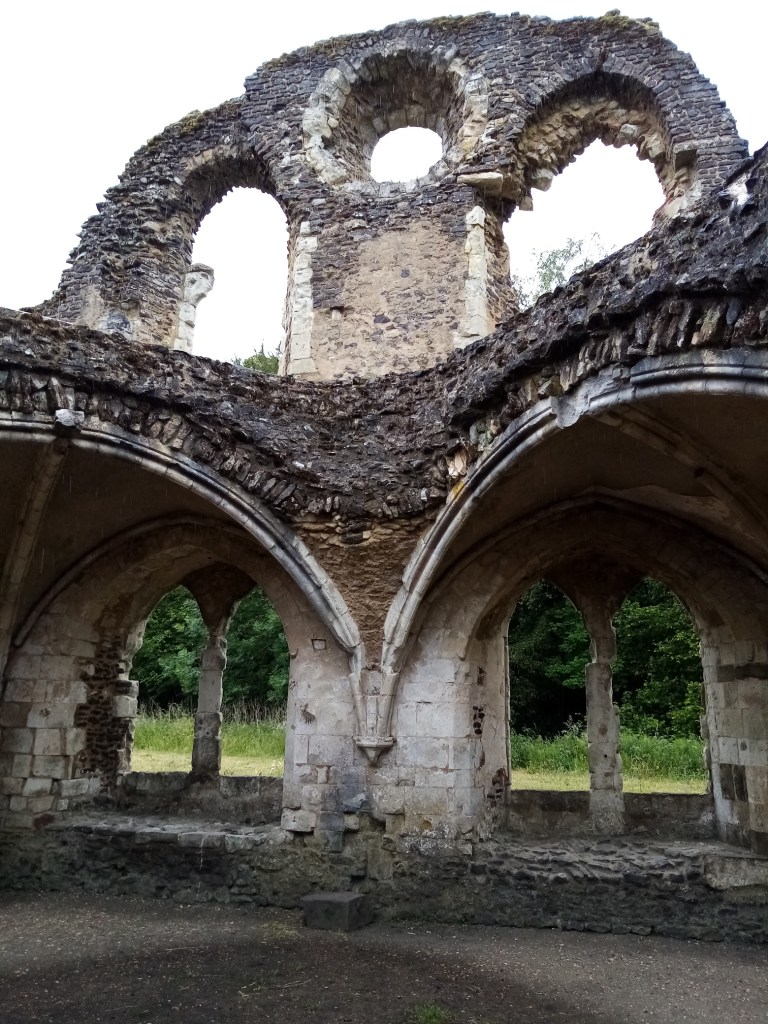
This abbey is a property of English Heritage and the website says that this is the first abbey of the Cistercian monks (from France) to be built in Britain. It was founded in 1128 and rebuilt in the 13th Century, following flood damage from the nearby River Wey. This was another large complex of buildings and included fishponds and farmlands; the monks were self-sufficient and also sold their produce. Following dissolution in 1536, it was granted to Sir William Fitzherbert, the treasurer of the King’s household. It was dismantled and the stone used for local building works including nearby Waverley House, which is now a Christian conference centre and head office of CWR.
This is the vaulted refectory (dining hall) which has an atmospheric, gothic feel. It’s been used as a setting for several films: Elizabeth: The Golden Age; Hot Fuzz; Into the Woods; The Huntsman: Winter’s Tale, and loads more, plus some TV productions.
Dormitory………………………………………and Dining Hall
Newark Priory
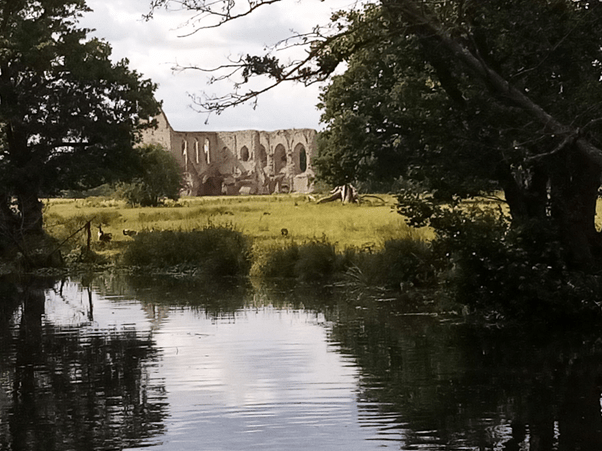
This one, an Augustine Priory, has a beautiful setting, again in the middle of floodplain of another part of the River Wey, which still floods regularly today. You might question why they were built in such a vulnerable place, but they needed to be near a supply of flowing water, and there is evidence that the monks undertook water management and altered the river channels for fishing. Unfortunately, it’s situated on private land, so it can only be seen as glimpses through the trees from the Wey path. It was established in 1189 and disestablished in 1538. The Prior was pensioned off, a good outcome for him for often they were ‘let go’ as we might say today, with nothing. The valuables were sent to the Tower of London and the building fell into ruin with some of the stone being taken away to repair local roads. It’s now listed as a Grade 1 Ancient Monument, which means it can’t be altered in any way, ever. A dawn service is held in the ruins on Easter Sunday at 6am, run by local churches.
This is about as close as you can get, but the walk alongside the peaceful River Wey makes it a worthwhile visit
Lesnes Abbey
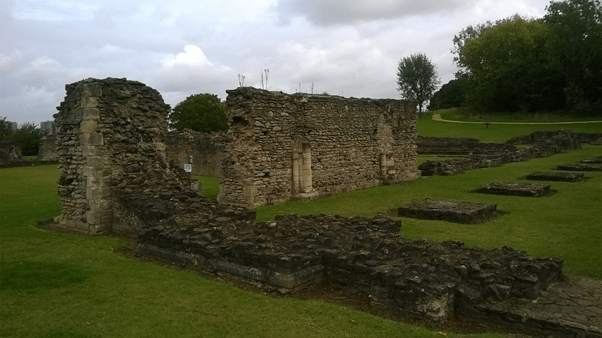
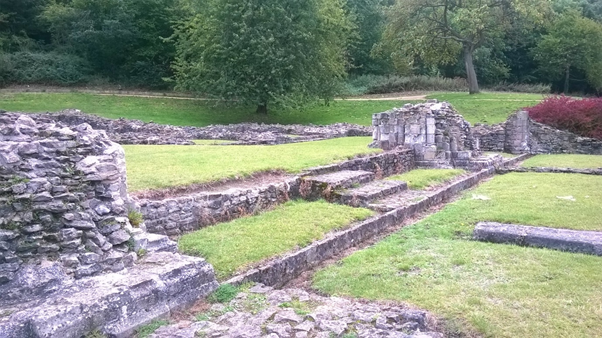
A bit further East and closer to London, in the London Borough of Bexley, lie the ruins of Lesnes Abbey. Founded in 1178 by Richard de Luci, the Lord Chief Justiciar, which was similar to a modern Prime Minister. It is said he established it as a penance for the murder of Thomas Becket, in which he was involved. This was an Augustine Abbey and the duties of the monks were to ‘baptise, preach, give penance and bury the dead.’ It’s situated in the ancient Lesnes Abbey Woods and its walls have been partially restored so the visitor gets a good idea of its size and purpose. Although it was clearly a very large complex of buildings, it never became a large community and was one of the first to be disestablished in 1534. As with the others, the stone was used for local buildings. It’s now a free to visit public park and is on the wonderful South East London Green Chain Walk.
Loving these arches, they’re not original though!
That’s the end of the pictures, but I want to say a couple of other things about the abbeys/priories and their inhabitants. It’s tempting to think that people were much more ‘Christian’ 900 years ago; they were certainly more ‘religious’. You have to remember firstly, that the church had a lot of power and wealth, and therefore control over others; and secondly that people were very superstitious in their beliefs. Young men and women were encouraged to enter holy orders, believing that their reward for a life of poverty, chastity and obedience would be in the next world, not this one. That said, most monks and nuns lived productive, rewarding lives: caring for the sick and offering hospitality; growing produce and rearing livestock for themselves and to sell; managing their own lands and financial affairs. Also, abbeys provided a safe haven; monks were not expected to fight in battle (these were violent times!) And lastly, although they ate a meagre, spartan diet, they would not starve if famine came to the area, as many farmers and labourers would. At a time when all life was precarious, except for the very rich, the monastic life might have seemed the best option!
I’m still having to be creative about posts due to the lockdown; hope you like this selection of words I’ve seen on notices, posters and plaques around the capital (visited before the lockdown, I hasten to say) and more locally, revealing more of God’s presence on our streets (see also January).
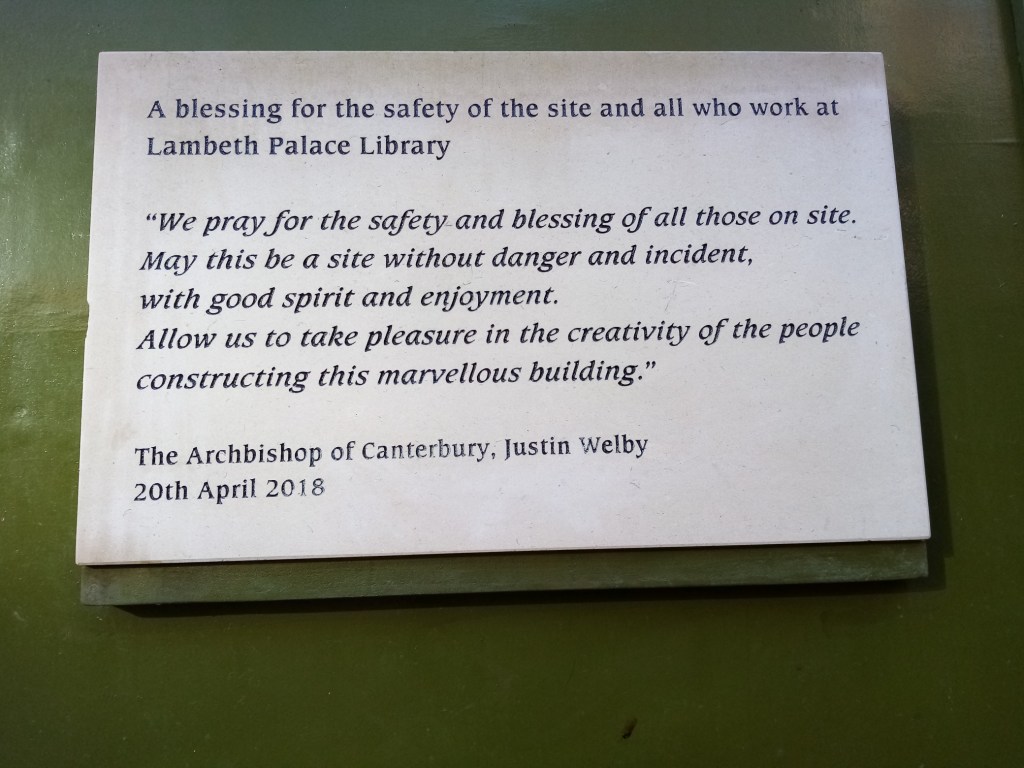
Prayer for Workmen at Lambeth Palace
No apologies for repeating this picture from January. I love that the Archbishop of Canterbury specifically said a blessing over all the workers on the building site at Lambeth Palace, how many other building sites get a blessing, do you think?
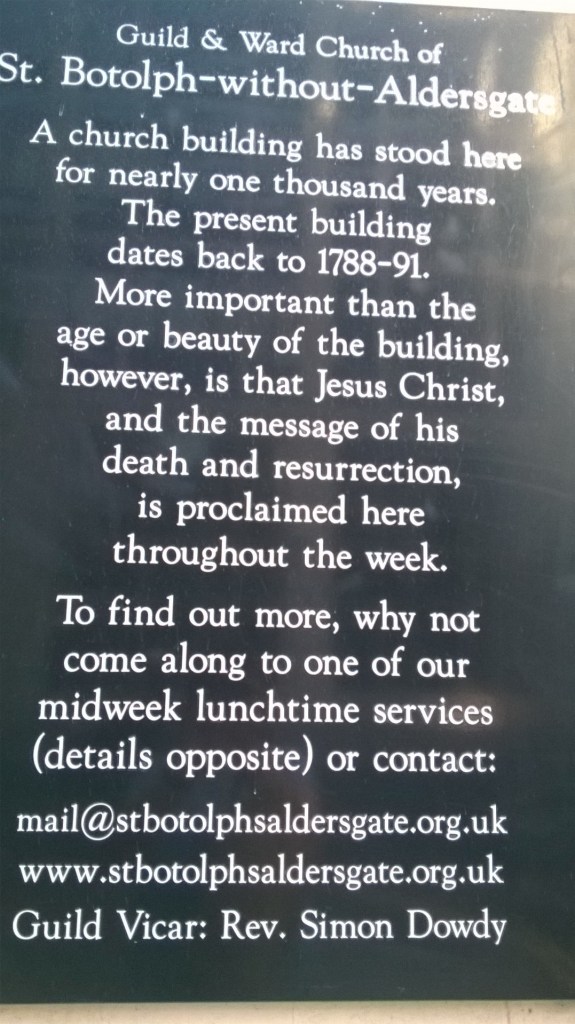
Sign outside St Botolph Aldersgate
This sign emphasises that, though the church building is wonderfully old, with so much history and beauty, the most important thing is that Jesus is present now and has been for 1,000 years. It makes me think of everyone who has worshipped here down the ages. I wasn’t able to go inside but it’s on my list of places to visit when lockdown ends. (It’s a very long list!)
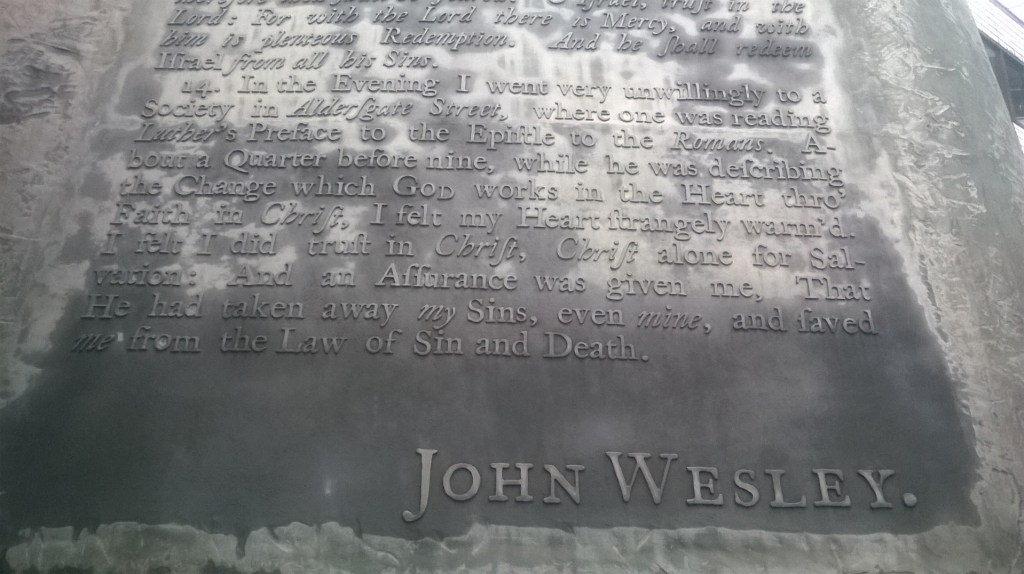
John Wesley Conversion Plaque
Amazingly, this huge bronze plaque is situated right outside the Museum of London, you can’t miss it! I talked about this in my Museums in March post; John Wesley and his brother Charles were active in the church: doing good works among the poor and leading Bible studies. But I’m guessing they did not realise that God’s love could be personally assured for each individual. I love the way it says ‘In the Evening I went very unwillingly to a Society……’ (presumably a Bible study group of some sort!) While he was there, John ‘felt my heart strangely warmed’ – the Holy Spirit was convicting him of his sin, but at the same time, assuring him that Jesus had forgiven him and saved him ‘from the Law of Sin and Death.’ Not often you see a testimony outside a museum, I love it!
Sign at St Mary-le-Bow, EC2
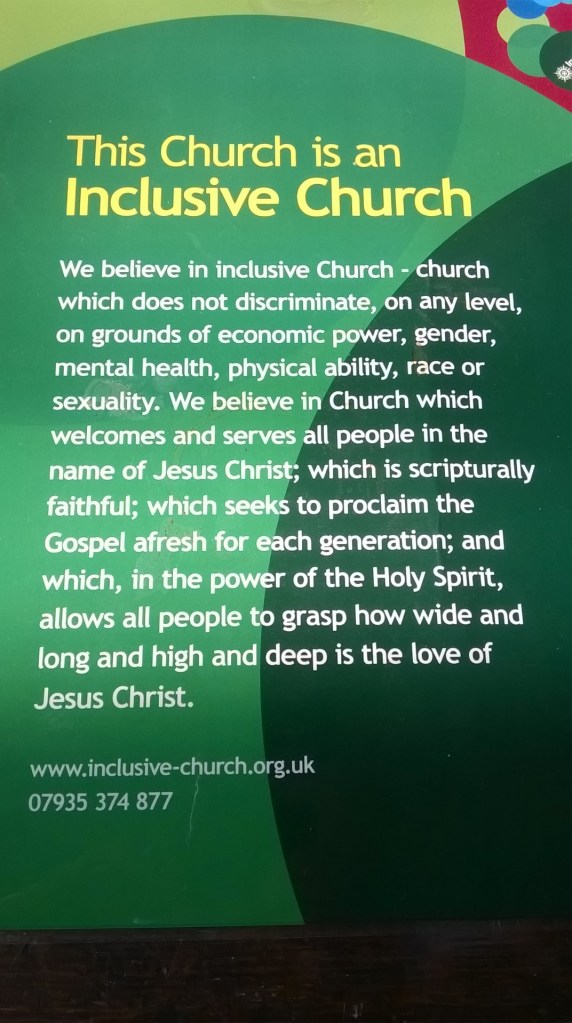
Inclusive Church believes that the suffering caused by discrimination is the same, whatever its reason. ‘IC’s unique interest and expertise is in recognising the experience of being “outside” because of the process of discrimination……(it) confronts the generic problem of discrimination within the church. It does this by promoting an inclusive view of the scriptures and appealing to the values of social justice.’ From www.inclusive-church.org.ukBrilliant stuff!
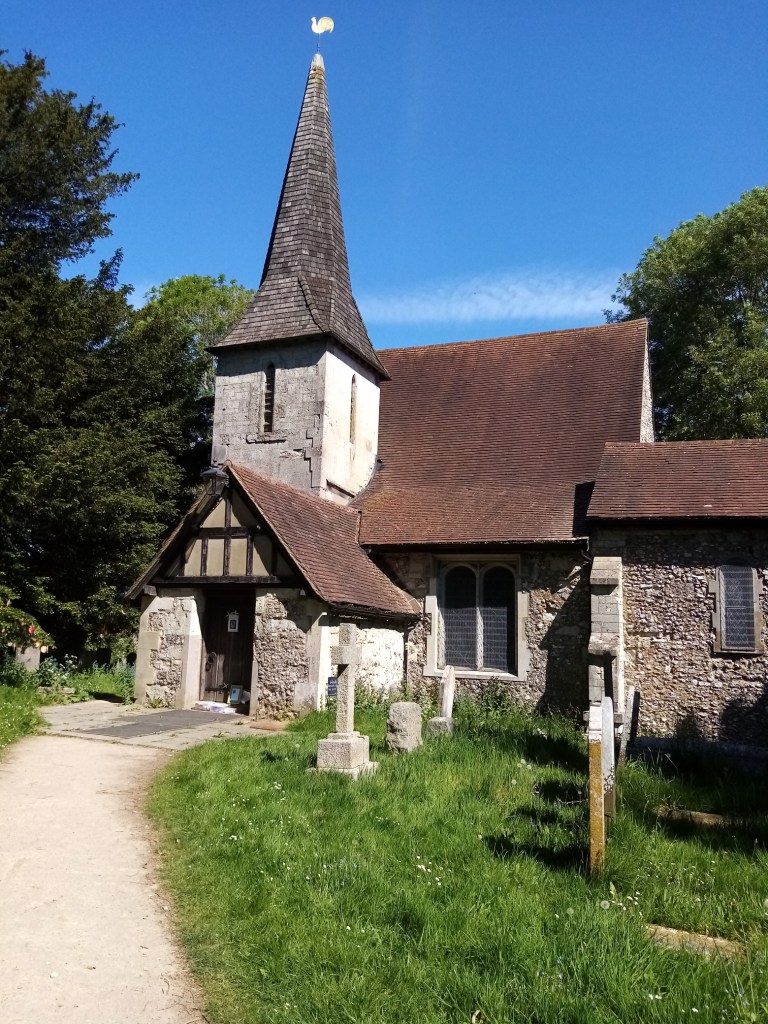
Chaldon Church, near Old Coulsdon
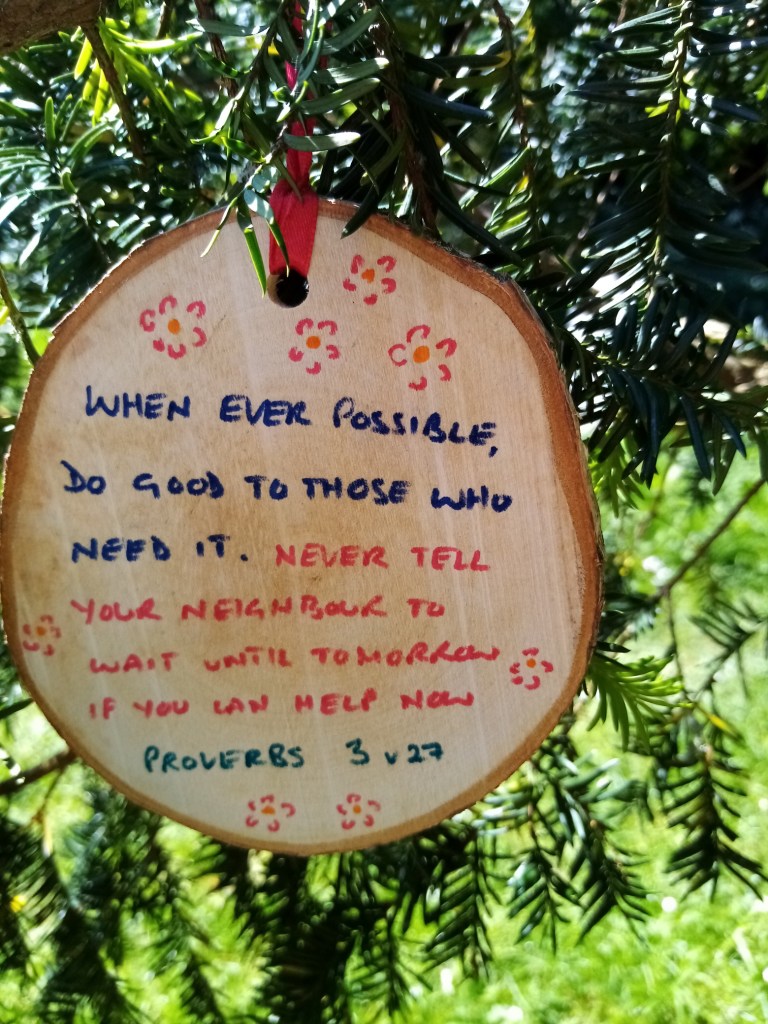
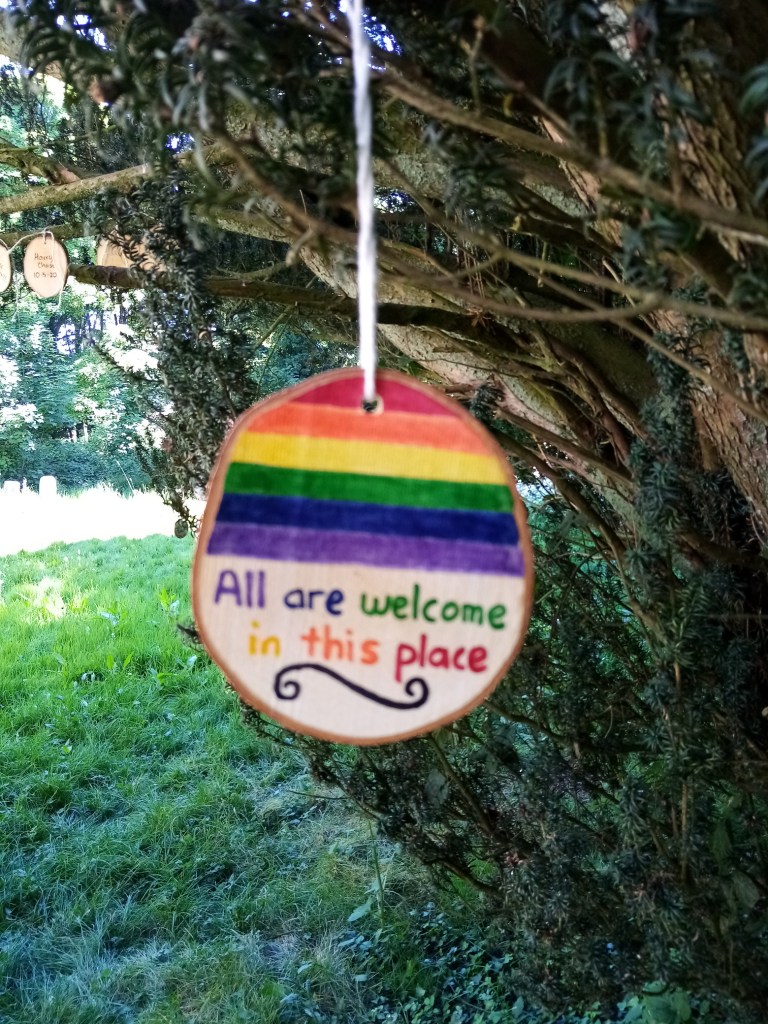
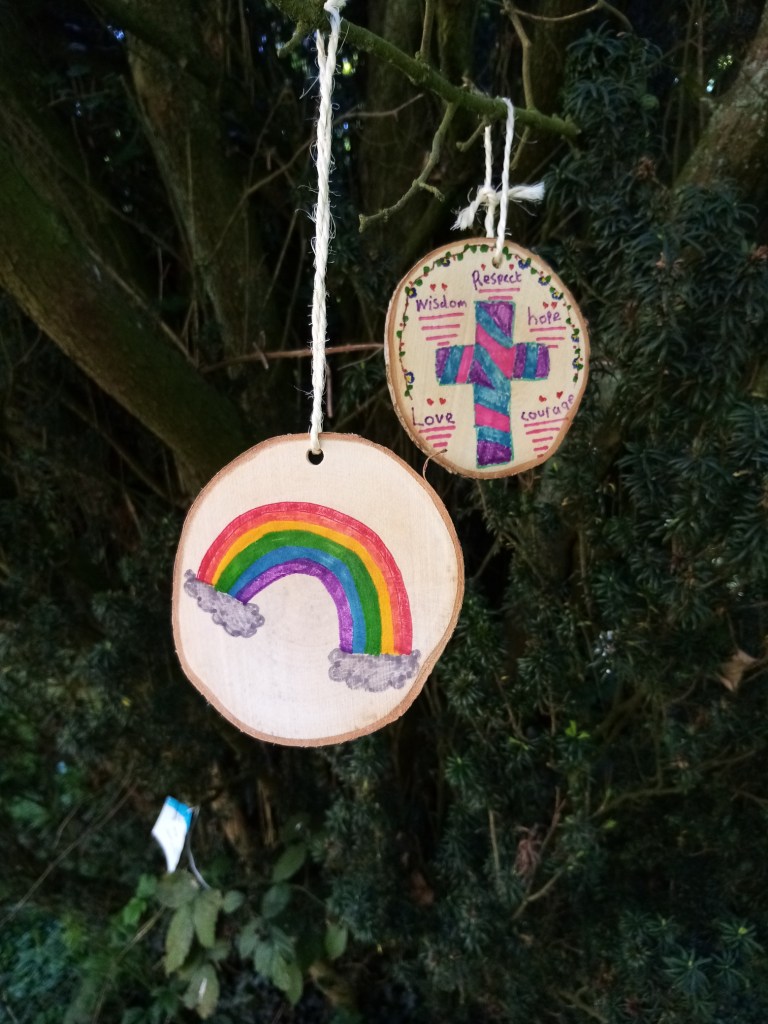
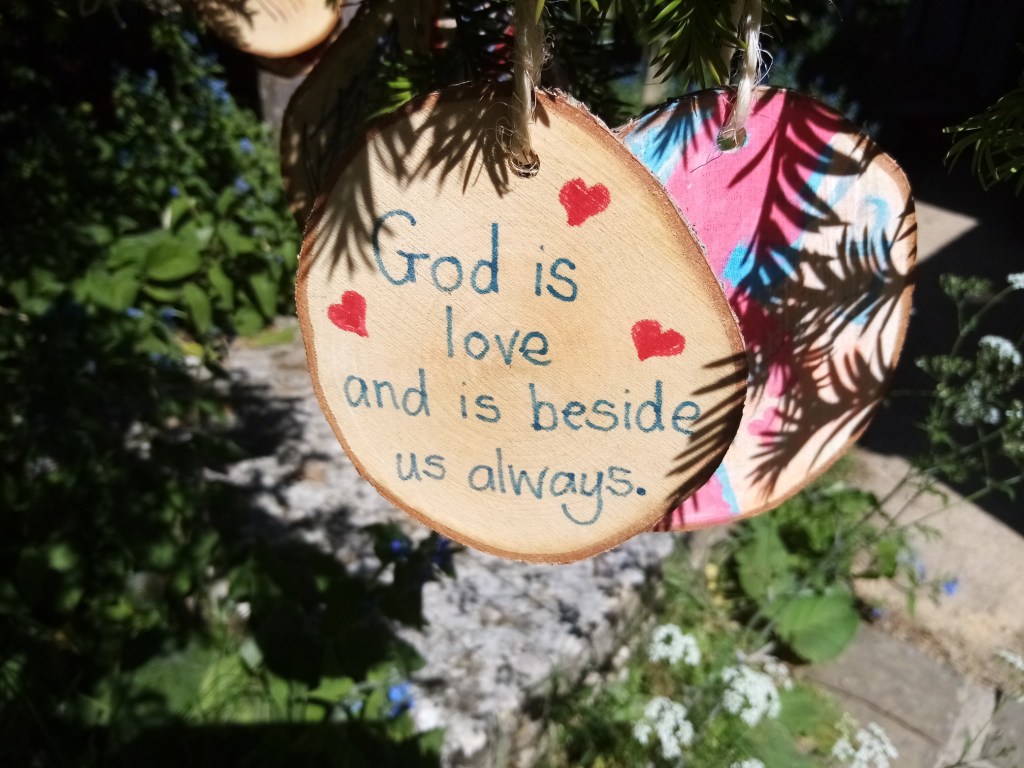
One of the benefits of lockdown is exploring and visiting places nearer to home. This gorgeous country church is reached by crossing Happy Valley and some crop fields, and then along a country lane. And still has a Croydon postcode! The Vicar has had the brilliant idea of providing wood discs and pens for people to decorate or write a message to hang on the yew tree. These are a few of my favourites.
The world has changed since I started writing this post. You won’t be able to visit these museums for a long time, and that’s a shame, because they are all well worth a visit, not least because each one shows the impact of Christianity on London and its people in different ways for nearly 1000 years. I’ve included their websites so you can learn more about them if you want.
I’ve chosen five London museums which have a Christian connection. Three of these tell the story of people simply obeying what they believe God has told them to do, resulting in worldwide recognition and huge changes in social and health care. Two had less of a global impact, but both gave rise to movements which changed the social and spiritual thinking of their day. I’m putting them in date order, from 1080 to 1867!
Museum of the Order of St John
Everyone’s heard of St John’s Ambulance Service, but did you know that it has its roots in an ancient order of monks and knights, nearly 1,000 years ago?
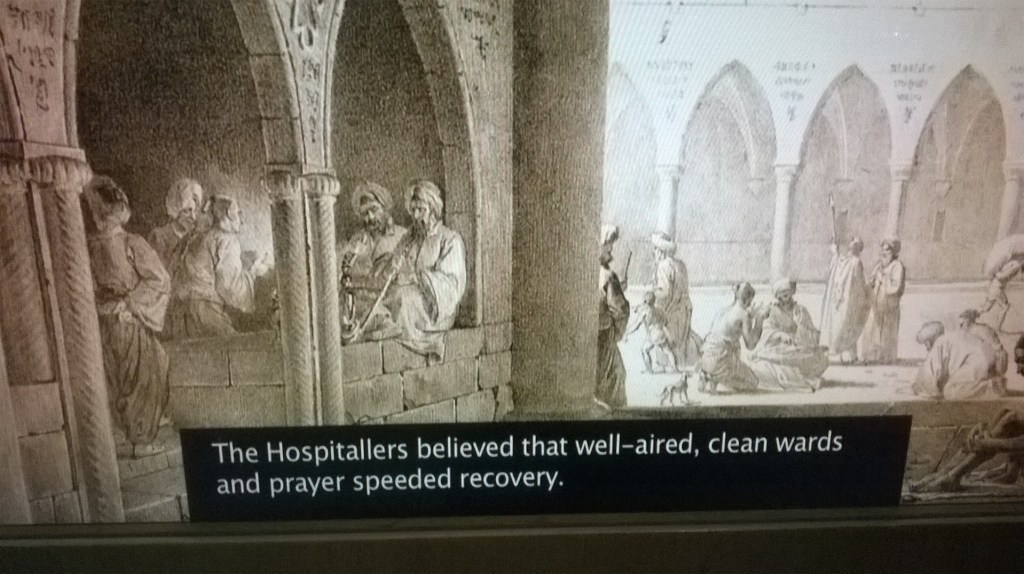
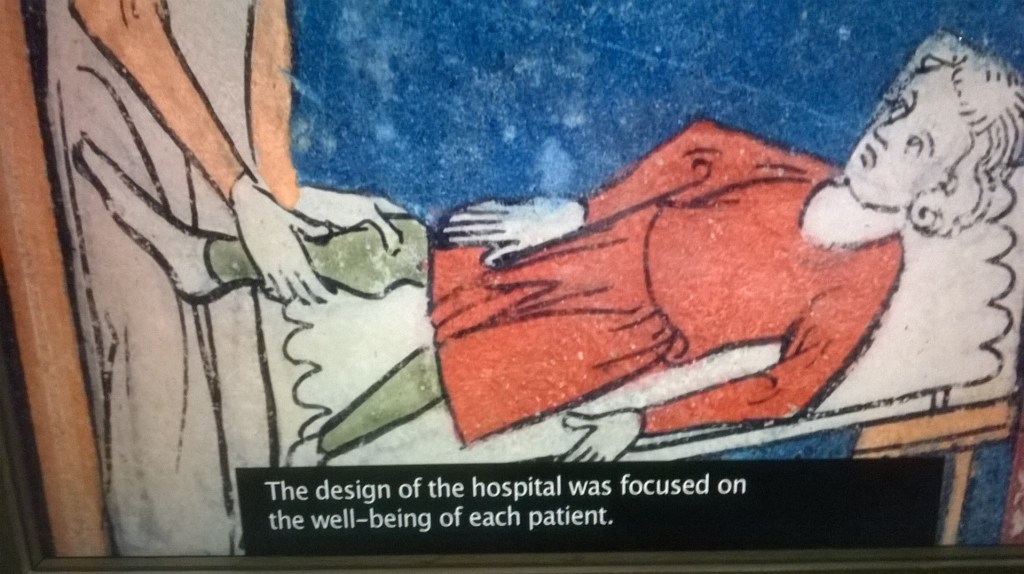
A group of monks founded a hospital in Jerusalem around 1080, to care for pilgrims who had become sick while travelling on pilgrimage to the Holy Land. They were known as the Hospitallers and they claimed they had been told by God that 1. They should care for all people, regardless of race or faith, and 2. They should care for individuals as if they were caring for Christ Himself. They became a military order during the Crusades (not engaged in combat but doing admin and medical duties), when they became the Knights of the Order of St John. The Order moved to Cyprus, then Rhodes, then settled on Malta. You can go and explore for yourself the following 800 years of St John’s history! The interesting thing to note is that because the Hospitallers believed ‘each patient represented Christ Himself’, they focused on provided the best care that they could, pioneering some very advanced practices: quarantine for people with infections, well-aired clean rooms, each patient to have his own bed and the dignity of hospice care for the dying. Cutting edge stuff for nearly 1,000 years ago!
‘Bart’s is the oldest hospital in Britain still providing medical services which occupies the site it was originally built on’ (Wikipedia). It was founded in 1123 by a courtier of Henry I, named Rahere, who was also a priest. On pilgrimage to Rome he fell ill and is said to have had a vision of St Bartholomew, who told him to establish a priory and hospital in London, specifically, at Smithfield, just outside the city walls. On his return to England, Rahere did just that, telling his master the King about his vision and his divine calling to build a hospital and priory on the site of the King’s Market at Smithfield. The King graciously agreed and Rahere built and subsequently became the leader of the priory of St Bartholomew. And then chroniclers of the time began recording miracles occurring in the priory: a lame man was healed at the altar, a woman had her ‘feeble’ limbs cured, a man who was mute began to speak again. Yet more healings took place in the adjacent small hospital, which grew in size, as people heard about the miracles, and the hospital gained a reputation for excellence in more conventional medicine! I like the way God doesn’t only do the miraculous but works with servant-hearted and willing people. A few hundred years later, King Henry VII, who was busy dissolving monasteries all over the country, granted ‘to the Mayor and Commonalty of London and their successors for ever the Hospital of St Bartholomew, its church and other properties.’ So that’s why the hospital (rebuilt several times) still stands in the same place after nearly 900 years. It became one of the first medical schools in the country, a training facility for surgeons. The museum is very small but charts 900 years of history. (Incidentally, the ‘King’s Market’ nearby became the famous Smithfield Meat Market!)
Address: Museum & Archives, St Bartholomew’s Hospital, West Smithfield EC1A 7BE
A brief history: John Wesley was born in 1703 and his father Samuel was a nonconformist minister, whose two sons followed him into the priesthood. John and Charles became known as ‘Methodists’ because of their methodical way of studying the Bible. Interestingly, this was a derogatory term used by others, but the Wesley boys liked it, so it stuck. The actual name of their study group was ‘The Holy Club’, hmm, I can see why they preferred ‘Methodists.’ The group also placed importance on social action, working among the poor, especially the homeless and children, and prisoners, who at the time had to rely on people on the outside for food, etc. The Wesley brothers definitely had compassion for others, and an interest in the Bible but didn’t seem to apply the message of the Gospel to themselves. Then in May 1738 John had a ‘conversion experience’, during a church meeting: ‘I felt my heart strangely warmed. I felt that I did trust in Christ….and an assurance was given me that he had taken away my sins, even mine, and saved me from the law of sin and death’. Charles also experienced God’s love for himself and became a great hymn writer. John embarked on what today we would call a preaching tour, travelling across the country on horseback, stopping at villages and towns and speaking to people about God’s love for them in the open-air (unheard of at the time.) Amazingly, he travelled 4,000 miles per year and preached 40,000 sermons in his lifetime. He famously said, ‘The world is my parish’. The Museum of Methodism has a brilliant introduction video narrated by Huw Edwards from the BBC, which really brings Wesley’s story to life. You can also visit the Methodist Chapel and Wesley’s beautiful Georgian house, all on the same site. Again, I won’t say any more, you have to see for yourself!
Address: Museum of Methodism, 49 City Road, London EC1Y 1AU
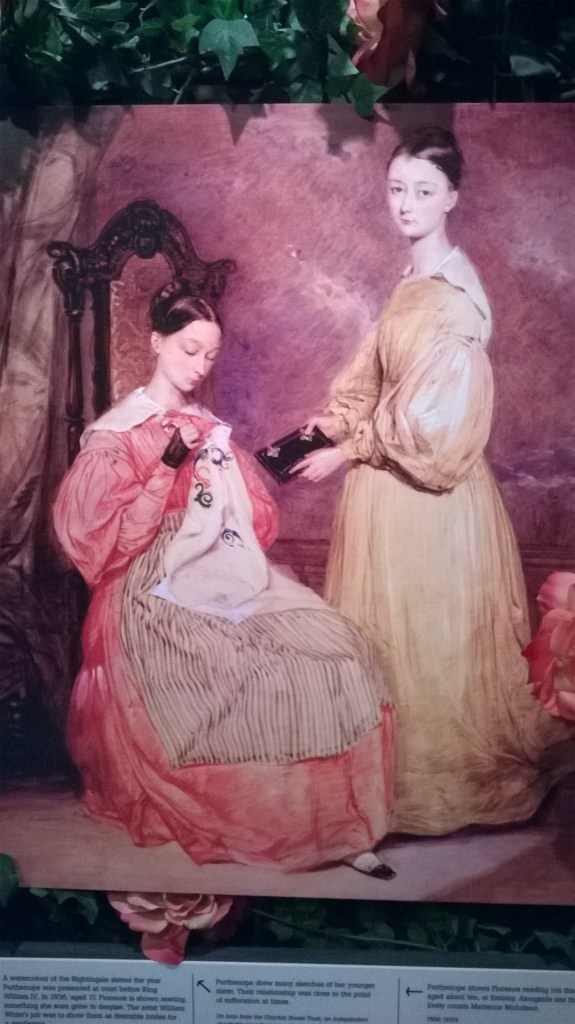
Florence was born into a wealthy family in 1820; she and her sister were bought up to be fashionable and educated young ladies. Educating Florence meant she grew up with an enquiring mind, discussing philosophy with her father and excelling in Maths. That wasn’t what her parents intended, in those days young ladies were not supposed to use their accomplishments for a future career. Florence became interested in nursing, and at 16, she clearly felt God’s call to serve him. When she told her parents that she wanted to become a nurse, they were horrified, because ‘the stereotype of nurses at the time was of drunken women with loose morals who nursed the sick because they weren’t fit to do anything else. The only other kind of nurses were nuns.’ (Premier Christianity). A world away from the graduate profession of today! But, through her parents, Florence came into contact with independent, career-minded women; also because of the fashion of the idle rich for continental travel, she had had the opportunity to visit well-run German hospitals, with trained, competent nursing staff. So you could say Florence’s parents were responsible for her wanting to become a nurse, and eventually they agreed she could train.
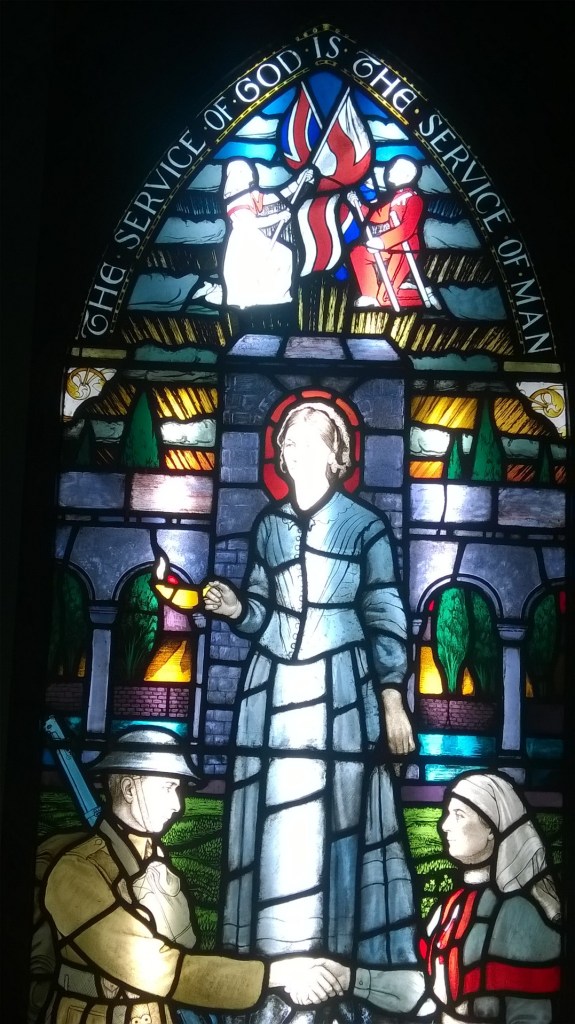
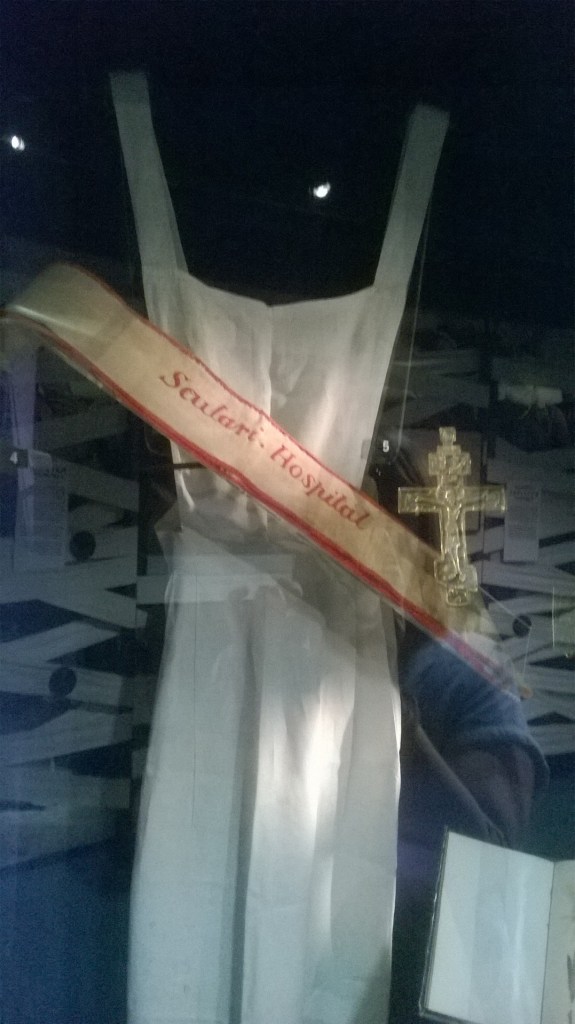
After training, Florence was appointed as Matron-in-Charge of ‘The Institution for the Care of Sick Gentlewomen’ in London, but in 1854 she accepted an invitation to lead a team of nurses to Scutari, Turkey, where Britain had just entered the Crimean War. The conditions in the military hospitals were atrocious, with more soldiers dying in hospital than on the battle field. This wasn’t just due to appalling sanitary practices, but also appalling admin! Florence, with her talent for administration as well as being a highly competent nurse, set about organising hygienic nursing practices, recording information and organising supplies. She took an interest in the soldiers’ mental and spiritual health, and even paid for more nutritious food for them from her own pocket; basically, she cared. Florence Nightingale’s desire to serve God, her compassion for the sick and her exceptional administration skills, radically changed how hospitals were run. The exhibits and displays in the Museum trace Florence’s life story and show how nursing has developed in the last 200 years. I love that the new NHS hospital to be housed in the Excel Centre in Docklands, is being named The Nightingale.
Address: Florence Nightingale Museum, St Thomas Hospital, Lambeth Palace Road SE1 7EW
The Ragged Schools were established by Dr Thomas Barnardo in 1860. He was born in Dublin in 1845 and said of himself that as a child he was ‘selfish and thought that everything that was not his should belong to him’. (Wikipedia). As he grew older, he changed dramatically and as a young man, he wanted to make up for his selfish attitude. He went to London to train as a doctor with the intention of going to China to become a missionary doctor. The hospital where Thomas trained was The London, in Whitechapel in the East End, one of the poorest areas of the country. Thomas saw disease and poverty every day, sick and malnourished adults, and children as young as three playing in the dirty streets. He walked among the people, reading to them from the Bible to try to give them hope, but he realised he could and should do more. He abandoned his plans to go to China and never completed his medical training, instead setting up his Ragged School. In Victorian times, there were no free schools, even at an elementary level, and Thomas realised that a child would never be able to change their circumstances without access to education, and the cycle of deprivation would continue. Any child who wanted to, could attend his school, they received a hot meal in addition to what we would call today basic literacy and numeracy. Thomas struggled to get the children to listen and even to sit still, but he persevered and gained their trust and respect. Then one day by chance, Thomas found out that almost all the children at the school were homeless and was shown a group of boys sleeping on the rooftop of a building, huddled together for warmth. Thomas was horrified and set about raising funds for a Boys Home, a place of shelter and safety, food and warmth. His first Home had 25 places and was quickly filled to capacity. Then came another turning point in his life: one winter’s night he had to turn a boy away from the Home. The next morning, in the lane beside the house, he saw two men carrying the body of a boy, the one he had turned away. He had frozen to death in the night; Thomas was heartbroken. He vowed never again to turn anyone away and had a large sign put up above the door: No destitute childever refused admission. Eventually there were 96 Children’s Homes, caring for over 8,000 children. The work of Dr Barnardo’s Homes continues today, simply known as Barnardo’s. Their work has changed from providing residential care to adoption and fostering services and social care. The Museum is delightful, housed in the original school with the classroom, kitchen and laundry furnished as they would have been in the 1860s, and also an exhibition of local history.
Address: Ragged School Museum, 46 – 50 Copperfield Road, Mile End E3 4RR
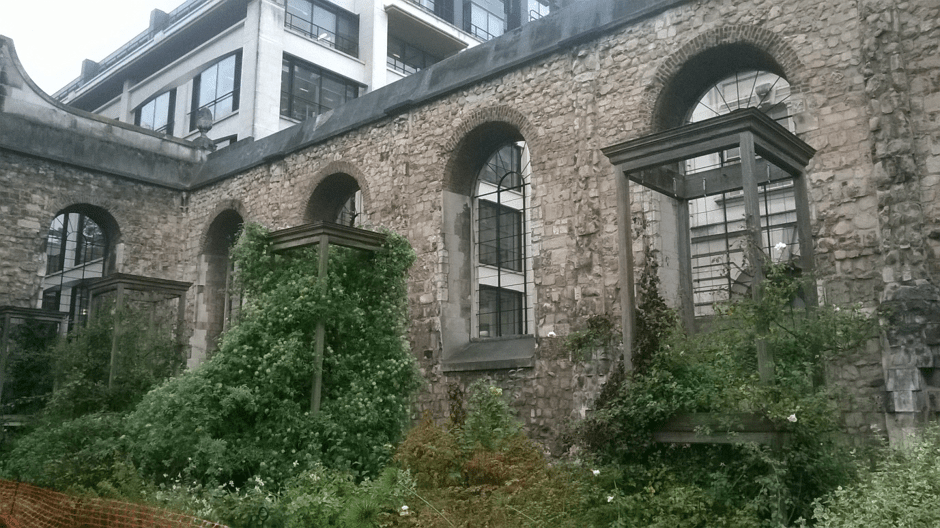
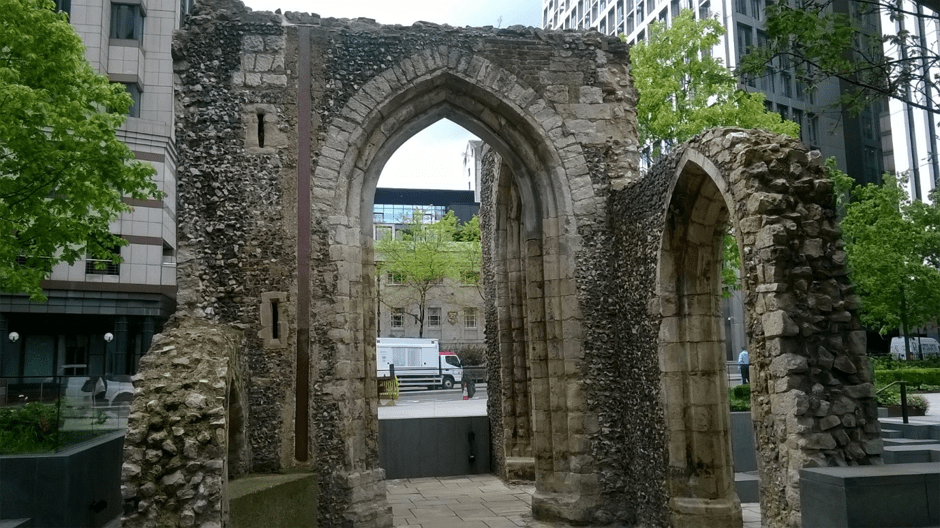
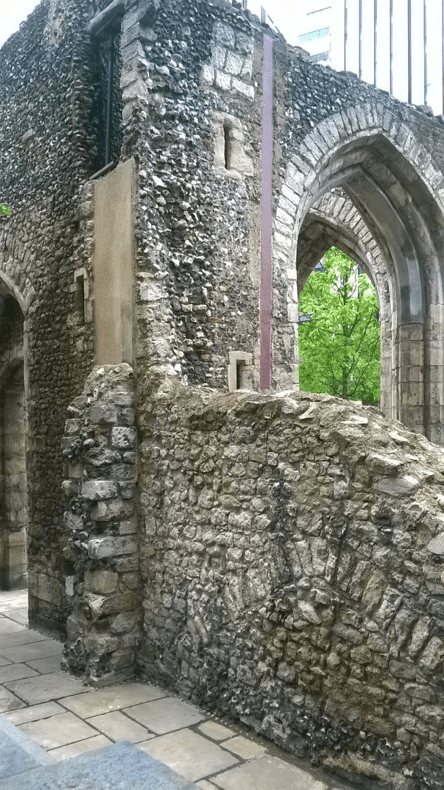
There are some beautiful ruins right in the middle of London, you just need to know where to look. The best thing about them is that they’ve been left in their romantic ruinous state and nature has been allowed to take its course, surrounded by the concrete, glass and steel of 21st Century London. I think the contrast between ancient and ultra-modern adds to their charm. Sometimes you can even climb on their walls! All these sites are free to visit. I’ve included their addresses and nearest tube, in case you fancy a visit.
St Dunstan’s in the East
The surviving church tower
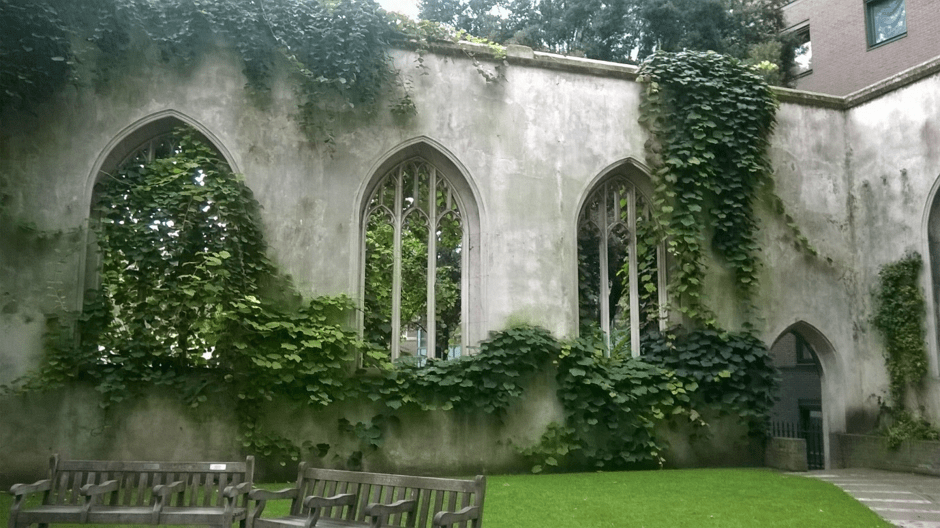
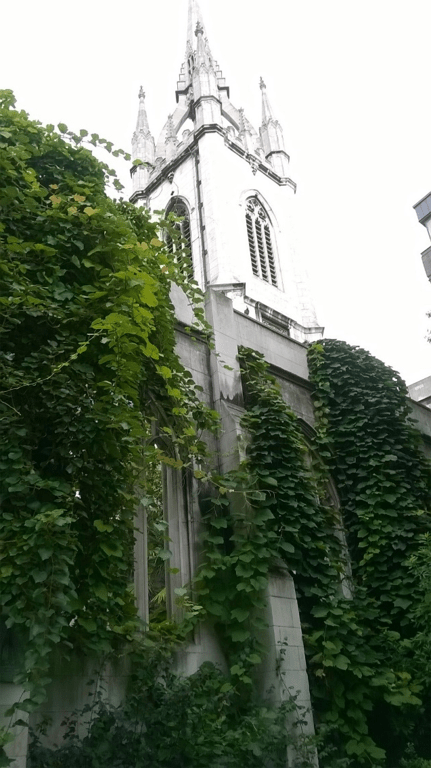
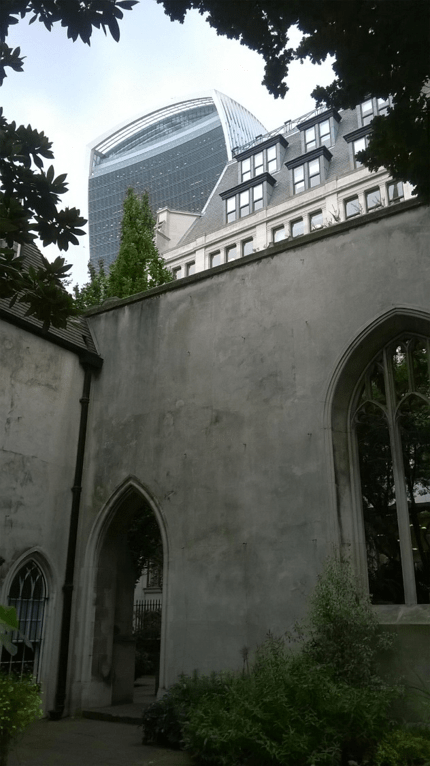
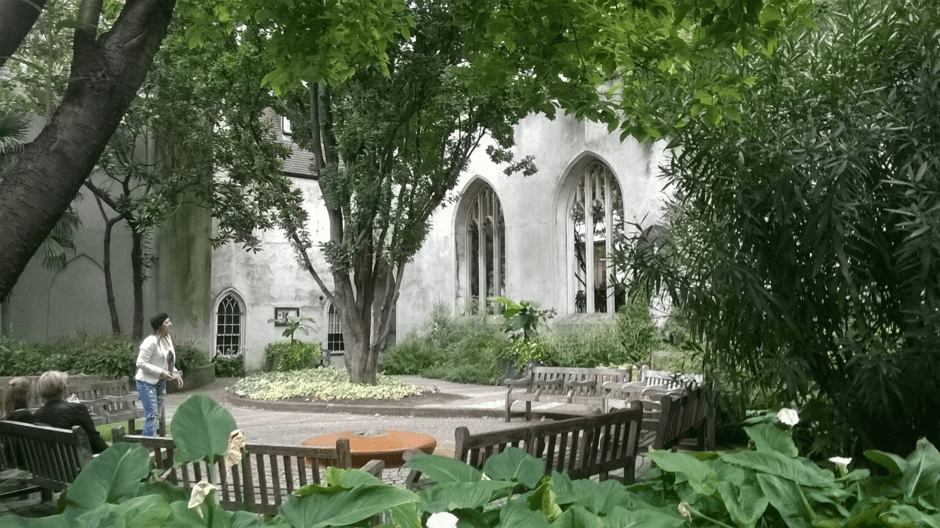
This is St Dunstan’s-in-the-East, now a public garden, one of Time Out’s top Romantic Venues in London. The church has had an unlucky history: severely damaged in the Great Fire, rebuilt twice and finally bomb damaged in the Second World War. In 1967 the decision was taken not to rebuild it but to create ‘one of the most beautiful gardens in the City of London’. The lovely fairy-tale tower escaped bombing, and I also love the arched windows, it’s a wonderful space to sit and relax. Outdoor church services are held here, and it’s also used as a setting for plays when that gothic look is required. The Walkie Talkie building peeping over the wall provides a 21st Century touch!
Address: St Dunstan’s Hill, London EC3R 5DD
Nearest Tube: Monument/Tower Hill
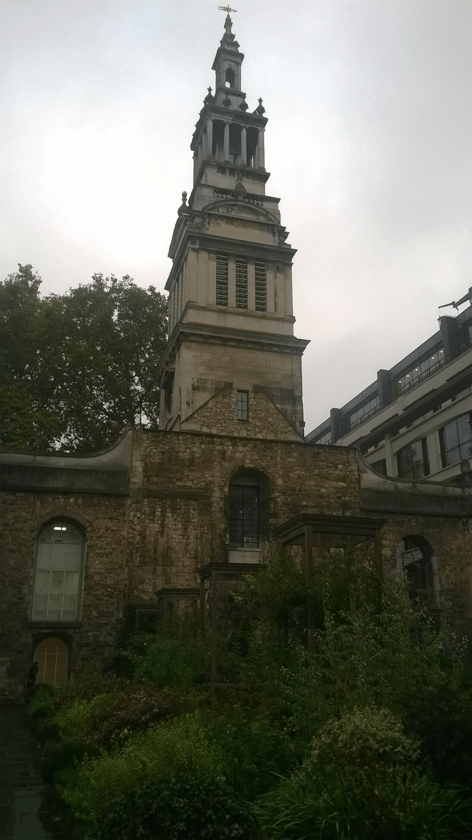
Christchurch Greyfriars
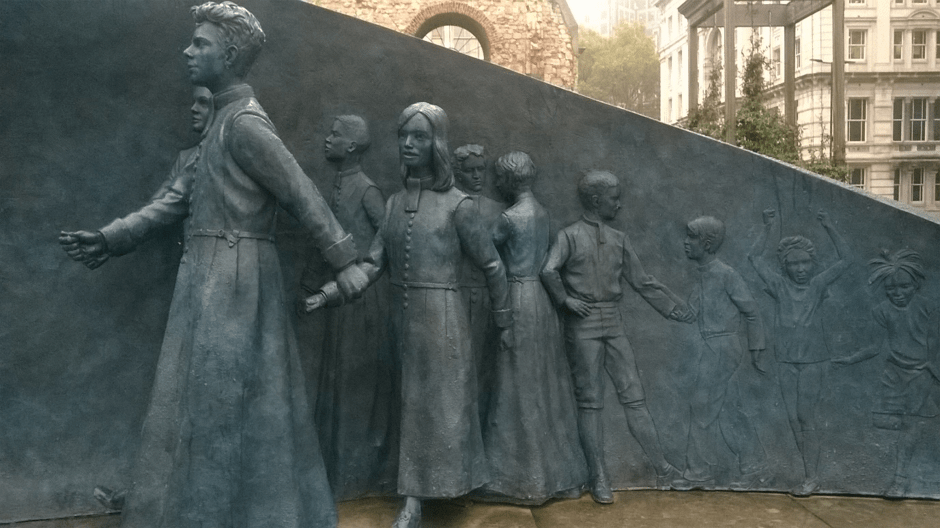
Pupils of Greyfriars Hospital
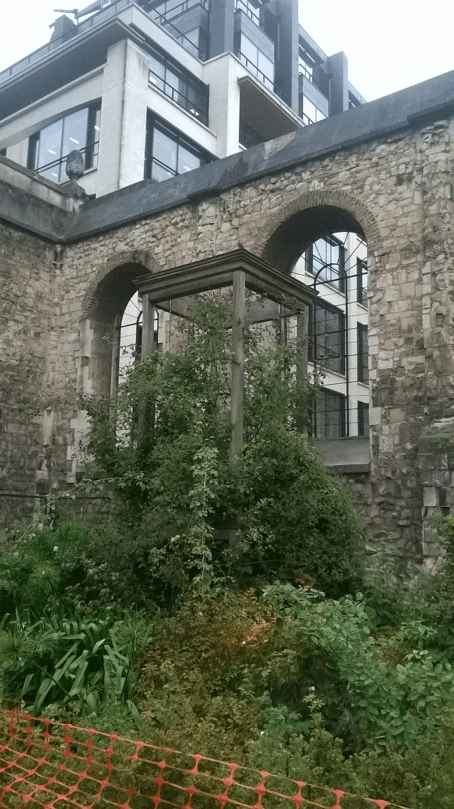
Turn left out of St Paul’s Station and you’ll come across another of the City Gardens, Christchurch Greyfriars. The original site of the Franciscan church of Greyfriars was established in 1225 and was destroyed by the Great Fire in 1666. A new church, designed by Wren, was completed in 1704, but this was destroyed by incendiary bombs in 1940; the fate of so many City churches. As with St Dunstan’s, the Tower of the rebuilt church escaped bombing and has remained pretty much intact, which I think adds to its charm. The square wooden frames with the climbing plants are situated where the original stone pillars were. Near the church is the site of Christ’s Hospital, founded by Edward VI in 1552. Not actually a hospital but a school built to house, feed and educate needy children. The school still exists in Horsham. Interesting fact: In previous centuries, hospital meant school and hospice meant a place of refuge, very different from today’s meanings.
Address: King Edward Street, London EC1A 7BA
Nearest Tube: St Pauls
St Alphage London Wall
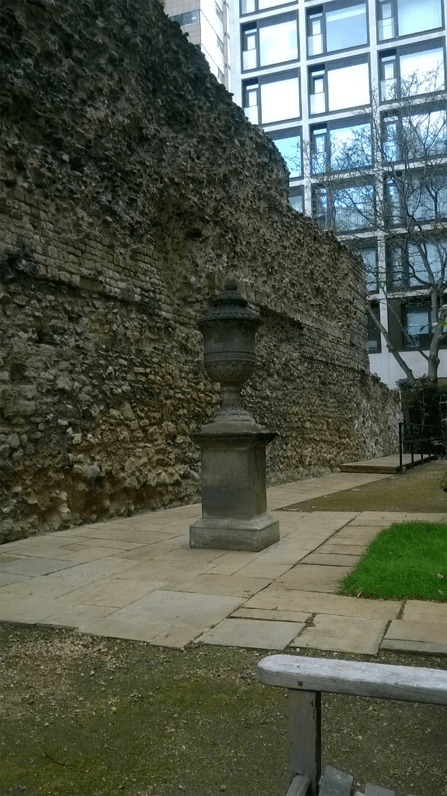
Roman London Wall
This is the one you can climb on: St Alphage. I think this is my favourite because it’s right next to the Roman London Wall, parts of which are nearly 2,000 years old. The walls of the church we see today are the remains of the tower, dating from the 14th Century, all other parts of the church were destroyed in the two World Wars. However, bombing uncovered the remains of the Roman Wall behind the church, previously hidden by more recent buildings, how amazing is that? I love the location of this church, an oasis of ancient in the modern City buildings. I would love to travel back in time 1,000 years just for a glimpse of London as it was then. The adjoining churchyard was built over, thank goodness they left the church alone!
Address: St Alphage Gardens, London Wall Place EC2Y 5EL
Nearest Tube: Moorgate
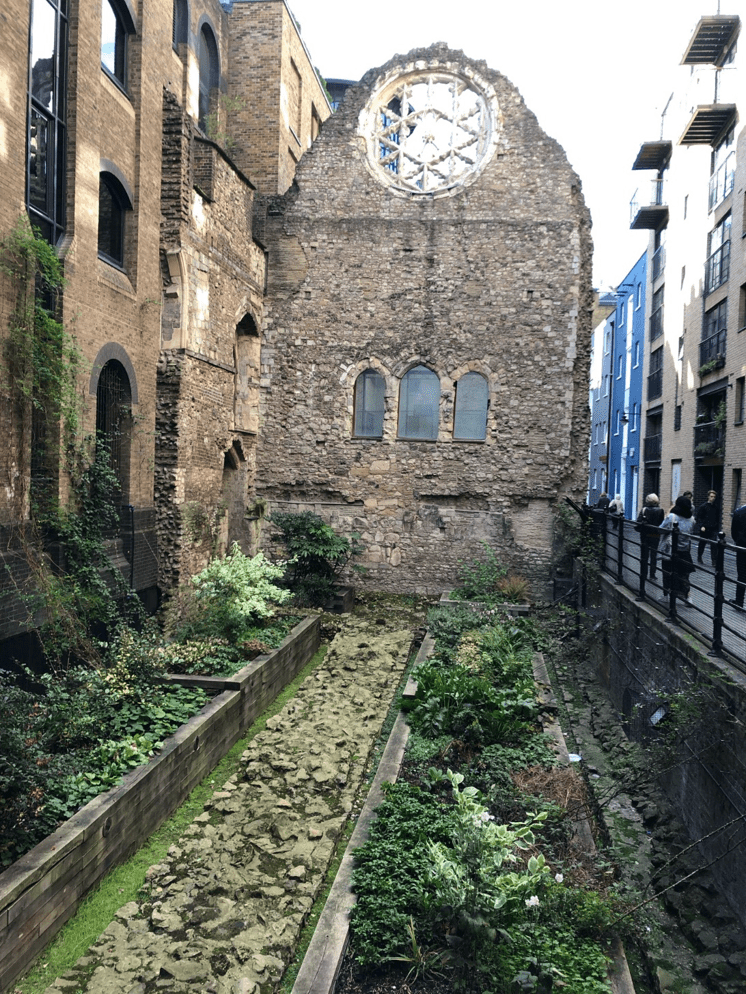
Palace of Westminster
The Palace of the Bishops of Westminster, now with gardens laid out in the grounds
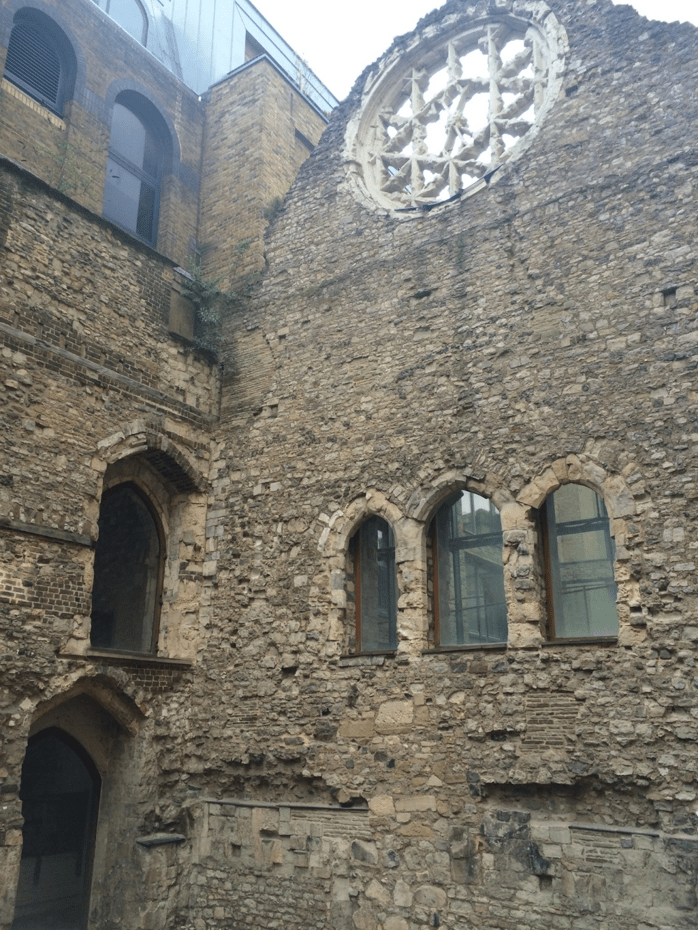
This is all that remains of the palace of the powerful bishops of Winchester, one of the largest and most important buildings in Medieval London. ‘Founded in the 12th Century by Bishop Henry de Blois, it was built to house the bishops in comfort when staying in London on royal or administrative business.’ So says the sign at this site. This is another of the historic buildings that could have easily been completely demolished in subsequent centuries but was revealed when the Southbank area was redeveloped in the 1980s. This area is packed with historic interest: nearby is the Anchor pub on Bankside where Pepys watched the Great Fire burn in 1666; there’s a replica of the Golden Hinde; the Clink Prison Museum; and the replica of Shakespeare’s Globe Theatre.
I love London, I love history, and I’m a Christian, so I decided to do a Blog about Christian London, past and present. Equipped with my 60+ Oyster Card (thanks, Mayor of London), I’ve spent a lot of time wandering the capital and have found that Christianity is alive and well and living in London! Yes, God is here and always has been: in churches, charities, in people and ordinary places. There’s over 1,000 years of Christian heritage in the City, which spread outside its ancient walls as London grew.
So…this is how it’s going to work. Each month I’m going to take a different theme: e.g. buildings/people/churches/places/museums, with a current or historic Christian connection, which I have personally visited, and give my own, sometimes quirky perspective on. There will be 4 or 5 each month, depending on the number of Sundays in the month, totalling 52 by this time next year. That’s the plan, anyway.
First, some acknowledgements.
Tired of London, Tired of Life: One thing a day to do in London; and London: The Weekends start here: 52 Weekends of things to see and do (Virgin Books) are two wonderful books by Tom Jones (not the singer!) about anything and everything that can be visited in London, much of it free. Other ‘What to do in London’ books are available!
Open House London weekend: held on the third weekend in September; all types of buildings in the 33 London boroughs open their doors for free visits, including churches and synagogues. If you’ve never visited, I recommend you go this year!
http://www.london-city-churches.org.uk There are at least 50 church sites in the Square Mile, these are mostly open to the public and each has its unique story and characteristics. It’s encouraging to see how much these churches have done and continue doing to serve their communities. Some have been involved in social action for 1000 years!
So here goes, hope you enjoy my exploration of Christian London……
January – A Parish Church, a Palace, a Park and…some Plants
Walking down from Waterloo Station towards the River, past the London Eye, the London Dungeon, the Shrek Experience, a variety of eateries, and the other tourist draws, you go under Westminster Bridge and it feels like a different part of London. With St Thomas’ Hospital and Evelina’s Children’s Hospital on the left and the Houses of Parliament across the River on the right, there’s a sense of heritage and history, goodwill and peace. A 15-minute stroll brings you to Lambeth Pier, not included in my ‘things beginning with P’ heading, but which I do have something to say about later. Cross the road and you reach….
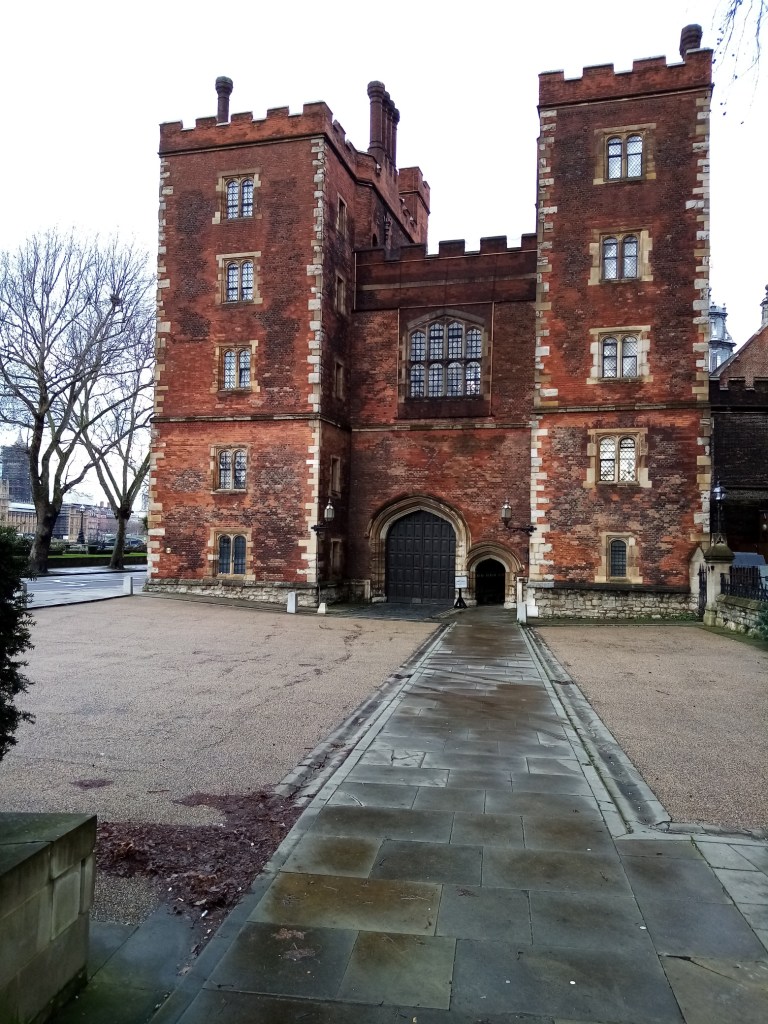
A Palace – Lambeth Palace has been the London residence of the Archbishop of Canterbury for 800 years. (I thought Justin Welby was looking old….) The oldest remaining part of the palace is the Lollard’s Tower (1435) which was used as a prison in the 17th Century. And there’s this Tudor gatehouse which gives the palace its imposing frontage.
Front of Lambeth Palace
When I walked down Lambeth Palace Road to look at other parts of the Palace, I found it was covered with hoardings as the palace’s library is being refurbished. I was a little disappointed until I noticed what’s written on the hoardings: