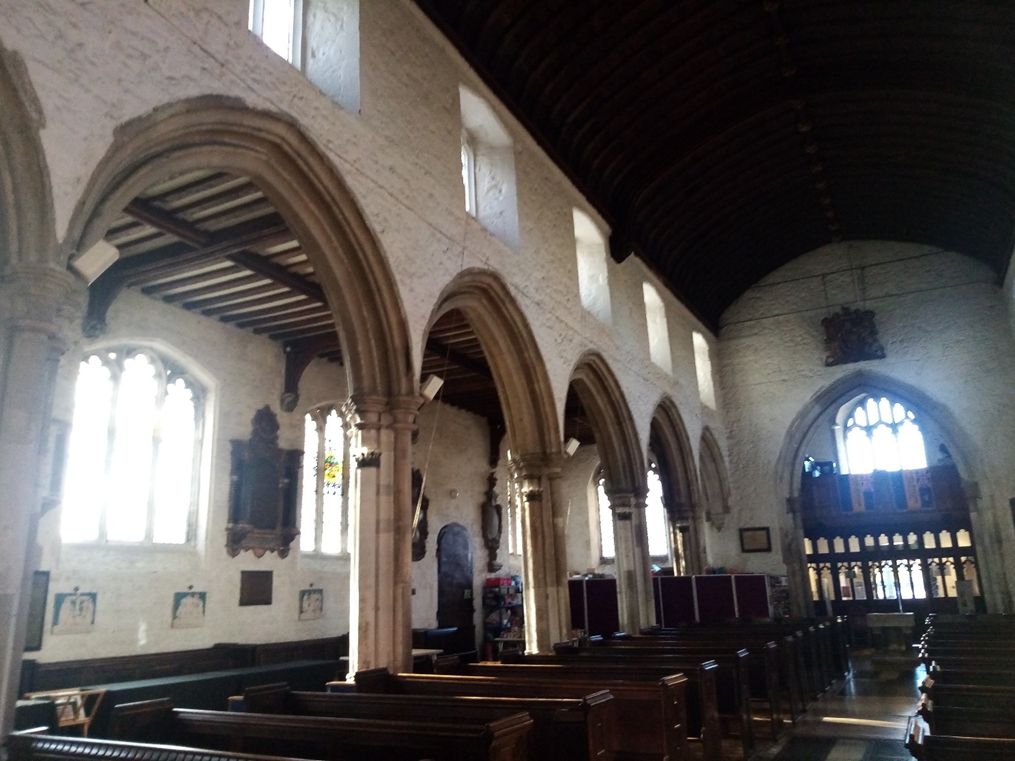
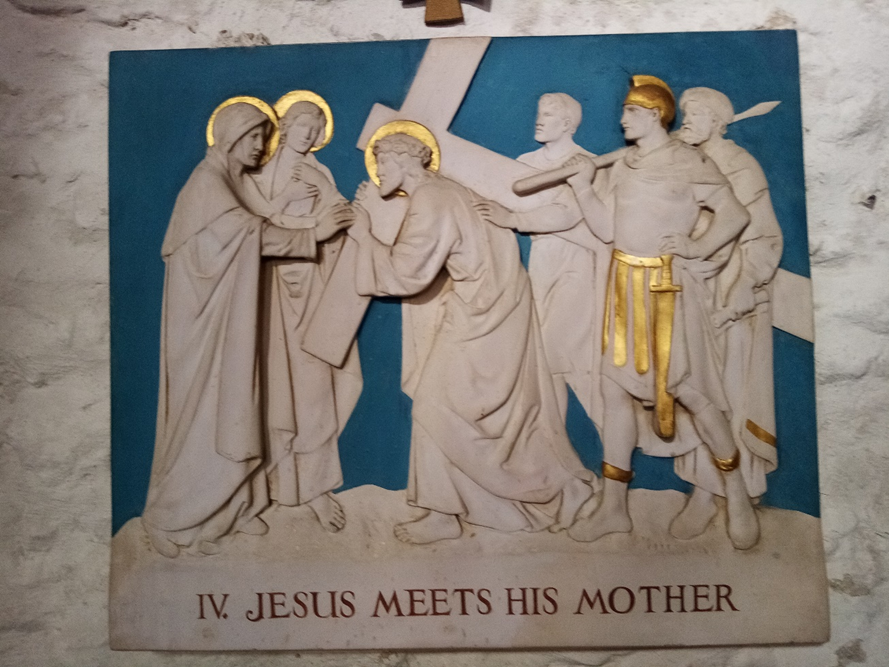
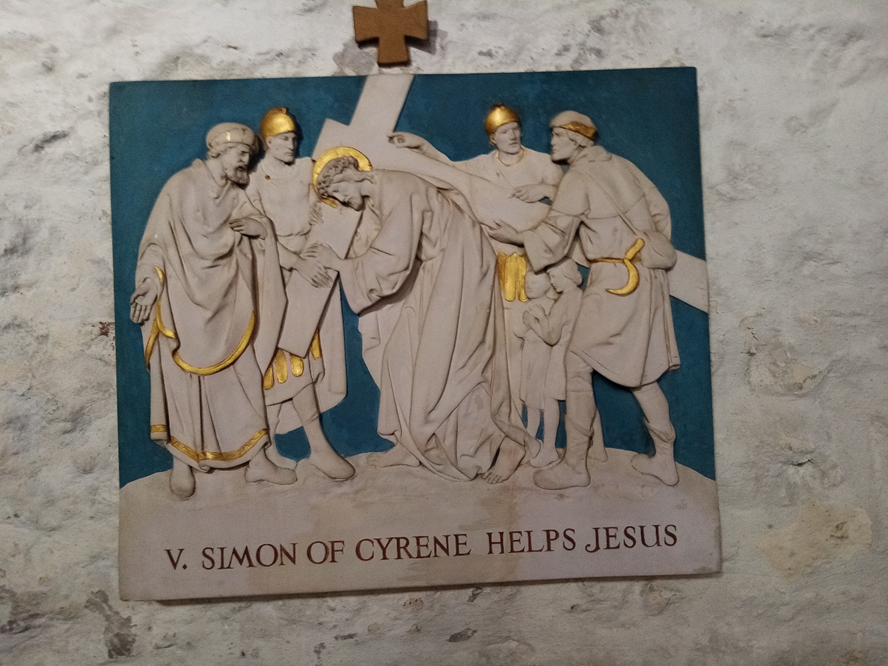
August – Pocket Parks

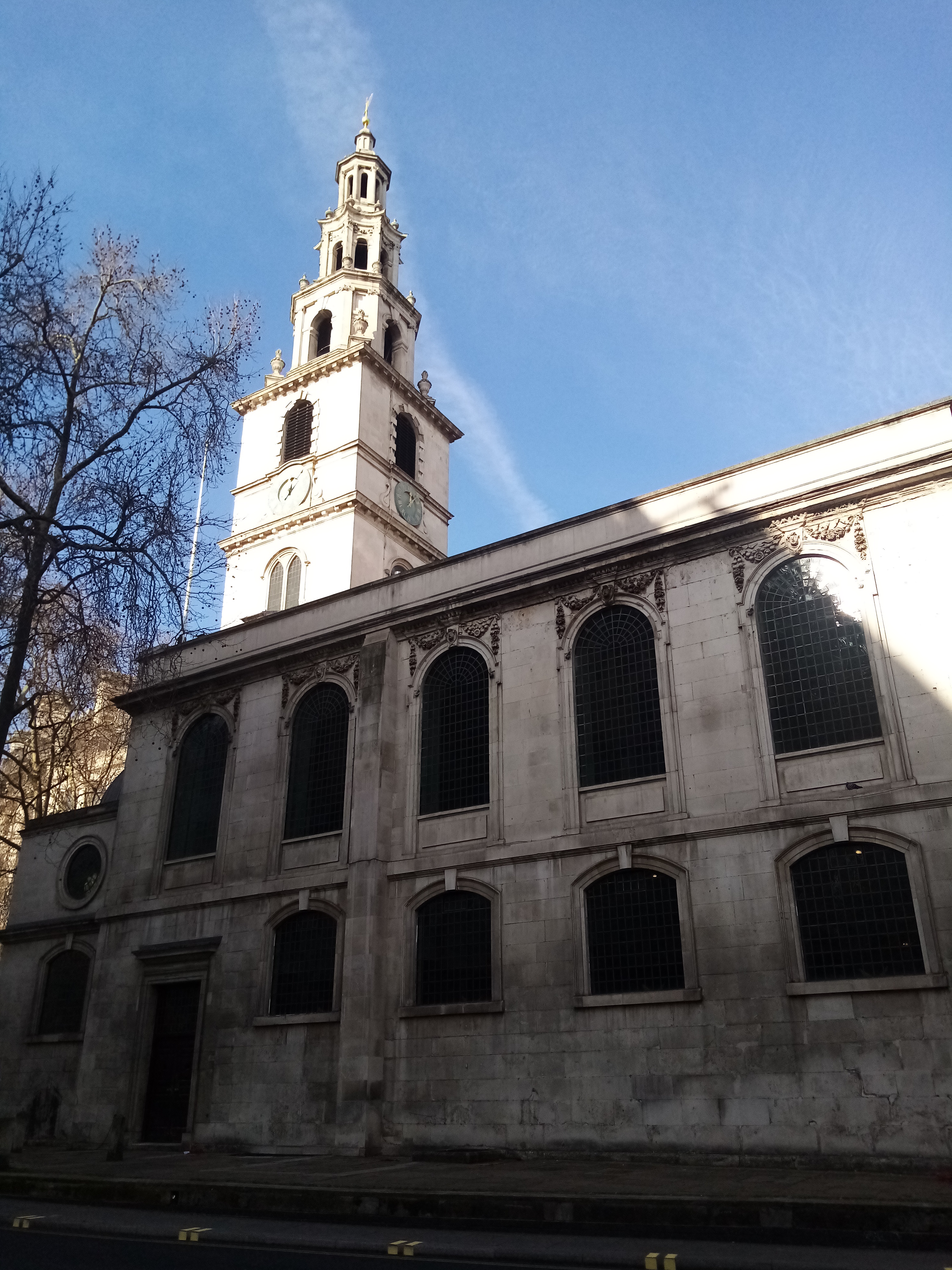
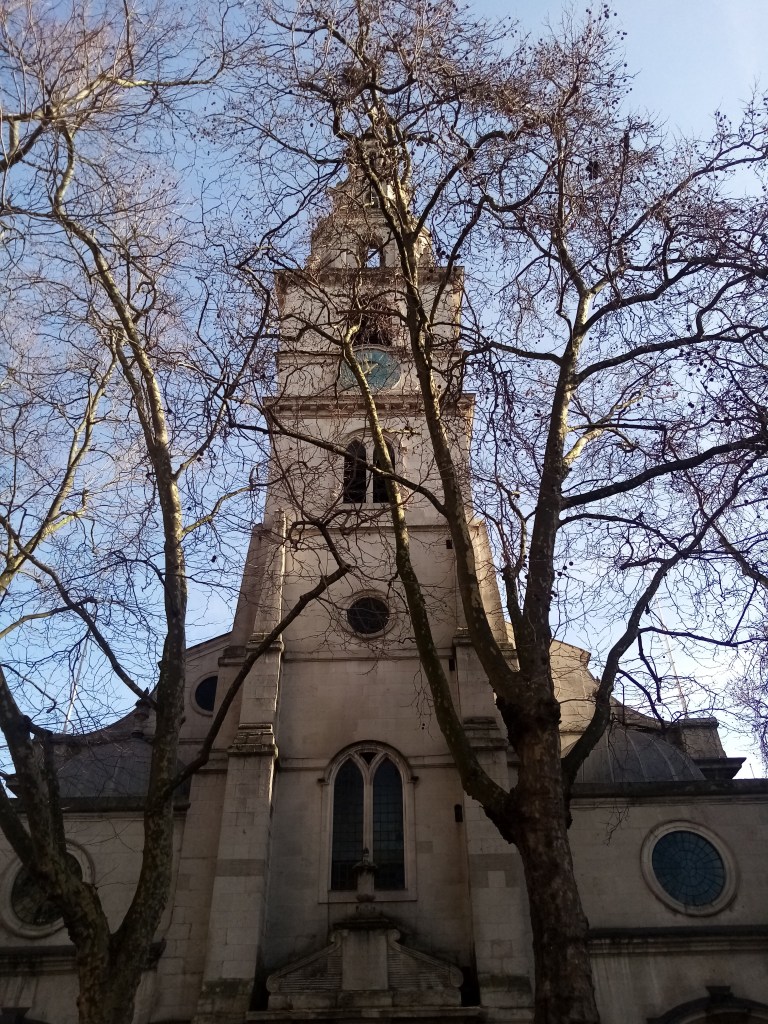
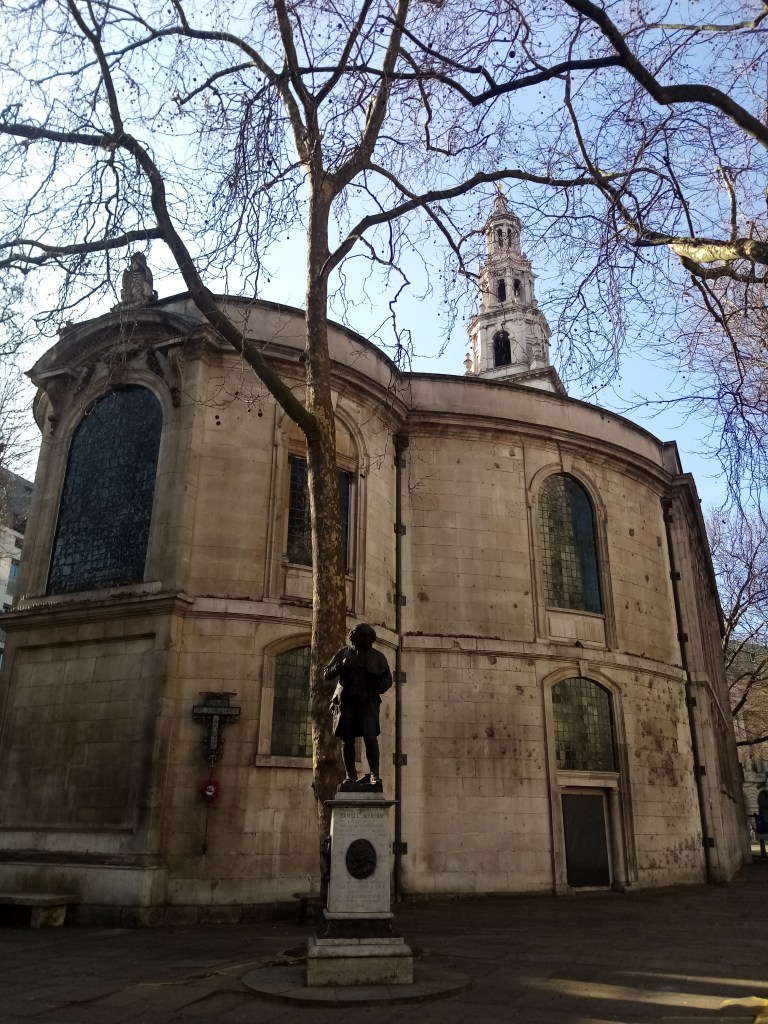
I featured some gardens in City churchyards in January 2021 when it wasn’t possible to go inside churches because of COVID restrictions. But I didn’t know that these small oases dotted around the City are known as Pocket Parks. Mostly frequented by office workers in their lunchbreaks, they are lovely, leafy green spaces to sit and relax, especially in Summer. Here are four from the west of the City of London; three are sites where the church is long gone, the fourth is a somewhat larger pocket next to a church, and one of my favourite parks. I’m hoping to look at another four over to the East next month.

Christchurch Greyfriars Churchyard
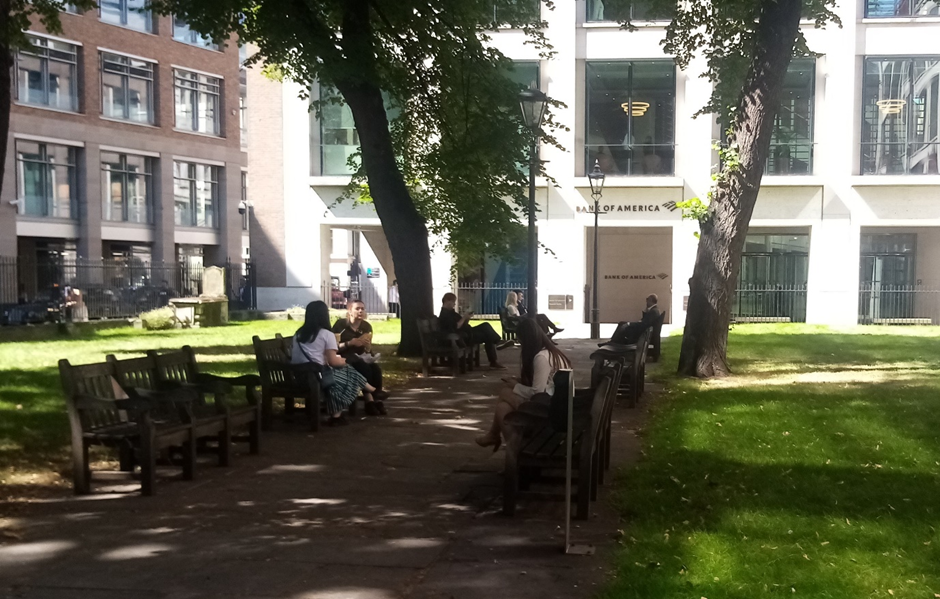
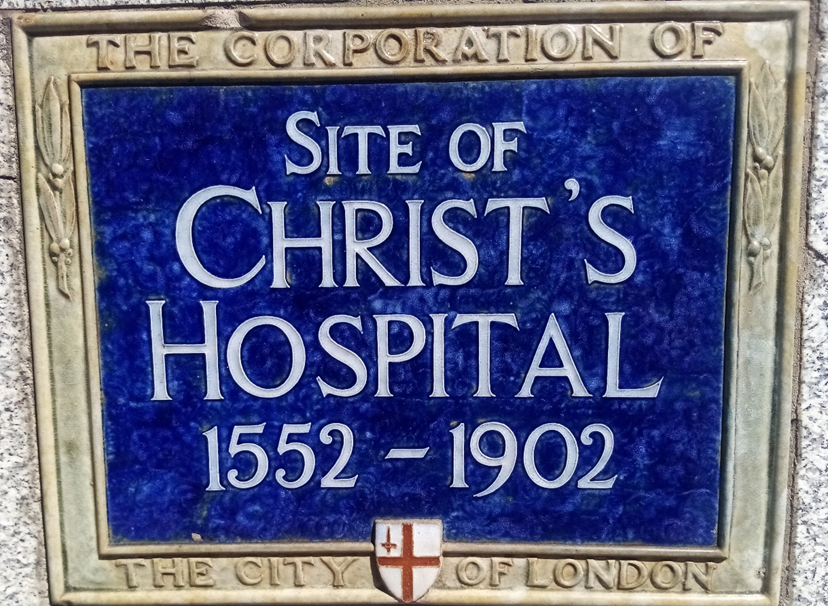
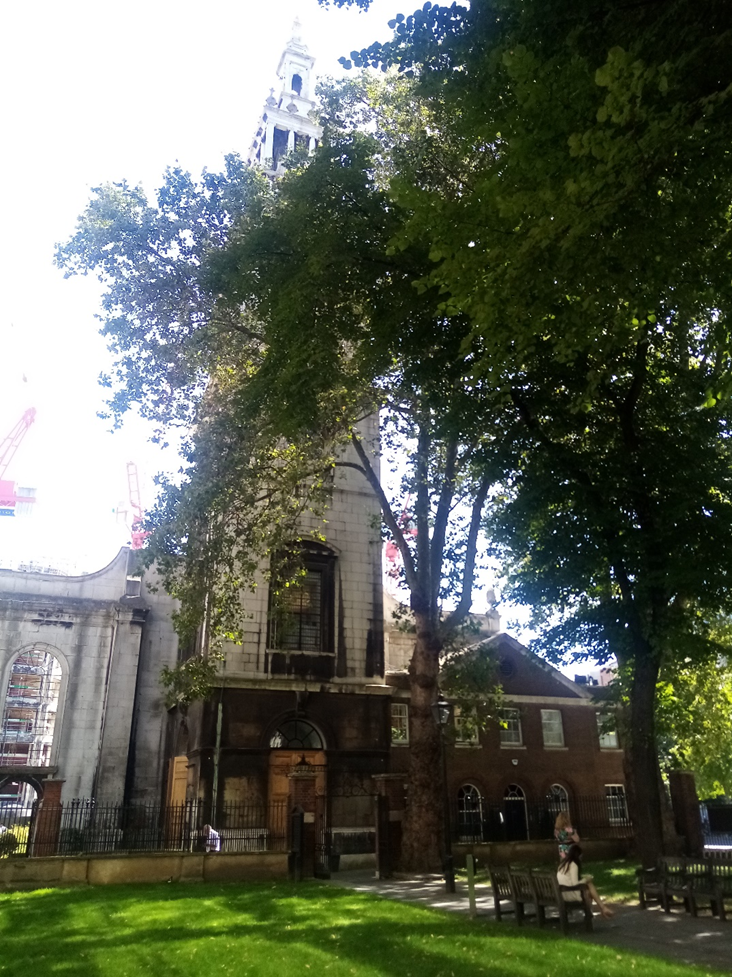
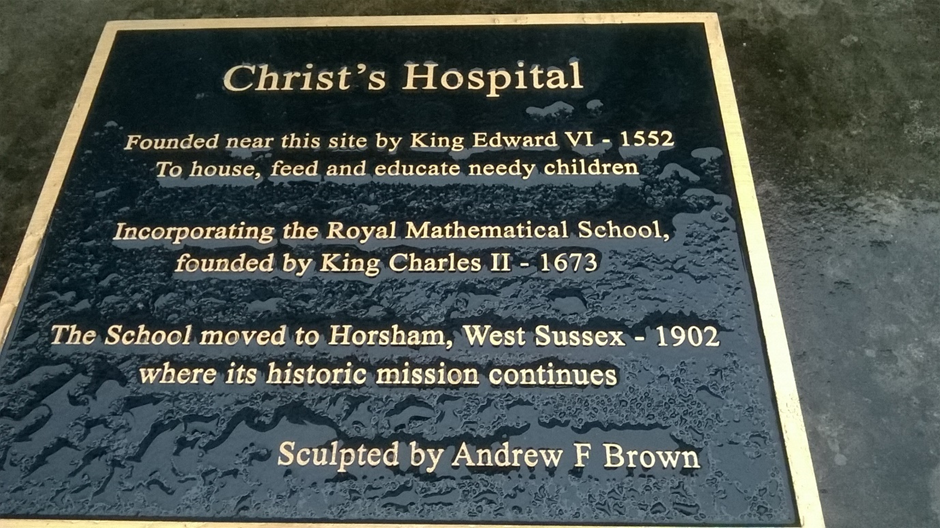
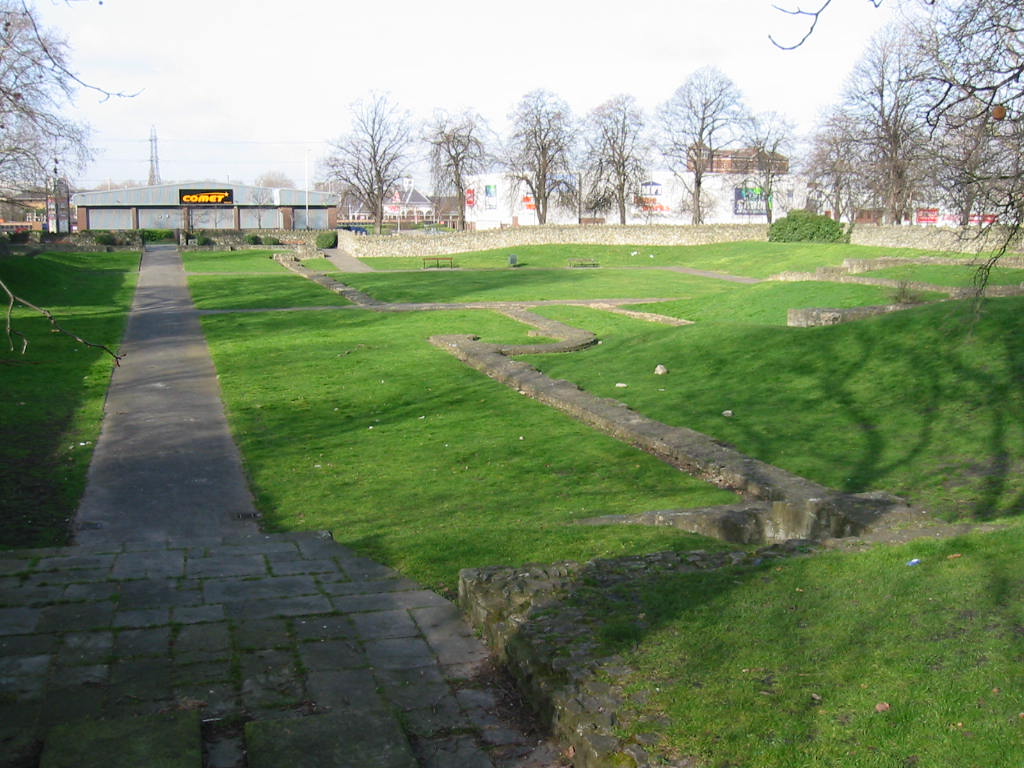
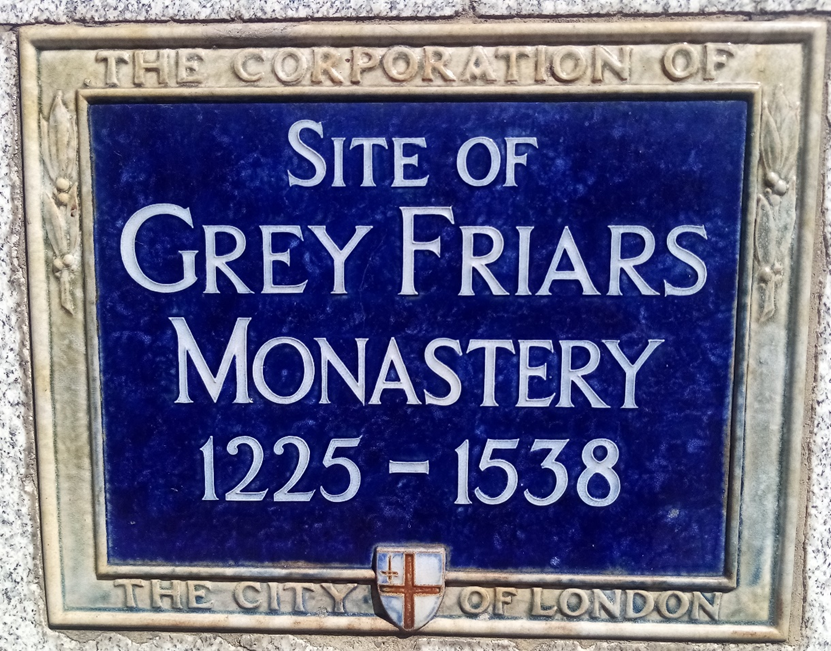
The garden is in two parts: a beautifully restored flower garden in the nave of the bombed-out Wren church (I wrote about this in ‘Romantic Ruins’ way back in February 2020), and this plain grassed area with shady trees and benches. The two areas are separated by the restored church tower which looks very dramatic from either side. The reason for including this very ordinary looking garden is because part of this site was once a huge Franciscan monastery. The name Greyfriars is a reference to the grey habits that the monks wore. The first building (1225) was quite small but the replacement, begun in the 1290s was much larger, the second largest religious building in Medieval London. It was 91m long and 27m wide and had 11 altars! These two plaques are on the wall of the Bank of America building adjacent to the park; it’s a huge building but the priory would have been bigger! The monastery was dissolved in 1538 in the Reformation and the building and fittings were badly damaged and looted, and left in ruins. But in 1546 Henry VIII gave the priory to the City Corporation and the buildings were converted into Christ’s Hospital School in 1552, founded by Henry’s son, Edward VI. The word hospital was also a term for place of education or shelter, not just a place for health care. The school remained on this site for the next 350 years, relocating to Horsham in 1902.

Source: Wikipedia
Goldsmith’s Garden
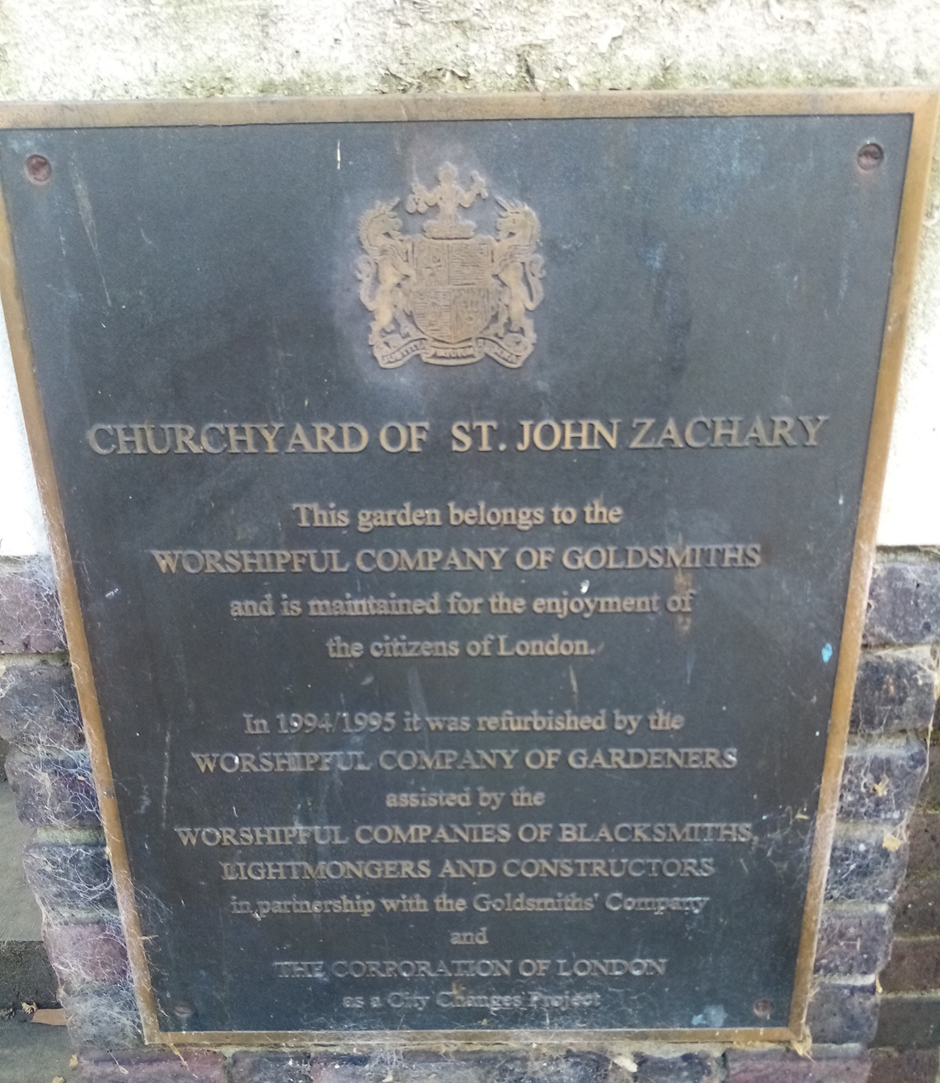
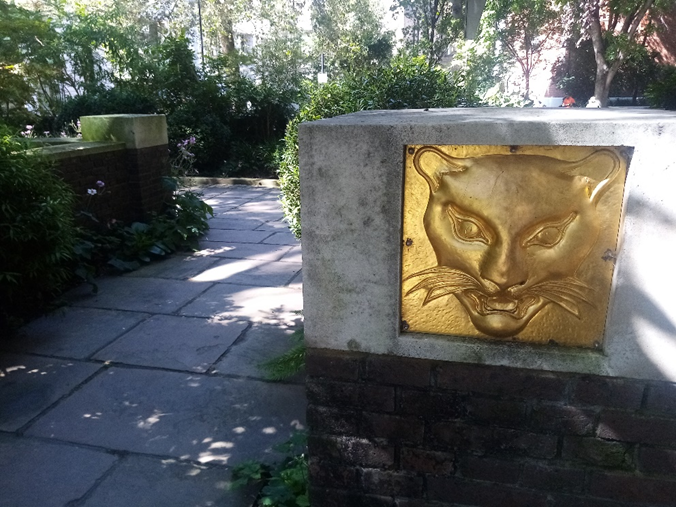
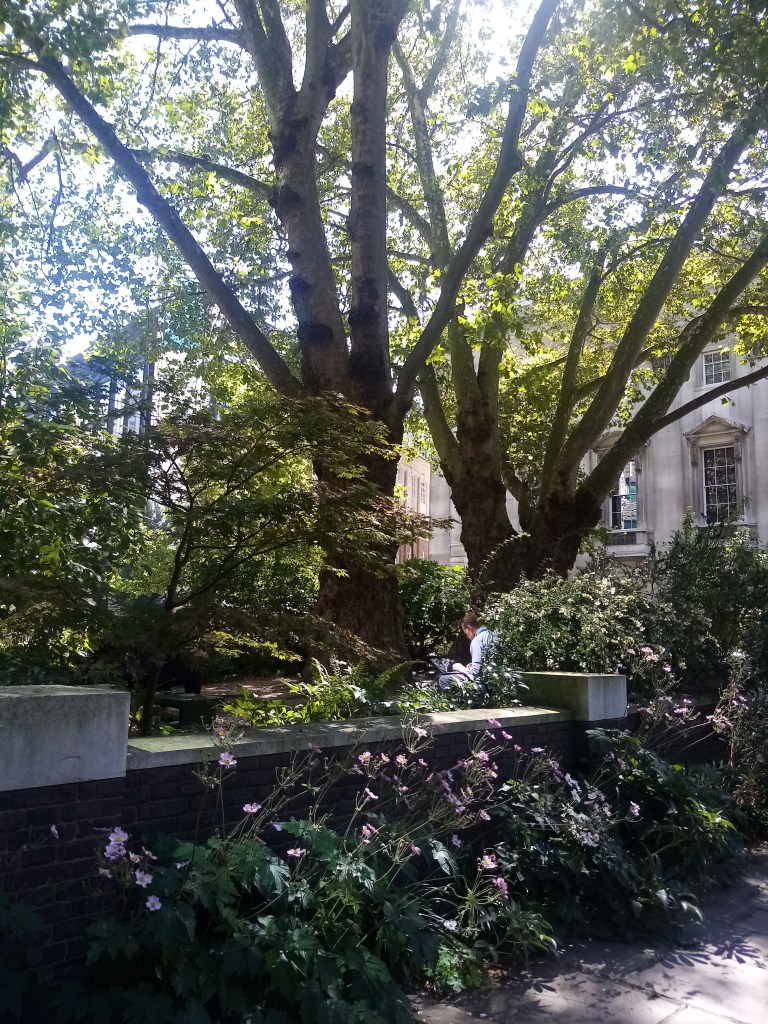
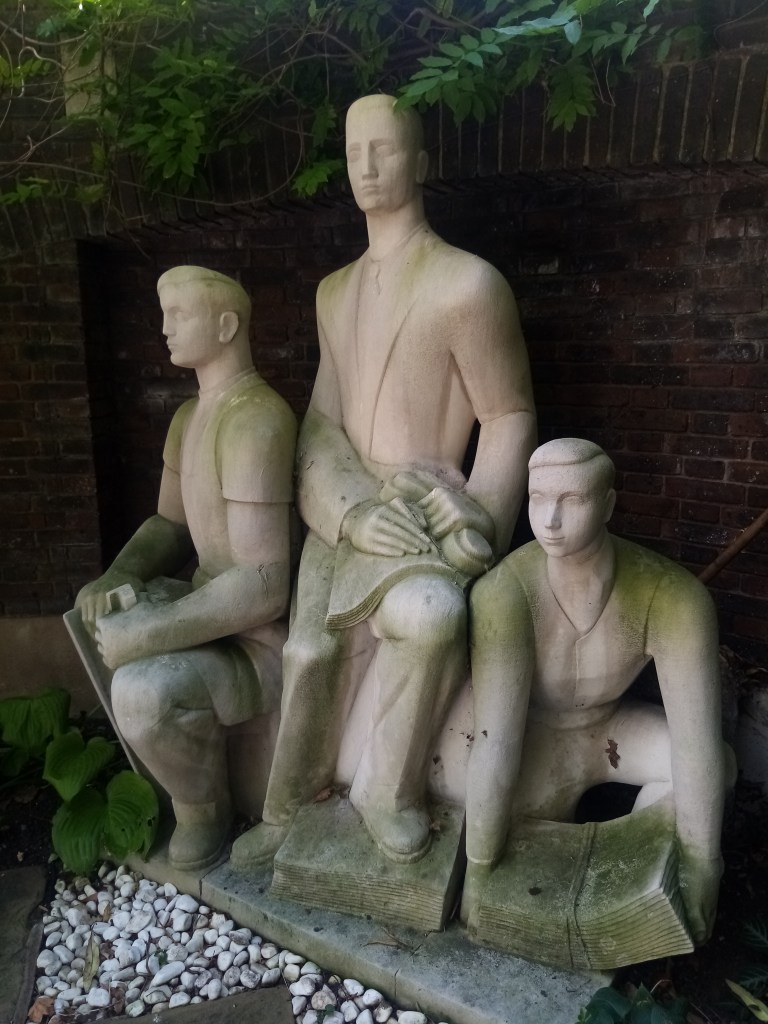
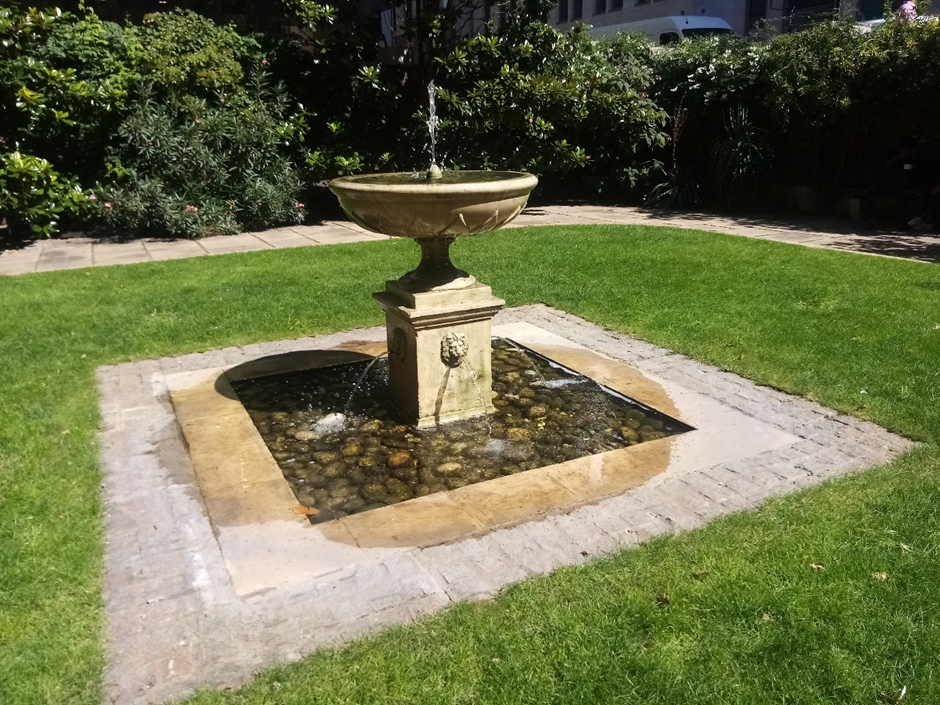
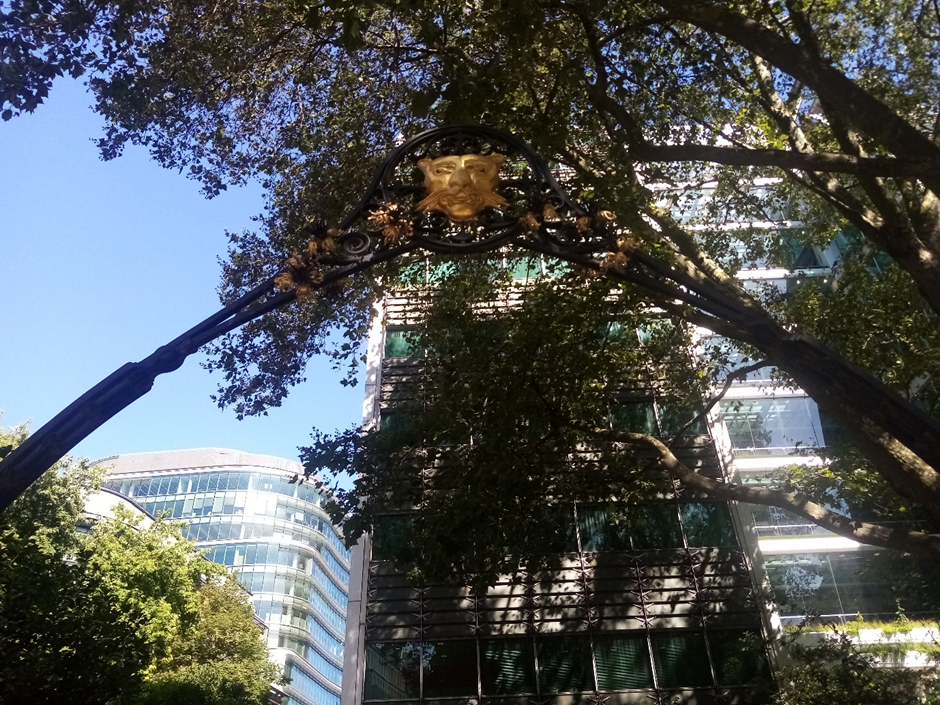
The next Pocket Park is Goldsmith’s Garden, former churchyard of St John Zachary. The original church, dedicated to John the Baptist (John, son of Zachary) was destroyed in the Great Fire and not rebuilt. The site was first laid out as a garden by World War Two fire wardens in 1941 and is now owned by the Worshipful Company of Goldsmiths whose livery hall is across the road on the other side of Gresham Street. In 1995 the garden was refurbished by the Worship Companies named on the plaque above, creating the garden we see today. The garden is on two levels: at street level there are benches and flower borders with a huge London plane tree in the centre offering welcome shade. Down some steps to a square sunken garden with a small fountain in the middle of a grass lawn and in one corner, The Three Printers, a statue by Wilfred Dudeney. It depicts a newsboy, a printer and an editor, and surprisingly, is Britain’s only public monument to the newspaper industry. The statue was originally situated in New Street Square, Holborn but was relocated when the square was redeveloped. The other interesting items in the garden are these plaques of golden leopards, the symbol of the Goldsmiths’ Company.

Sources: Wikipedia; ianvisits.co.uk
St Olave’s, Silver Street

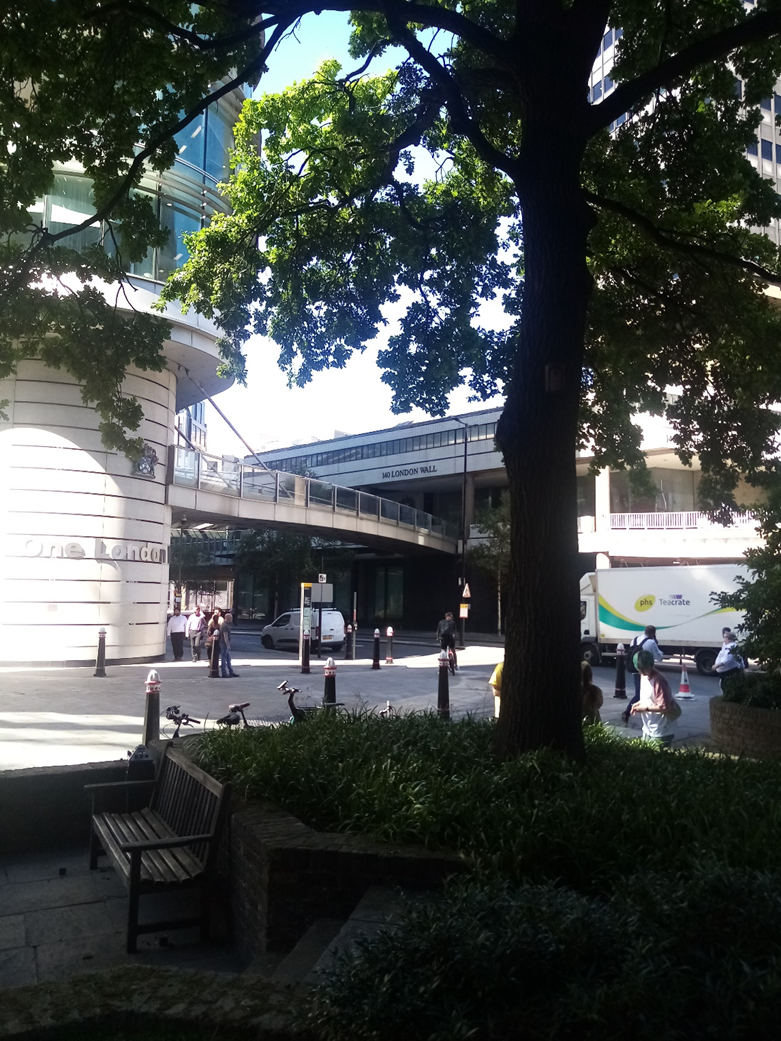
Photo taken from the garden looking towards 1 London Wall and the Museum of London

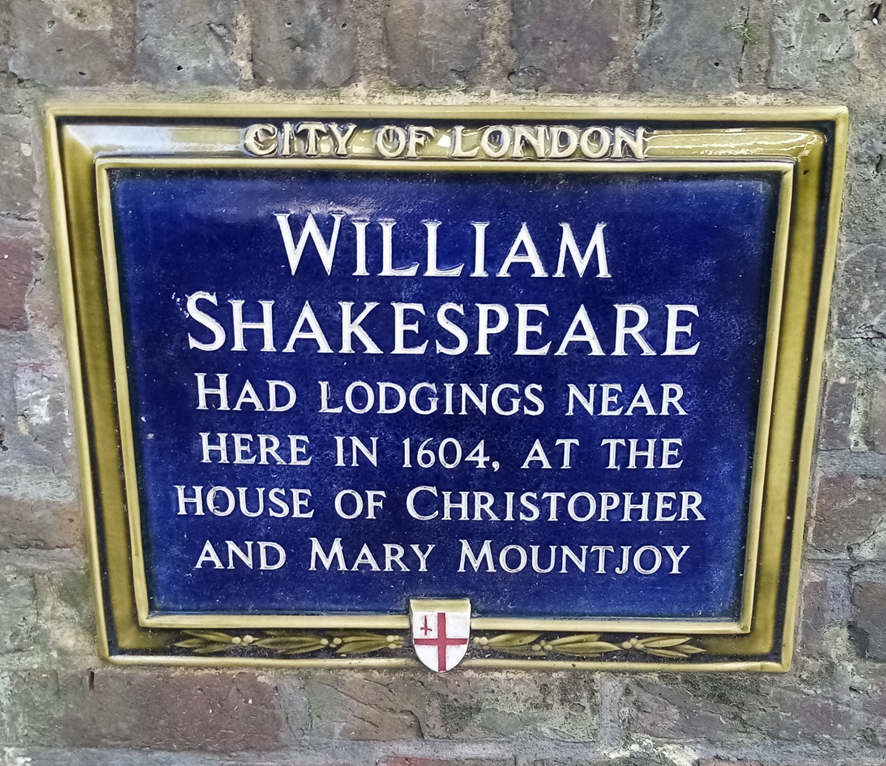
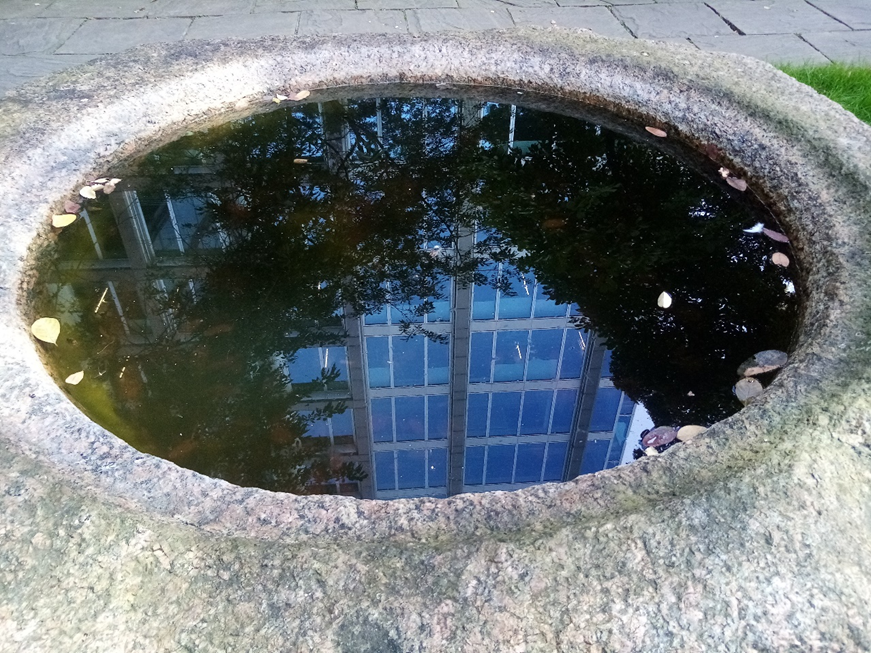
The Medieval London City landscape looked vastly different to how we see it today. Instead of modern office blocks of various sizes there were churches – lots of churches, so many of which did not survive fire and war. St Olave’s Silver Street is a stone’s throw from Goldsmith’s Garden and is on the corner of Noble Street and the dual carriageway that is London Wall. The church that stood here was destroyed in the Great Fire and never rebuilt but the site was maintained as a churchyard for burials.  The church was dedicated to St Olaf, one of three churches with this name in the City; Olave is the anglicised spelling of Olaf. He was the first Christian king of Norway and fought alongside the English against the Vikings at the Battle of London Bridge in 1014. On his death, Olaf was canonised and remains the patron saint of Norway. This area was one of the most heavily bombed in World War Two, consequently it was completely redeveloped post-war, with the creation of the Barbican Estate and the construction of London Wall, which the original Silver Street became part of. Some interesting things about this Pocket Park: William Shakespeare lived on Silver Street for a few years in the early 1600s, very probably he attended St Olave’s. A very worn plaque, found in the rubble of the Blitz reads: ‘THIS WAS THE PARISH CHURCH OF ST OLAVE SILVER STREET DESTROYED BY THE DREADFULL FIRE IN THE YEAR 1666.’ And lastly, I love this reflective pool of water in what is probably one of the church’s columns.

Source: livinglondonhistory.com
Photo Credit: livinglondonhistory.com

Postman’s Park

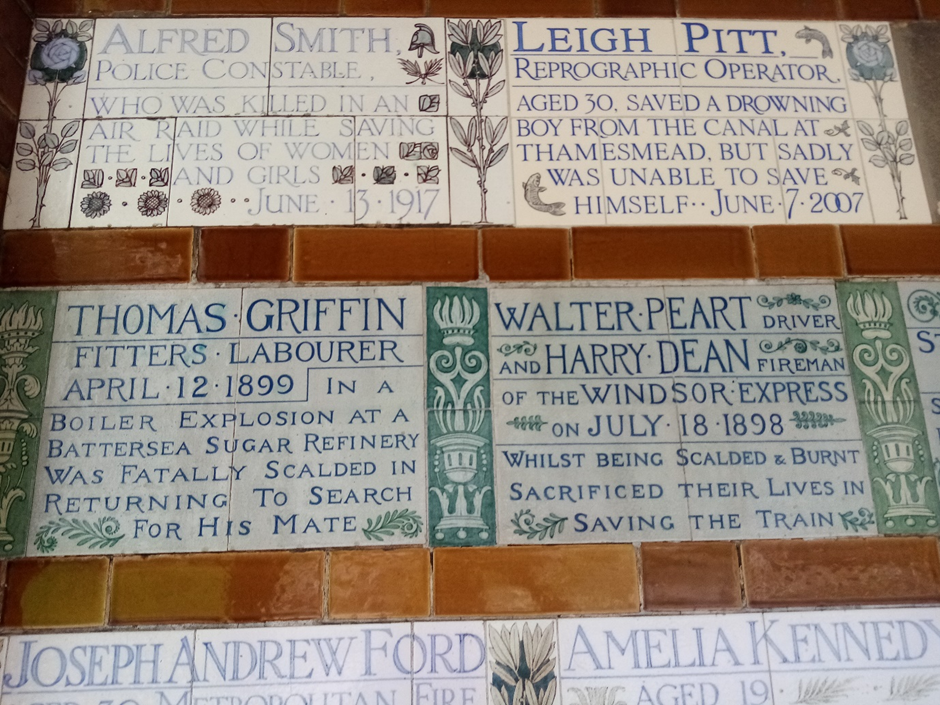
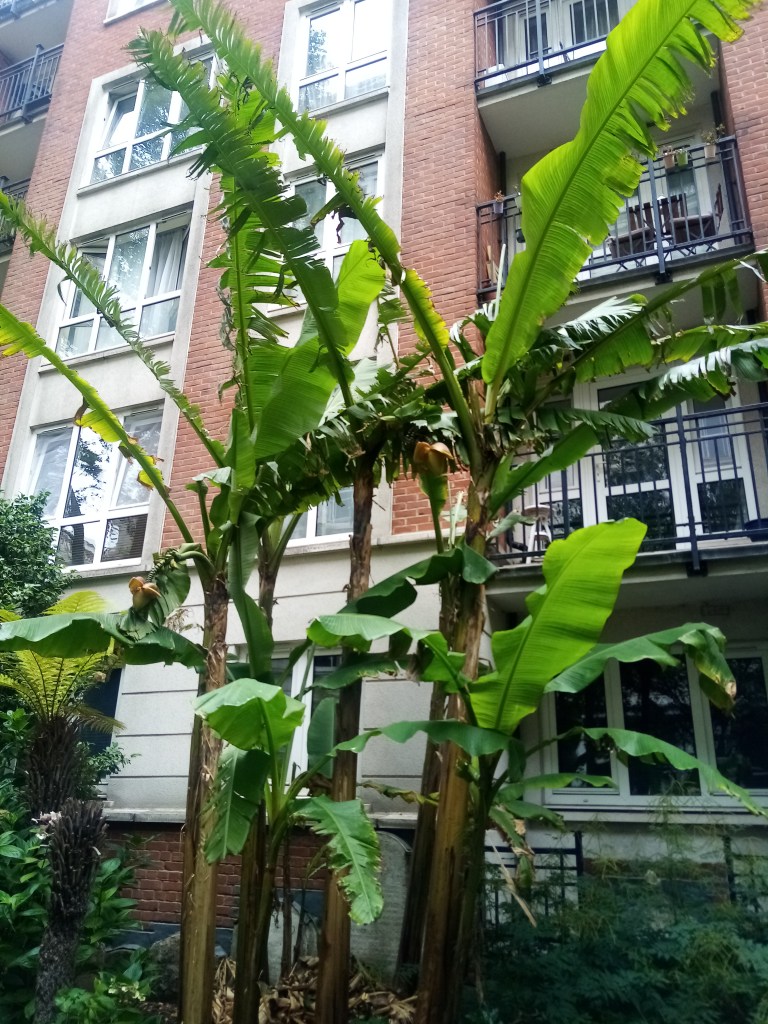
Postman’s Park opened in 1880 on the site of the former churchyard of St Botolph’s Aldersgate, a church still standing and in use (I wrote about it in ‘Churches on the London Wall’ February 2022). The Park is so named because the General Post Office (GPO) had its headquarters nearby and the park became very popular with workers in the building. The churchyard continued as a burial ground for the next 20 years and then in 1900, the artist and sculptor George Frederic Watts proposed a national monument be erected to the bravery and self-sacrifice of ordinary people. After rejecting the idea of a single huge bronze figure ‘a statue to Unknown Worth’, he came up with the idea of recording acts of self-sacrifice on individual tablets to be displayed on a memorial wall. The Vicar of St Botolph’s purchased the land from the City Parochial Foundation (who planned to build on it) and Watts himself paid the £700 (£84,000 in 2023) and Watt’s Memorial to Heroic Self-Sacrifice was created. By the time of Watt’s death in 1904 only 13 of the planned 120 memorial tablets were in place; his wife Mary continued the project, overseeing the installation of a further 40. In 2009, a new tablet was added to the memorial, the first for 78 years. I love how spacious this park is and that it’s not overlooked by tall buildings, and has some lovely palms and ferns. Absolutely worth a visit, it’s where we stopped for lunch on my ‘Churches on the London Wall’ Walking Tour.

Source: Wikipedia
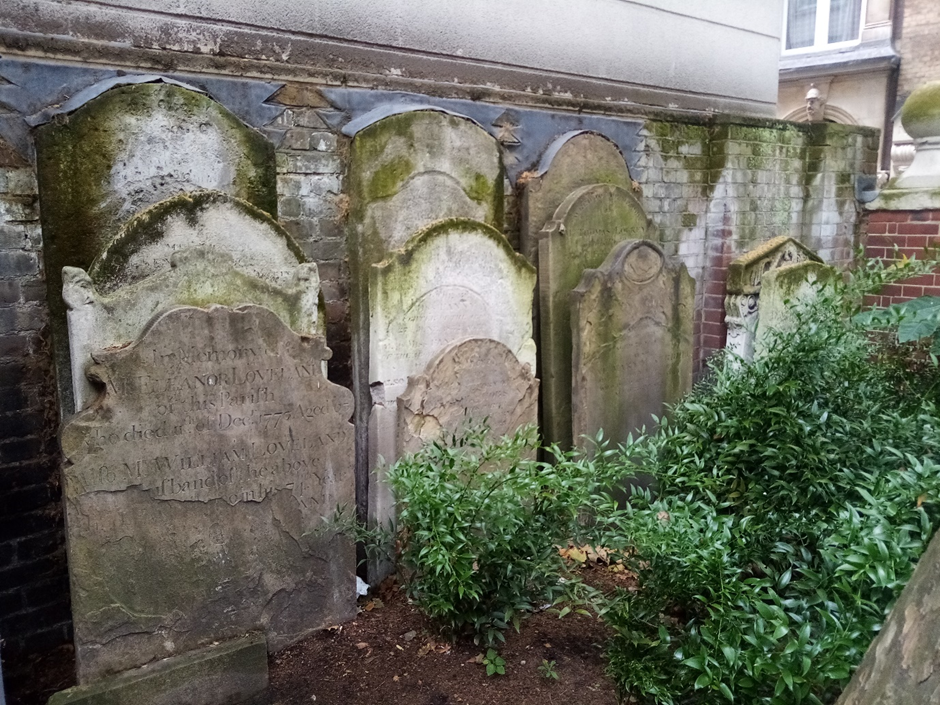
Gravestones stacked against a wall at Postman’s Park

And lastly….I spotted the City gardeners’ van, thanks guys!

smart

July – Churches with Domes

The dome of Christopher Wren’s masterpiece church, St Paul’s Cathedral, is one of the most iconic and recognisable landmarks in the City of London, a must-see for every tourist. It even features on the moquette seats of the London Underground, along with the London Eye! I’ve featured St Paul’s before, but the wonderful dome has its own interesting story and deserves its own entry. There are several other London churches which feature domes, all with interesting histories and beautifully designed interiors:

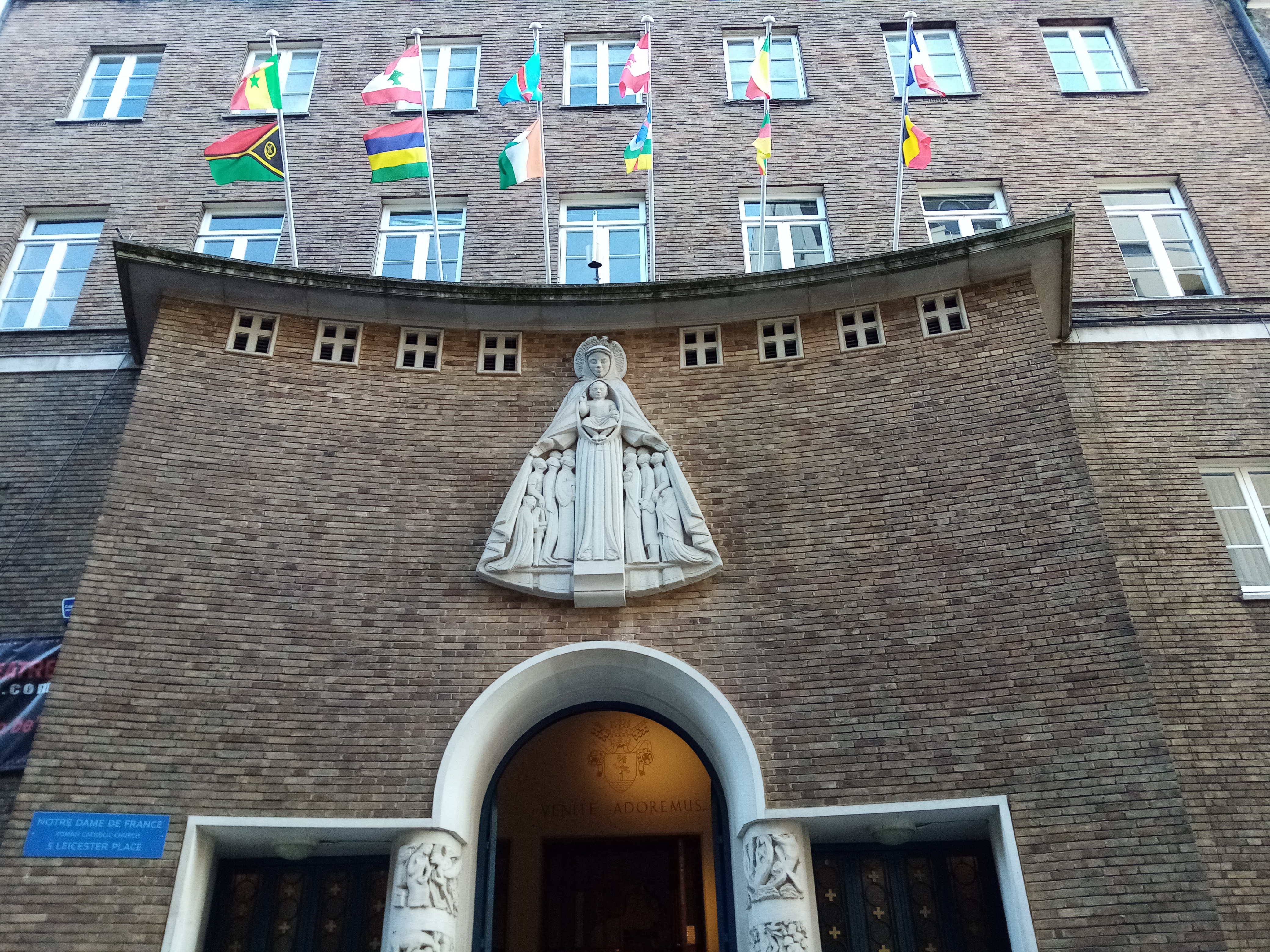
Notre Dame de France, Leicester Square

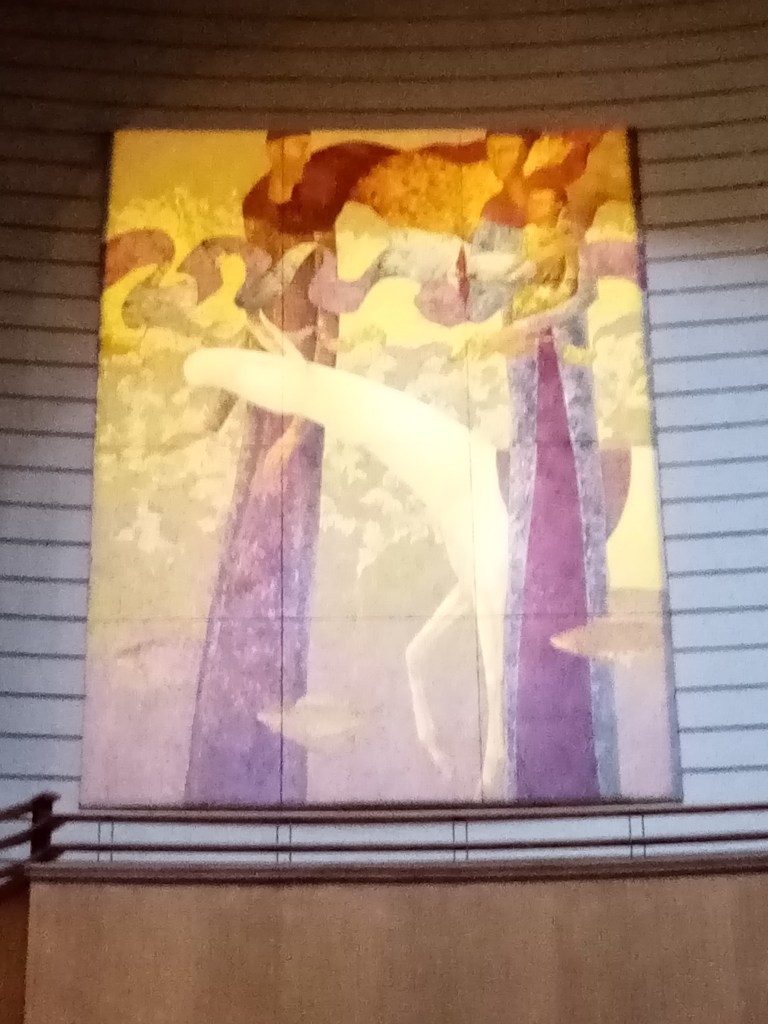
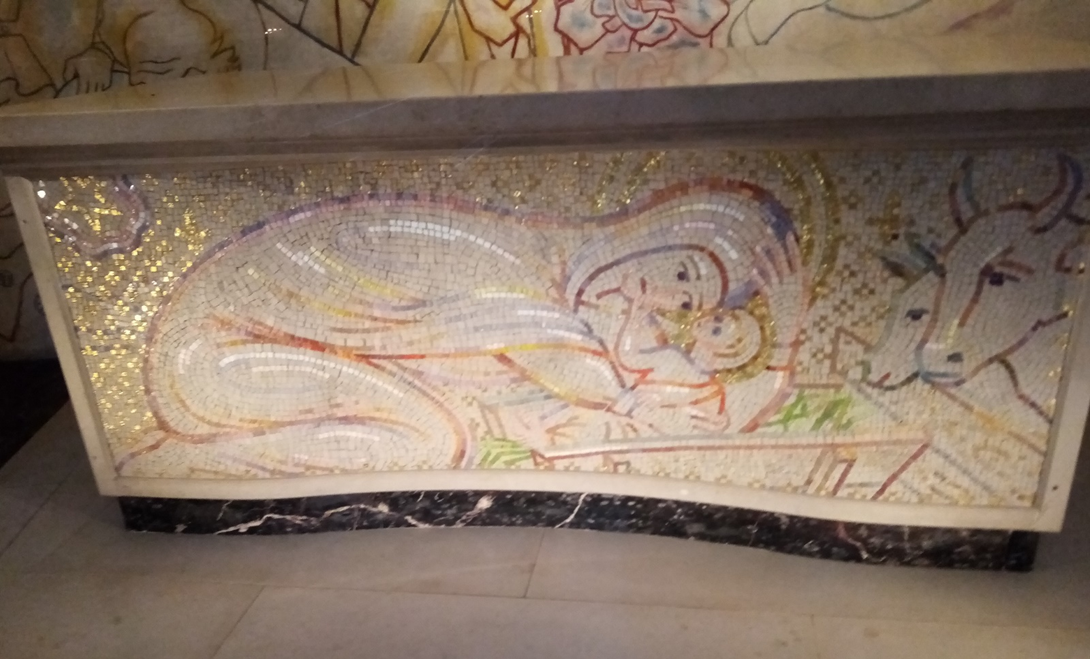
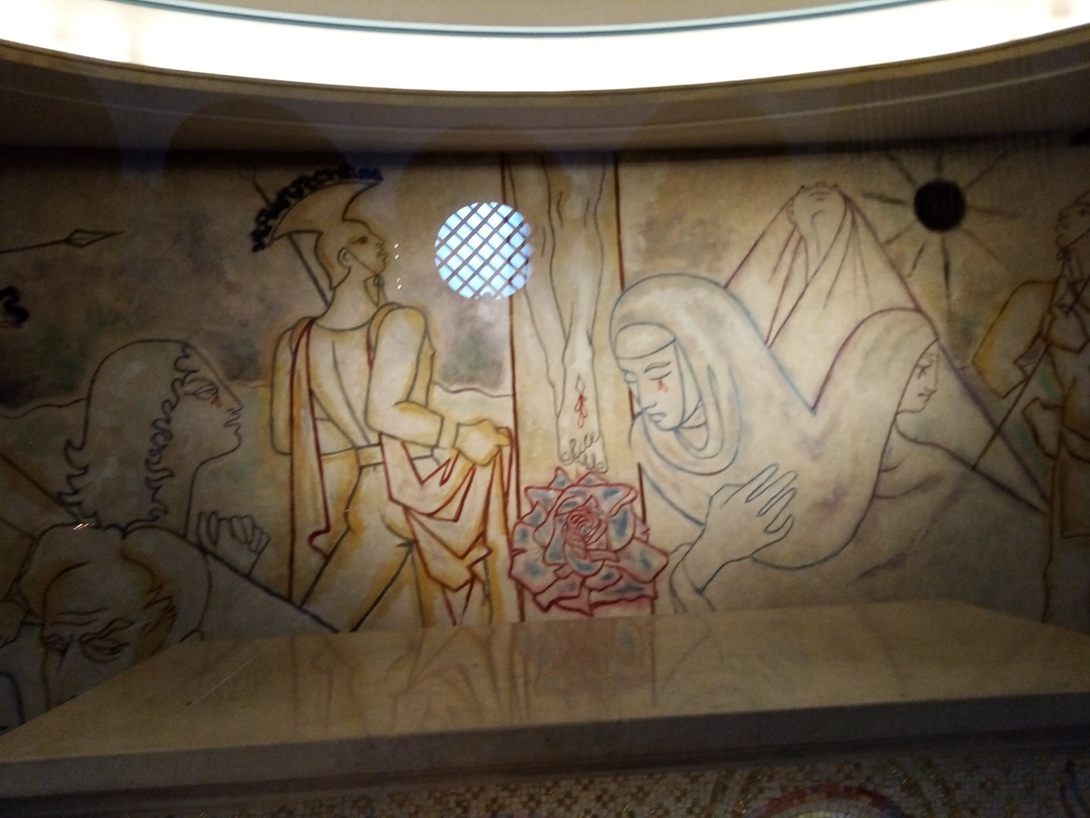
This is a French Roman Catholic Church located just off Leicester Square. The use of the building as a church dates back to the mid-1800s, but the building itself is older and previously served a completely different purpose. In 1861 the Archbishop of Westminster, Cardinal Wiseman, wanted to establish a church to support the large French community in the area around Soho. In charge of the project was Father Charles Faure, who discovered and purchased a circular building known as Burford’s Panorama; an early form of visual entertainment and a tourist attraction in the early 1800s (precursor to the moving picture house which now dominates Leicester Square.) Faure employed a French architect to transform the building into a church, retaining the dome as a feature. The church was badly damaged by bombing in 1940 and had to have extensive structural repairs and redecoration, finally reopening in 1948. The French cultural attaché Rene Varin, with the support of the French Ambassador and British Prime Minister Anthony Eden, wanted to create ‘a sacred space that would honour France’ and approached eminent artists of the time to create artworks to decorate the newly rebuilt church. The interior of the church feels like part worship space, part art gallery and looks surprisingly modern, definitely not 75 years old. Worth a visit if you are in Leicester Square, here’s a taster of the artworks:

Sources: Notre Dame de France Church Website; Wikipedia

Mosaic of the Nativity by Russian artist, Boris Anrep (1954)
Crucifixion by Jean Cocteau (1960)
I nearly forgot to include the dome!

St Stephen Walbrook

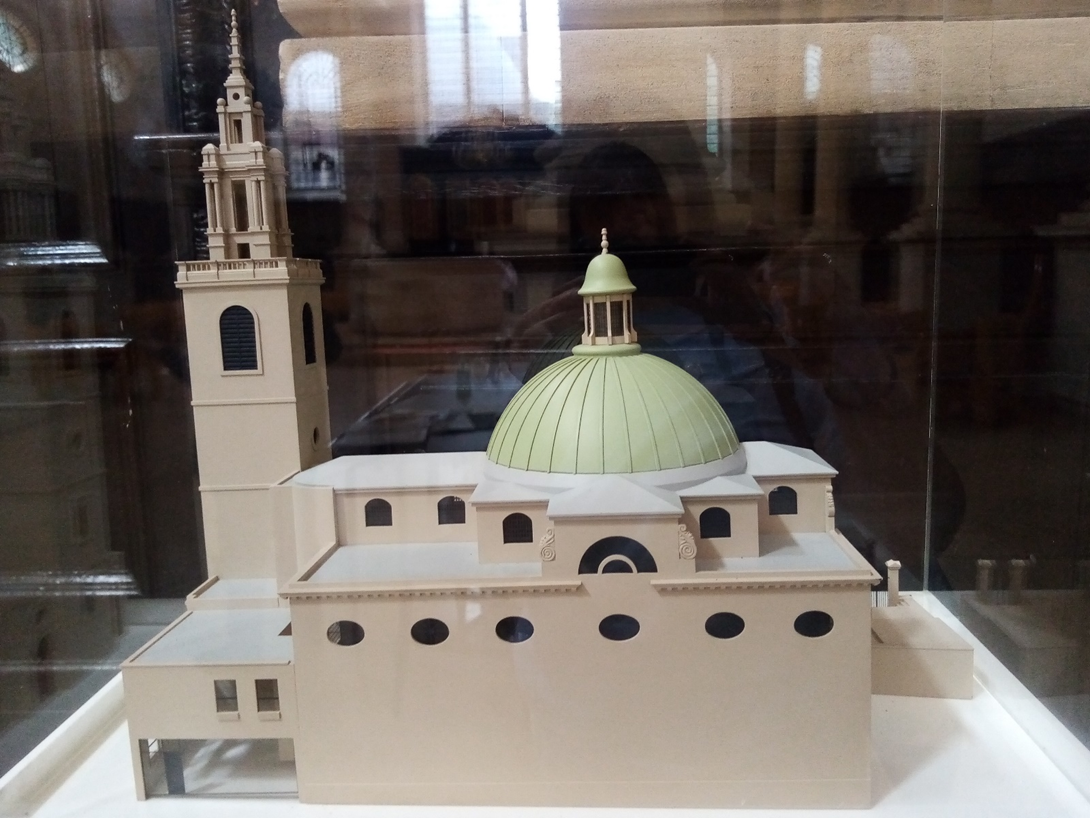
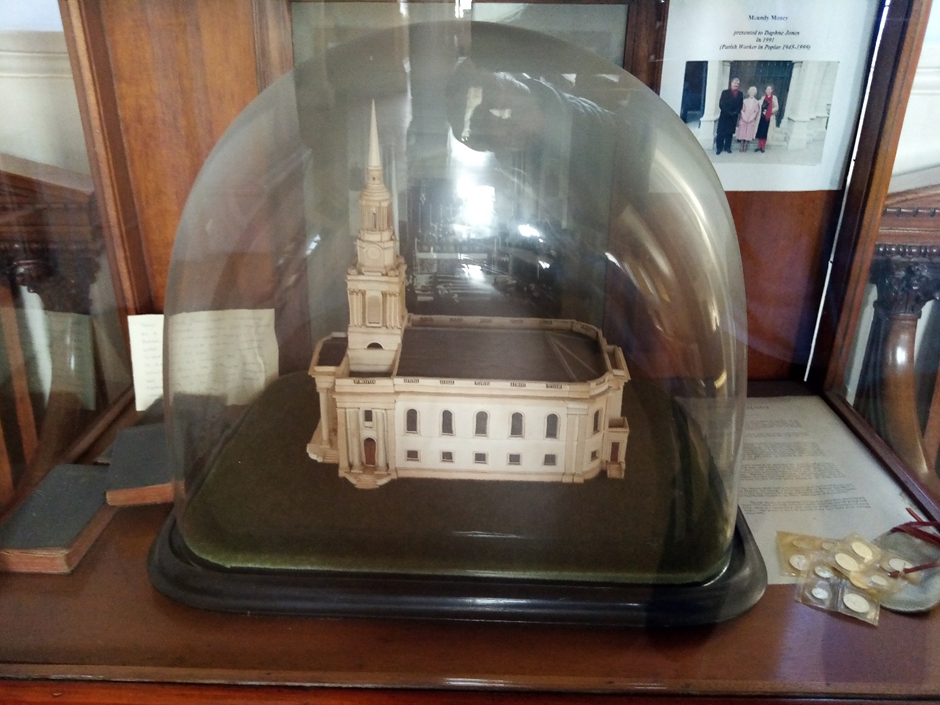
Model of St Stephen inside the church

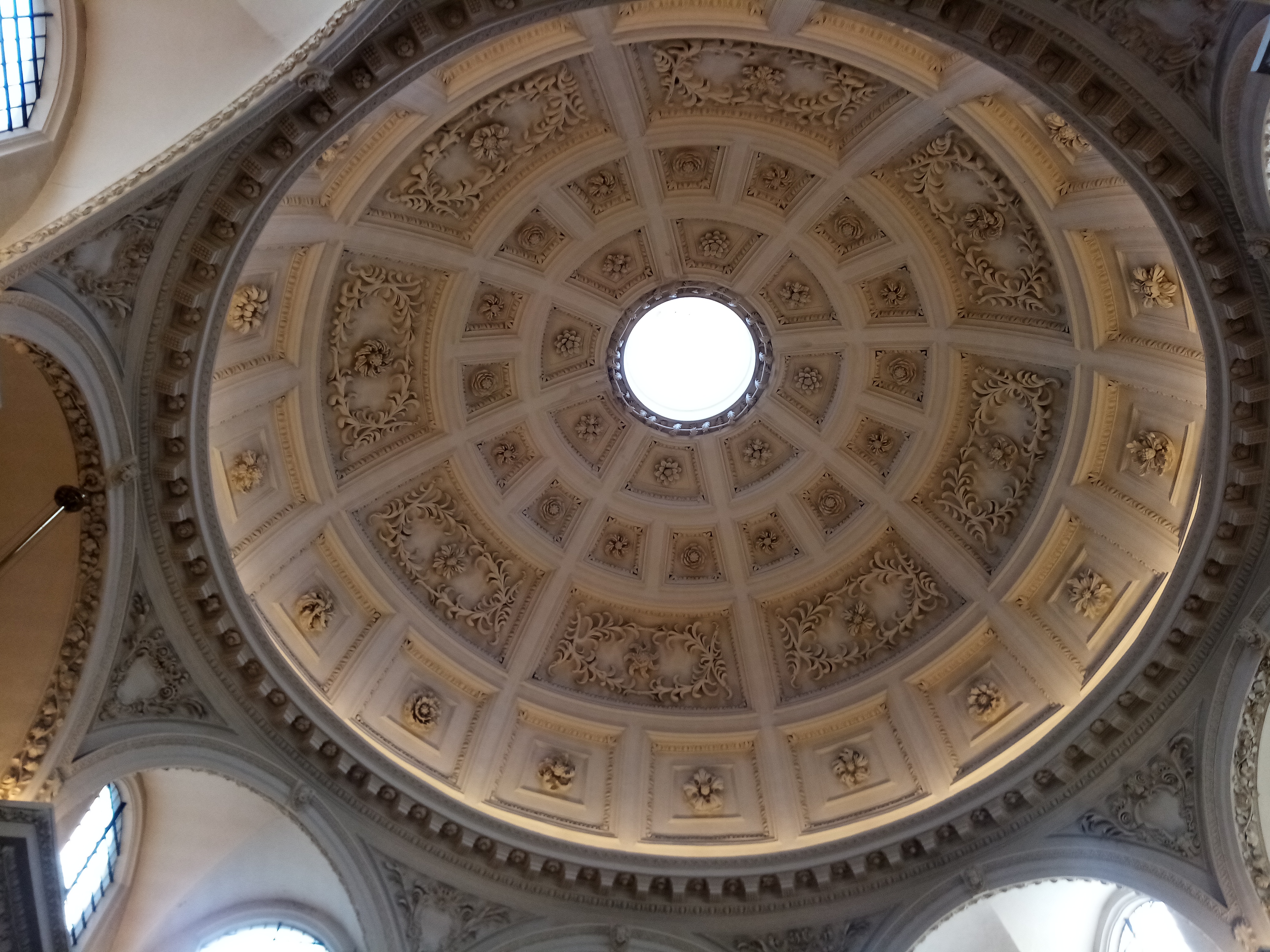
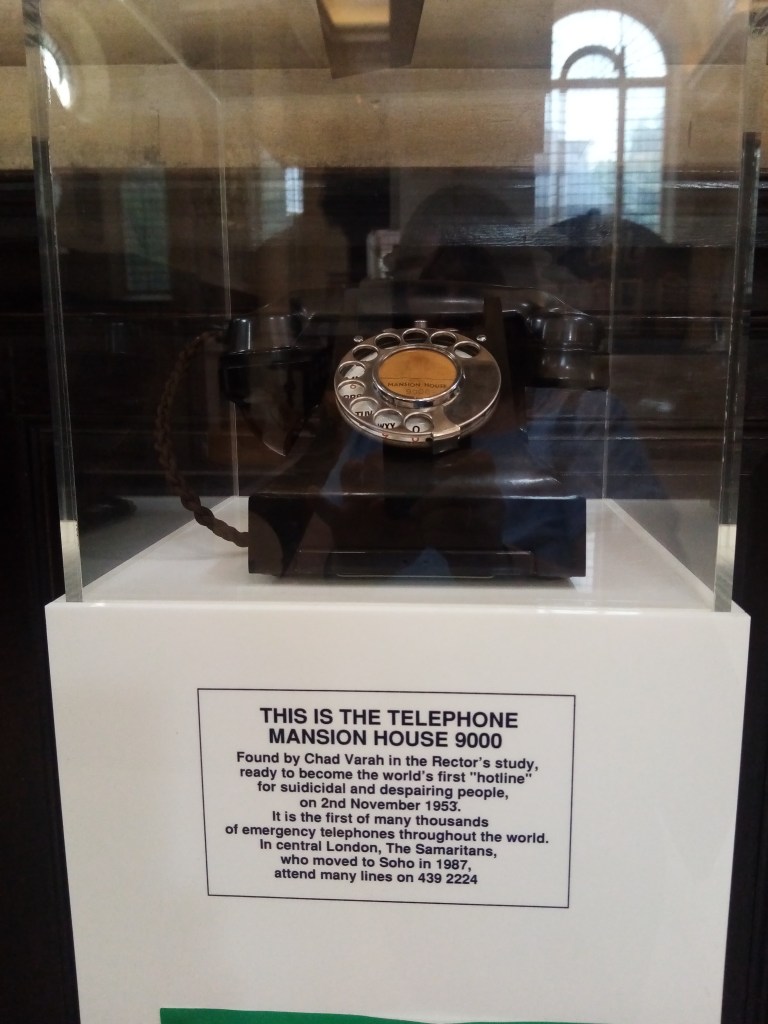
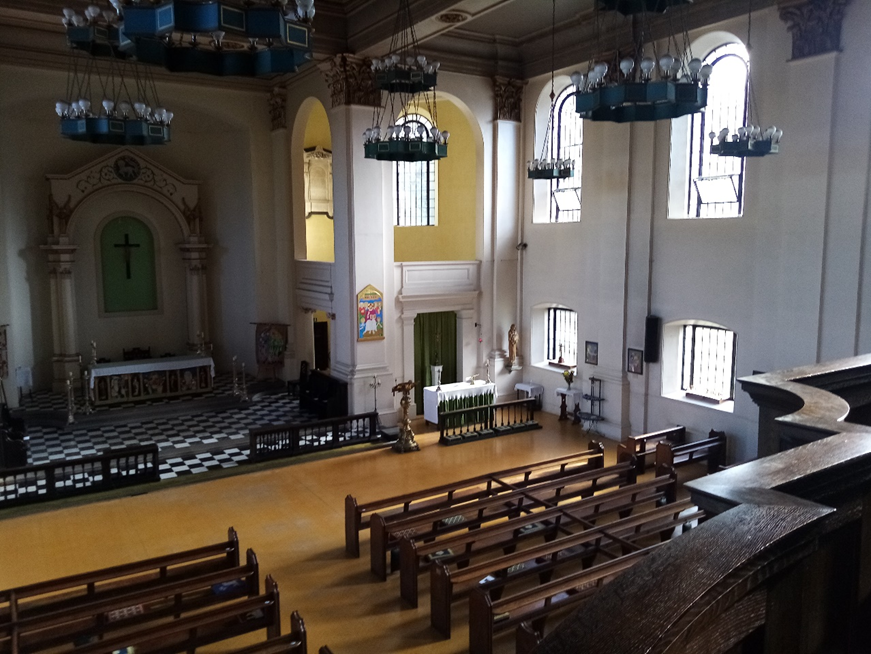
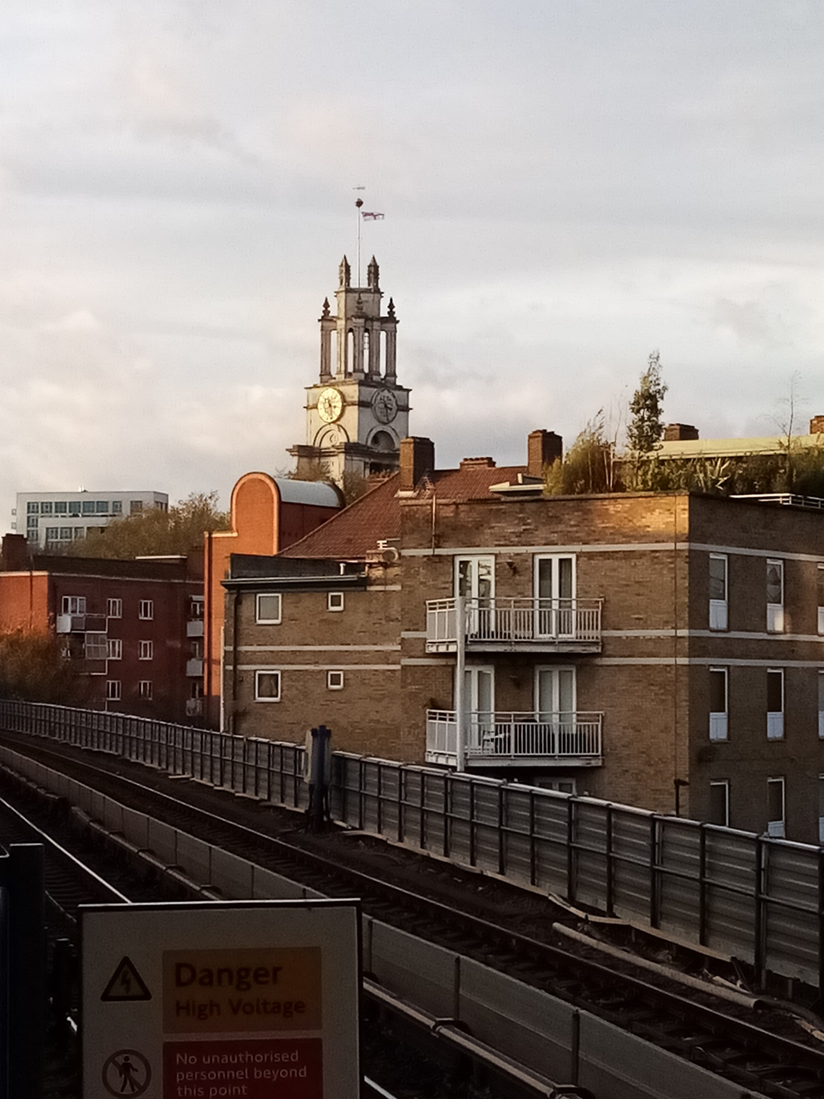
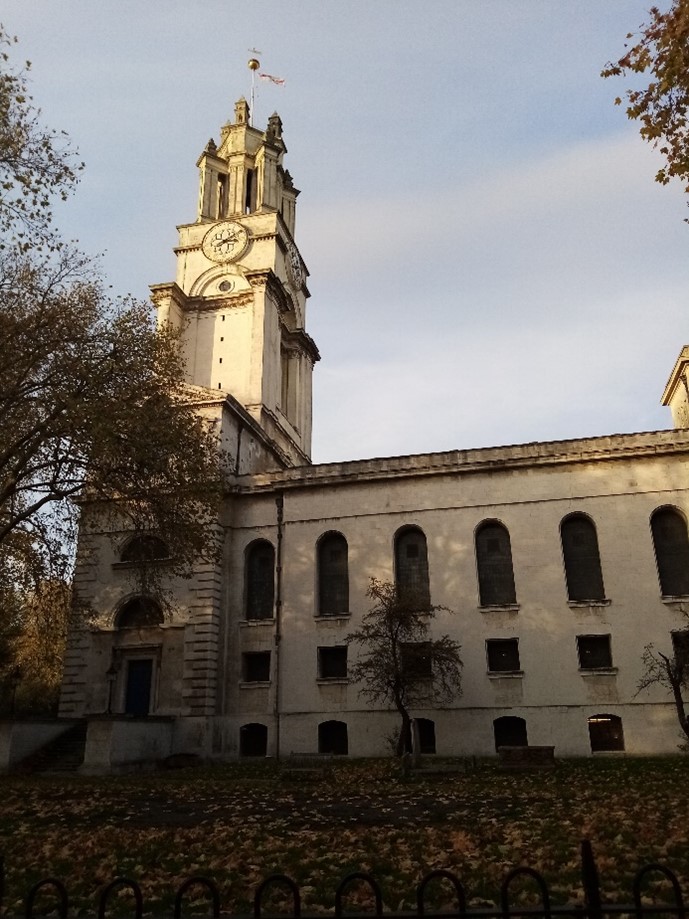
Situated in the City, originally beside the Walbrook stream, the first church on this site was built as early as 700AD, or more likely, 980AD. A Saxon church, it was built on the foundations of the Roman temple of Mithras, following the practice of hallowing a pagan site. By 1428 this church and its graveyard were too small for the parish and a larger church was built on higher ground twenty metres to the East; soon after, the Walbrook was culverted and became a street. This church was completely destroyed in the Great Fire of 1666, and was one of the churches chosen to be completely redesigned and rebuilt. Enter Sir Christopher Wren, creative genius, who worked as surveyor, architect, structural engineer and in the case of St Stephen, labourer; it is said that he was personally involved in the construction of the church. The rebuilding of the church began in 1672 to a unique design; Wren lived at No. 15 Walbrook, so this was his own parish church. The 19-metre-high dome is based on Wren’s original design for St Paul’s Cathedral and is centred over a square of twelve columns. The walls, tower and columns are made of stone, but the dome is made of timber and plaster covered with copper. In 1953 the Samaritans charity was founded by the rector of St Stephen’s, Dr Chad Varah. The first branch of the charity operated from the crypt beneath the church before moving to Marshall Street in Soho. The first telephone used by the charity is displayed in a glass box in the church. In 1987 a massive white polished stone altar commissioned from the sculptor Henry Moore by churchwarden Peter Palumbo was installed in the centre of the church, a dramatic addition to the church furnishings.

Sources: Leaflet in the church; Wikipedia

The magnificent Dome of St Stephen’s
Stone Altar sited under the dome
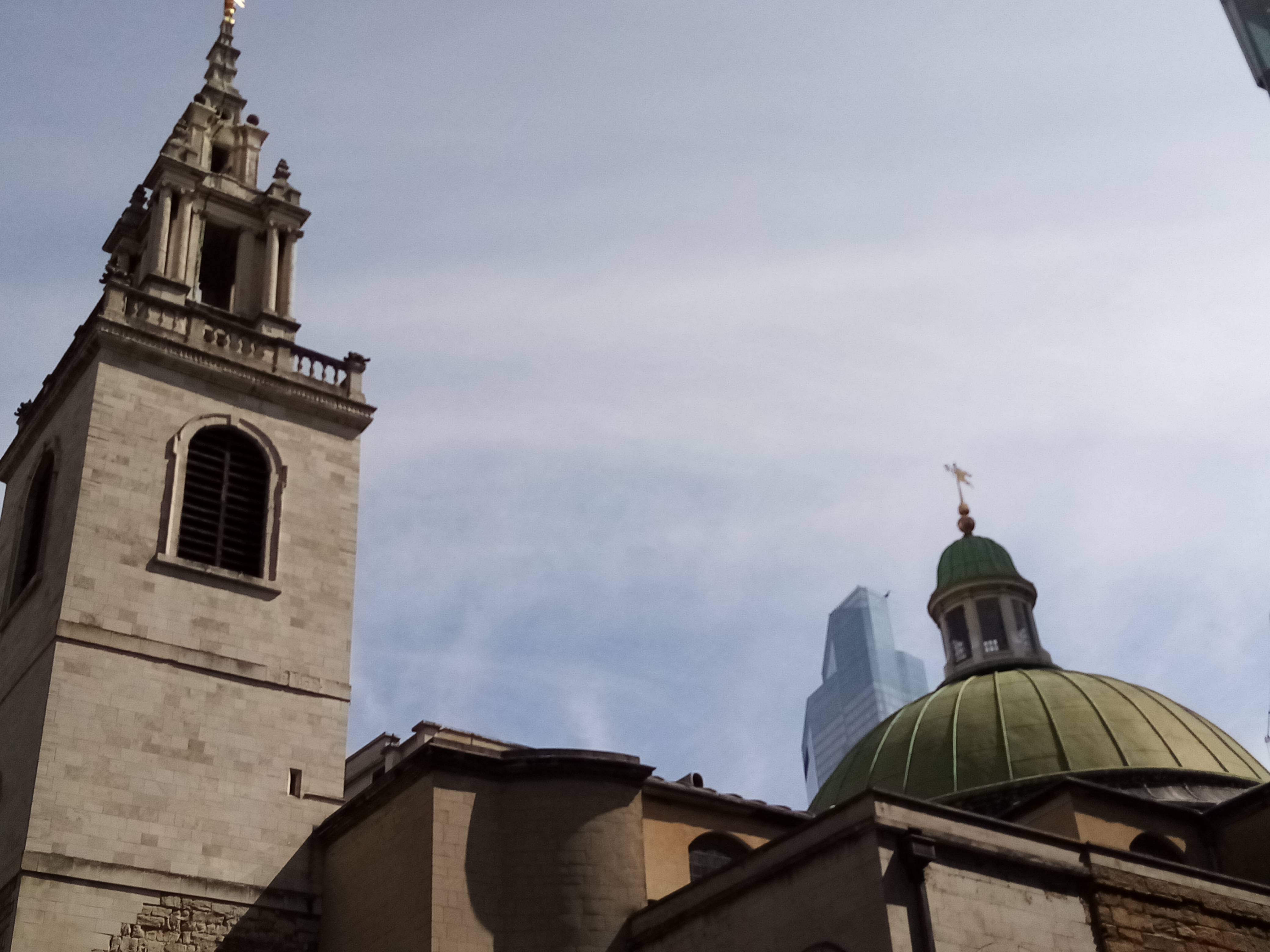
Exterior shot of St Stephen with a new build in the background

Temple Church, Inns of Court

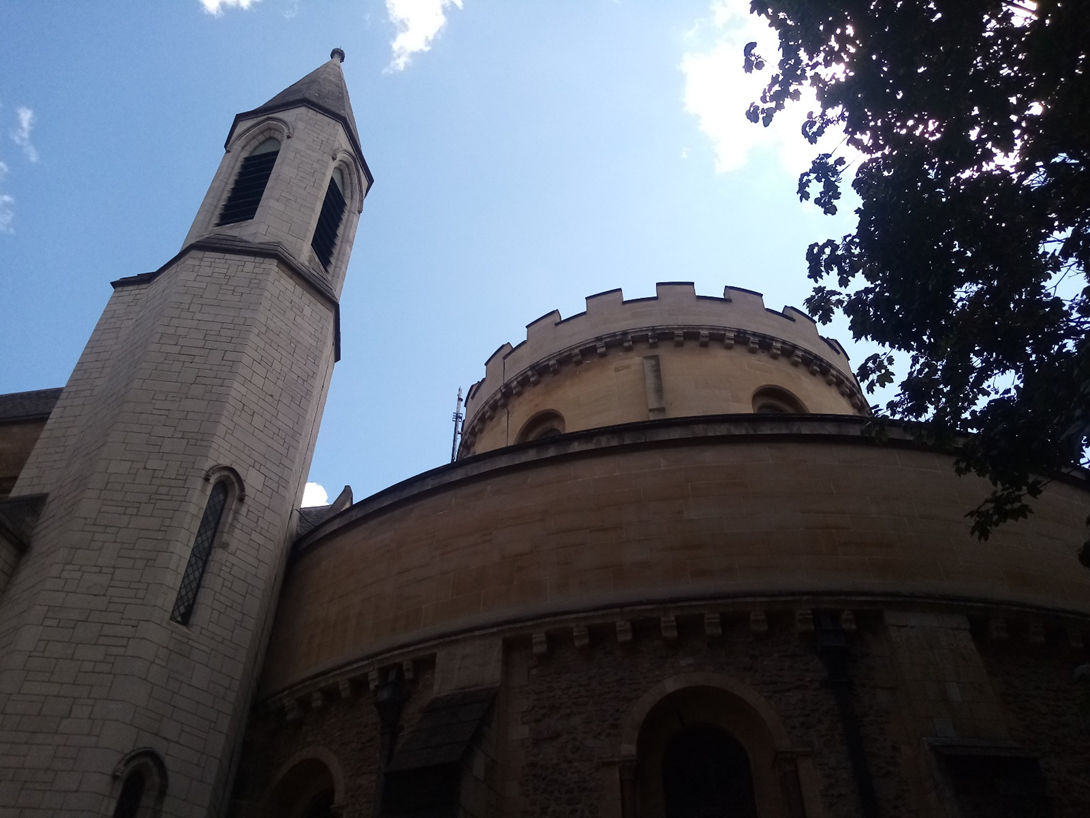
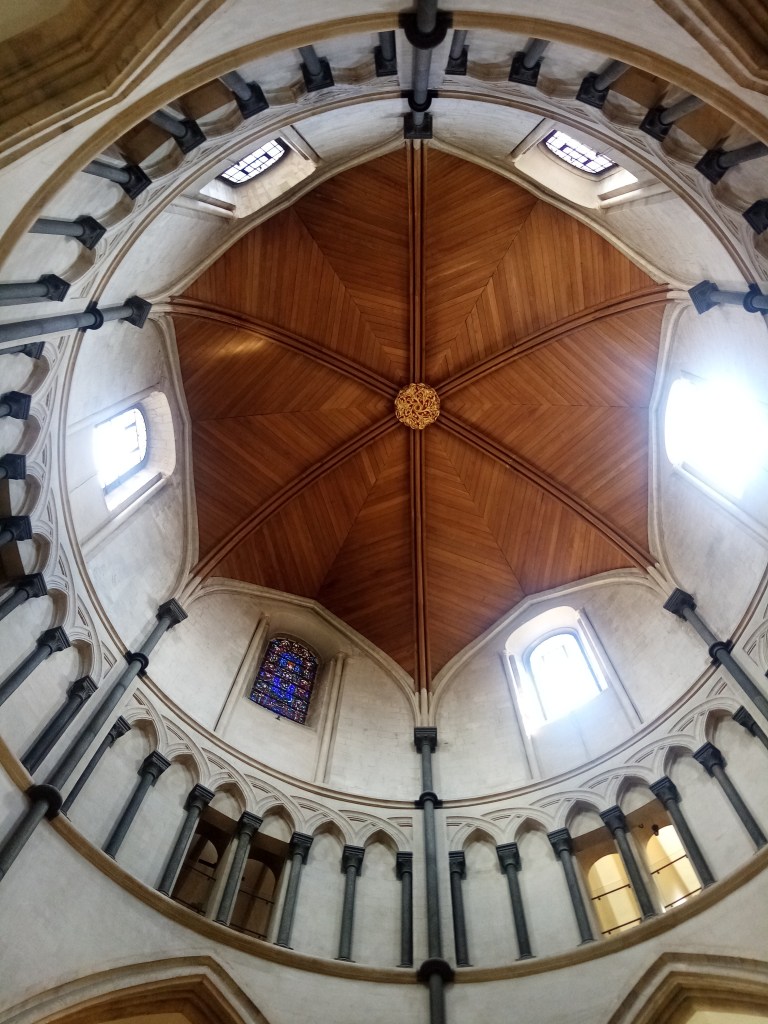
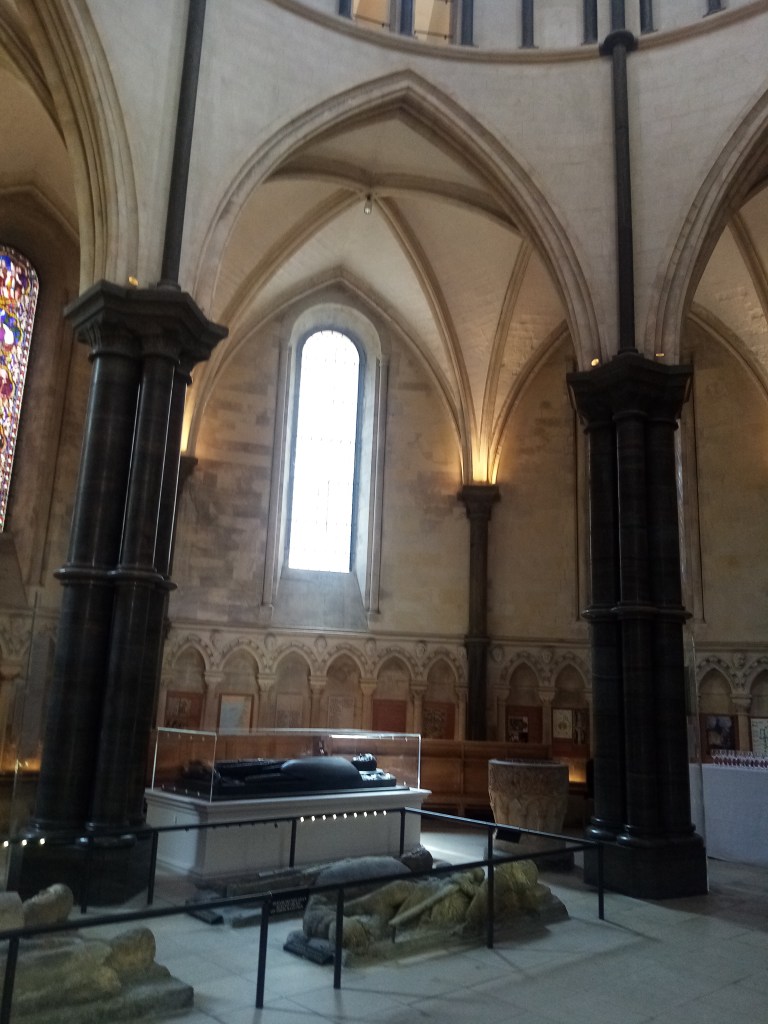
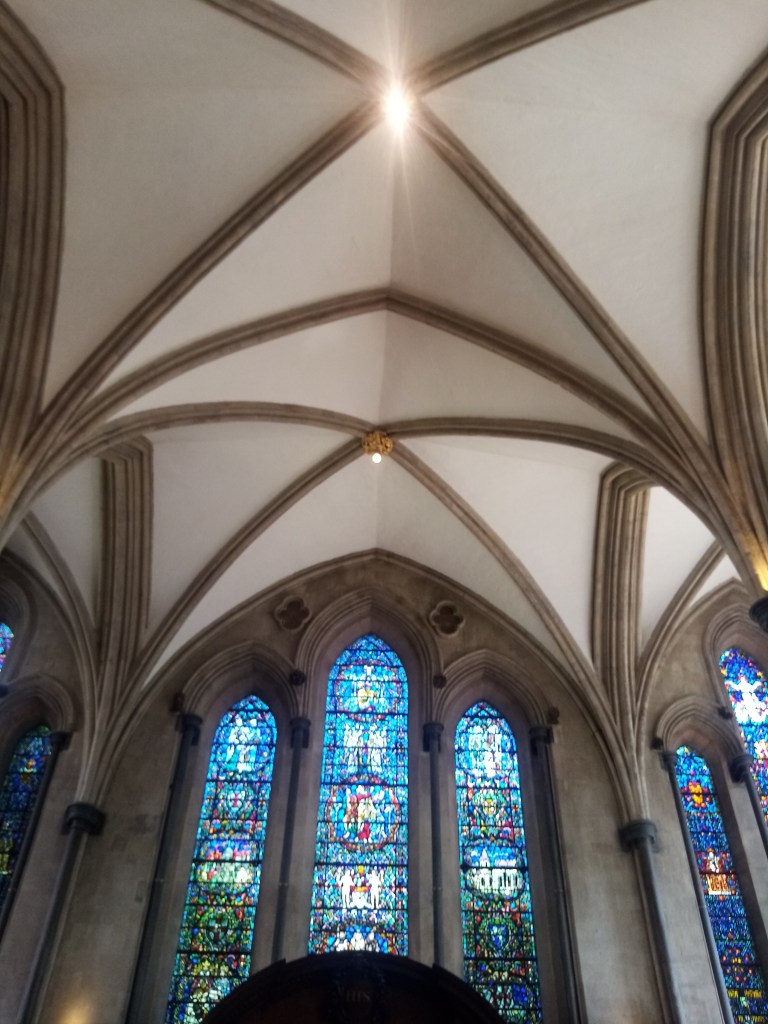
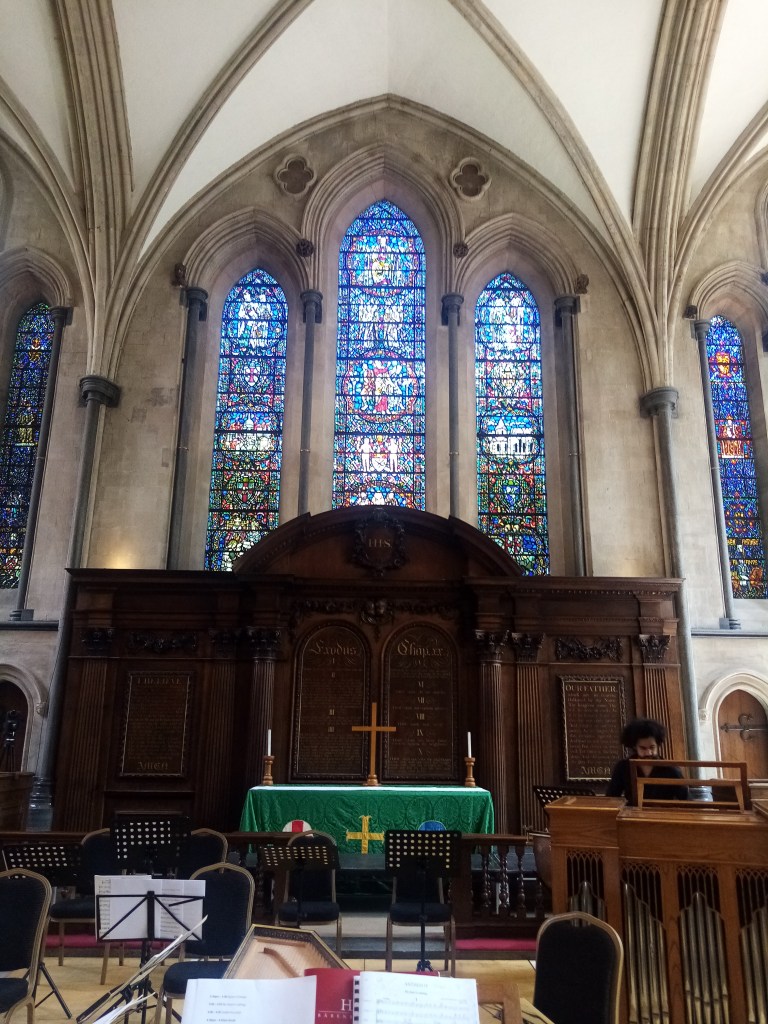
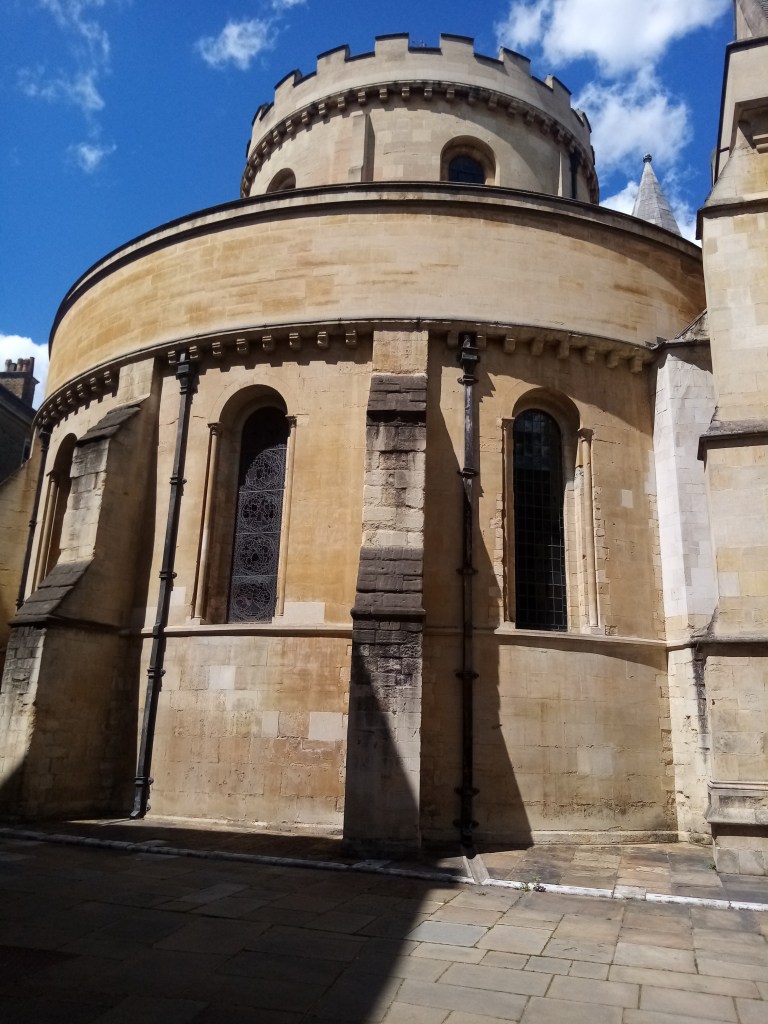
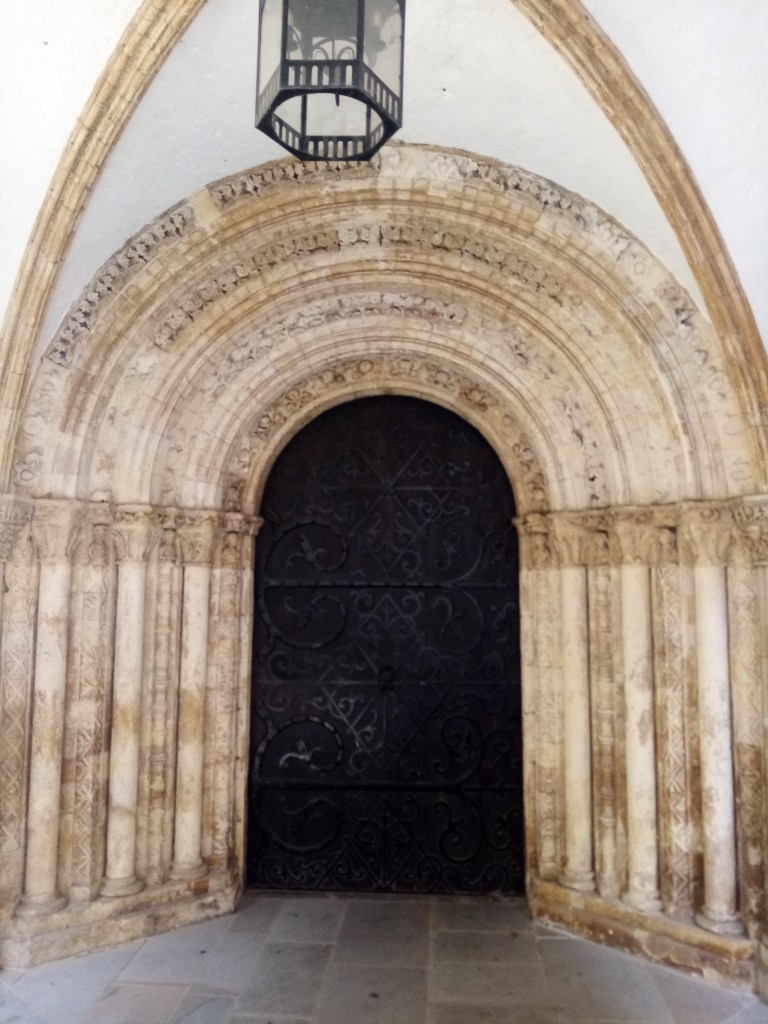
The church’s website says: ‘Welcome to the prayerful and beautiful Temple Church, steeped in the history of Christendom, this country and the whole Common Law World.’ The ‘Round Church’ as it was once known was constructed in 1162, probably England’s earliest Gothic building. It is modelled on the round church of the Holy Sepulchre of Jerusalem, the site of Jesus’ death, burial and resurrection. In medieval times, Jerusalem was the centre of the world, so the Round Church in London represented Jerusalem in the capital of England. If you were standing under the dome of Temple Church, you were spiritually as close as you could be to Jerusalem. The site was originally a much larger monastic complex, headquarters of the Knights Templar and a military training facility for the military branch of the Order. Fast forward to 1215 and Temple Church is King John’s London Headquarters. Here, in January 1215, the King was confronted by barons who demanded that the monarch be subject to the Rule of Law like every other citizen. Six months later, as proof of his allegiance to the Rule of Law, John signed the Magna Carta at Runnymede on the banks of the River Thames: the very beginning of democracy and the Rights of the Common Man. Temple Church is owned jointly by the Inner Temple and Middle Temple Inns of Court, and the Church serves the lawyers and other staff of the Inns of Court with pastoral care, church services and a dedicated programme of music. Not surprisingly, the church is hired for use as a film location, concert venue, lecture hall and reception venue. A wonderfully atmospheric space!

Sources: Temple Church website; Wikipedia

Dome of St Paul’s Cathedral

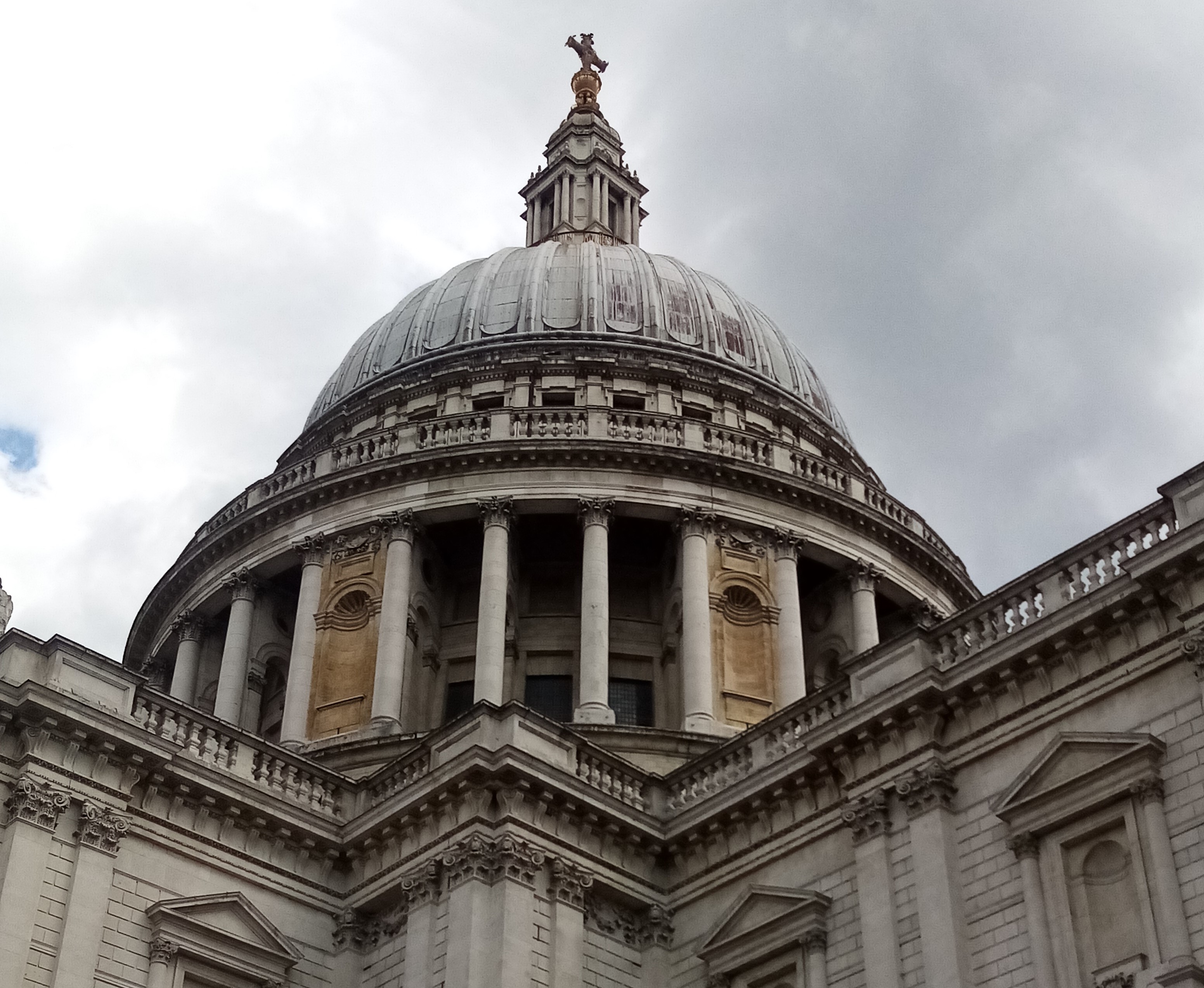
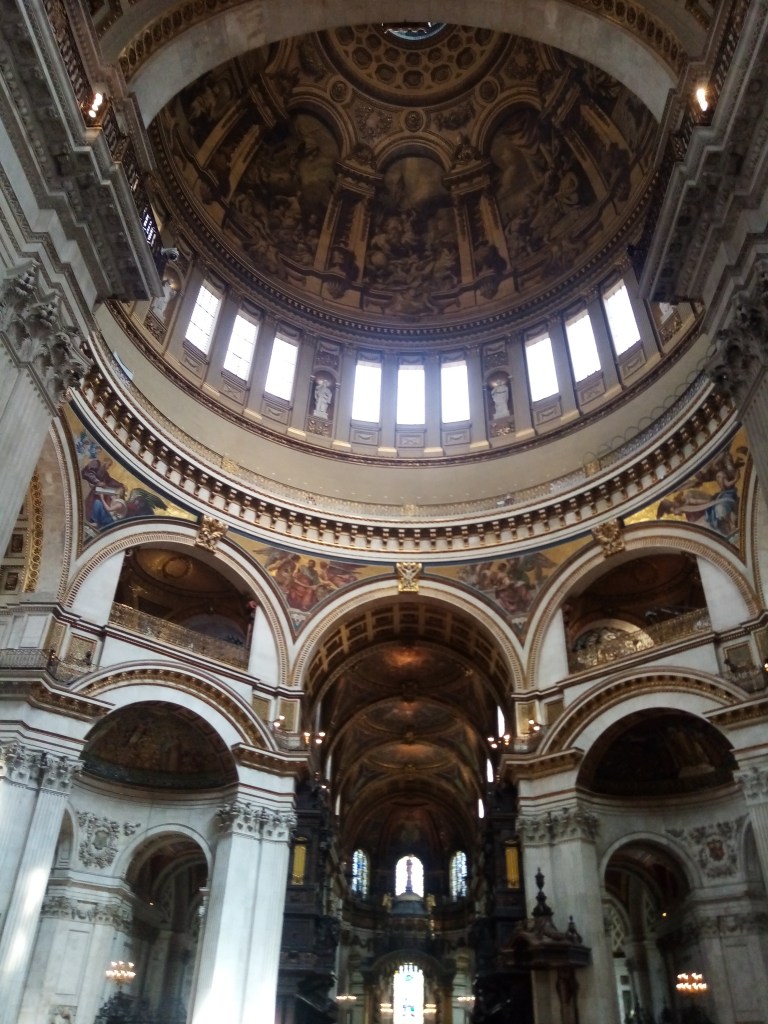
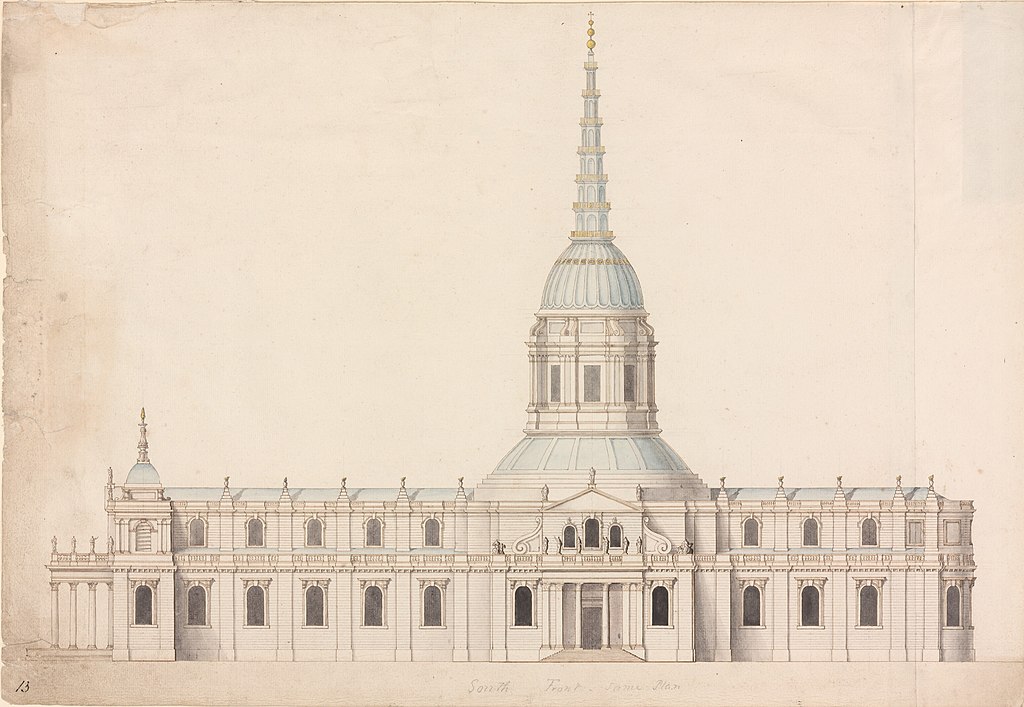
When Sir Christopher Wren submitted his designs for his new cathedral to the Church Commissioners, they were not keen on his plan for a huge dome, preferring the idea of a more traditional steeple topped by a spire or cross. After extensive negotiations a compromise was agreed: a smaller dome would be topped by a spire, but Wren never actually added the spire! Instead, he designed a magnificent stone lantern to be built on top, which Wren believed would dominate the horizon – he was right there! A golden cross completes the iconic look. The dome weighs 65,000 tonnes, one of the largest cathedral domes in the world and there are three galleries incorporated into its design. The Whispering Gallery runs around the interior of the dome, so-called because a whisper against the wall can be heard on the opposite side of the gallery. The Stone Gallery and the Golden Gallery run around the outside, the latter is just below the lantern and is 85 metres (528 steps) from the floor. During the Second World War, Winston Churchill declared ‘St Paul’s must be saved at all costs’, and at the height of the Blitz, he would ask on waking each day, ‘Is the dome still safe?’ He rightly believed that the cathedral was a target for enemy bombers and that its destruction would have been a severe blow to the morale of Londoners and to the whole country. To this end, he deployed teams of volunteers to patrol the network of passages and roof spaces of the cathedral 24 hours a day, putting out fires from incendiary bombs before they could spread. The cathedral received two direct hits, but the dome was undamaged. After a night of intensive bombing in 1940, the area around St Paul’s was mostly reduced to rubble, but the cathedral remained standing.

Source: St Paul’s Cathedral Official Souvenir Guide

Brass plaque in the floor directly under the centre of the dome
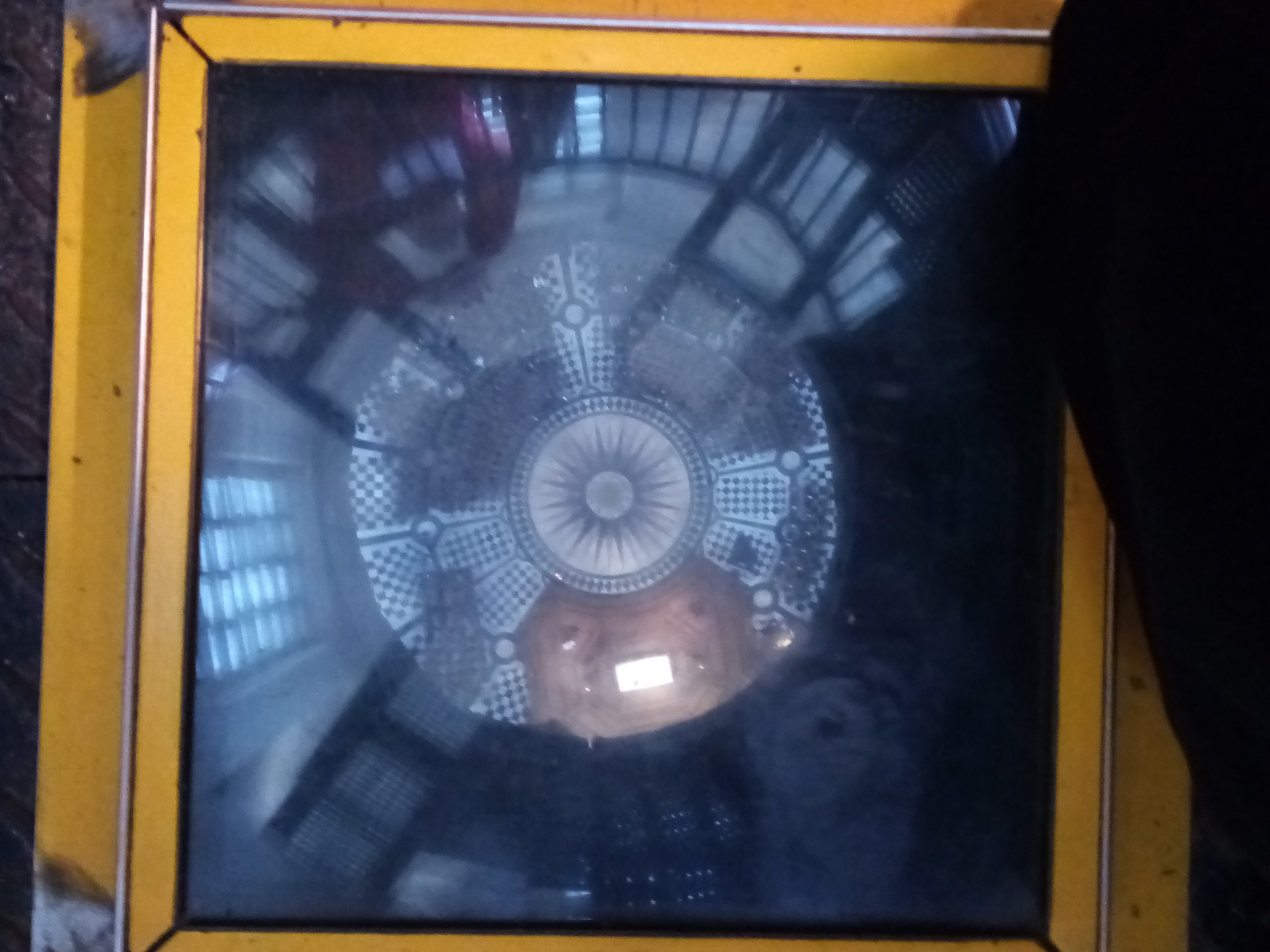
Looking down to the floor of the cathedral from inside the dome (I took this photo through glass from about two thirds up the 528 steps!)
The original ‘Warrant Design’ which Wren altered to his own specification. Wikimedia Commons: File 74 -AS ll.13. S elevation.jpg

June – Southwark and the South Bank

The area south of the Thames in London was slower to develop than the North side due to its frequently waterlogged ground in winter. Across the river, Londinium was quickly established as a major centre of trade, commerce and administration in the Roman Empire, while the south side was just one road you travelled to reach the only bridge to the City. As centuries rolled on, the south bank, being outside the jurisdiction of the City, gained a reputation as a centre for all kinds of entertainment: by the Middle Ages, gambling, cock fighting, bear baiting, theatre-going and brothels were all on offer. All these things were seen as vices (even the theatre!) so for centuries you were able to live your respectable life on the North side of the River, head over to the South side to the ‘Liberty of the Clink’ to indulge your pleasures and vices, and come back home to the City with a clear conscience. I’ll talk more about these shocking double standards a little later, but I’ll start with two churches, the first no longer used as a place of worship but with an interesting history:

St Thomas’s, Southwark

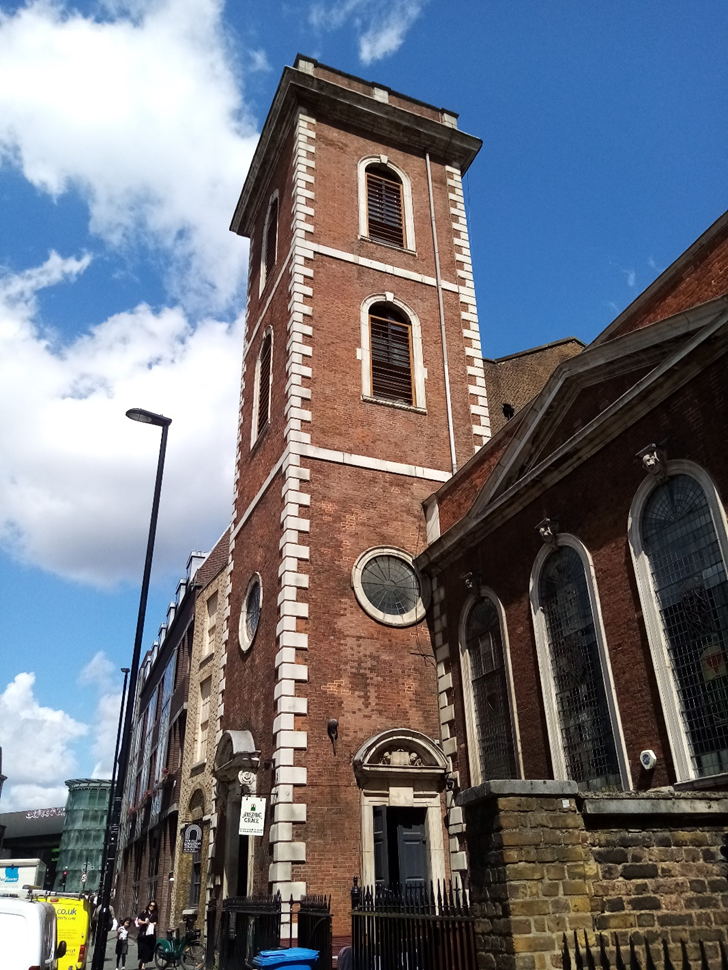
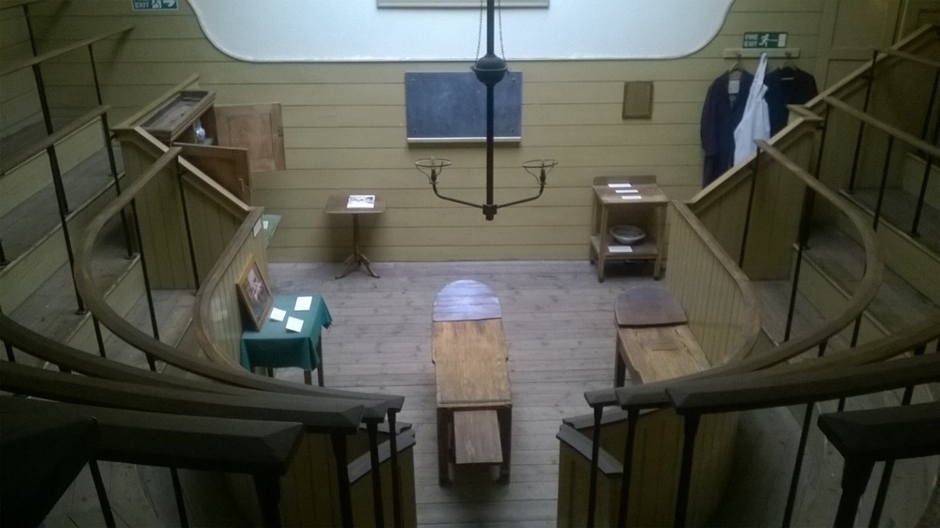
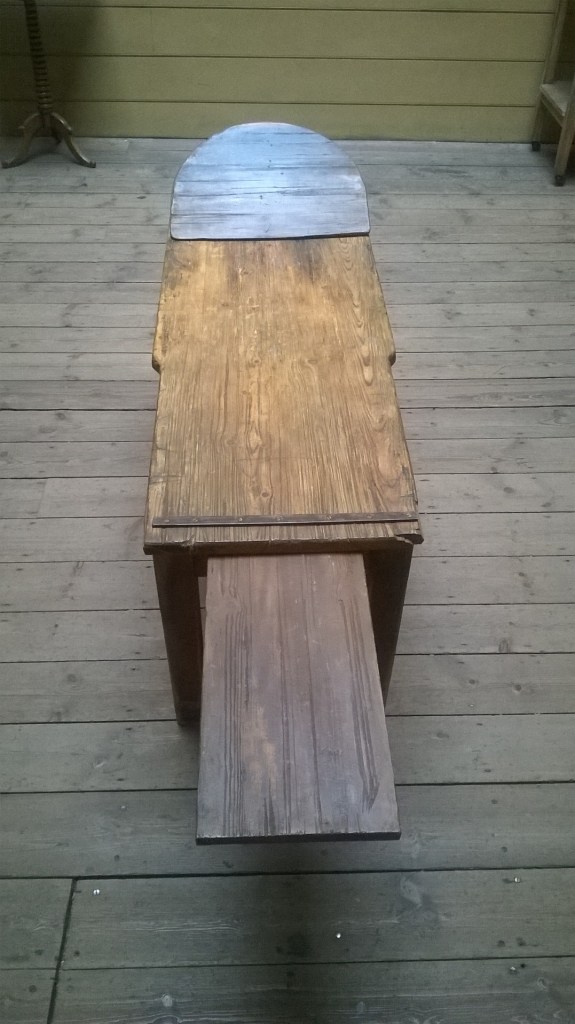
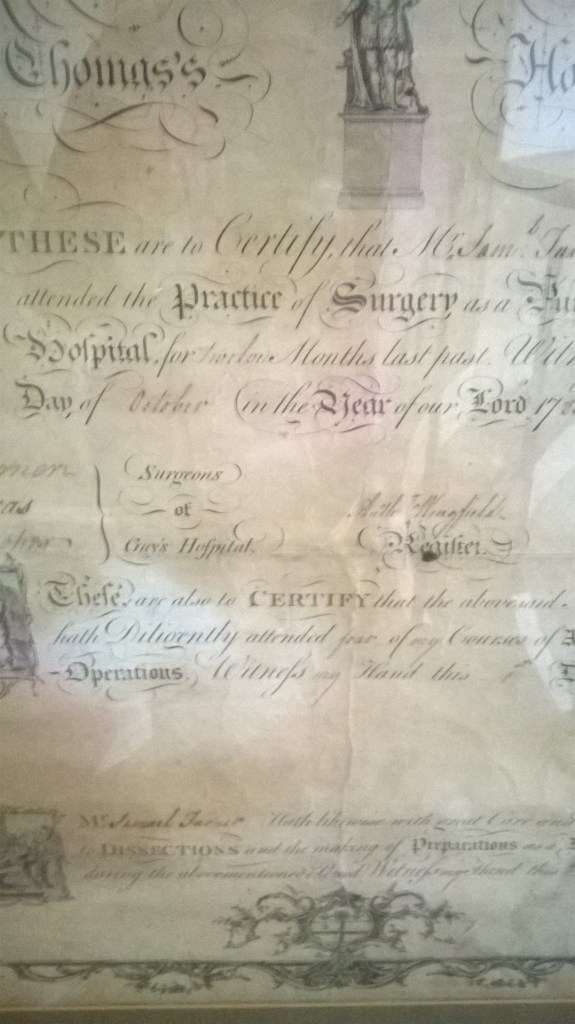
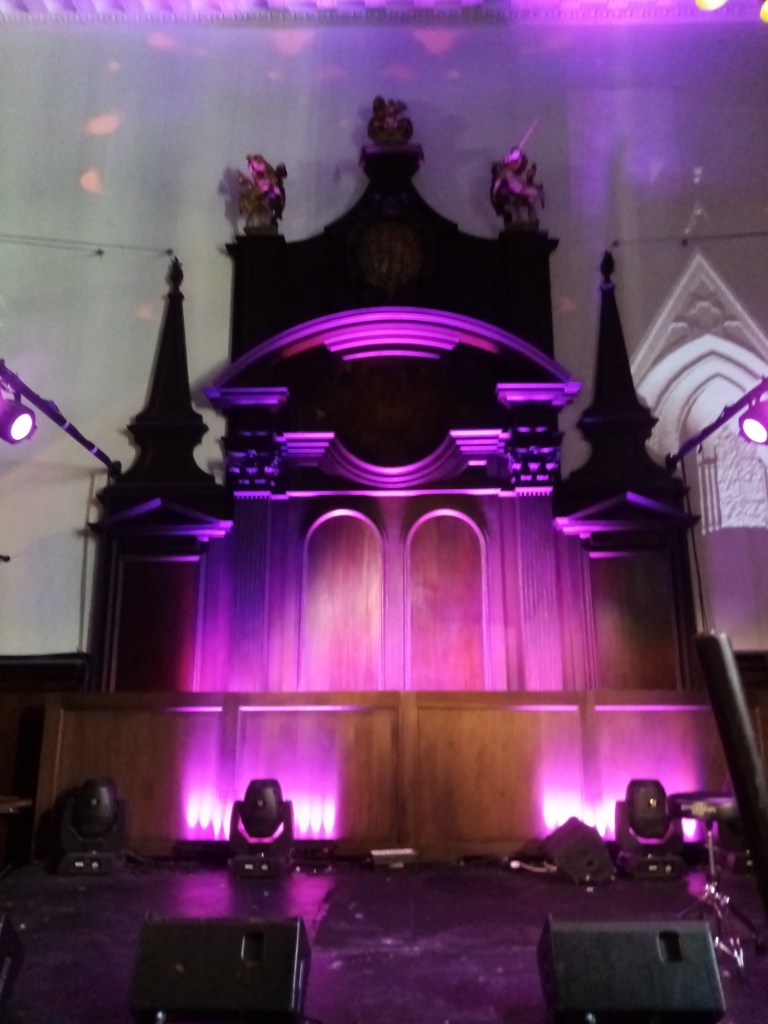
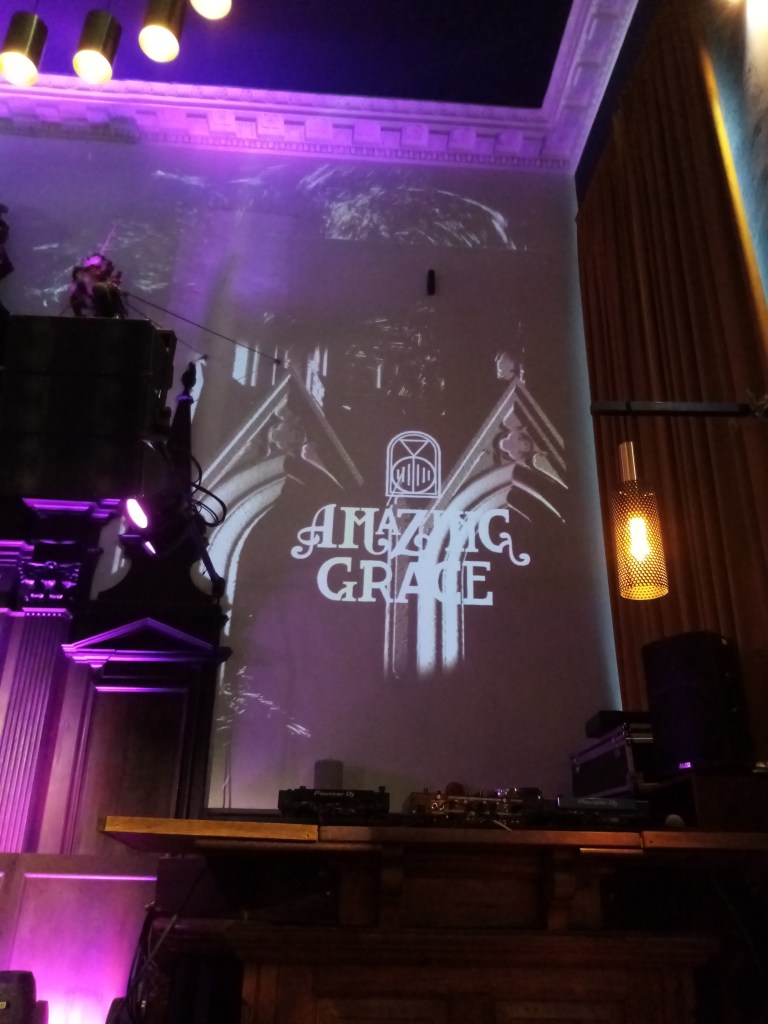
Still looking very church-like on the outside, St Thomas’s now has two very different functions: it houses The Old Operating Theatre of St Thomas’s Hospital, and is also a bar, Amazing Grace! Firstly, some history: the first church on this site was part of the original St Thomas’s Hospital, an infirmary and Augustine priory in the precincts of St Mary Overie (now Southwark Cathedral), established in 1212. The present church was built by the Hospital Governors in 1703, and had a garret at the top in which were stored boxes of medicinal herbs – ‘The Herb Garret’. In 1822 part of the Herb Garret was converted to a purpose-built operating theatre for the hospital; previously operations had taken place on the wards (scary!) St Thomas’s use as a church became redundant in 1899 when the parish merged with St Saviours (now the cathedral.) It is now a museum of surgical history and one of the oldest surviving operating theatres. I’ve visited the museum and it’s not for the faint-hearted! Other parts of the building were used as office space and in 2010 it became the HQ of the Cathedral Group Property Development Company. Also in the building is the Amazing Grace live music venue and bar which retains many of the church’s original features, and actually looks pretty cool, I popped inside to get some pics.

Source: Wikipedia

St George the Martyr, Southwark

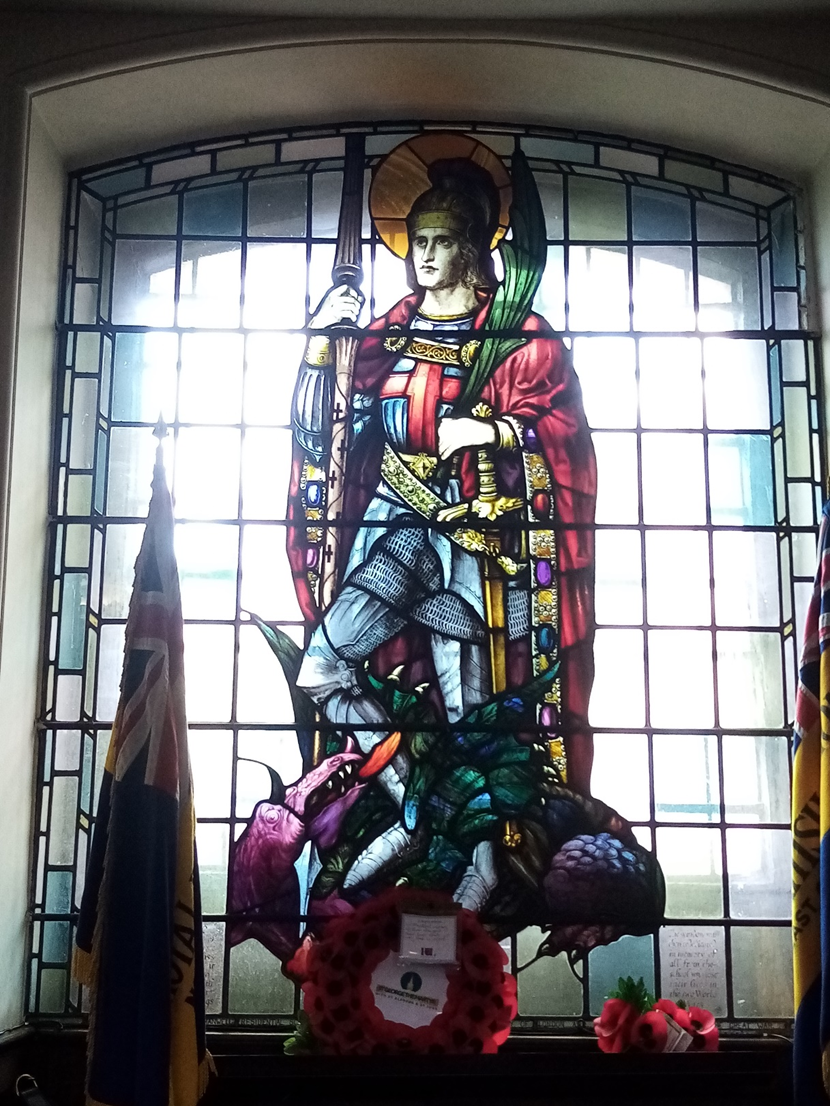
St George of England slaying the dragon (stained-glass window in St Georges)

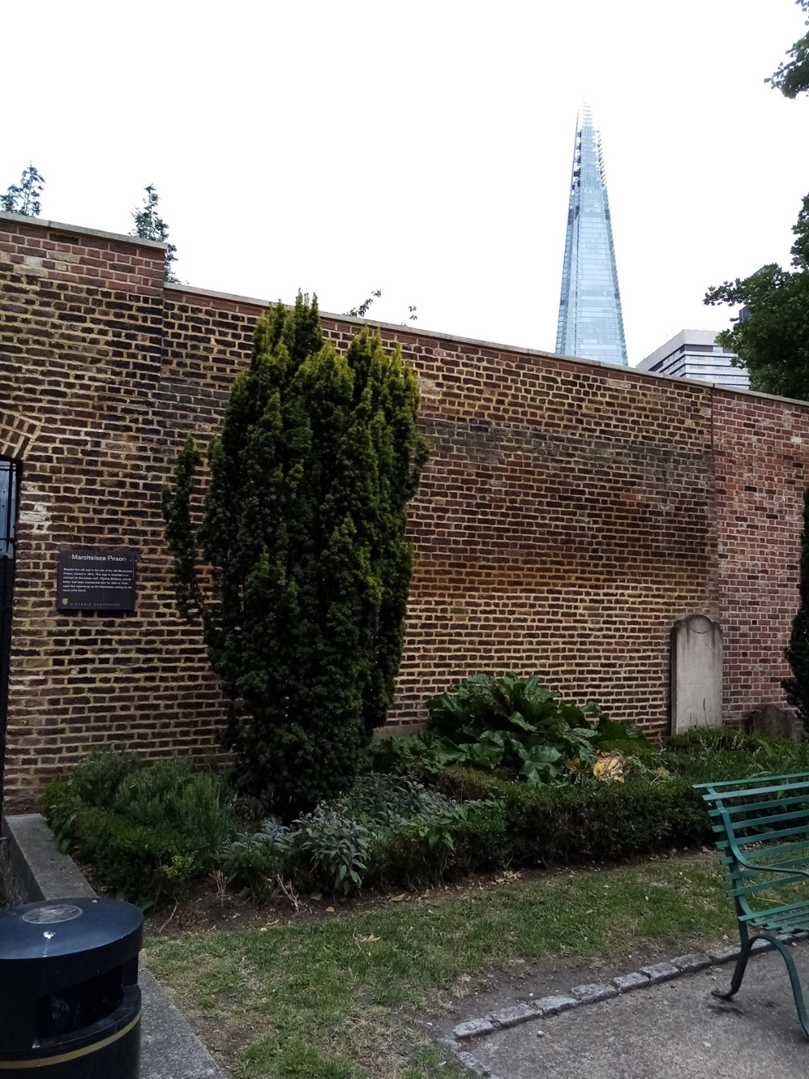
According to tradition, St George was a soldier in the Roman Army and was killed by order of the Emperor Diocletian for refusing to persecute Christians and for confessing his own Christian faith. The earliest reference to the church in Southwark is in 1122; at this time legends of St George and the dragon were popularised by Norman crusaders. This was the first church in London dedicated to the Saint. The present church, the third on the site, was rebuilt between 1734 and 1736 and later enlarged so by 1852 had a capacity of 1,000 congregants. The Anglican evangelist William Cadman became Rector of the church in this year, but on his arrival it was reported that services were largely empty. Cadman set about making St George’s a ‘centre of operations’ from which volunteers worked in the local community: teaching in a Ragged School which he established and encouraging parishioners to attend ‘adult schools’ of worship and Bible Study. The church has literary connections: Charles Dickens lived nearby in Lant Street, lodging in a house belonging to the Vestry Clerk of St George’s. One wall of Marshalsea Prison still stands, bordering the churchyard, and in 1824 Dickens’ father, John, was incarcerated for debt which he could not repay. Twelve-year-old Charles had to leave school and go to work in the ‘blacking factory’. He went on to write ‘Little Dorrit’ which is set in and around St George’s church. In the novel, Amy Dorrit’s father is imprisoned in the Marshalsea for debt, so this experience in his young life obviously had a profound effect on him.

Sources: Wikipedia, Church website

Surviving wall of Marshalsea Prison, with the Shard in the background
I do like a stained-glass window!

Bishops of Winchester Palace, Southbank

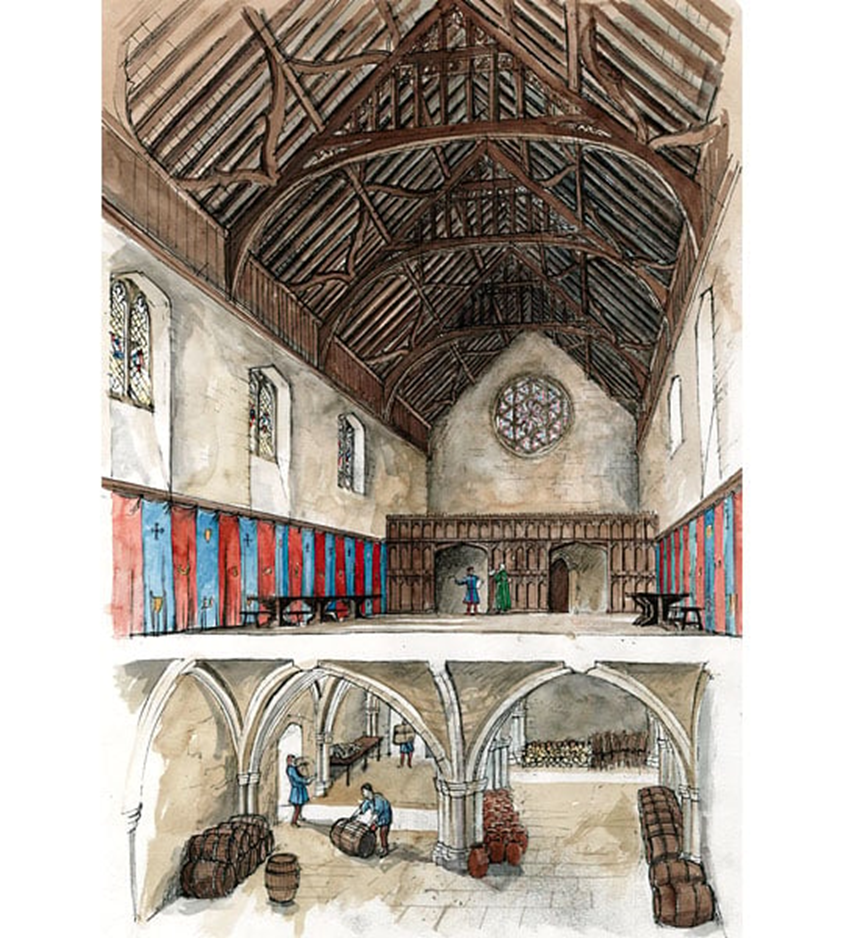
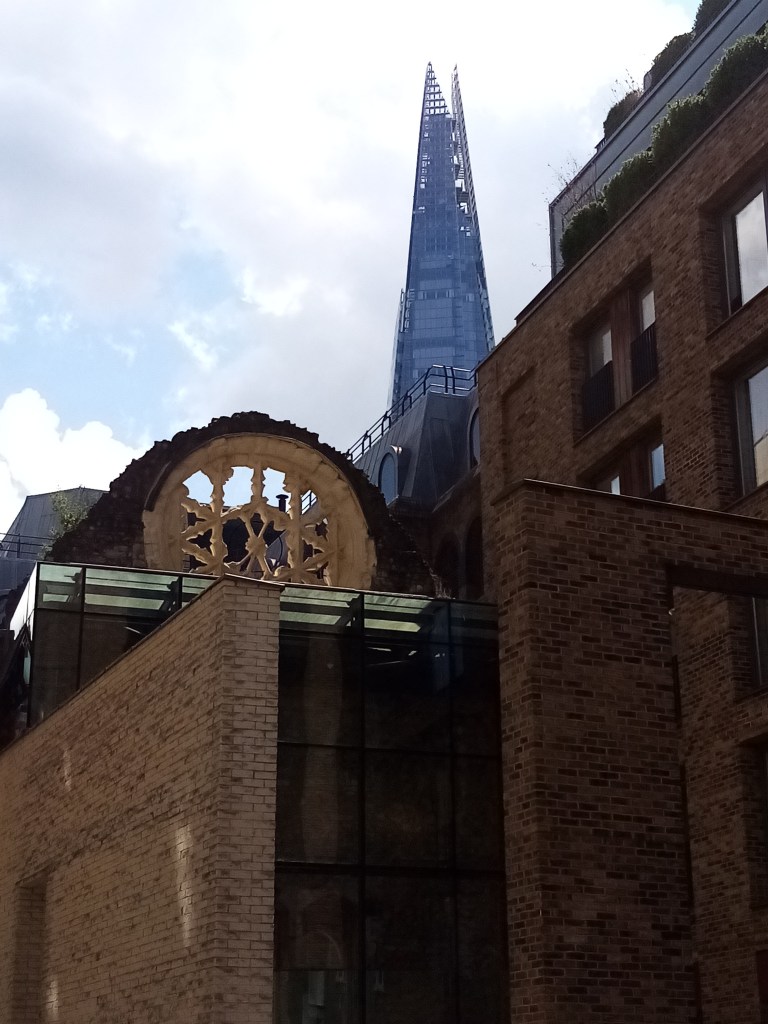
Remains of the 12th century palace; the Rose Window in the west gable.

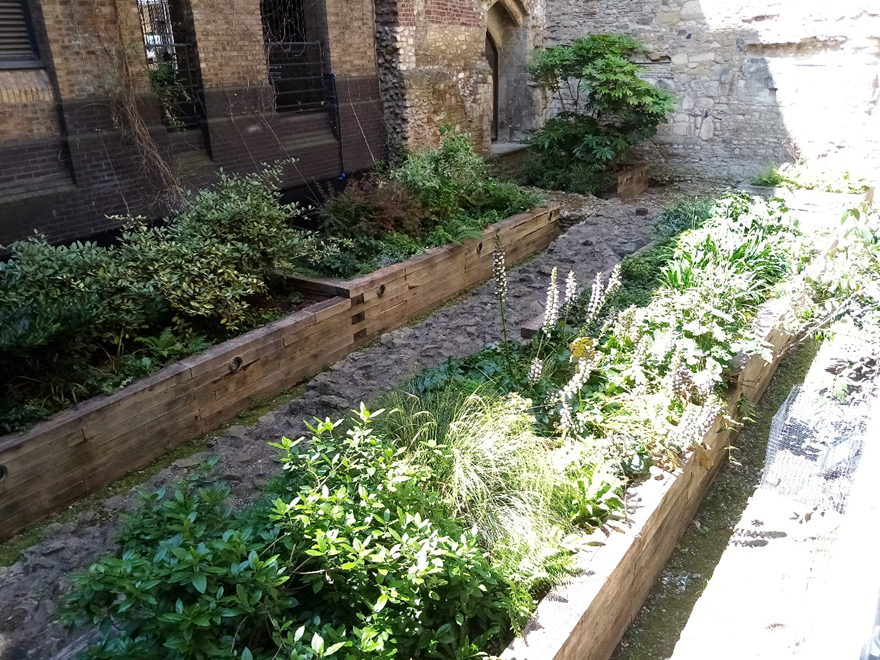
This was one of the largest buildings in mediaeval London, also one of the most important, being home to the powerful Bishops of Winchester. Built in the early 13th century, it was destroyed by fire in 1814, with the exception of two walls, part of the Great Hall. The site of the remains of the Palace is designated a Schedules Ancient Monument and is maintained by English Heritage, who have created a garden in the floor of the Great Hall. So why is the Palace of the Winchester Bishops in London? The reason is that the office of Bishop at the time was more than just a clerical role. He would have served as the King’s Royal Treasurer, equivalent to today’s Chancellor of the Exchequer and was required to attend Parliament with other bishops and abbots, so apparently they needed a huge, comfortable, high-status palace as their London residence (the palace contained a tennis court, bowling alley and pleasure gardens.) These early bishops were also major landowners in the London area, receiving rents from the gambling houses, cock and bear pits, theatres – and the brothels. From the 12th to the 17th century the Bishop of Winchester had the right to license and tax Southwark’s prostitutes, who became known as ‘Winchester Geese’. So high-ranking church officials were living off ‘immoral earnings!’ More about the Winchester Geese in the next section…..

Source: Wikipedia, English Heritage website

The Great Hall; picture from English Heritage

Crossbones Cemetery, Southwark

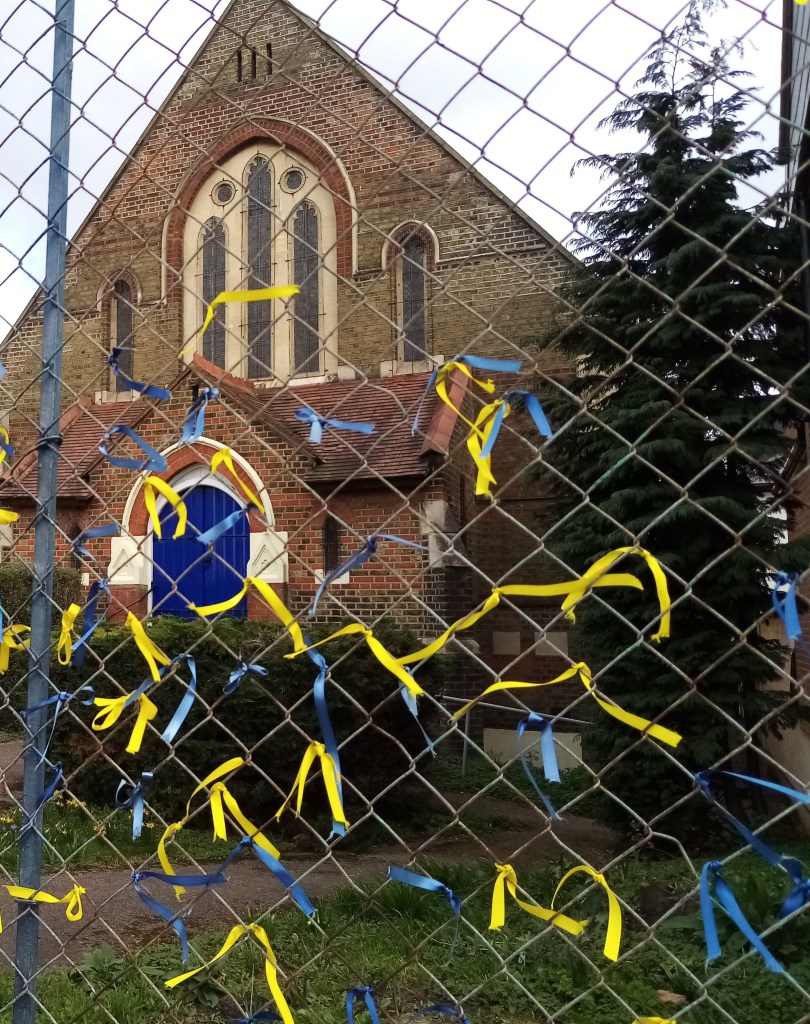
Ribbons tied to the fence of Crossbones Cemetery

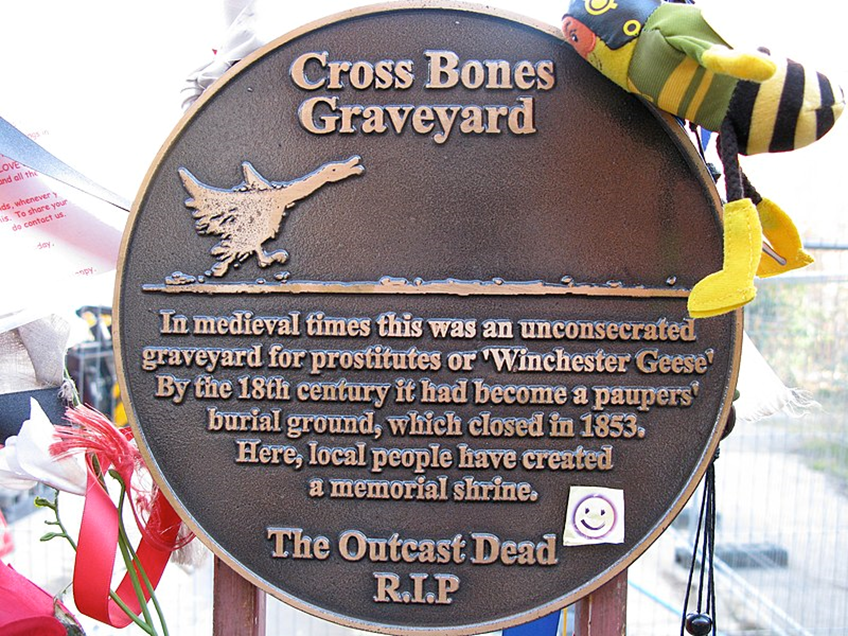
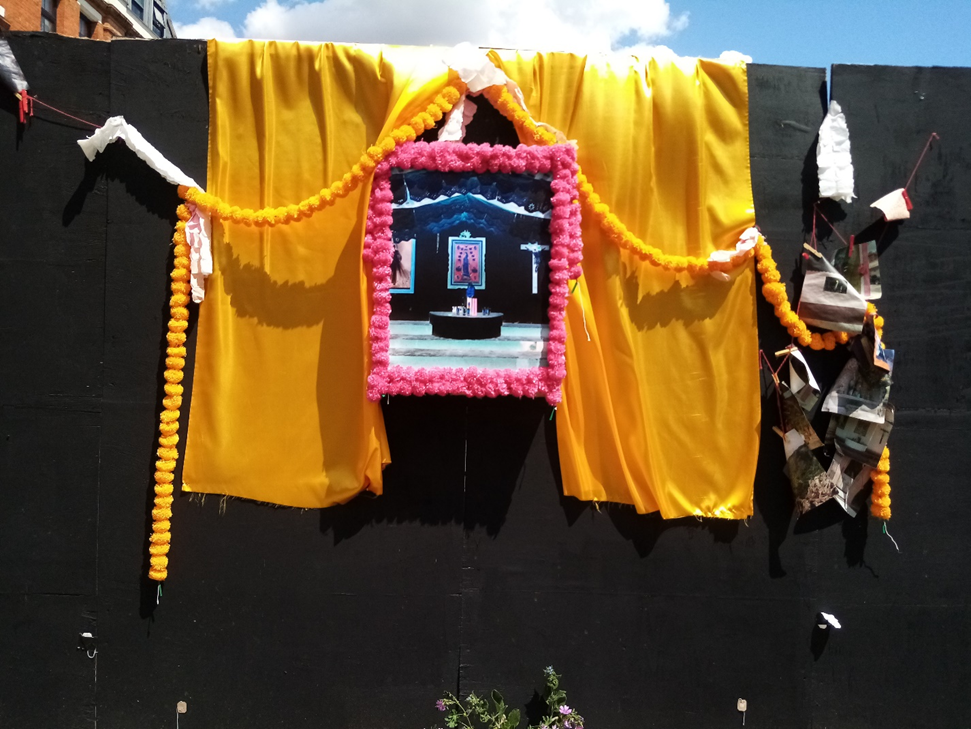
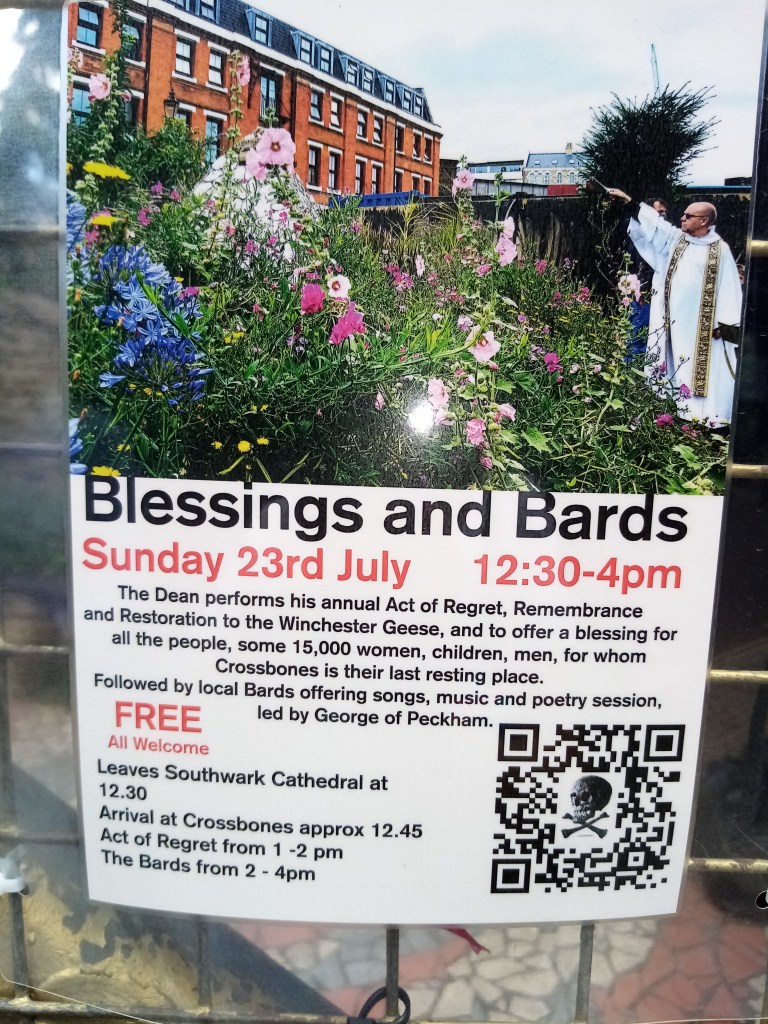
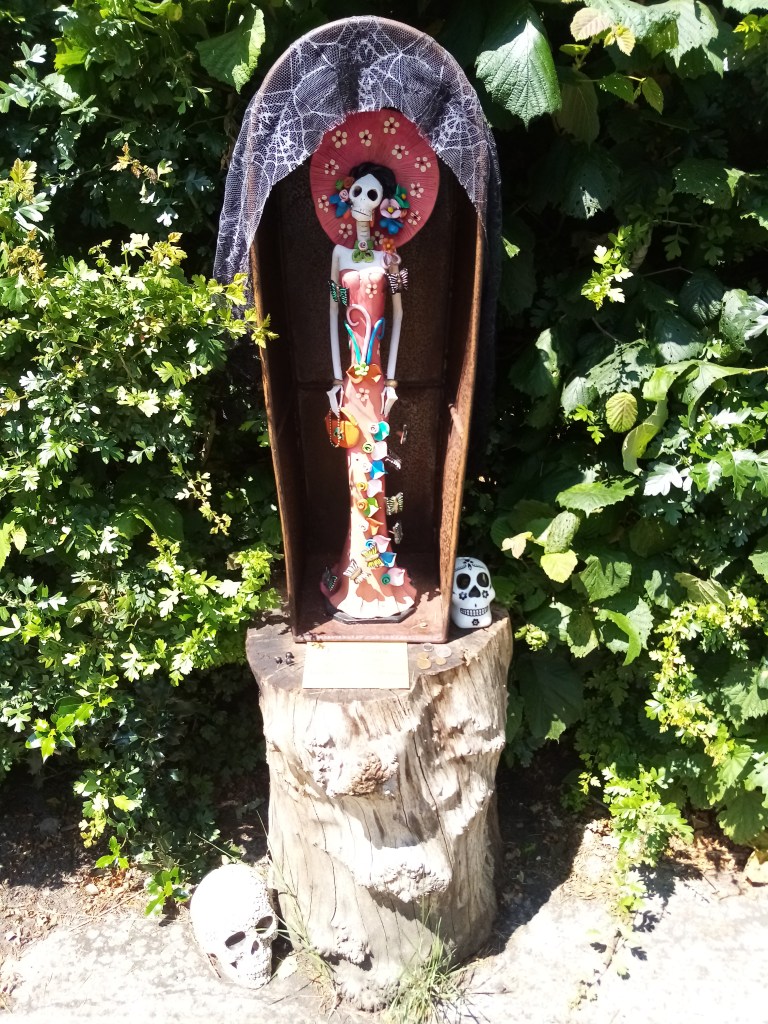
Crossbones is believed to have first been established as an unconsecrated graveyard for prostitutes or ‘single women’ as they were known. They could not be buried in the consecrated ground of a church because they were prostitutes: John Stow, in his Survey of London (1598) writes: ‘I have heard of ancient men, of good credit, report that these single women were forbidden the rites of the church, so long as they continued that sinful life, and were excluded from Christian burial’. So let’s think about this: the Bishop of Winchester took rent and taxes from the brothels, licensing them to continue offering their services to the male population of London, but the Church did not allow them a Christian burial on sacred ground because of their sins. But the men who paid for the service, well, somehow their sins don’t count when they leave the Liberty and return to the respectable City…..I’ll leave it there. By 1769 Crossbones had become a pauper’s cemetery and was closed in 1853, having become overcrowded with the dead and falling below the public health standards of the day. The land was sold as a building site in 1884 following the removal of the remains to other cemeteries. However, in 1991 the Museum of London Archaeology Service began excavating the site and uncovered 148 graves dating from between 1800 and 1853; tests showed that those buried had suffered from smallpox, tuberculosis, osteoarthritis and vitamin D deficiency. Over 40% were babies, the adults were mostly young women. Today the cemetery is a garden, a permanent memorial to the generations of marginalised and excluded people once buried there: ‘the Outcast Dead’.

Source: Wikipedia

Plaque erected in 2006 by Southwark Council, image Wikimedia Commons
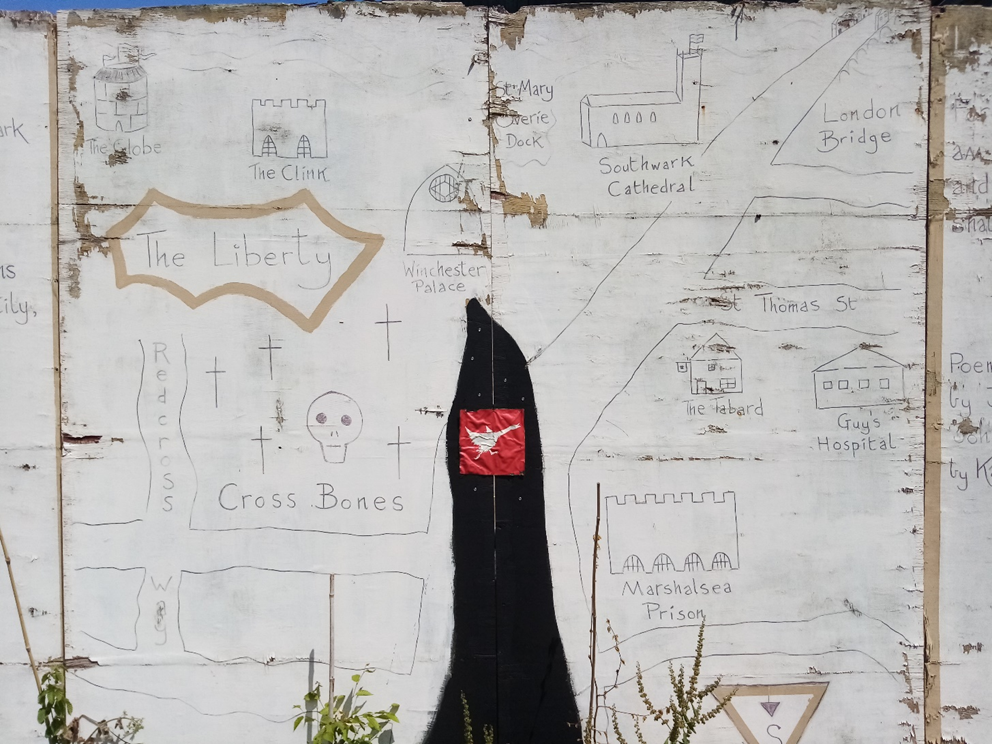
Rough map of the Liberty on a hoarding in the Cemetery

May – Churches in Hampstead

Continuing the theme of churches in the London boroughs, this month I visited Hampstead in the London Borough of Camden. This pretty village in NW3 has for 300 years been a favourite of artists, musicians, writers and other celebrities of the day. Because Hampstead is only four miles from Charing Cross, it was considered to be ‘in the country’, situated as it is on the edge of the 790-acre Hampstead Heath. Still favoured by celebrities and media figures today, Hampstead has more millionaires than any other area of the UK. The earliest record of Hampstead is a grant to the monastery of St Peter’s, Westminster (now Westminster Abbey) in AD986, and it is mentioned in the Domesday Book (1086). Hampstead is an interesting place to visit, even if you’re not seeking out churches….so I’ve included some local historical bits and pieces.

Source: Wikipedia

St John’s-in-Hampstead

Bell Tower of St John’s

This church is situated in Church Row, described as ‘the show piece of Hampstead’ Beautifully preserved Georgian houses line the street leading up to St John’s and its picturesque churchyard. The current building was completed in 1747 but the first record of a church on the site are from 1312. The original small church was replaced several times until in the early 1700s Hampstead grew in popularity as a fashionable, out of town health resort frequented by people who wanted to get out of the smoky, bustling city. The subsequent new-build of 1747 was again too small by 1827 as the population of London expanded outwards so it was extended, adding 524 seats. In 1871 plans were considered to demolish the tower as part of a ‘beautifying and improving’ project but this was protested by the likes of William Morris, Holman Hunt, Anthony Trollope and Ford Madox Brown among others, the glitterati of the day. I’m with them, I don’t see how knocking down a tower can improve a church! The churchyard is the final resting place of artist John Constable, architect George Gilbert Scott, comedian Peter Cook and Labour Party leader Hugh Gaitskell. I happened to visit on the public holiday for the King’s coronation and the church was open for festivities.

Source: Wikipedia

St Mary’s Hampstead

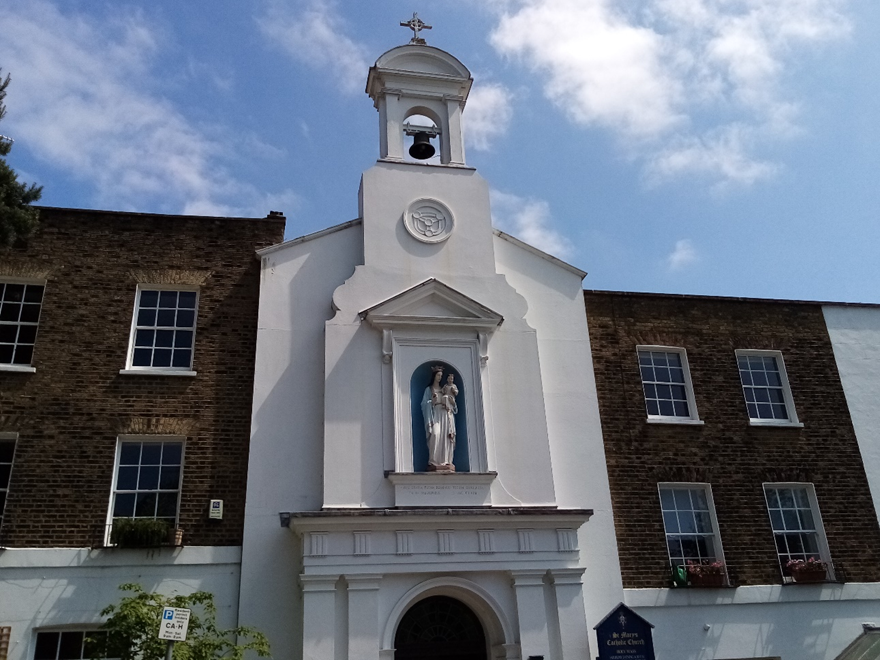
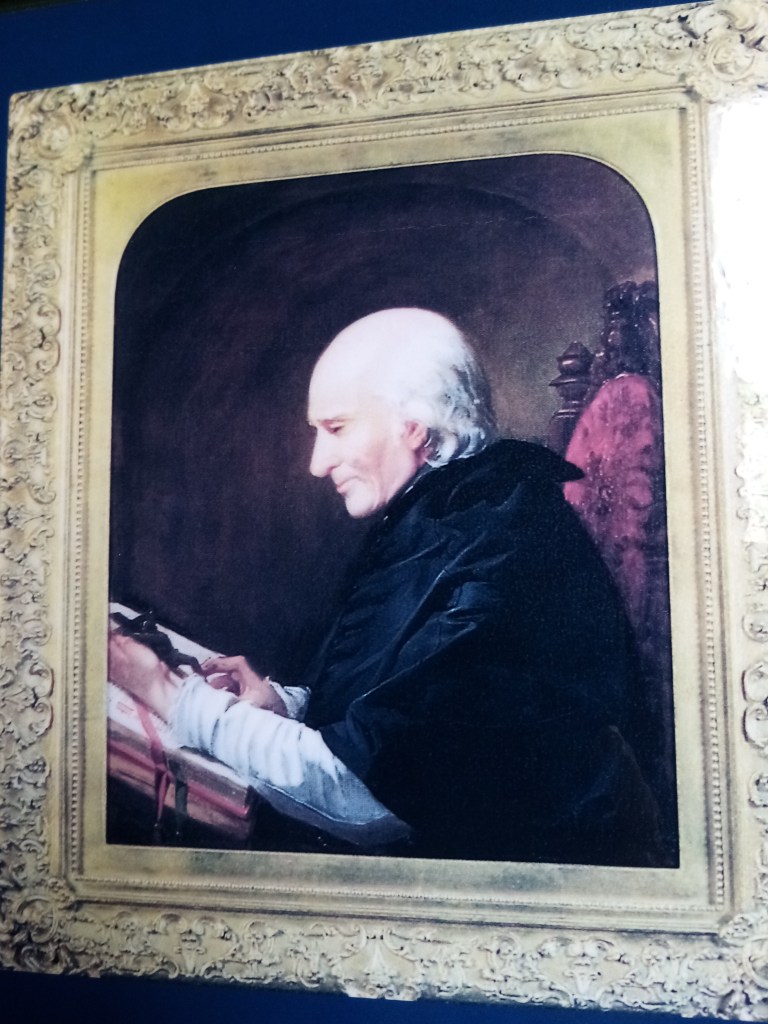
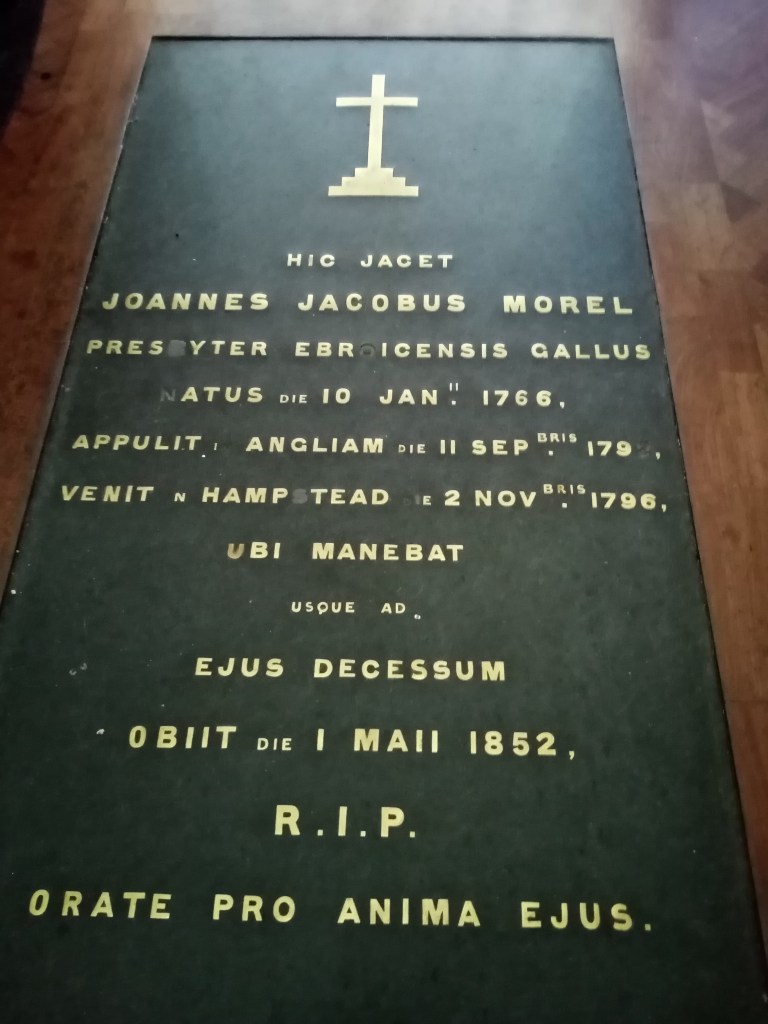
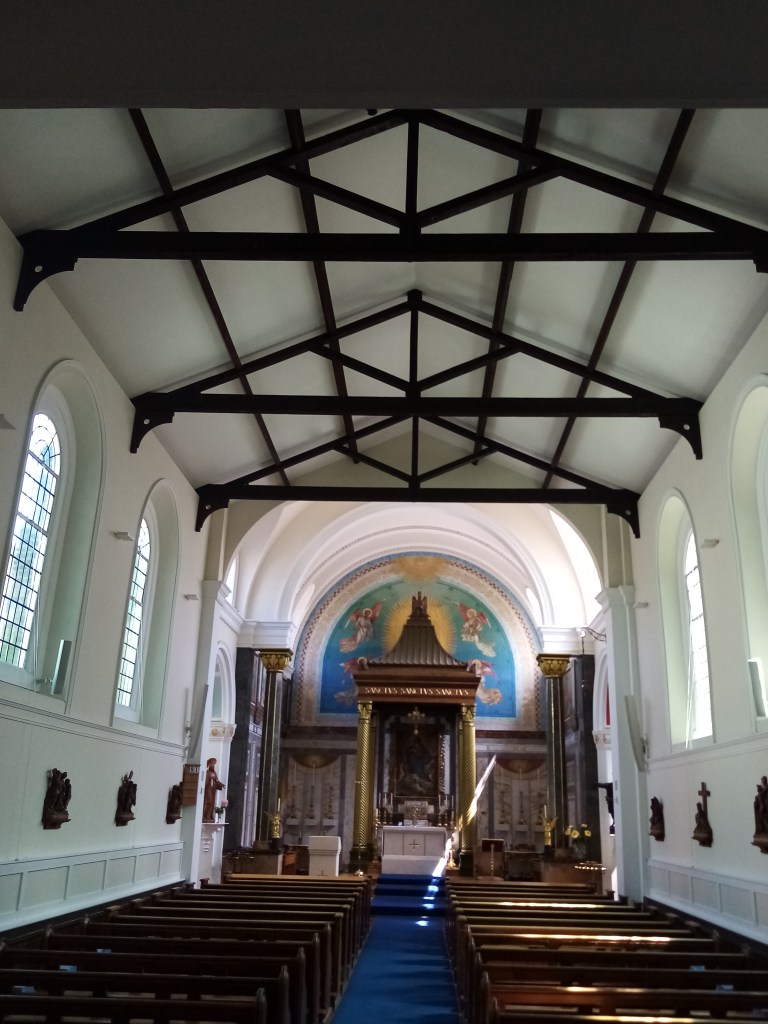
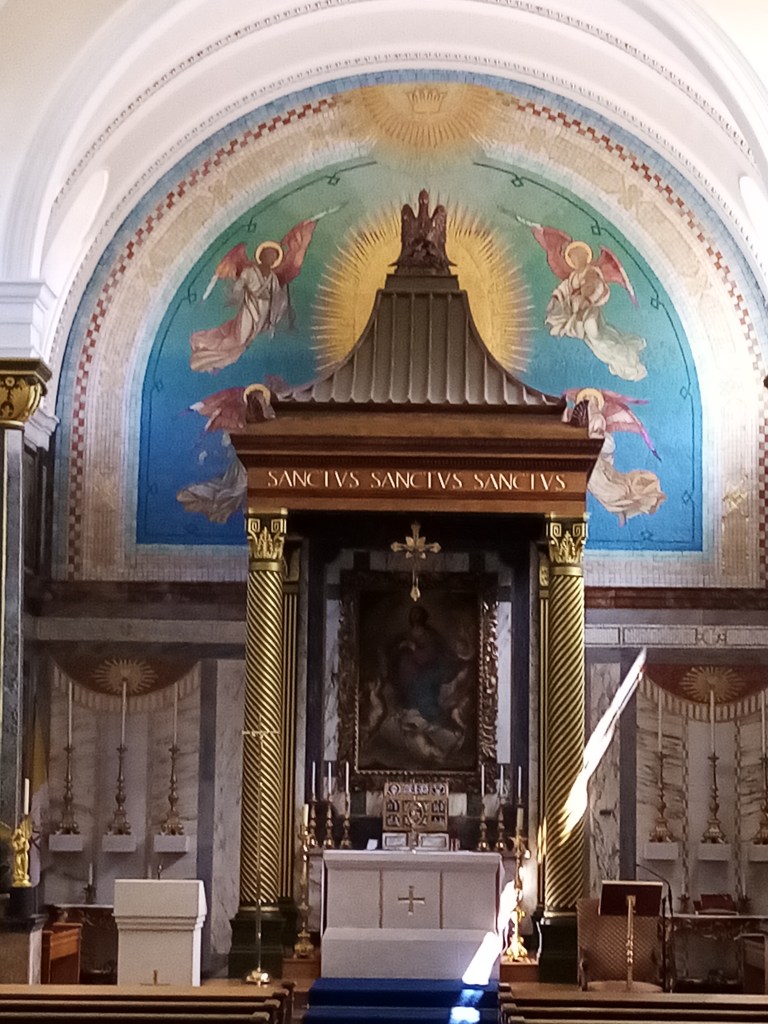
This pretty little church, formally a chapel, is located in Holly Place, part of a terrace of Georgian cottages and standing no taller than its neighbours, apart from the bell tower. The beautiful façade with bell tower and statue of the Virgin and Child, was designed by architect William Wardell. Originally the church had a plain frontage; the bell tower was added when the law was changed to allow bells to be rung from Catholic churches in 1852. St Mary’s was the first Catholic church to be established in Hampstead after the English Reformation in the 16th century. The first minister was a refugee from the French Revolution, who arrived in England in 1792.  Abbe Jean Jacques Morel’s first role was to act as chaplain to the many French families in exile in the village. After the defeat of Napoleon and the return of the refugees to France, Abbe Morel accepted an offer by the many other Catholics living in the area to be the Parish Priest of a newly-built chapel dedicated to St Mary in 1816. He made education a priority and quickly established two schools, one each for boys and girls, supported by wealthy parishioners. The sanctuary of the church is beautifully decorated with tile mosaics; I like the contrast with the plain white walls.

Source: Literature in the church; Wikipedia

St John’s, Downshire Road

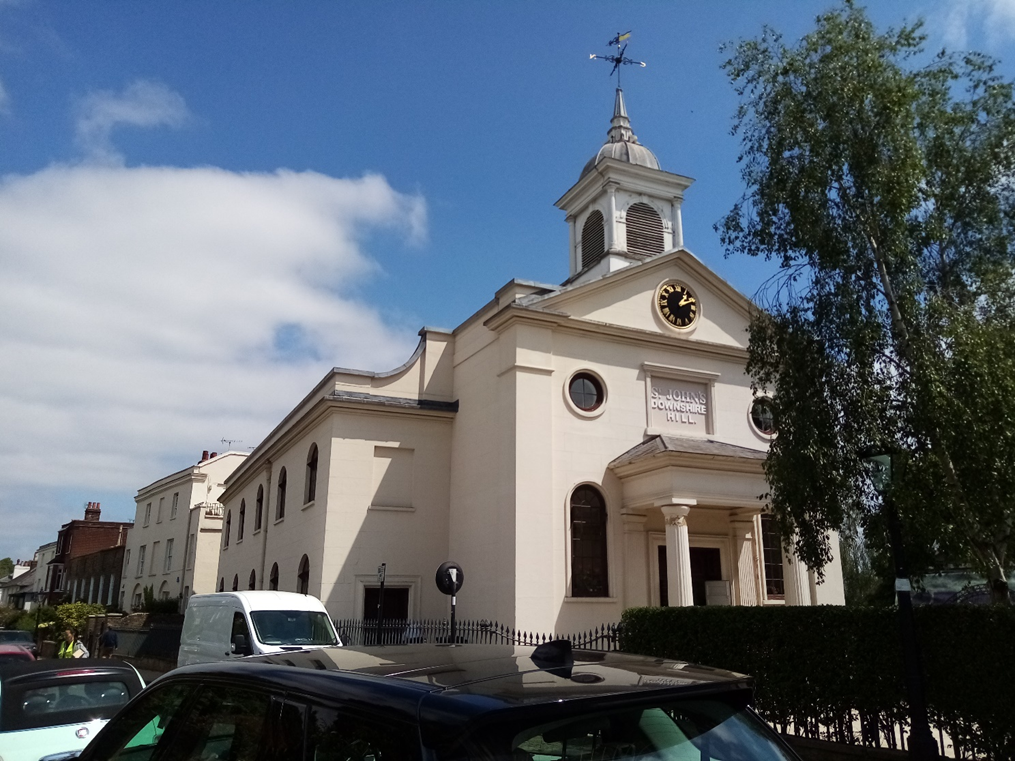
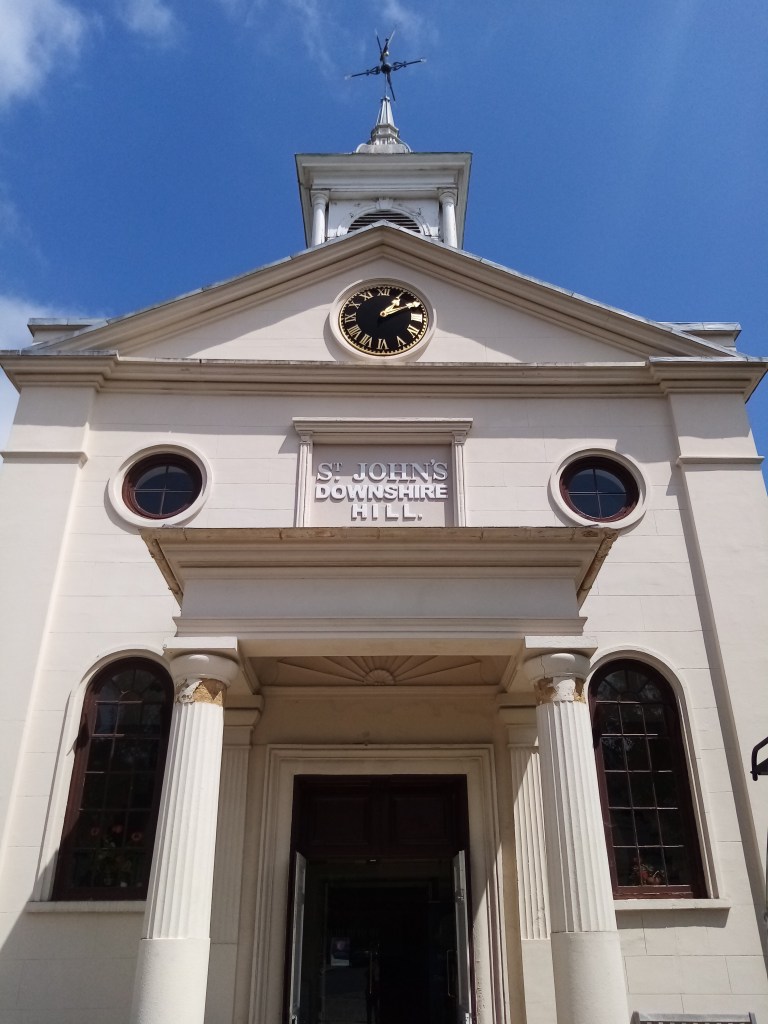
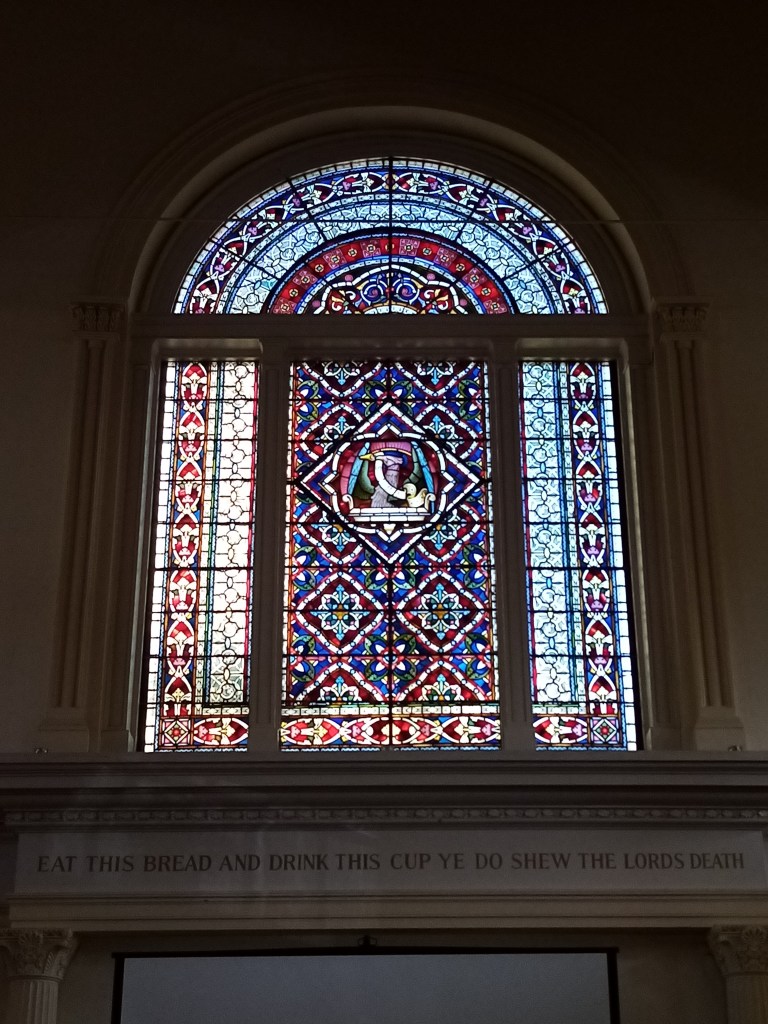
The other St John’s in the area is the only remaining Proprietary Chapel in the Diocese of London, and one of a handful left in England. A proprietary chapel is one that once belonged to a private person or a group of people, but was open to the public. They were common in the 19th century, being established to cope with rapid urbanisation. They were often set up by evangelical philanthropists to spread Christianity in cities where the expanding population could no longer be served by the parish church. As a proprietary chapel, St John’s is financially independent of the Church of England; all the ongoing running costs are provided entirely by the congregation. The land on which the church is built was purchased from the Manor of Belsize in 1812, and construction was completed in 1823. The former home of the poet John Keats is nearby in Keats Row. He lived there from 1818 until 1820, so he would have seen the construction of the church. In 1821, Keats relocated to Italy because of his failing health and never returned to Hampstead; he died later that year in Rome from tuberculosis, aged just 25.

Source: Wikipedia

Christchurch, Hampstead

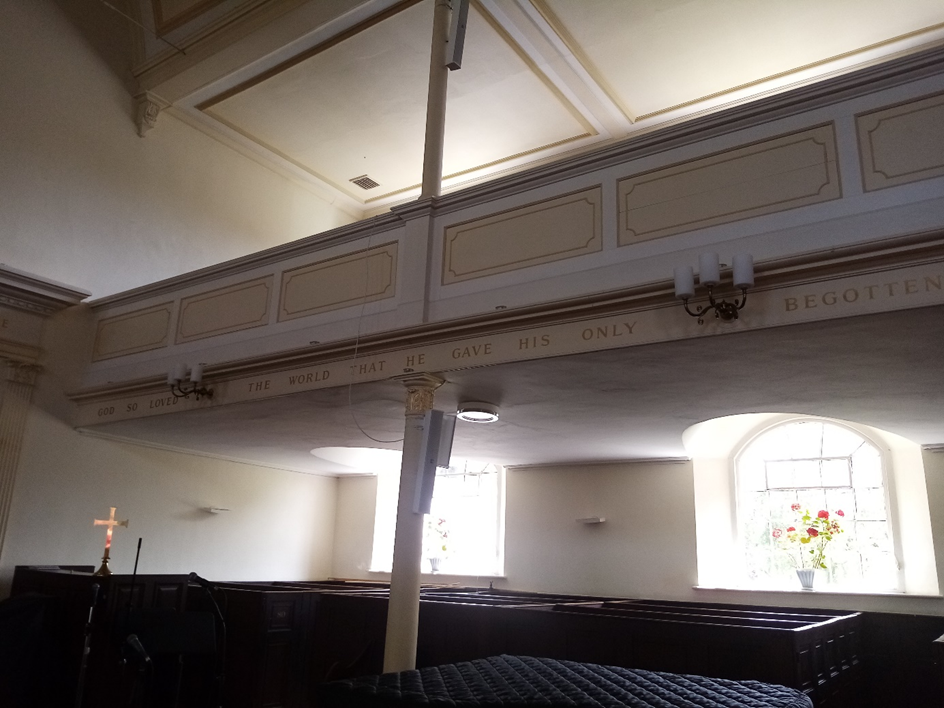
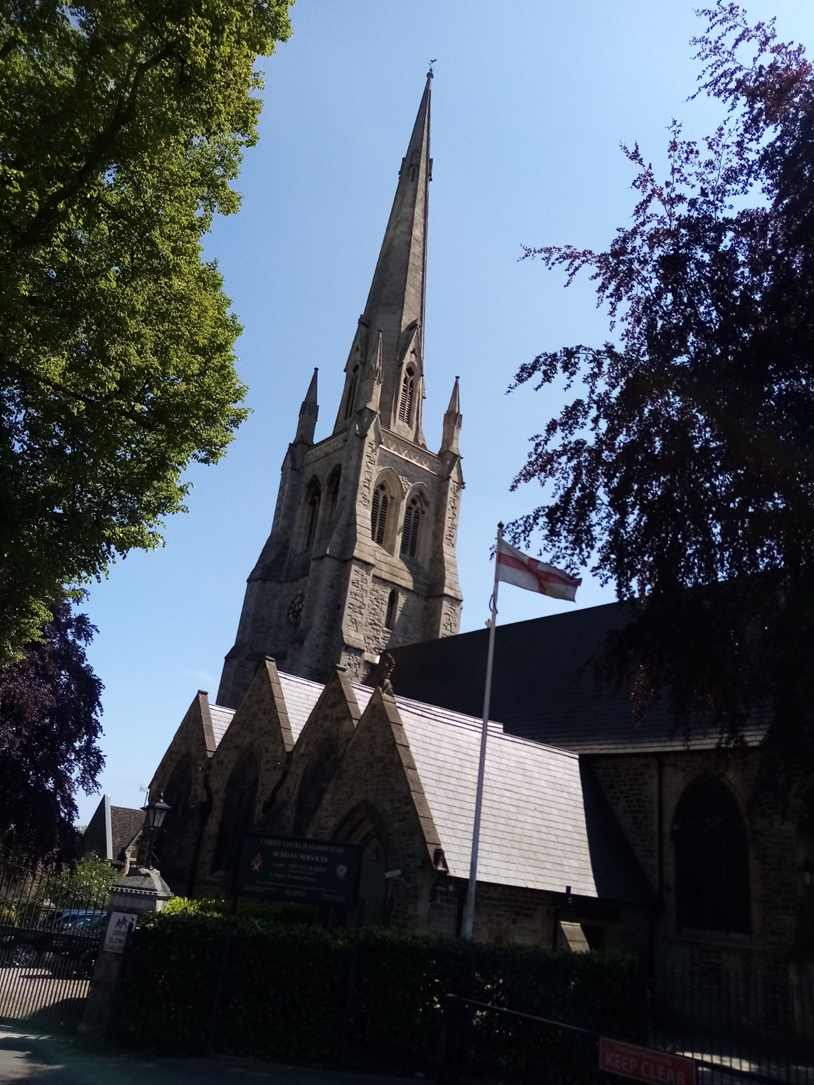
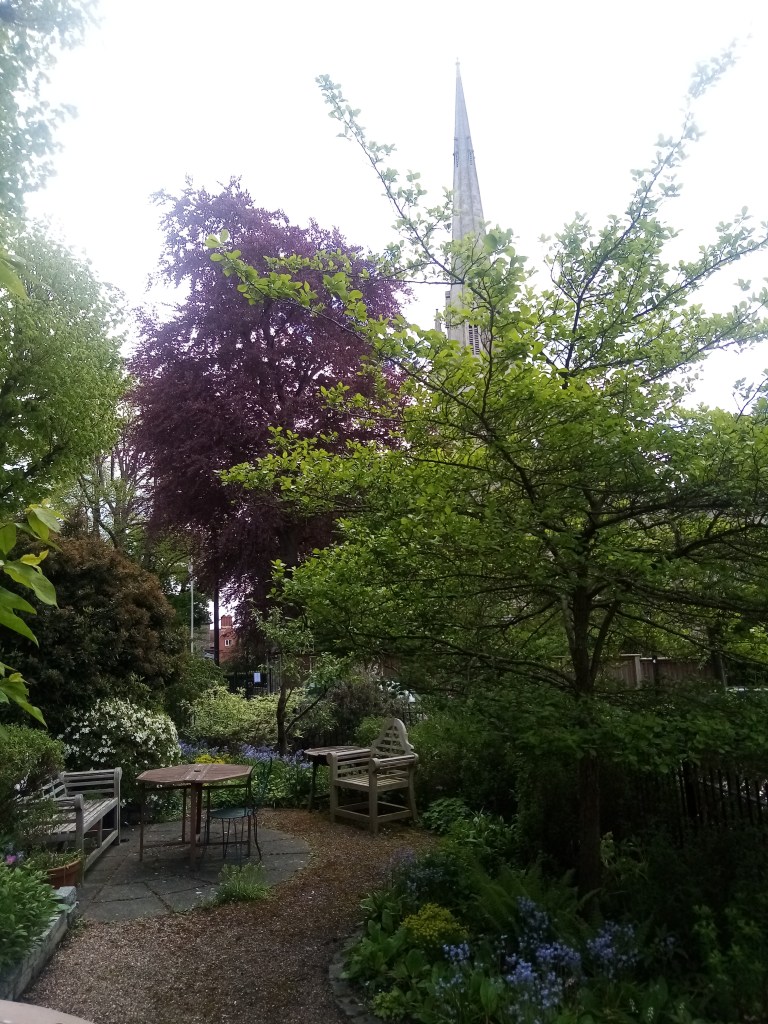
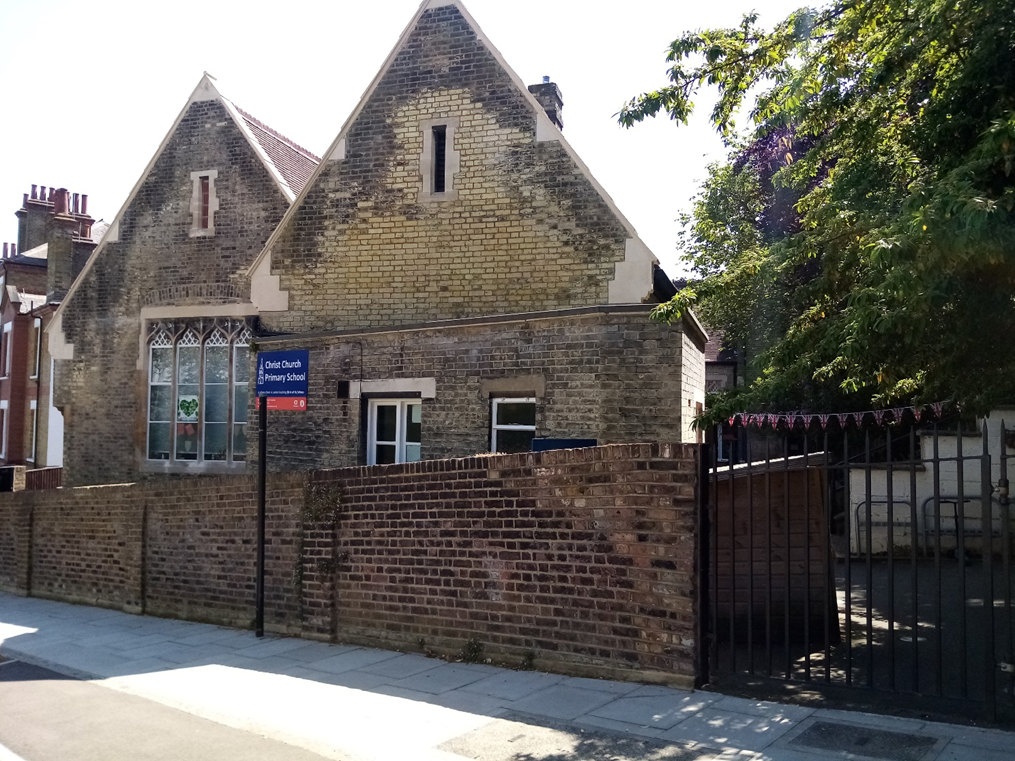
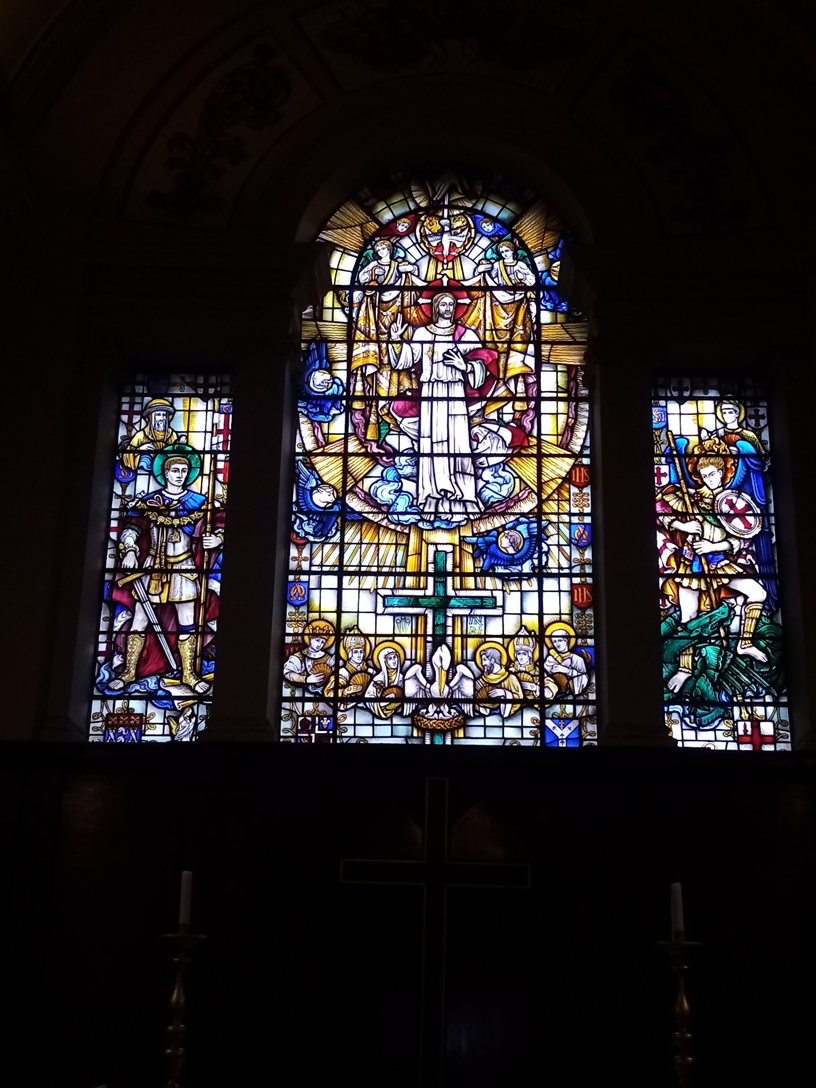
I was not able to go inside this church, which is a shame because it has been extensively restored and repaired, inside and out, as part of a Grand Restoration programme since 2015. But I love its tall, elegant tower and its location at one of the highest points in London. The church has long historical connections with the old village of Hampstead and the Heath, much of which is within the parish. The church was built in 1852 by architect Samuel Dawkes in the early English Gothic style. It’s situated in a very pretty square, Hampstead Place, and established its own school in 1855, originally just for infants, but now a primary and nursery school. Just two streets away from the church is a road leading to the confusingly named Vale of Health, not Vale of Heath, as I thought it was! This is a group of large villas entirely surrounded by the heath. The name the Vale of Health may have been coined as a deliberate attempt to change the image of the area: once a wet, marshy area, it was drained in 1777 by the Hampstead Water Co. and by the 1830s had become a desirable place to live for the romantic poets and other media figures of the day. Byron, Shelley and Taylor Coleridge all resided there at one time, and of course, Keats lived just down the road.
Source: Wikipedia; Hampstead: Vale of Health/British History

The Vale of Health Pond and Villas

April – Military Churches

I first thought of exploring the connection between churches and the military after visiting the Royal Military Chapel (or Guards Chapel) on Birdcage Walk, just down from Buckingham Palace. I also read an article in Premier Christianity about the impact of conflict on the Church in Russia and Ukraine; writing about the funeral of Queen Elizabeth ll, the author says: ‘Westminster Abbey was full of soldiers and regimental banners; a spectacular mix of Church, nation and military. But it wasn’t always like this. For centuries after the resurrection of Christ, his followers believed that when Jesus said “love your enemies” he actually meant it. Churches did not allow their members to be soldiers.’* So does the presence of armed soldiers at church services sit well with Jesus’ message to His church of peace, love and unity? Having visited both the Guards Chapel and St Clement Danes, the church of the RAF, I realise that the role of these churches is to support servicemen and women spiritually and in other ways, and to commemorate those who have died in conflicts. All members of the forces: army, navy and air force, are servants of the reigning monarch, formerly Queen Elizabeth ll and now King Charles lll, and many of their duties are ceremonial, as we will see at the King’s coronation on May 6th. Anyway, enough of the philosophising, here are the churches!

Reference: Nick Megoran, A Church at War? Premier Christianity, March 2023

The Guards Chapel

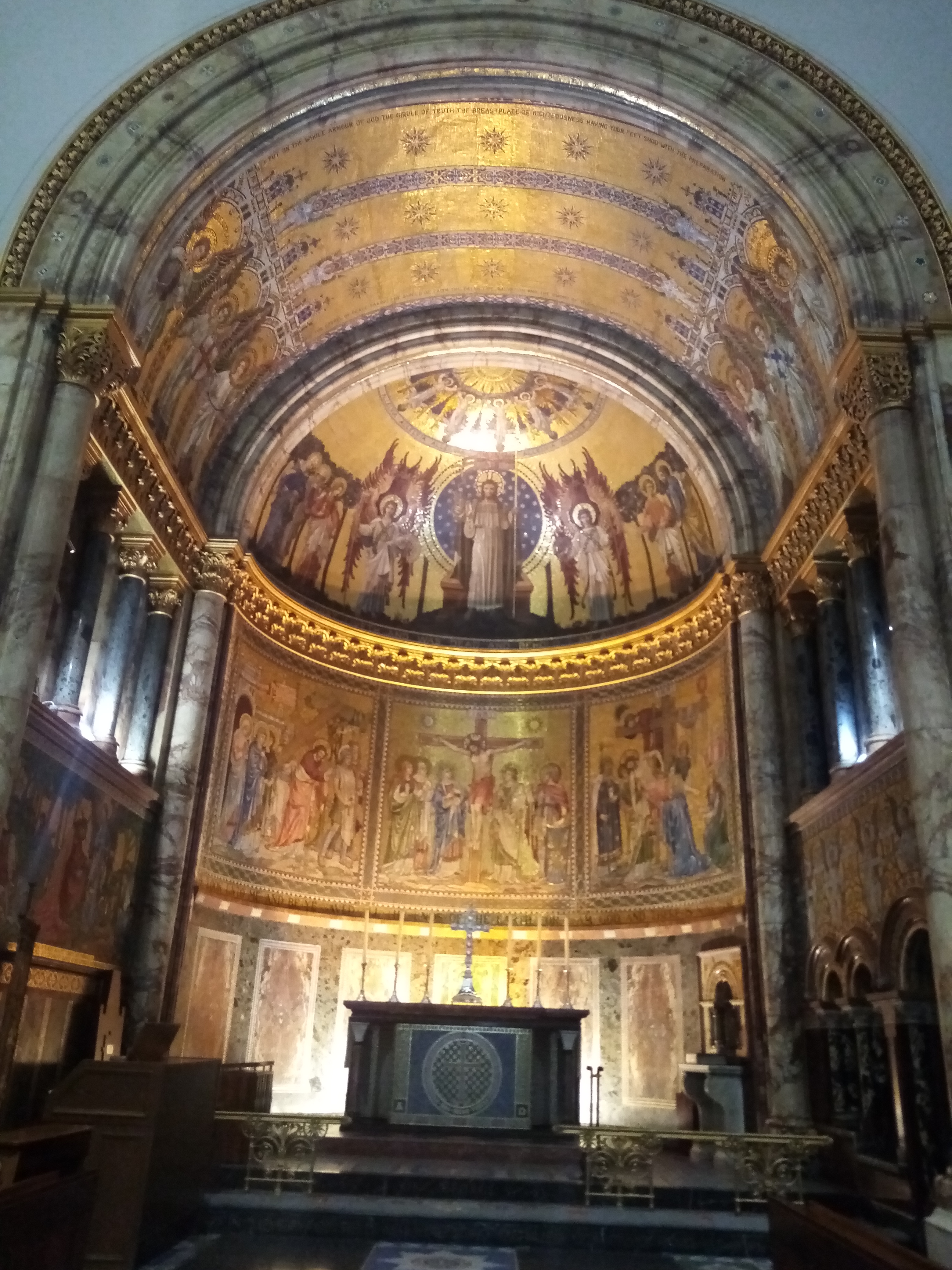
The spectacular apse of the Guards Chapel

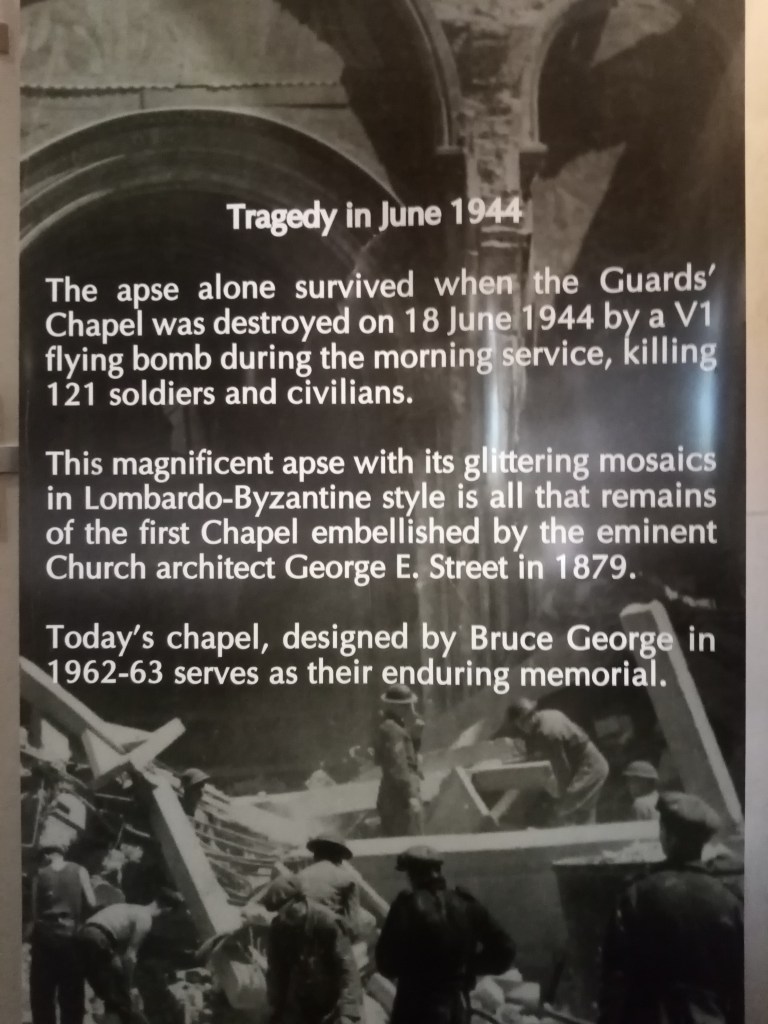
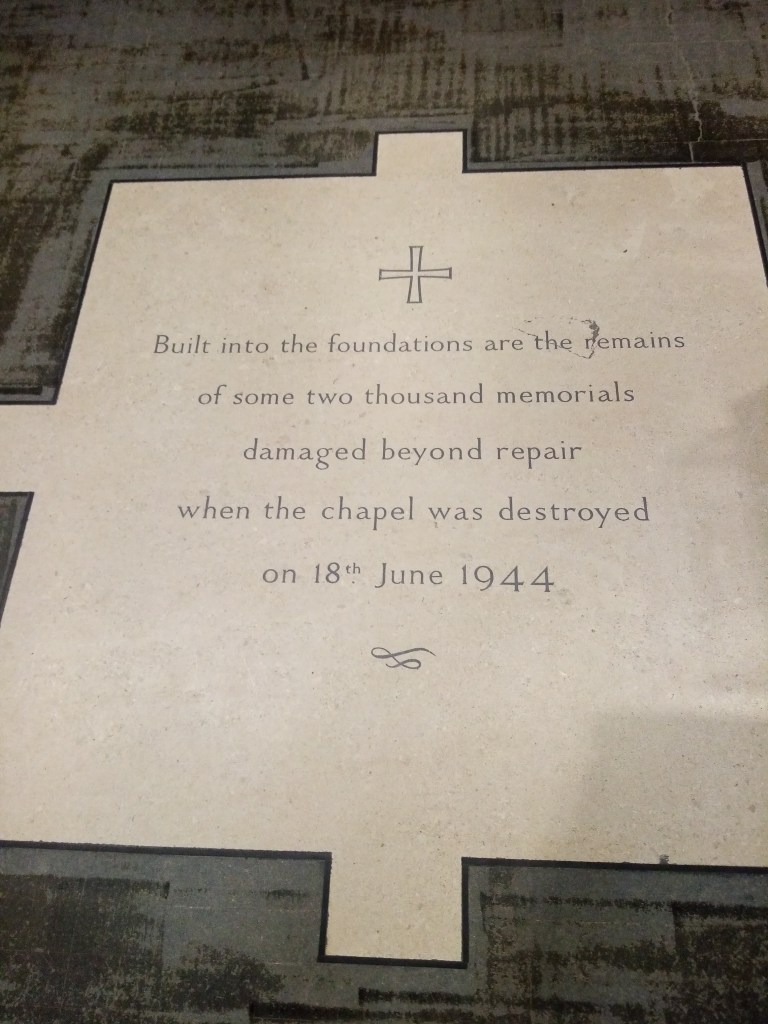
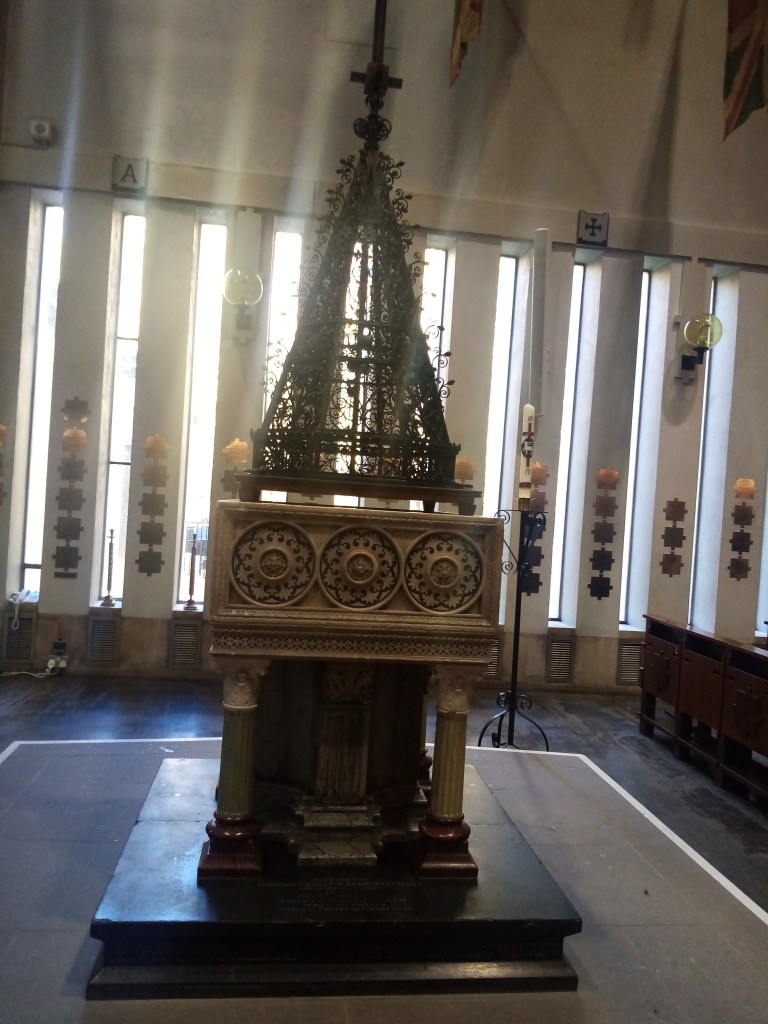
Wellington Barracks, close to Buckingham Palace, was completed in 1834 and its Chaplain, Dr William Dakins, campaigned for a chapel to be provided for the Guards of the Household Cavalry, to enable them to attend church services in their own building. The Royal Military Chapel, St James Park was built to accommodate a congregation of over 1,000 and the first service was held on 6th May 1838. The building was considered rather plain and austere, so money was raised to embellish and decorate the interior and to erect monuments to those who had died in service to their King (or Queen) and country. On Sunday 18th June 1944, tragedy struck when the chapel was hit by a flying bomb which exploded and almost completely destroyed it. 121 people, both soldiers and civilians were killed and many more were injured. The memorials and other artefacts were not reconstructed but all their remains were laid under the floor of the present chapel; ‘the new chapel thus rising from the foundations provided by the old, so forming a physical link between the past, the present and the future’* Amazingly, the apse, font and altar were completely undamaged and have been skilfully incorporated into the new building. The brilliance of the apse and altar are in startling contrast to the plain white walls of the new chapel.

Reference: Major A. G. Douglas, MBE, The Guards Chapel

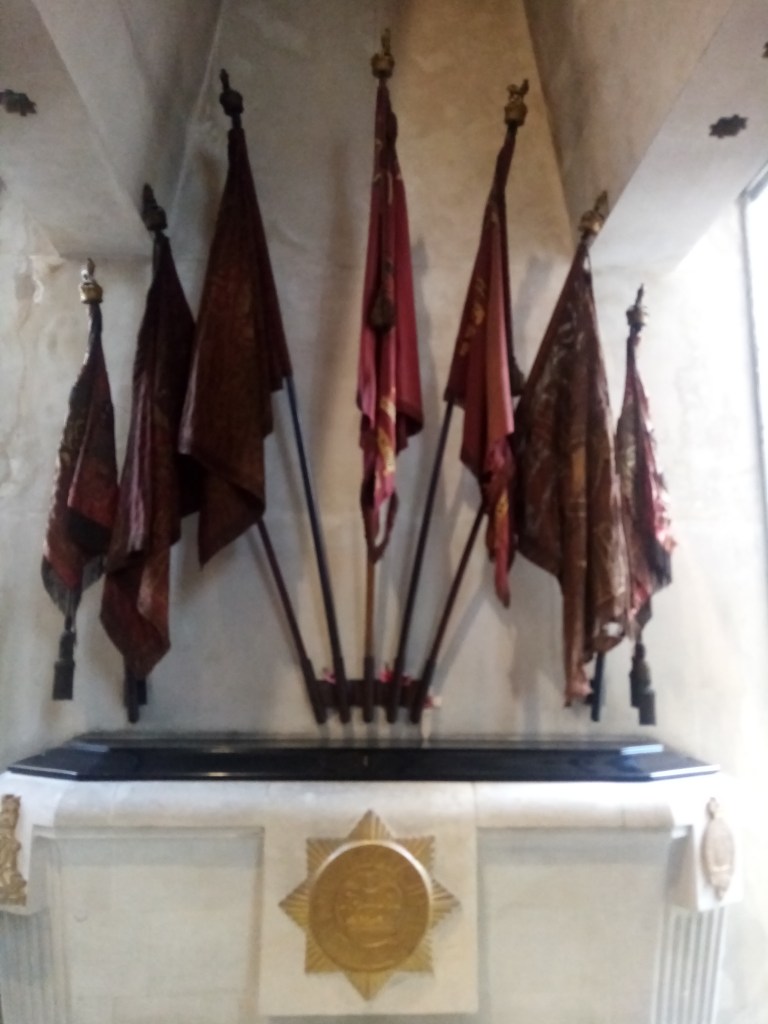
Regimental Flags

St Clement Danes, the Church of the RAF

Bomb damage to the outer walls of St Clement Danes

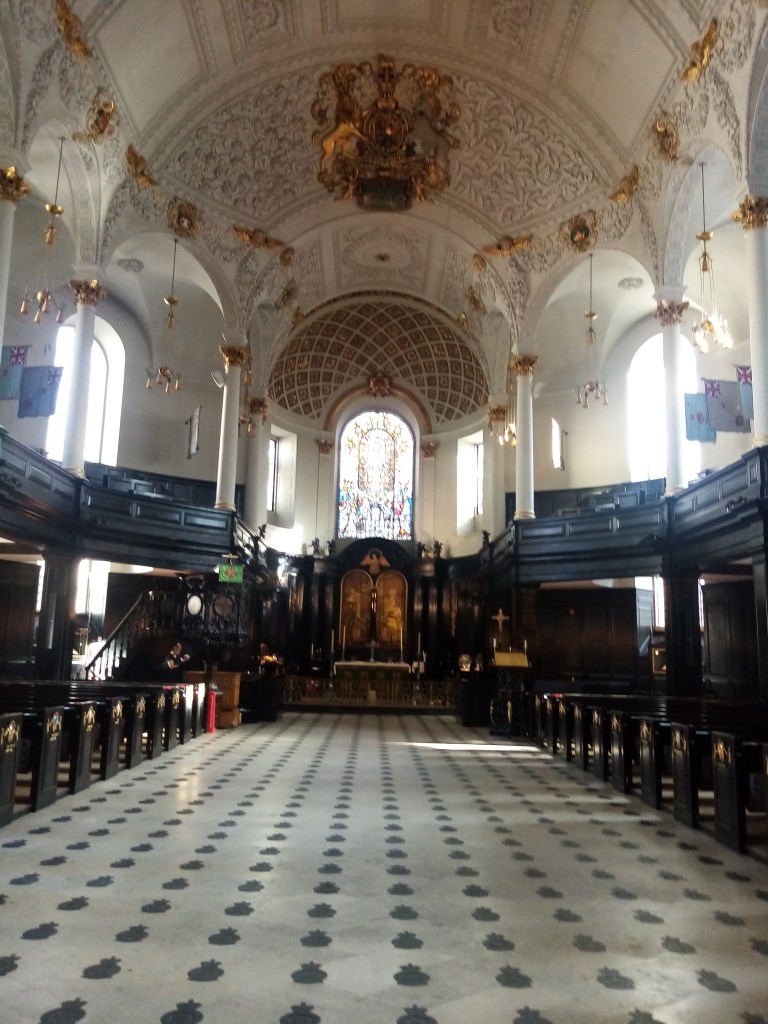
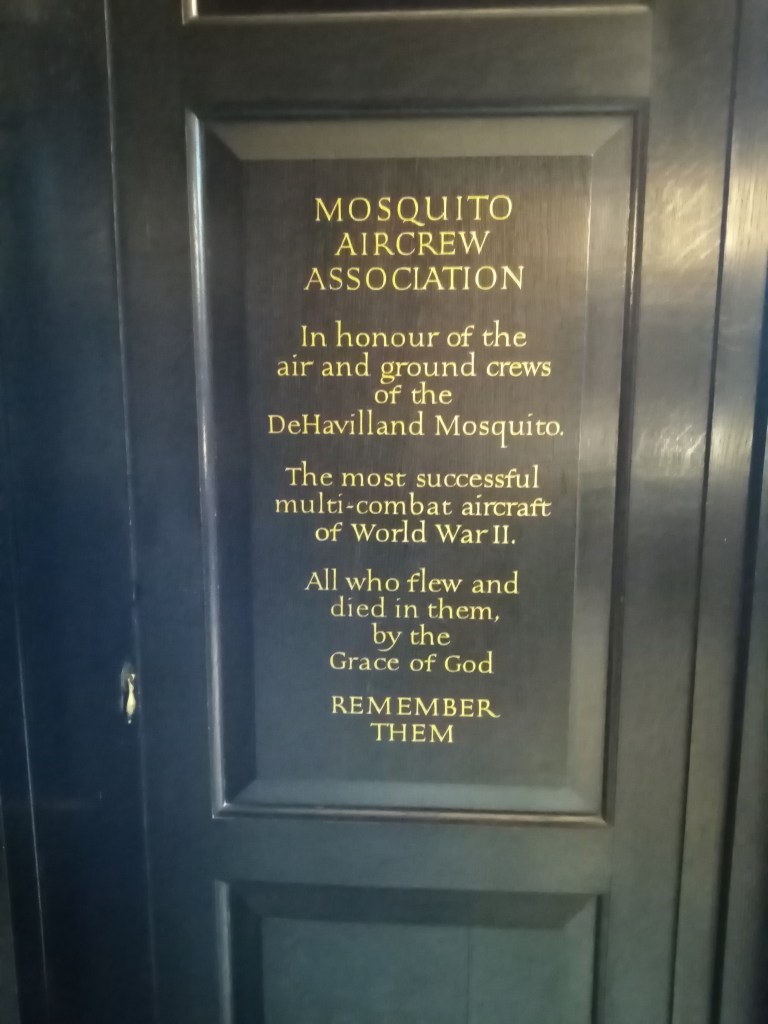
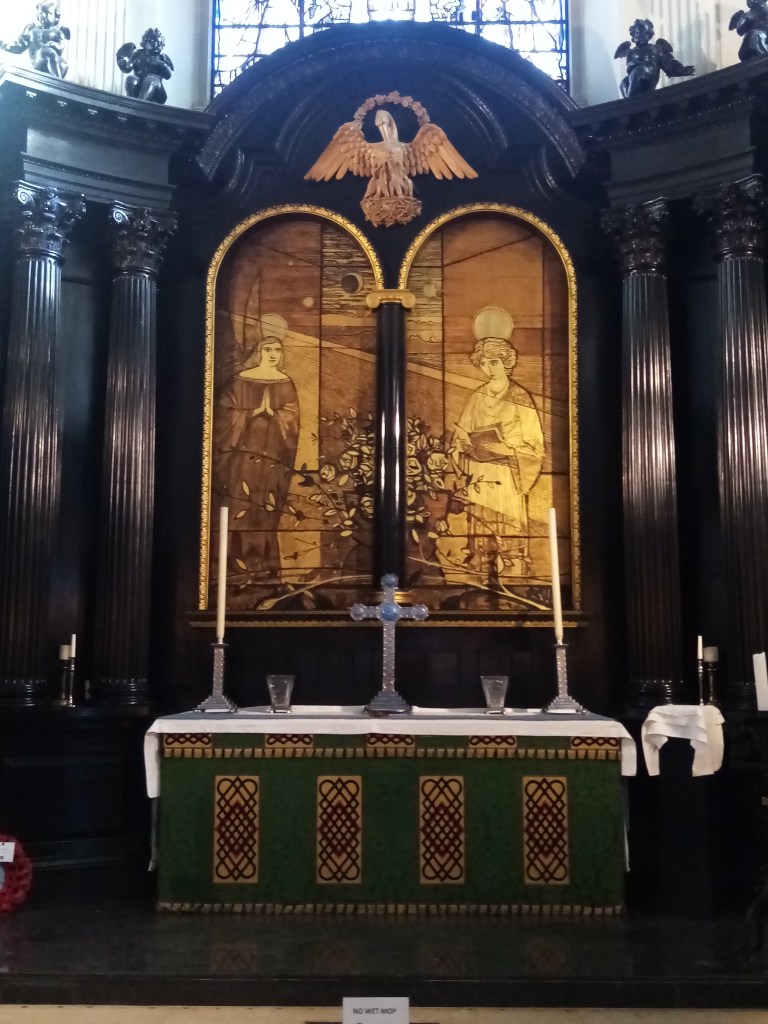
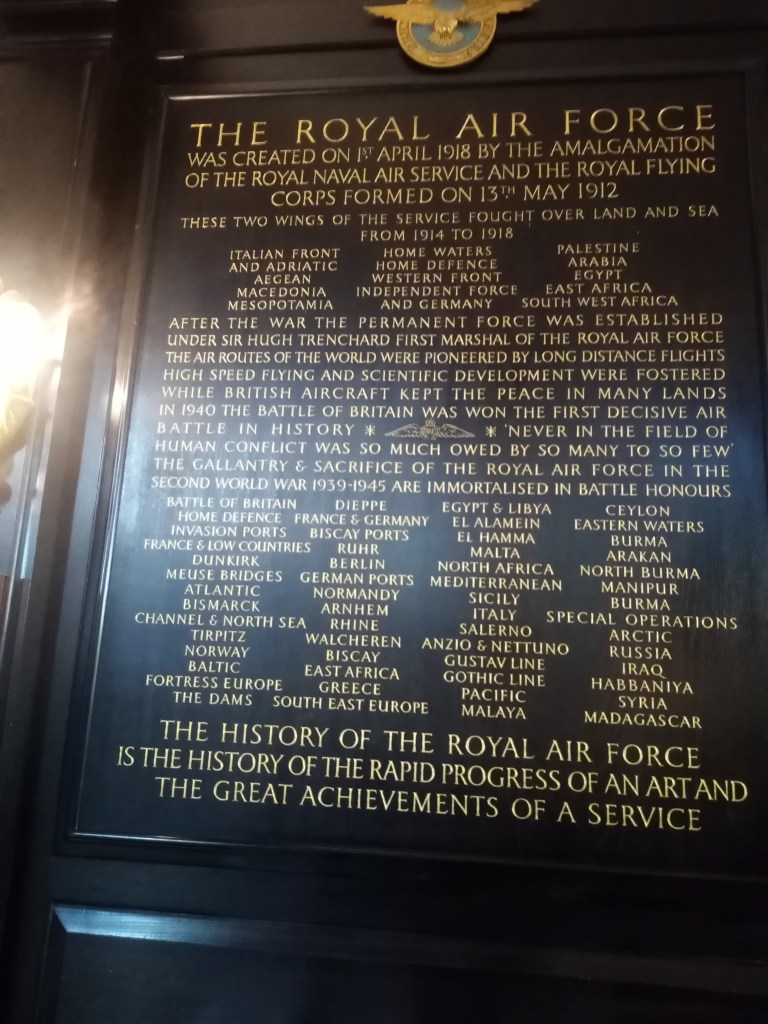
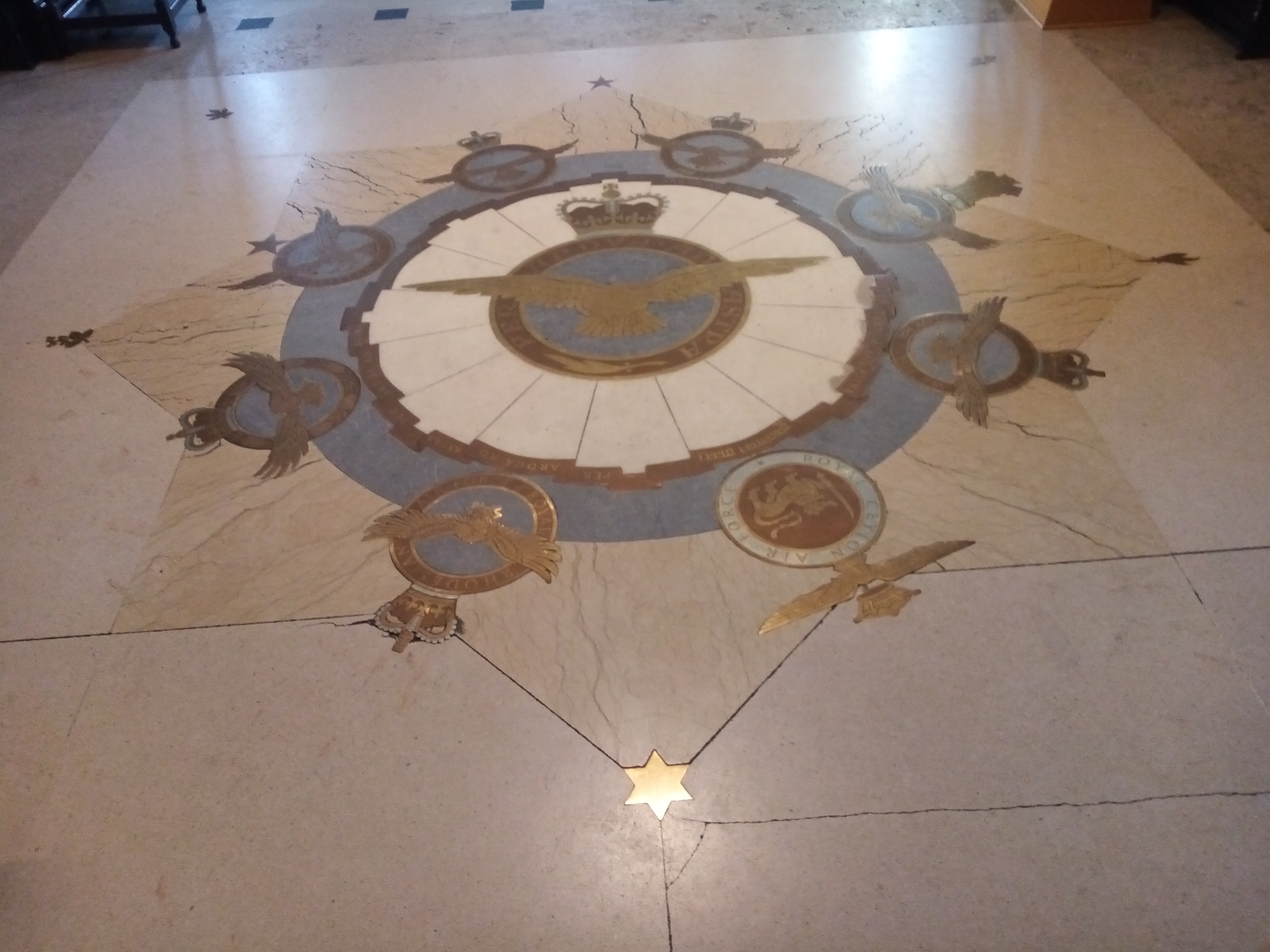
I wrote about this church’s 1,000 year old history two months ago, it’s story continues into modern times. This is another church that received a direct hit in World War ll: on 10th May 1941 an incendiary bomb exploded within the roof space and destroyed all but the tower and some of the outer walls. The night of 10th/11th May was one of the worst of the Blitz, bombing began at 11pm and continued til 5.30 the next morning, but it marked the last major raid of the Blitz. The church was not rebuilt and lay in ruins for over a decade. After the War the Royal Air Force were looking for a central London church to adopt. The Diocese of London agreed that if St Clement Danes could be rebuilt to Sir Christopher Wren’s original design, the RAF could have its central church. An appeal was launched and supported by Air Forces world-wide, and the church was restored and re consecrated as the Central Church of the Royal Air Force in 1958. St Clement Danes states its role ‘is to be a place of regular worship and to be a living memorial to those who died whilst serving in the Royal Air Force.’ The interior of the church incorporates lots of design features and memorials to the RAF which show the skill of those who rebuilt the church from its ruins.

Reference: Leaflets in the church

St Martins in the Fields

Picture from St Martins in the Fields Church website

The Vicar of St Martins in the Fields between 1914 and 1926 was Dick Sheppard, who was a member of the Christian Pacifist movement, a theological position which affirms that any form of violence is incompatible with the Christian faith. After ordination into the Church of England, Sheppard became a chaplain at a military hospital in France at the start of World War 1, but suffered what today would be diagnosed as PTSD, due to his experiences there and had to return home. This completely changed his view of warfare and he became a life long pacifist. He accepted the living at wealthy, fashionable St Martins, turning the church into a social care centre for those in need, particularly the area’s homeless and this work continues today. Unfortunately Sheppard suffered poor mental and physical health for the rest of his life but continued to campaign for peace, establishing the Peace Pledge Union in 1936 and writing several books about pacifism. He died aged 57 in 1937, two years before the outbreak of World War 2, I wonder if he would have gone on to write about war and peace if he had lived on into the war years? The War Memorials in St Martin in the Fields focus on the suffering that warfare causes, through actual conflict, through captivity, deprivation and disease, and through subsequent post-war health deterioration. This reflects Dick Sheppard’s belief that war is not glorious and good, but causes only suffering and tragedy.

Reference: Wikipedia

St Paul’s Cathedral War Memorials

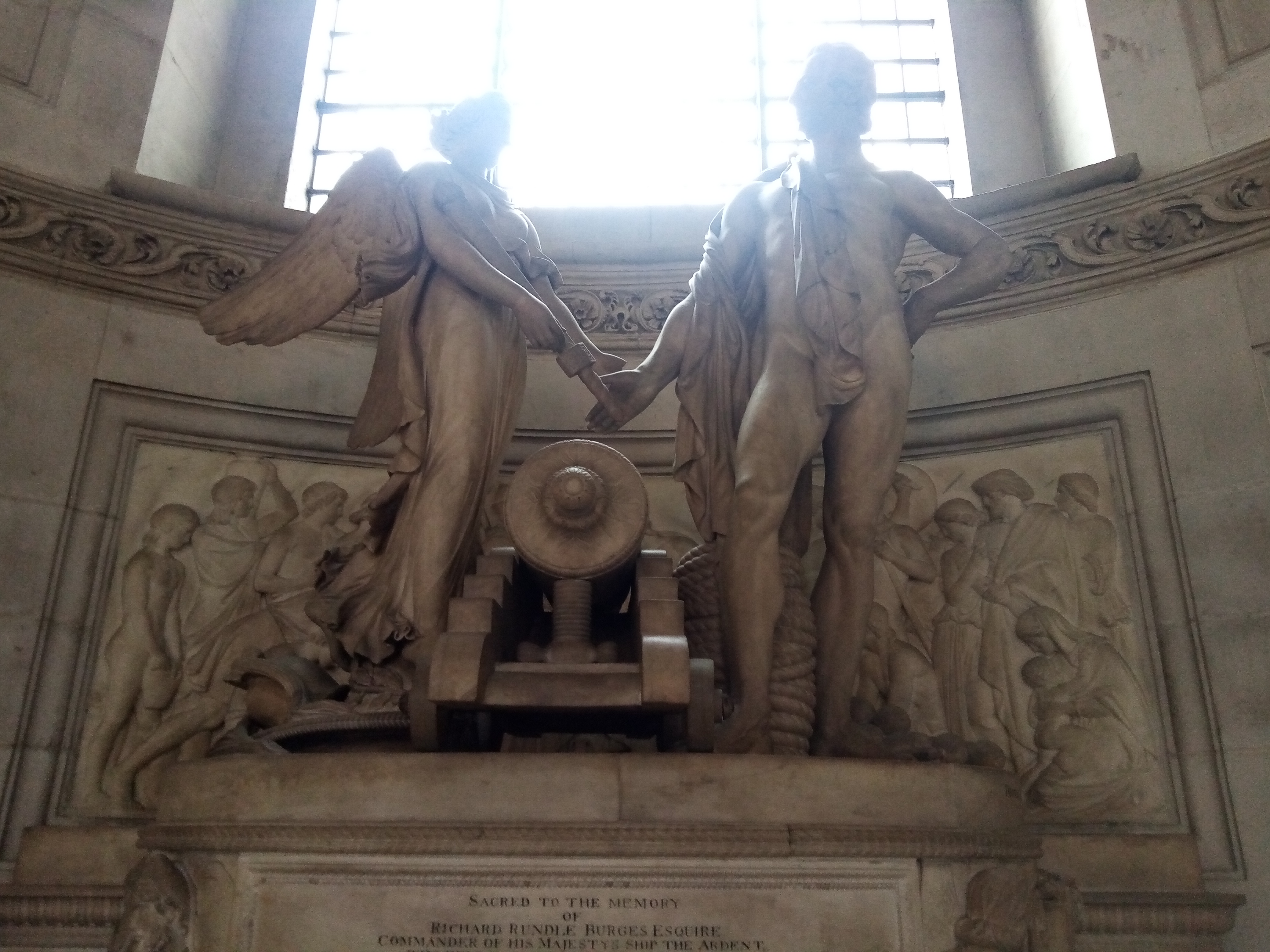
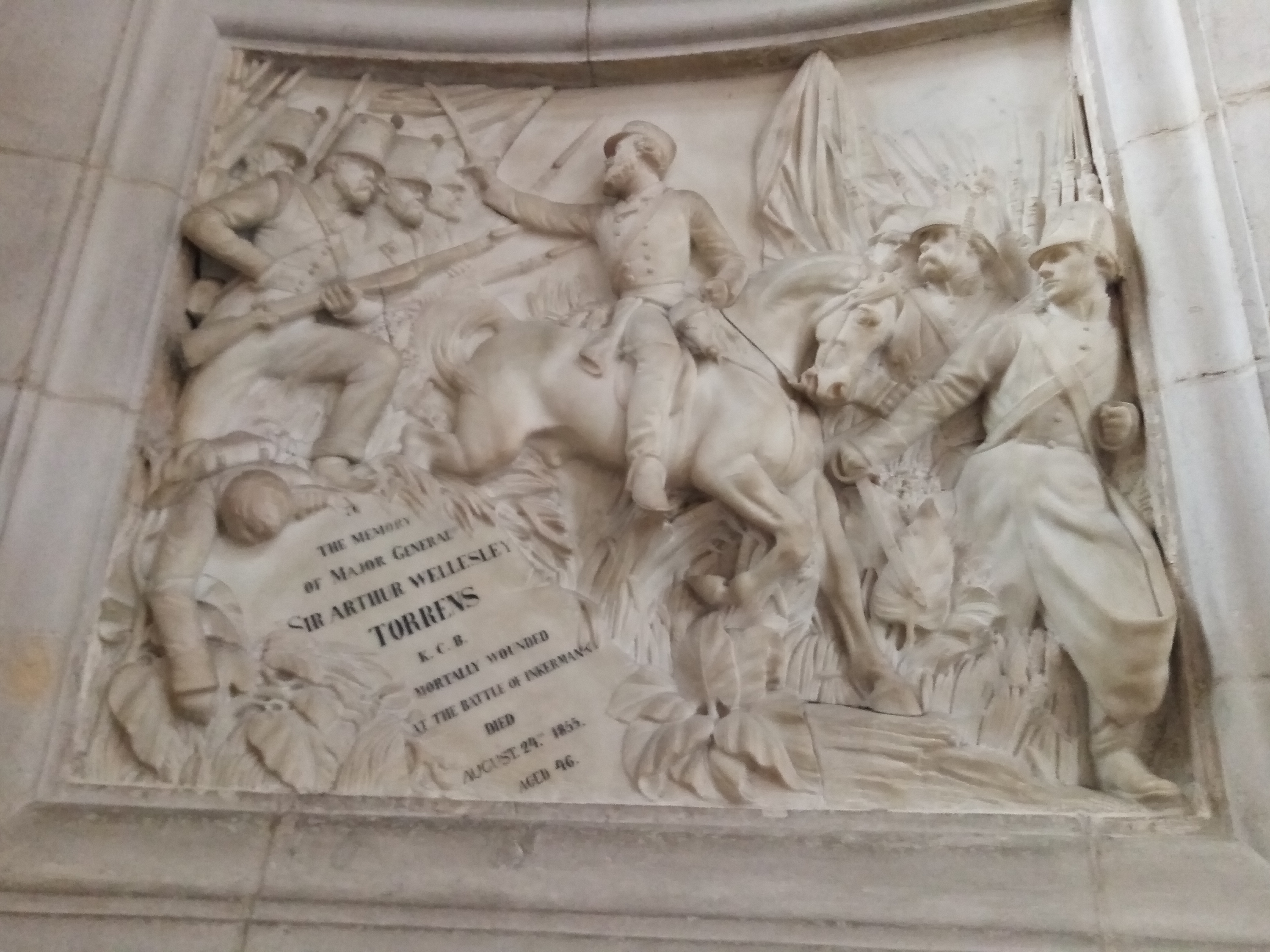
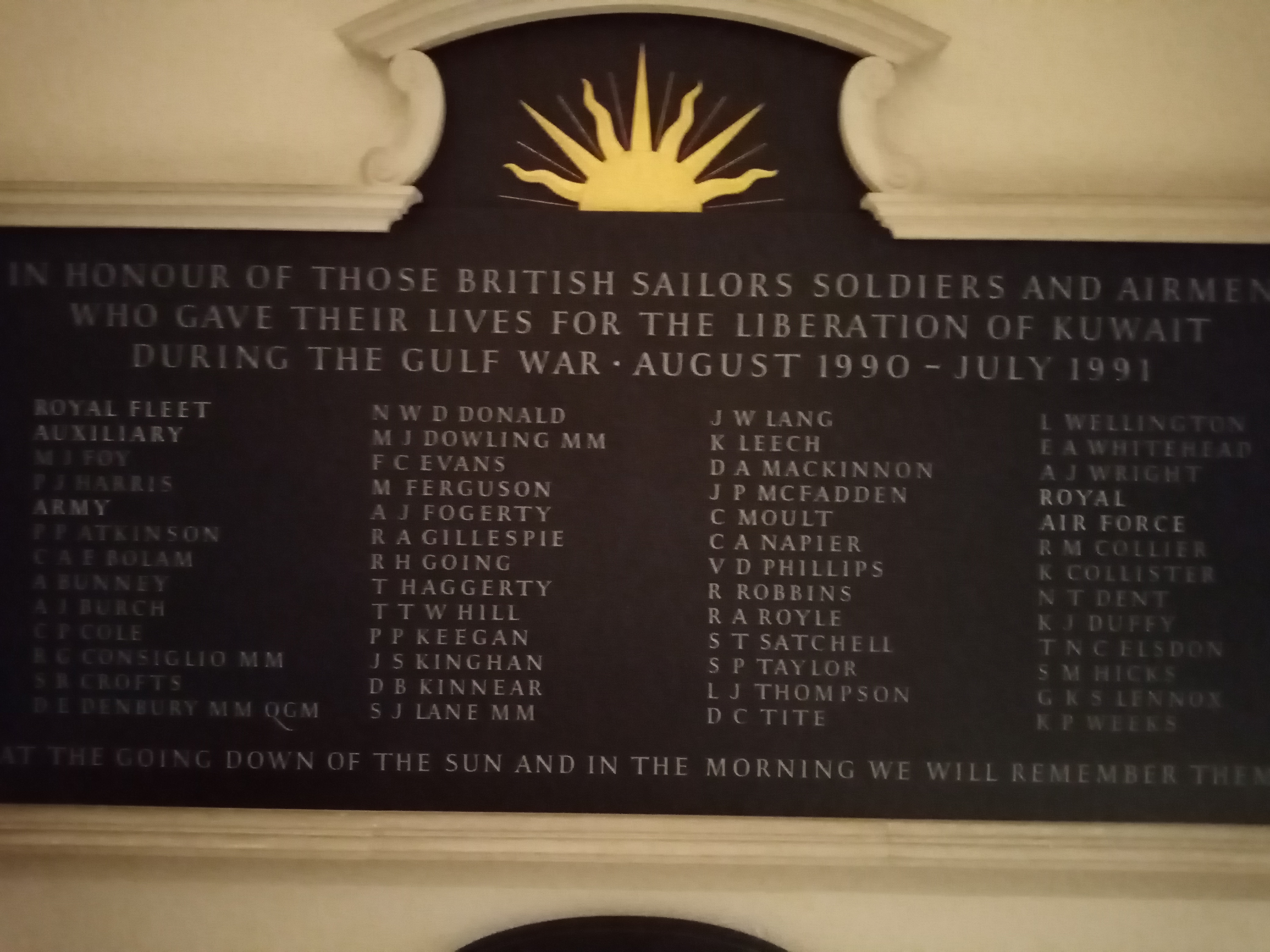
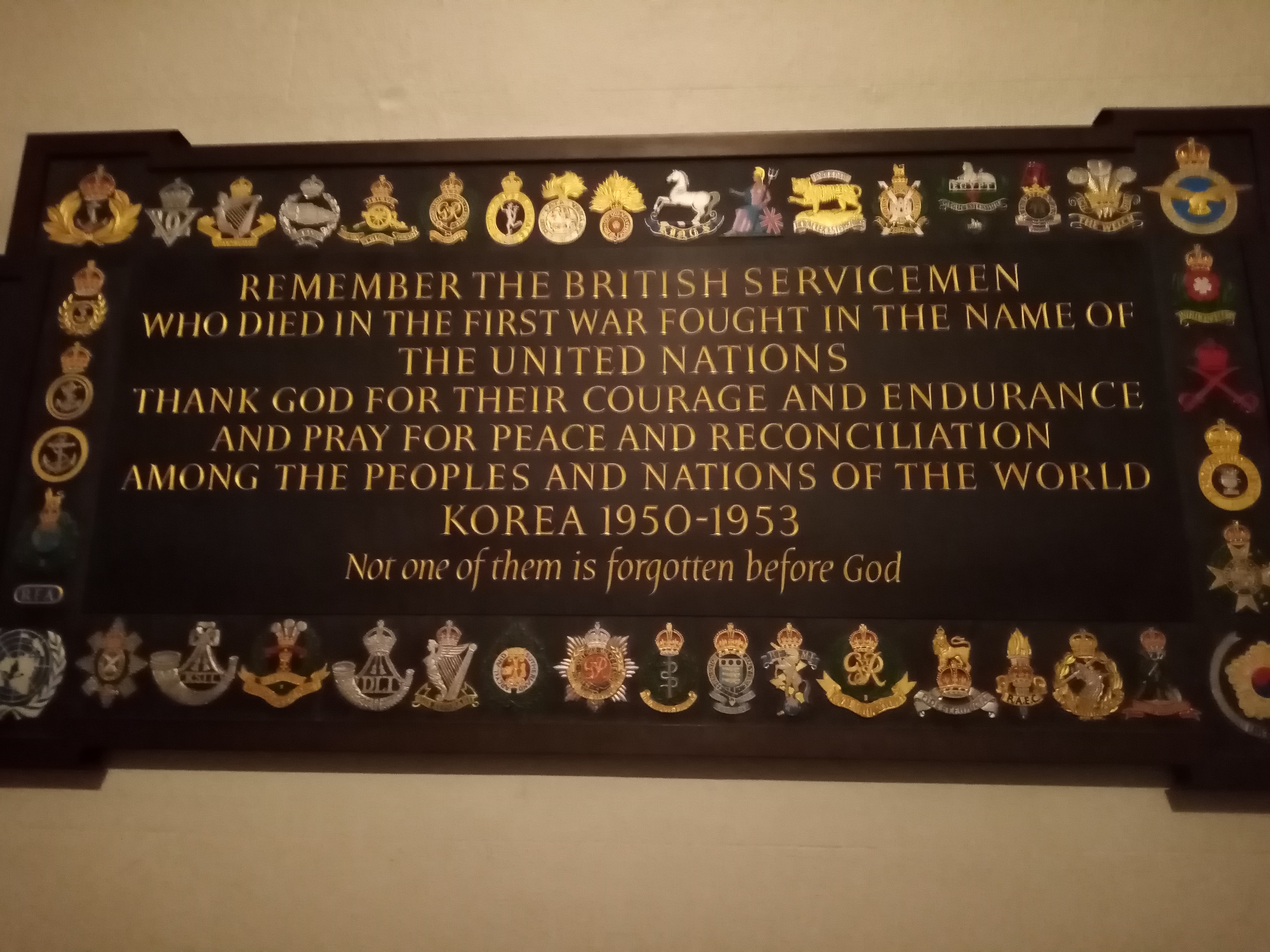
I’m finishing this month with photos of some of the War Memorials in St Paul’s. Some of these are very elaborate and detailed and seem to glorify war, or at least revel in victory. The photo above shows a couple from Greek mythology perhaps, standing beside a weapon of war, a cannon. Some mixed messaging, I think! It’s interesting how the casualties of war are commemorated and remembered: how the words and images used on the memorials have changed over time so that the later ones are less triumphant in victory, and more respectful and thankful for the sacrifice made by brave service men and women for their country.

Gulf War Memorial
Korean War Memorial

March – Churches with Daffodils

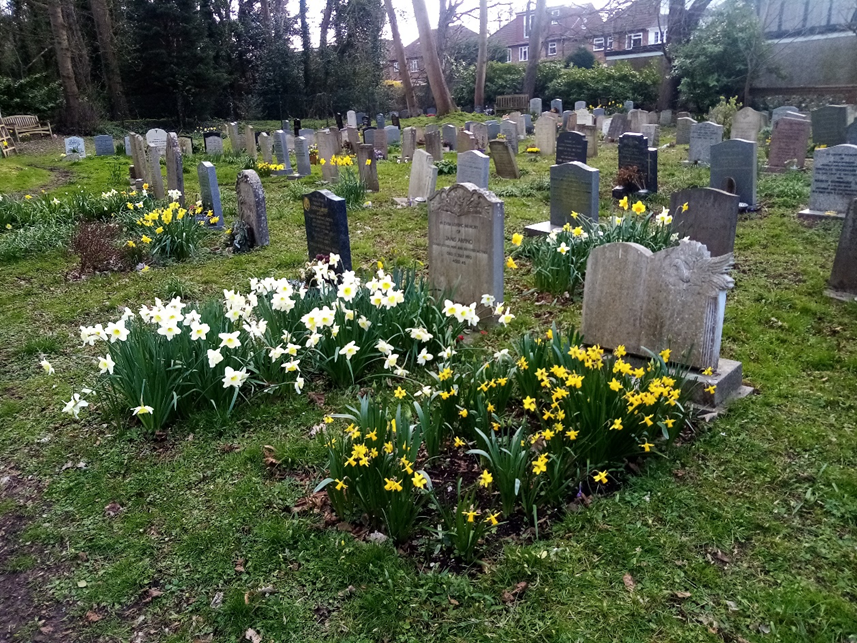
As my good friend Ric observed: ‘Spring always delivers!’ Daffodils are everywhere just now, looking beautiful and heralding Spring. So here’s another crop of ‘churches with daffodils’; I love it that these seasonal blooms don’t need any attention, they just ‘spring’ into life when the days get longer.

St Margaret of Antioch

This photo was taken over a month ago, in February half-term break, and already the daffs are looking good! St Margaret’s is the Abbey Church of Barking Abbey which I visited for last month’s post. The church dates back to 1215 and has served the ancient town of Barking as a centre of worship, education and community for eight centuries. As I mentioned last month, the Abbey was mostly destroyed in the Dissolution of the Monasteries of the 1530s but the church itself survived as by then it was a Parish church. I’m going to focus on community, as this is very much in evidence in the 21st century. The St Margaret Centre was commissioned by the then Archbishop of Canterbury, Dr George Carey and was opened in 1992. The Centre serves as a Warm Space three days a week, with a lounge, workspace and Wi-Fi. The Community Café offers low cost lunches and home made cakes and free hot drinks. There’s also a Rough Sleepers breakfast on Tuesday mornings. Walking round the ruins of the Abbey reminded me that centuries ago, the thriving Abbey would have provided similar food and shelter to the community, particularly those in need. In the mid-1800s Barking was a large and important fishing port, with a fleet of 110 fishing vessels. Tradition has it that the roof of the church was designed and constructed by local fishermen to resemble an upturned boat; there’s also a lovely sea-themed stained-glass window.

Sources: Information Booklet; Wikipedia; Church website

St Nicholas, Sutton

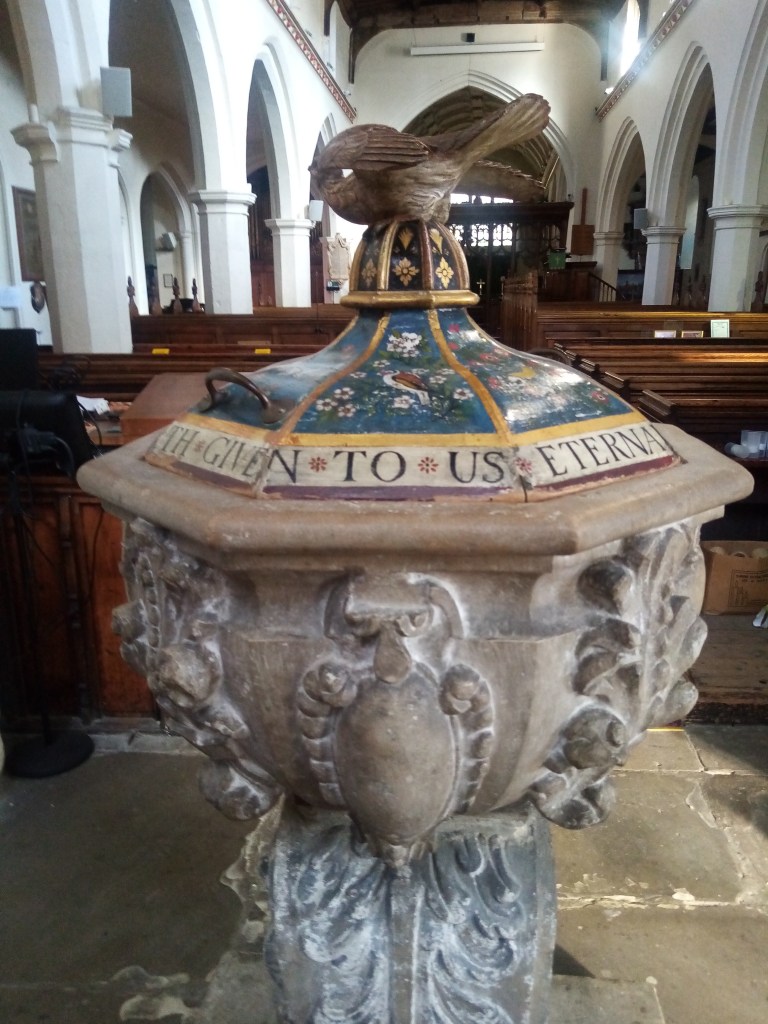
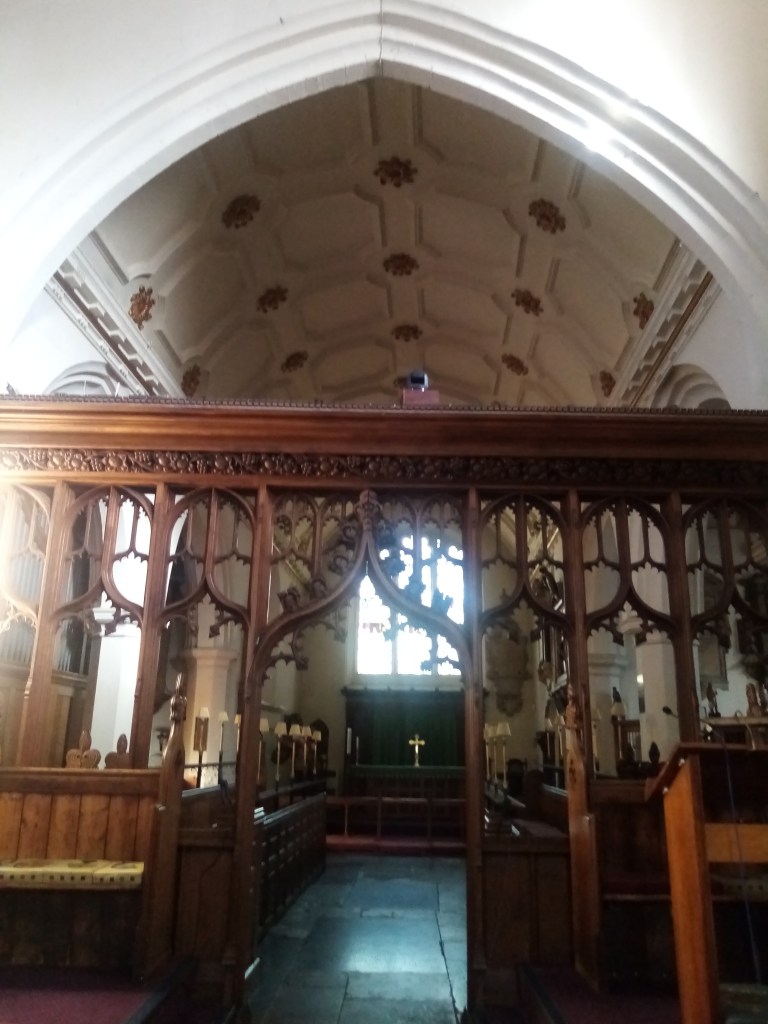
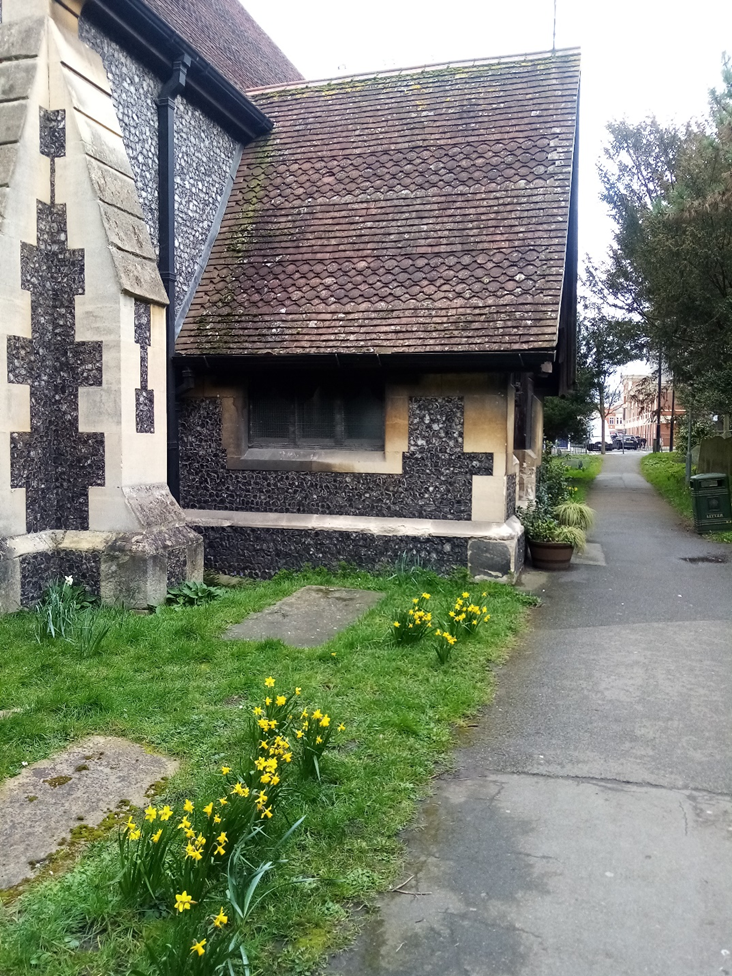
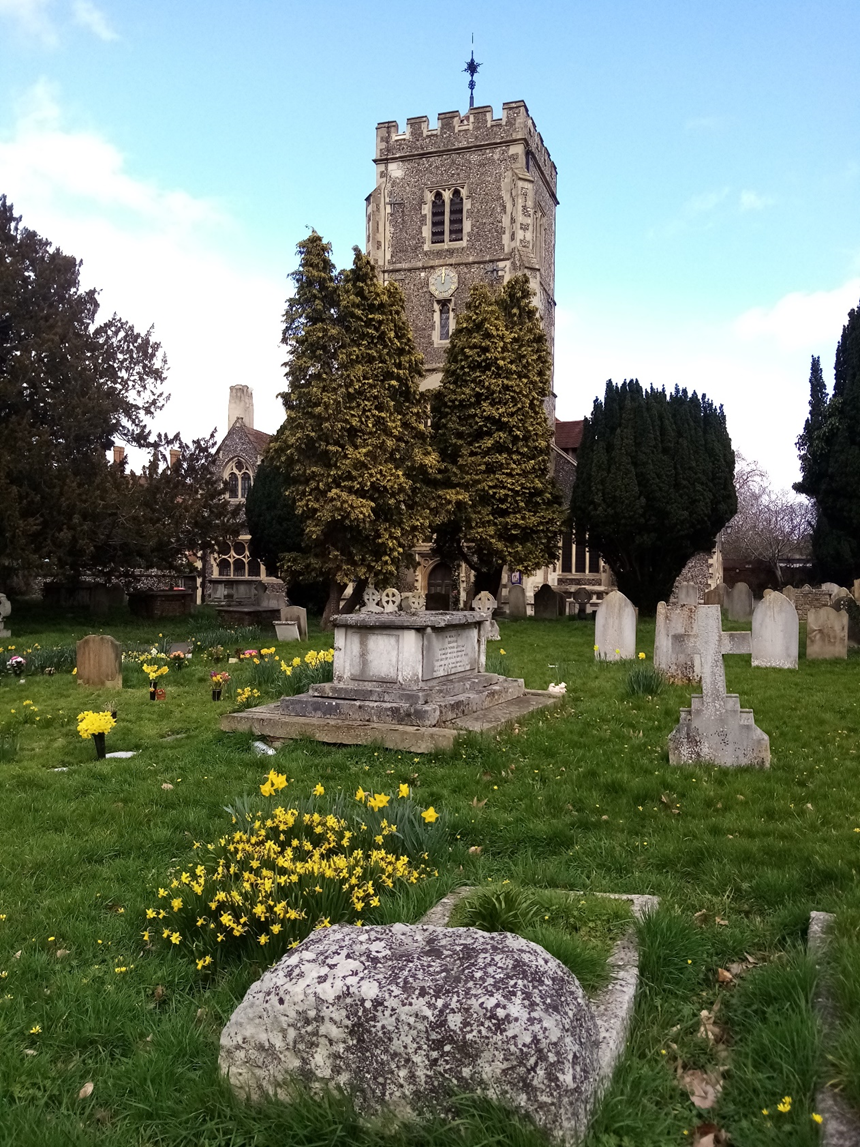
This ancient parish church is recorded in the Domesday Book of1086. The original mediaeval church was rebuilt in brick in 1864 at a cost of £7,600, to accommodate the increase in population. The church was designed by Edwin Nash, a Victorian architect in the Gothic style, and dressed with flint and stone, a popular style of the time.  The church contains several monuments taken from the old church, including a stone Mediaeval sacred basin, a ‘piscina’ used to rinse the vessels that held the bread and wine for Holy Communion. Also inside the church are two ‘Charity Boards’ recording charitable bequests in past centuries, going back to 1550. These bequests are all for specific purposes: the education of the children of the parish, the upkeep of the highways, to buy shoes and stockings for the poor, to buy bread and coal and blankets and clothing to be distributed to the poor of the parish. On the North side of the church the windows are plain glass instead of stained-glass as a reminder of the bomb which fell in the churchyard on the night of 24th September 1940. All the windows on this side were blown out, but this was the only significant damage to the church. Unfortunately, I was not able to go inside and see all these interesting things, as the church is only open one morning in the week. The pictures of the outside of the church almost make me think I’m in a country churchyard, not in a busy South London town.

Source: Church website

St Mary’s, Beddington

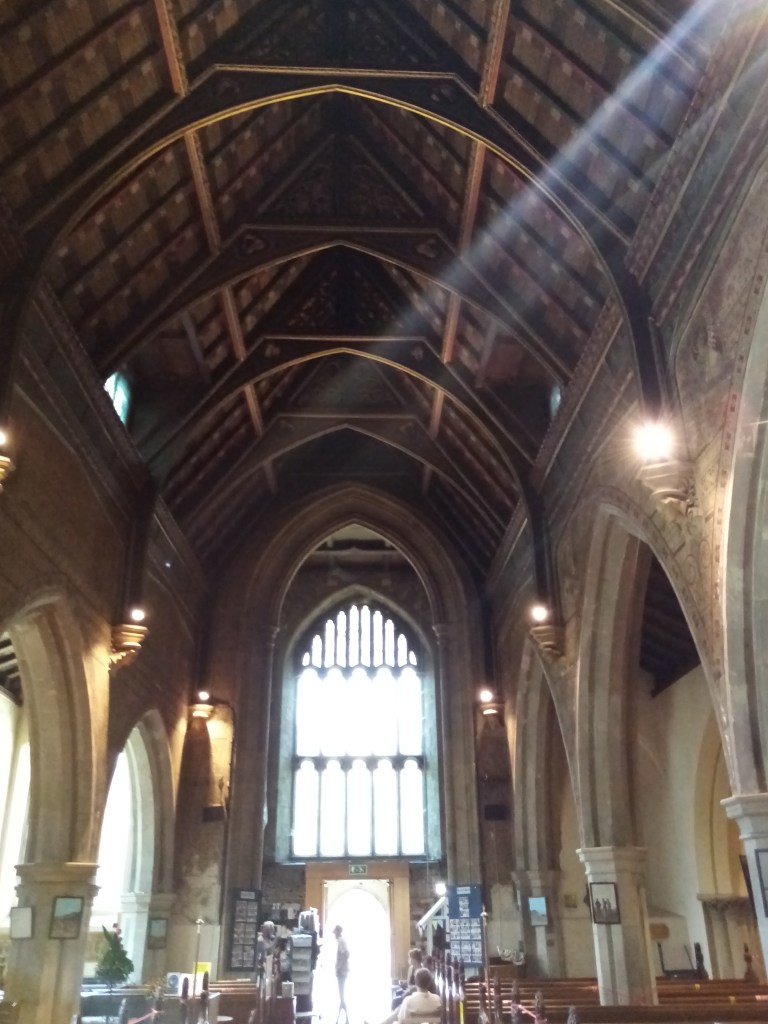
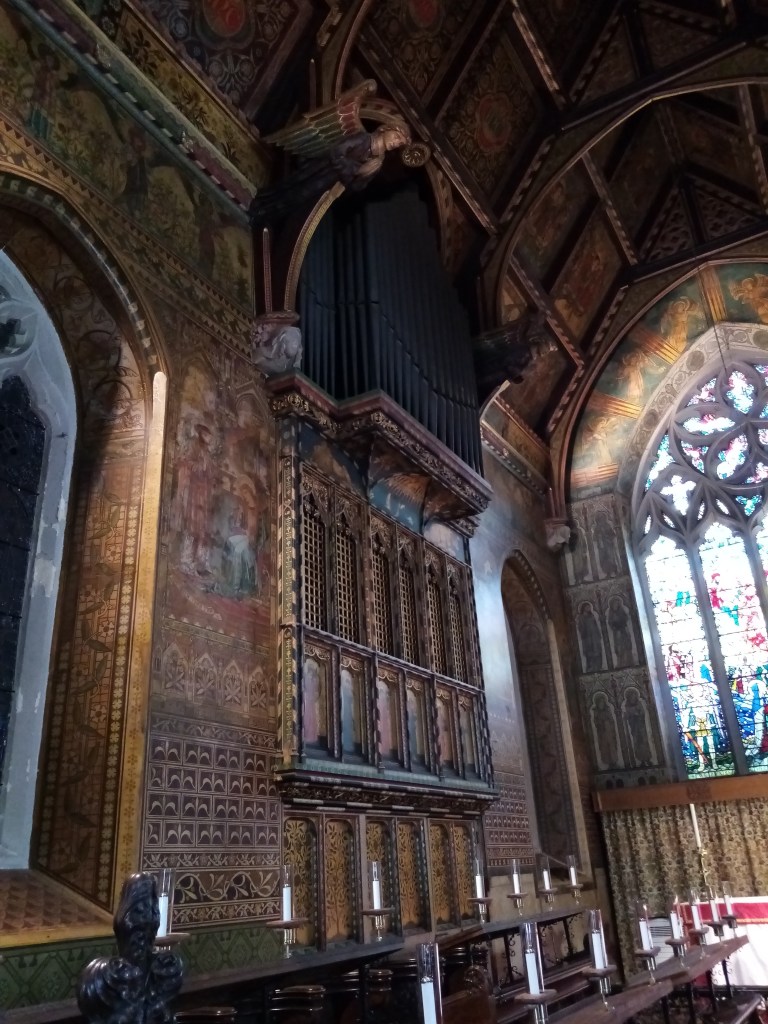
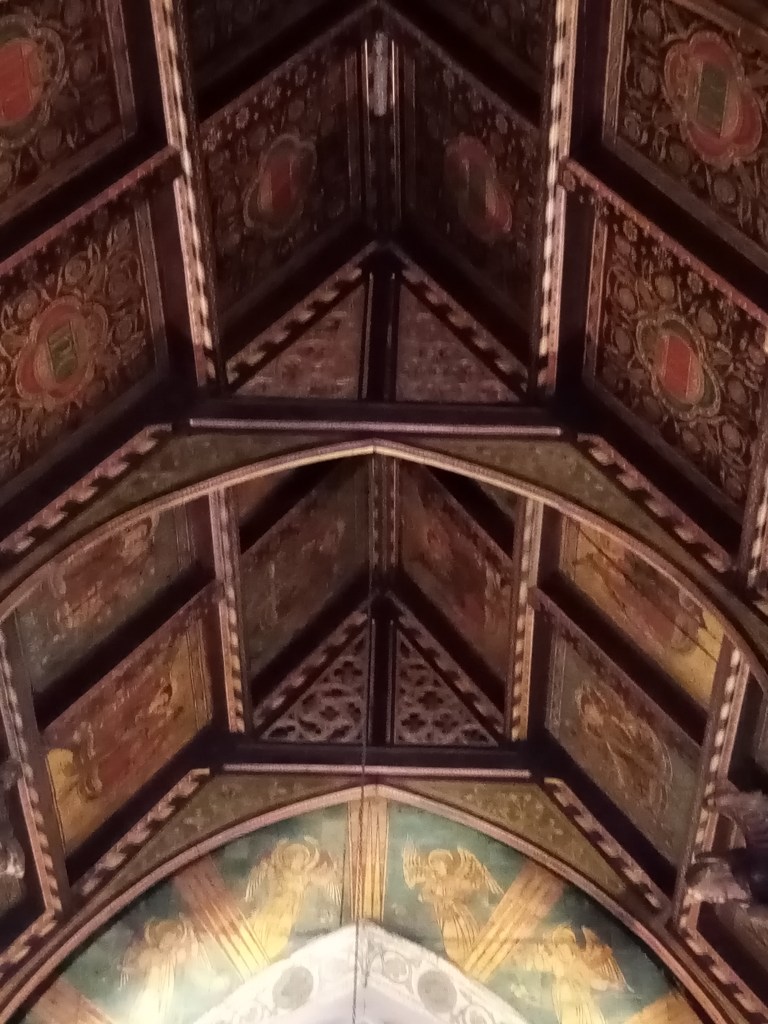
I make no apology for featuring our beautiful St Mary’s again, looking her best in the Spring sunshine. The present building was mainly built in the late 14th and early 15th century and there is evidence of a wooden church on the site in 1085, as referenced in the Domesday Survey. The church was extensively restored in the Victorian era in the then popular Arts and Crafts style, including wall and ceiling stencilled paintings. I recently enjoyed a latte in the Tower Coffee Shop which serves hot and cold drinks, home made cakes, snacks and ice cream. The café’s seating area is in the central aisle of the church, a wonderful atmospheric setting. St Mary’s has received National Lottery Heritage funding for a new project: Restoring and Celebrating the Arts and Craftmanship of St Mary’s Beddington. This will be used for important capital repairs to the building and also to support the local community through a programme of activities centred around the artwork and artefacts within the church. St Mary’s – beautiful, inside and out!

Source: National Churches Trust

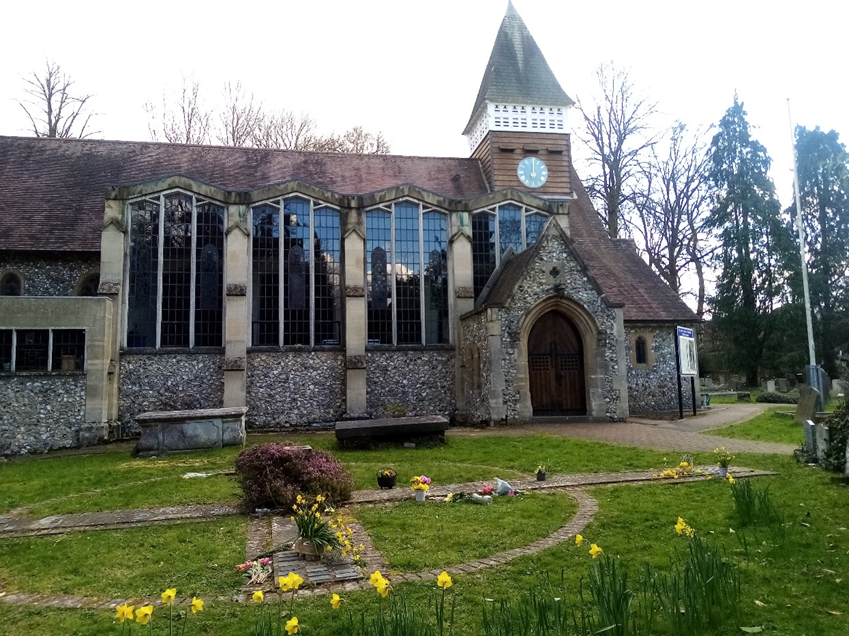
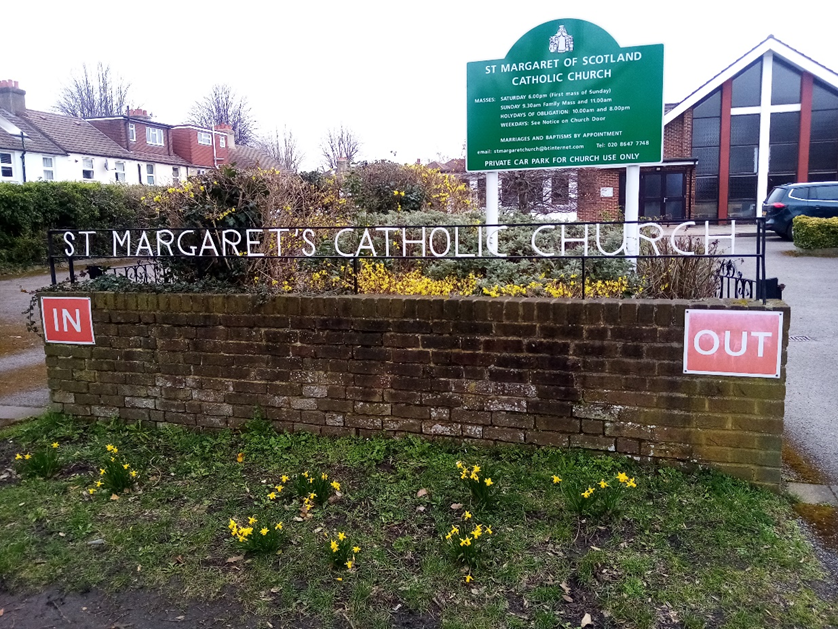
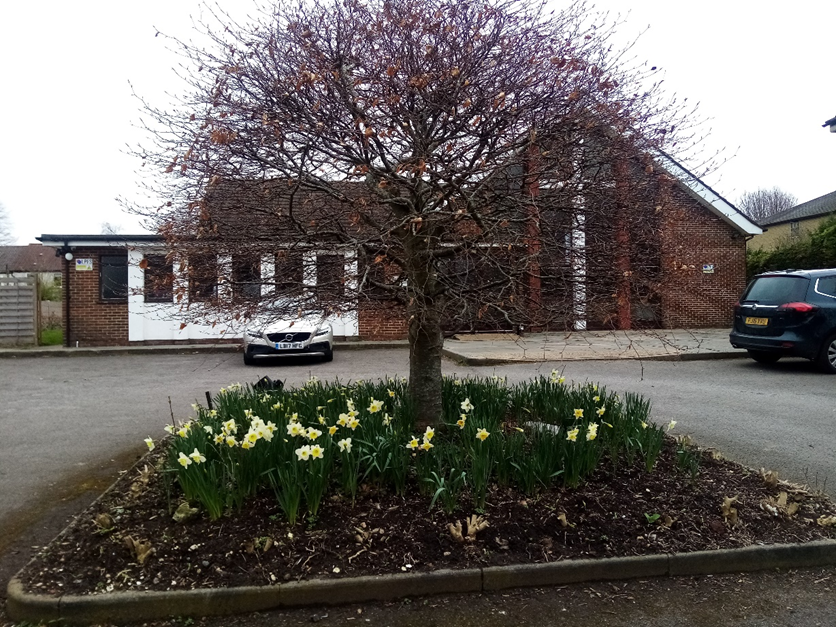
To finish, here are a few other local churches displaying glorious Spring daffs, two pics of each church: St Peter’s, Woodmansterne; St Margaret of Scotland, Carshalton; The Welsh Church, Sutton.

February – In the beginning, Part ll

Here are four more ancient sites of Christian worship and community, dating from the 600s to the 900s AD. Their origins are obscure and surrounded in myth and legend; little remains of the original buildings and the only evidence we have of their existence is documents from the time and stories handed down through the generations. But it was good to visit these sites and imagine myself back in time…..

Westminster Abbey

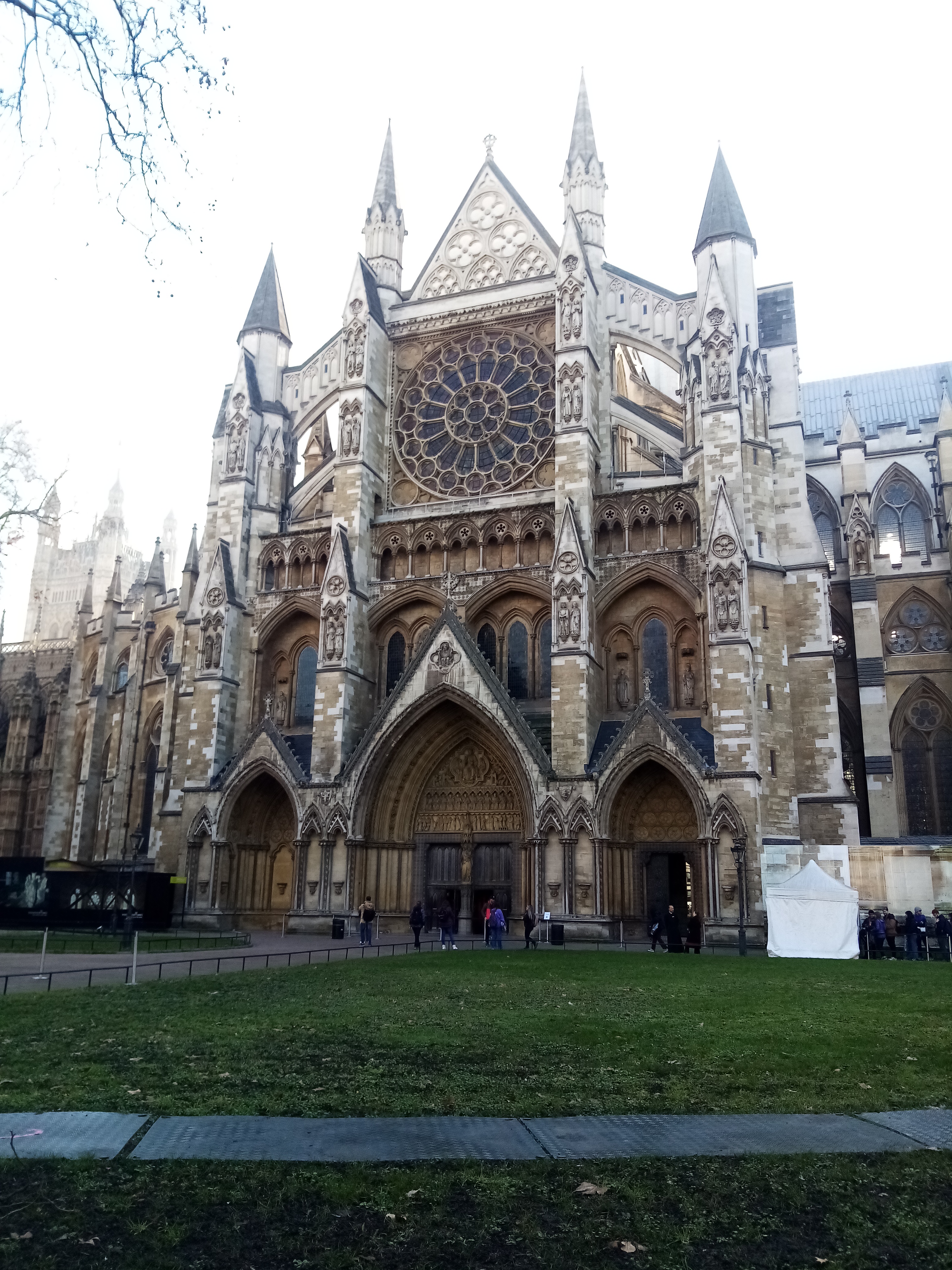
East facing entrance of the Abbey

The site of Westminster Abbey ( officially the Collegiate Church of St Peter) has been considered sacred for well over 1,000 years. ‘A document of 785 describes it as “that terrible place which is known as Westminster” – terrible, in this context meaning sacred or holy terror.’* The first recorded origins of a Christian site are of a monastery dedicated to St Peter in the 960s AD, probably founded by a Christian Saxon King, Sebert. There is also a legend/tradition that a young fisherman had a vision of St Peter (once a fisherman himself!) on Thorney Island; at one time the site was a small island in the Thames. Between 1042 and 1052, King Edward the Confessor began replacing the original wooden buildings with the new Abbey of St Peter, to provide himself with a royal burial church. The earliest remaining parts of the 11th century building are the Chamber of the Pyx and the Chapter House (see below.) The Abbey later became known as Westminster Abbey to distinguish it from the ‘East Minster’, St Paul’s Cathedral, and in the last 900 years, has been the location of 39 coronations, burial site of 18 English, Scottish and British monarchs, and at least 16 royal weddings.

*London The Biography, Peter Ackroyd, Vintage, 2000. Other sources: Wikipedia, Westminster Abbey website, notices in the Pyx Chamber and Chapter House

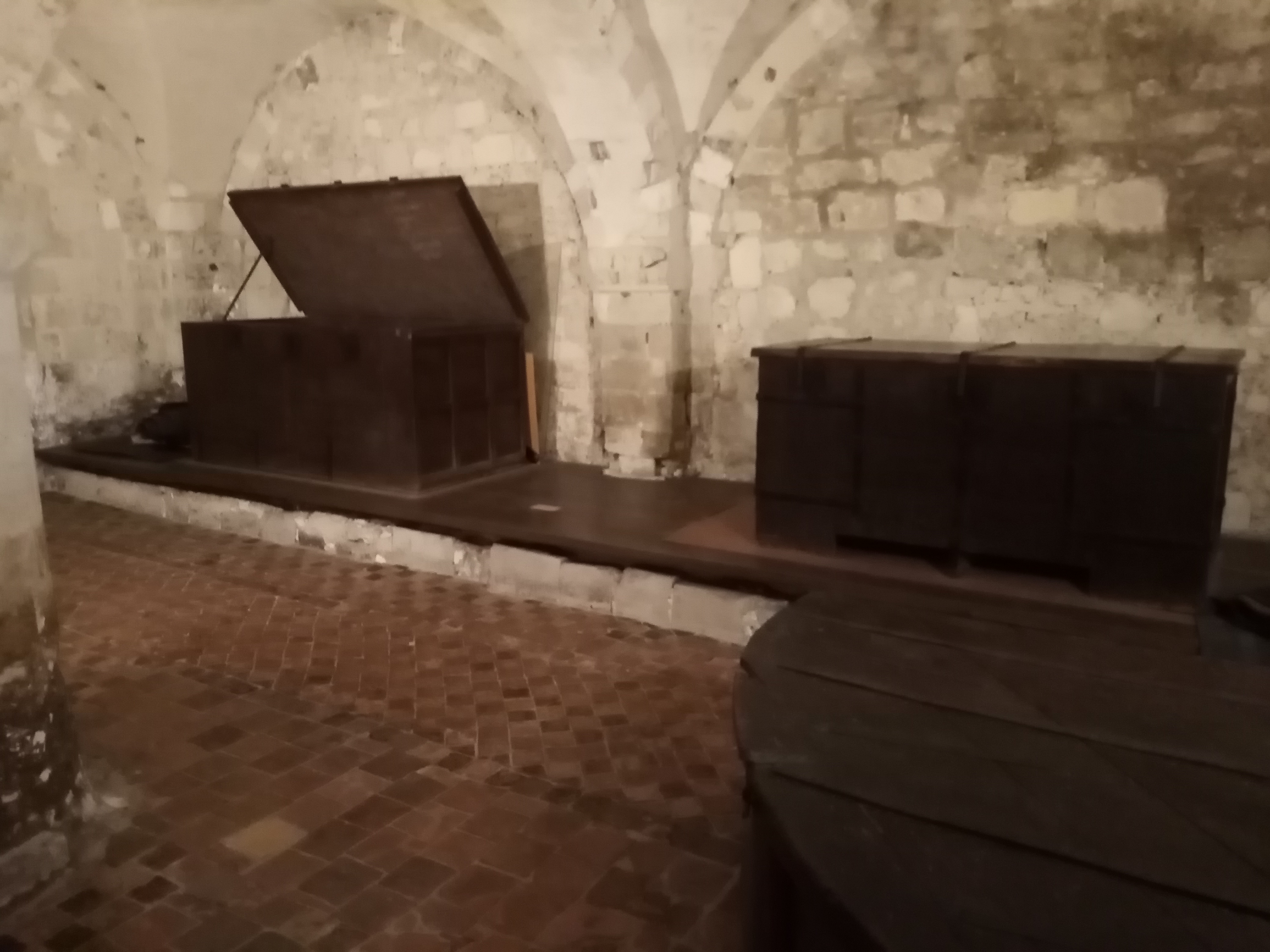
Storage boxes for valuables in the Pyx Chamber

The name ‘Pyx’ refers to small boxes containing the official samples of gold and silver coinage kept here. Newly-minted coins were annually tested against these samples in a public ‘Trial of the Pyx.’ The Pyx Chamber also served as a strong room, like a safe, containing valuable items belonging to the monarch.

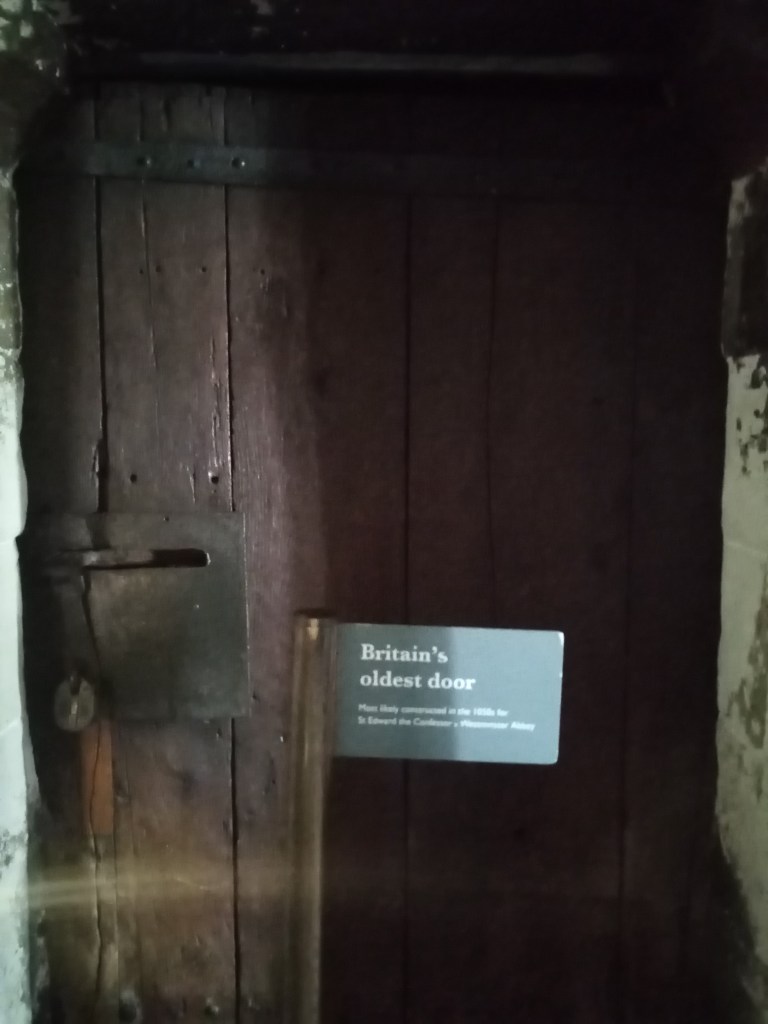
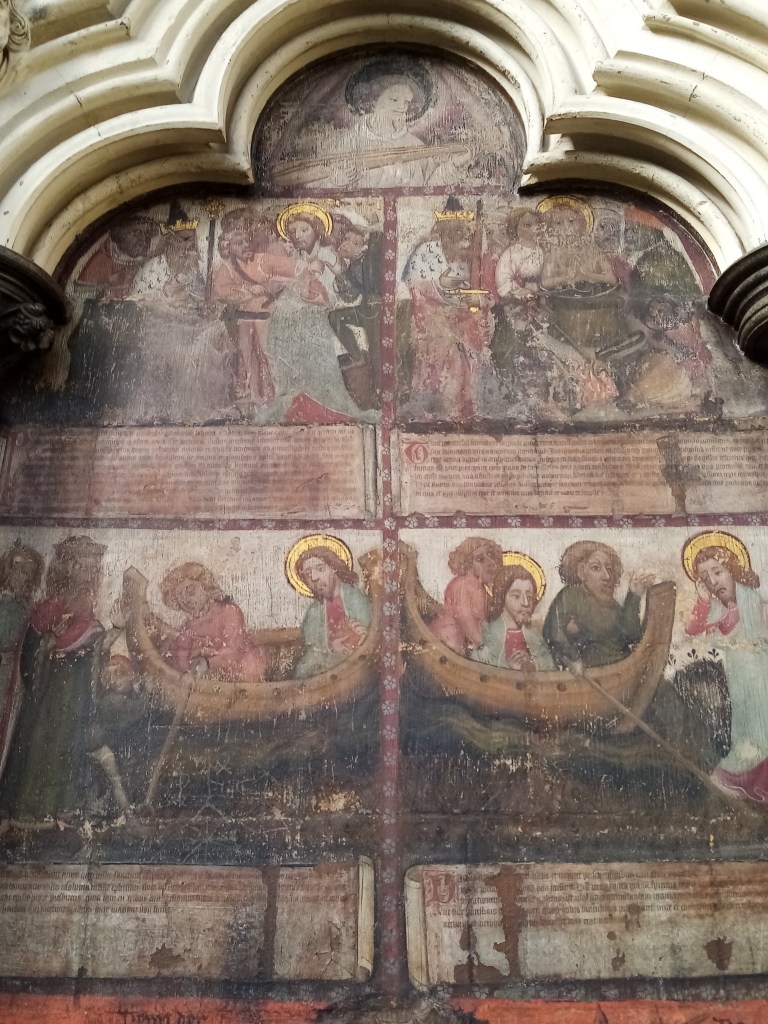
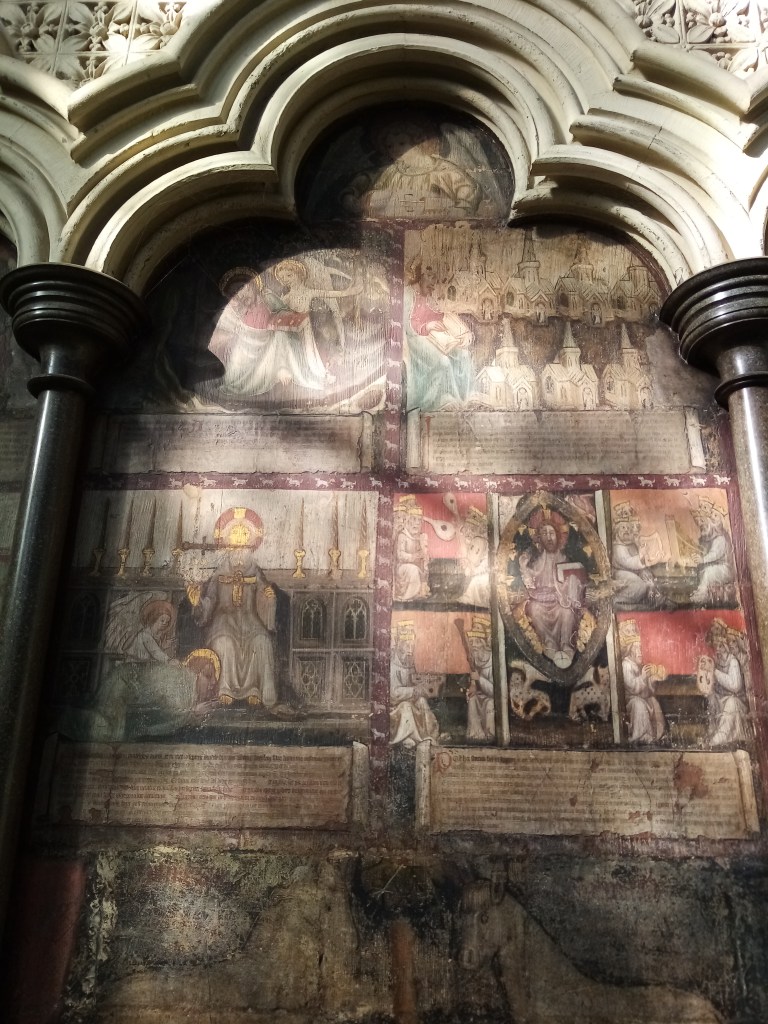
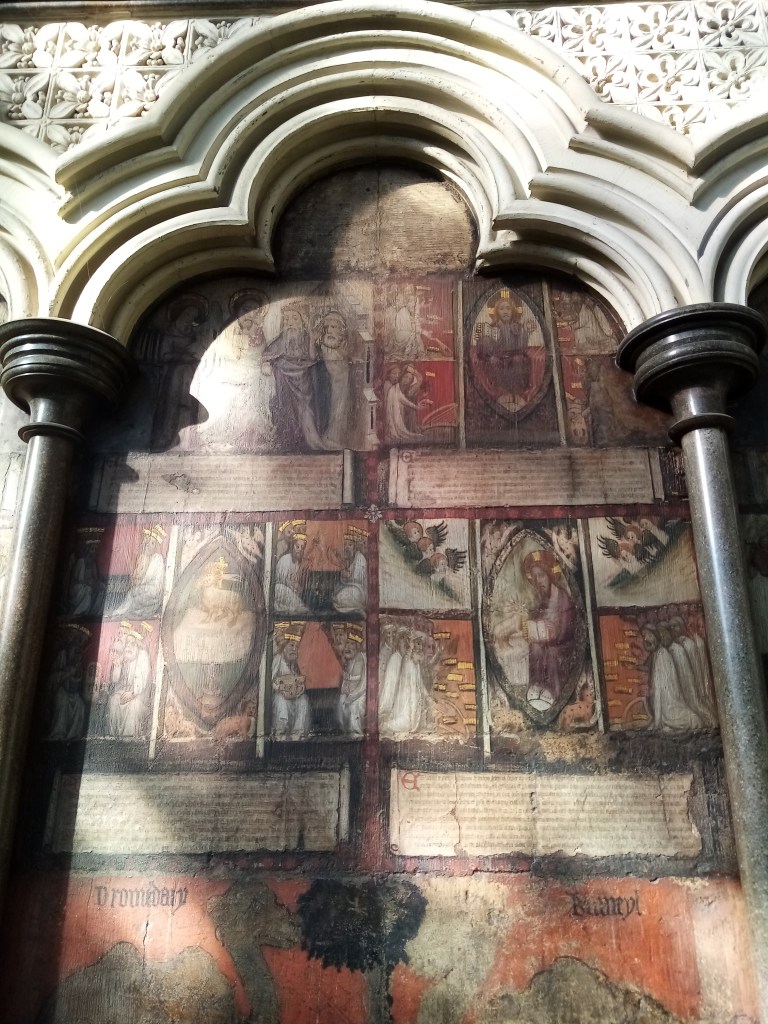
‘England’s oldest door’, made for Edward the Confessor, was not in situ but elsewhere in Westminster Abbey. The beautiful Mediaeval wall paintings in the Chapter House show scenes from the Book of Revelation.

Southwark Cathedral

Southwark Cathedral…and the Shard!

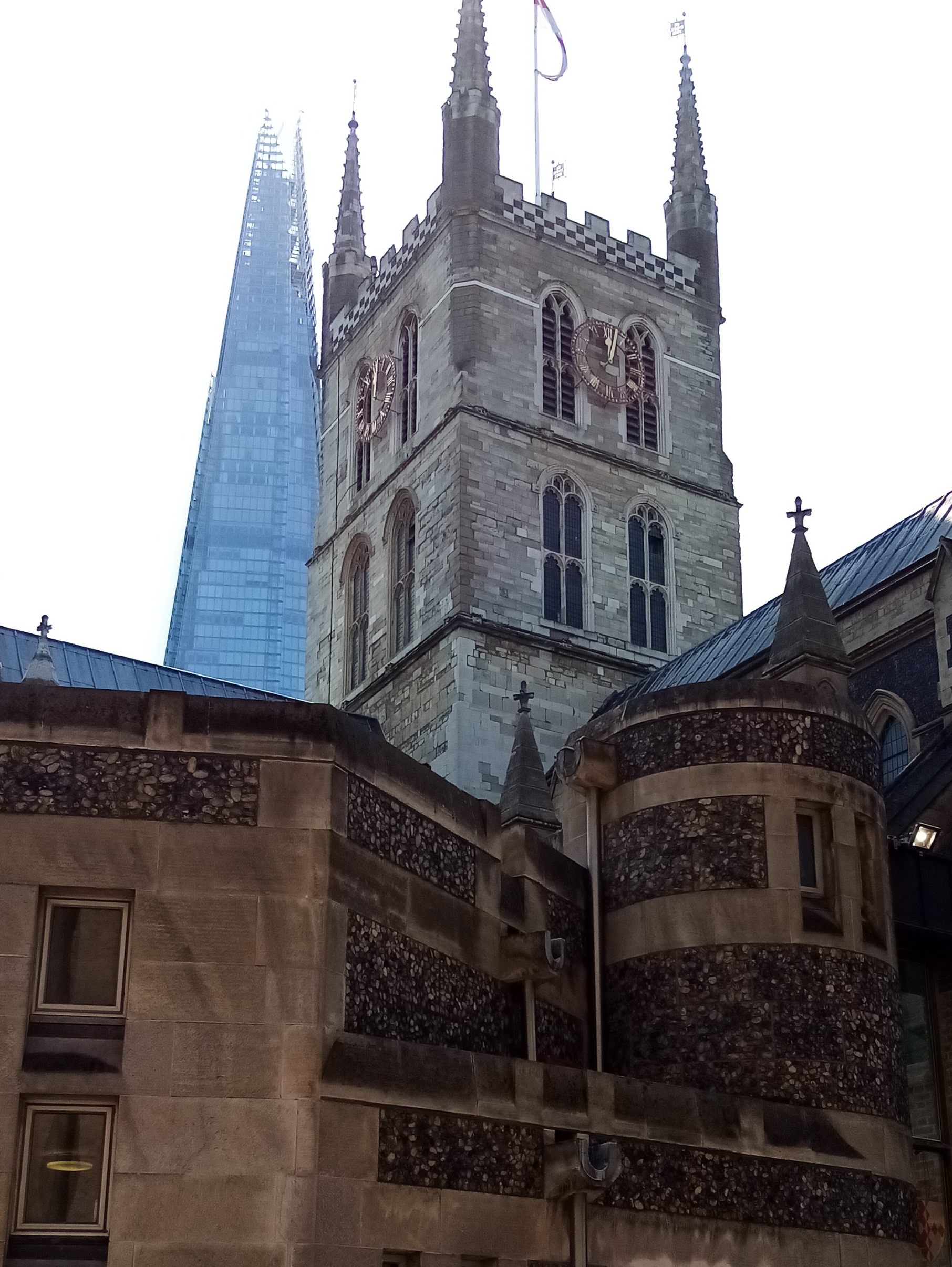
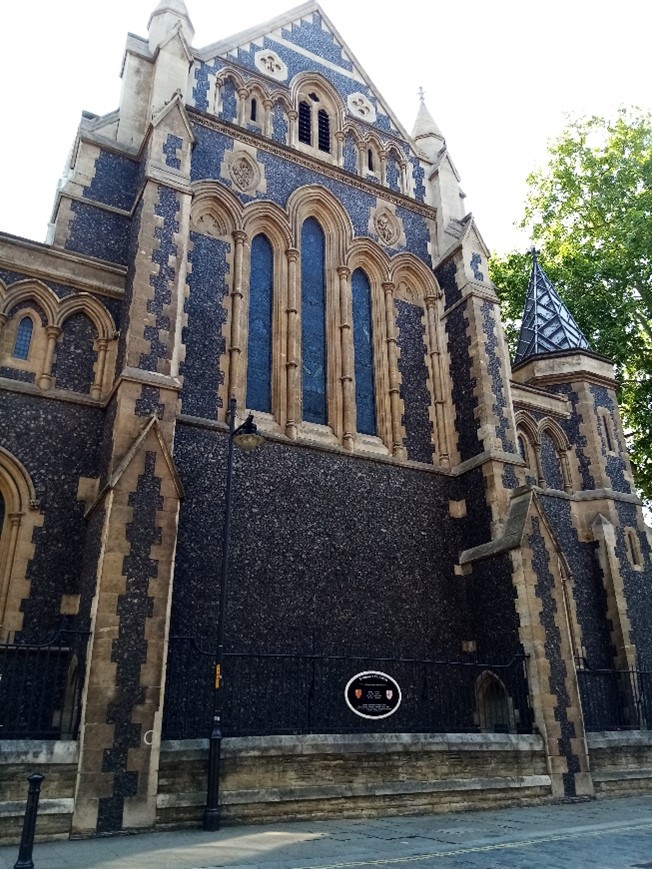
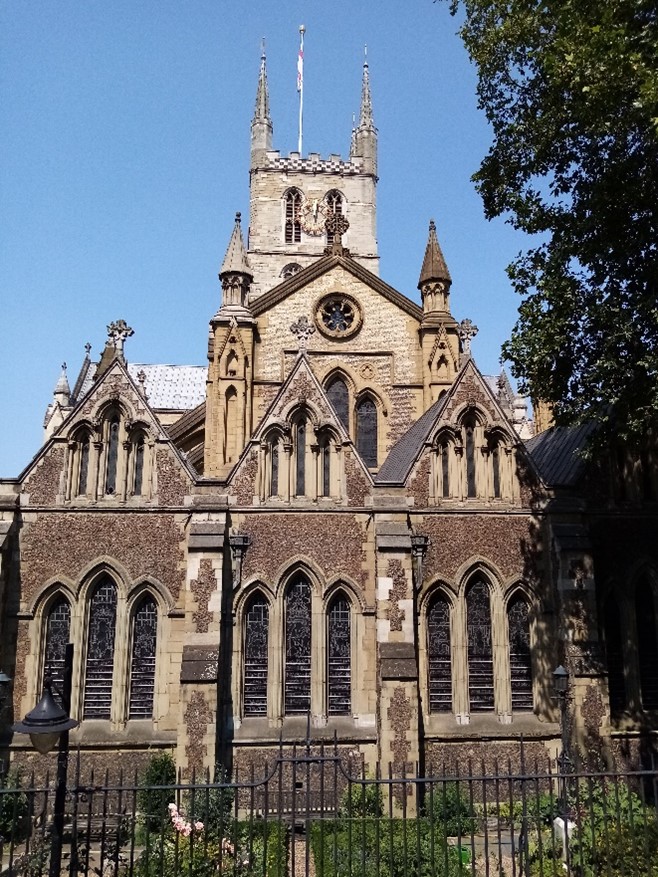
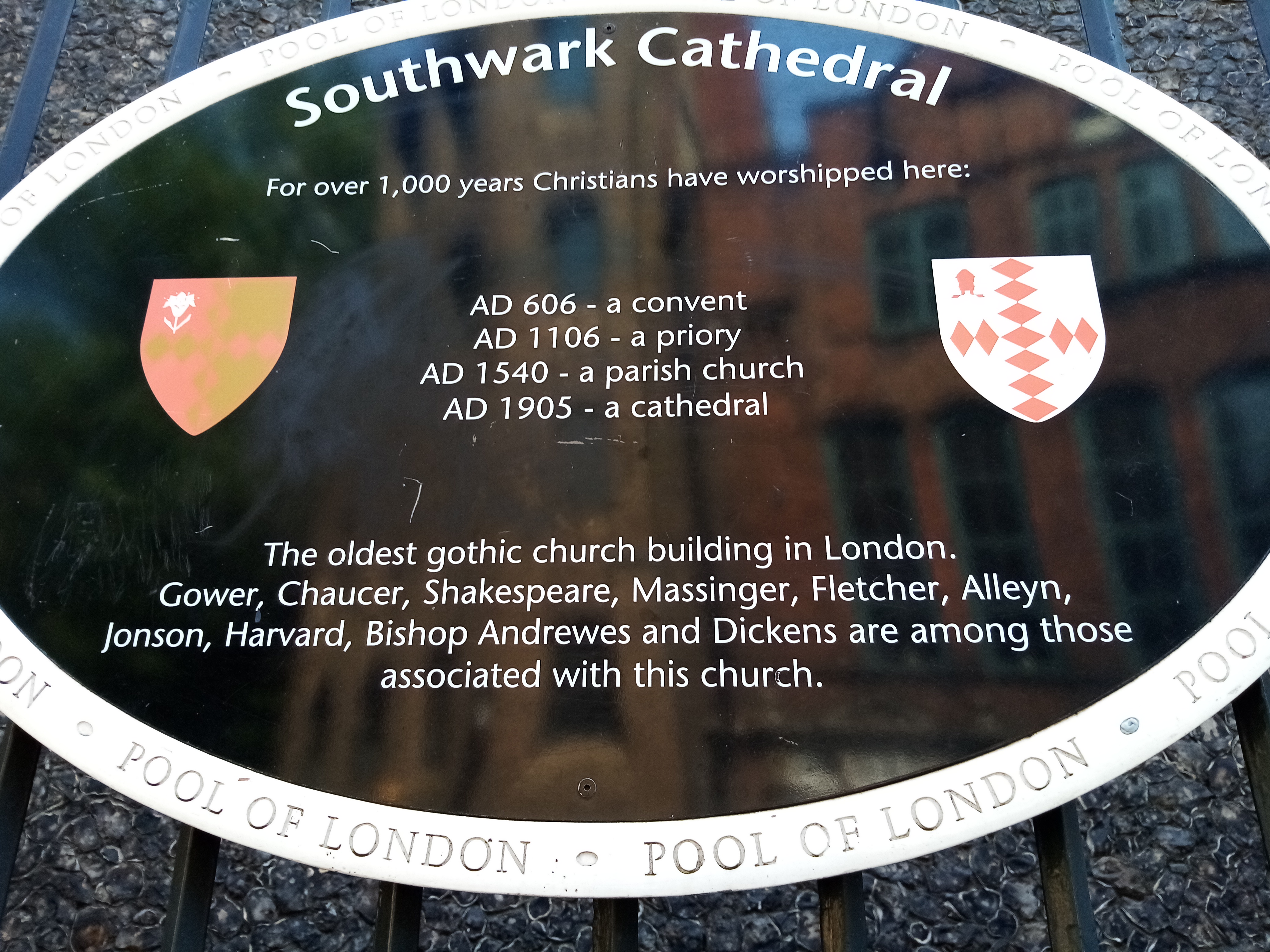
The Cathedral and Collegiate Church of St Saviour and St Mary Overie stands at the oldest crossing point of the River Thames; for many centuries this was the only entrance to the City situated across the river.  This has been a site of Christian community for more than 1,000 years but was only designated as a cathedral in 1905 with the creation of the Diocese of Southwark. As usual, its origins are surrounded in mystery; the 16th century historian John Stow suggests that the first establishment on the site was a community of nuns founded in 606AD by St Swithin, which may well be true. But the first verified reference is of a ‘minster’ in the Domesday Book of 1086. In 1106 the church was ‘re-founded’ as an Augustine priory. The church was dedicated to St Mary and known as St Mary Overie – ‘over the river’ – to distinguish it from all the other Mary churches on the City side. The Augustine cannons founded a hospital next to the church which was the direct predecessor of today’s St Thomas’ Hospital which stands today near Lambeth Palace. At the Dissolution of the Monasteries in 1539, the church became the property of Henry Vlll who rented it to the congregation! A group of merchants bought the church in 1611 for £800 from the then King James l. Small beginnings for a Cathedral whose diocese it serves has a population of two and a half million people, served by over 300 parishes.

Source: Southwark Cathedral website

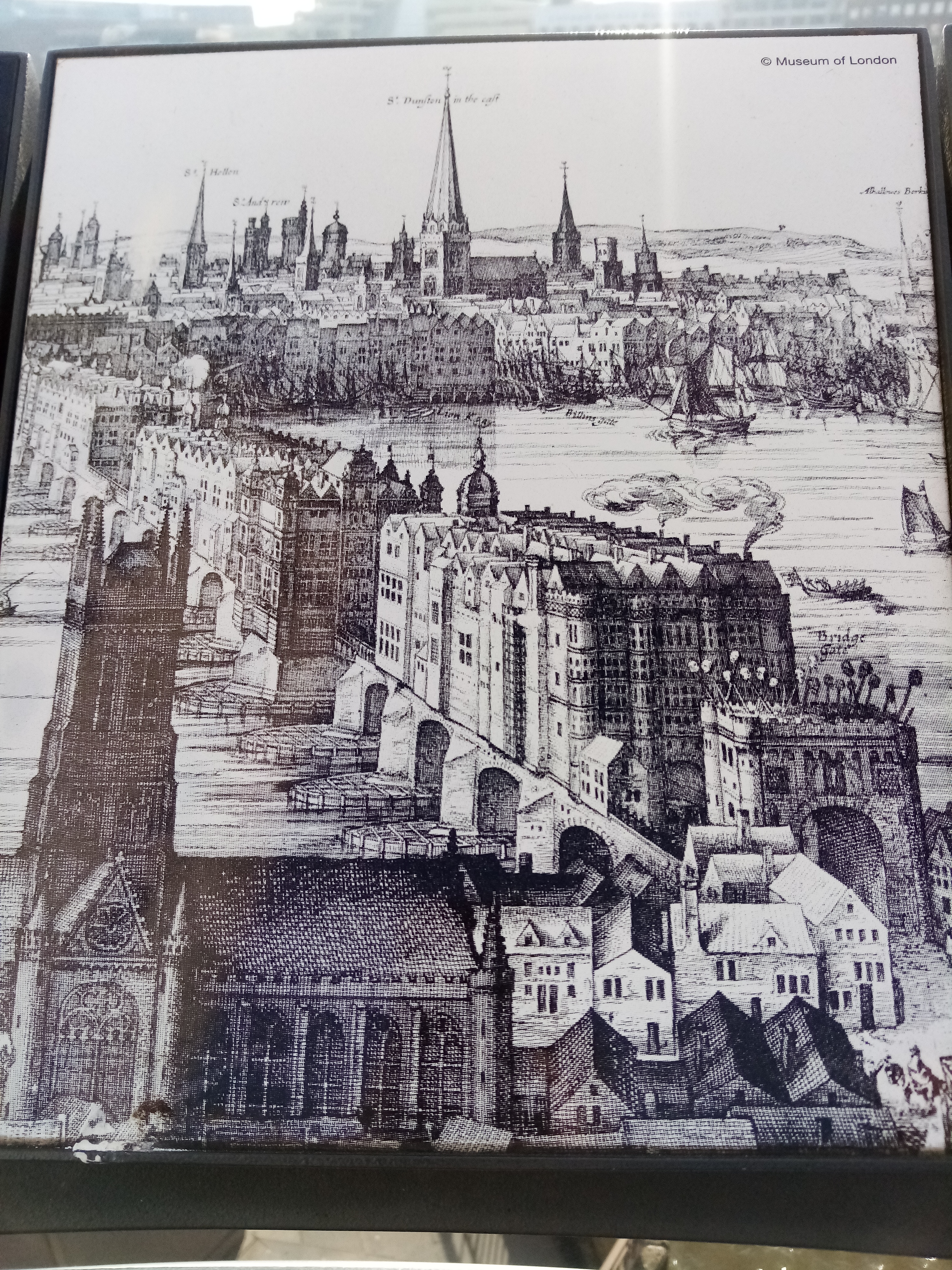
Engraving of Mediaeval Southwark Cathedral, looking across the River Thames

Barking Abbey

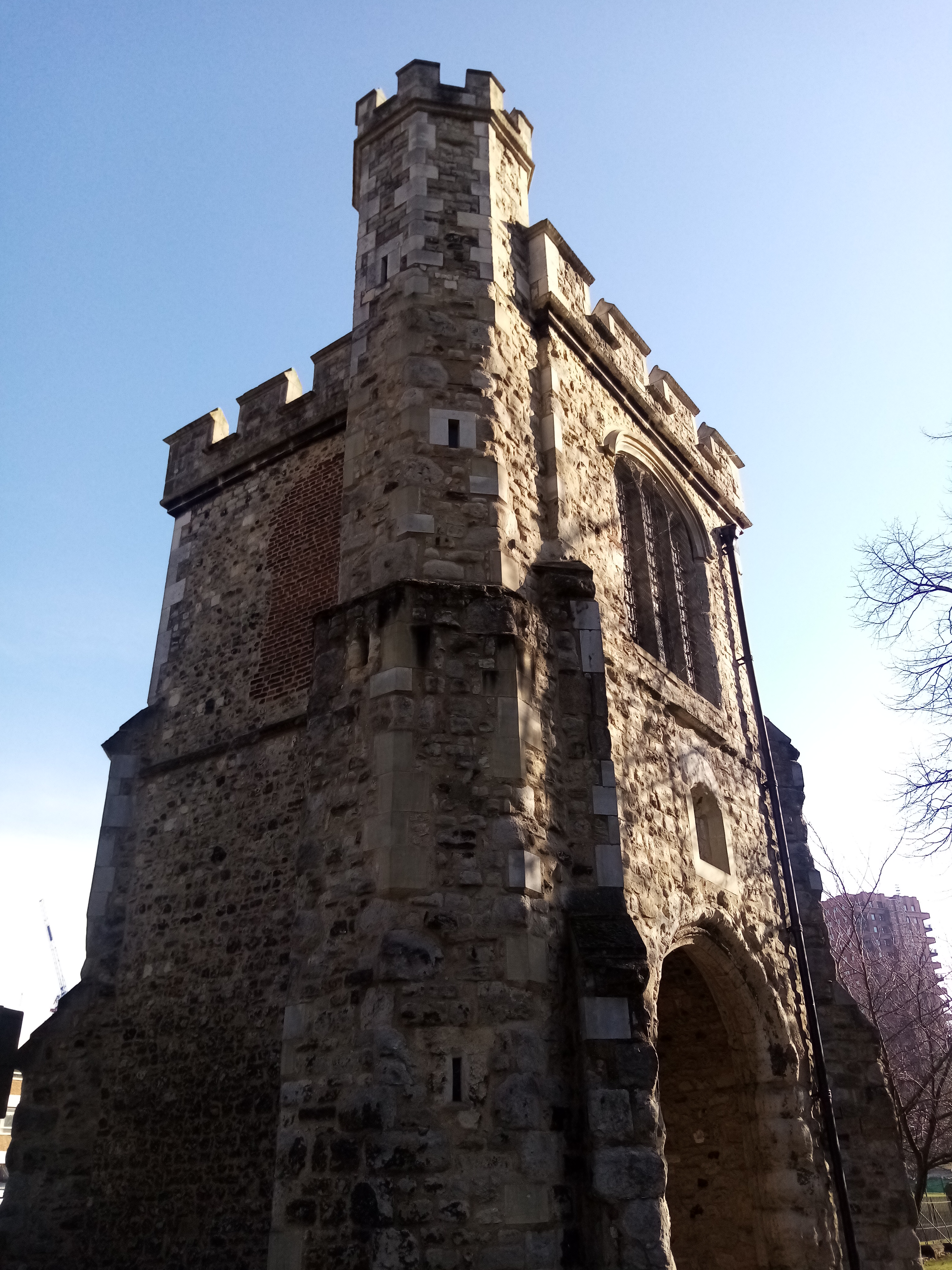
Curfew Tower

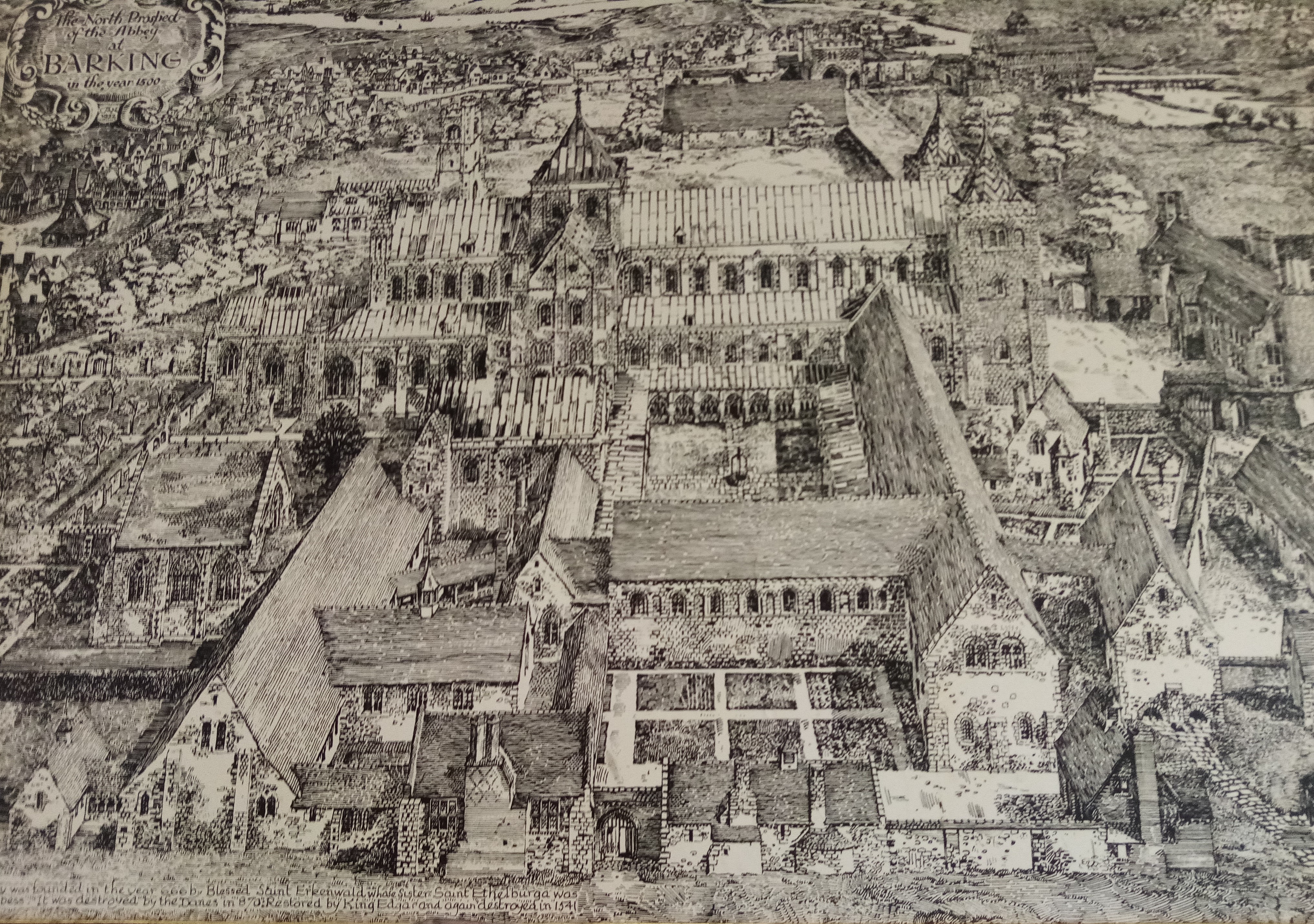
Travel East out of the City on the District Line and you reach Barking and its once-magnificent Abbey, although all that remains are a footprint of stone walls and the Curfew Tower. Its founder was St Erkenwald, Bishop of London, who in 666AD established a nunnery for his sister St Ethelburga, who became the Abbess. The siblings were of royal heritage and the Abbey was under the patronage of the Royal House of the East Saxons. Barking was a ‘double house’ of both nuns and monks in separate living quarters but sharing the church and public areas; both houses were ruled by an Abbess. Good to see gender equality flourishing in the 7th century! In 871 the small town of Barking was attacked by Vikings and came under the pagan Danelaw system; the Abbey was sacked and then abandoned. In 909 it was rebuilt as a female-only nunnery after the Saxons regained control of Essex. Following his coronation in 1066, King William 1st of England ruled from the Abbey for a while and gave the incumbent Abbess a royal charter. However, the Abbey’s glory days ended in 1539 as part of Henry VIII’s Dissolution of the Monasteries. Most of the stonework was taken away and used to build Henry’s palaces at Greenwich and Dartford.

Sources: Barking Abbey, Heritage Booklet 2016, Information boards at the site

Engraving of Barking Abbey circa 1500
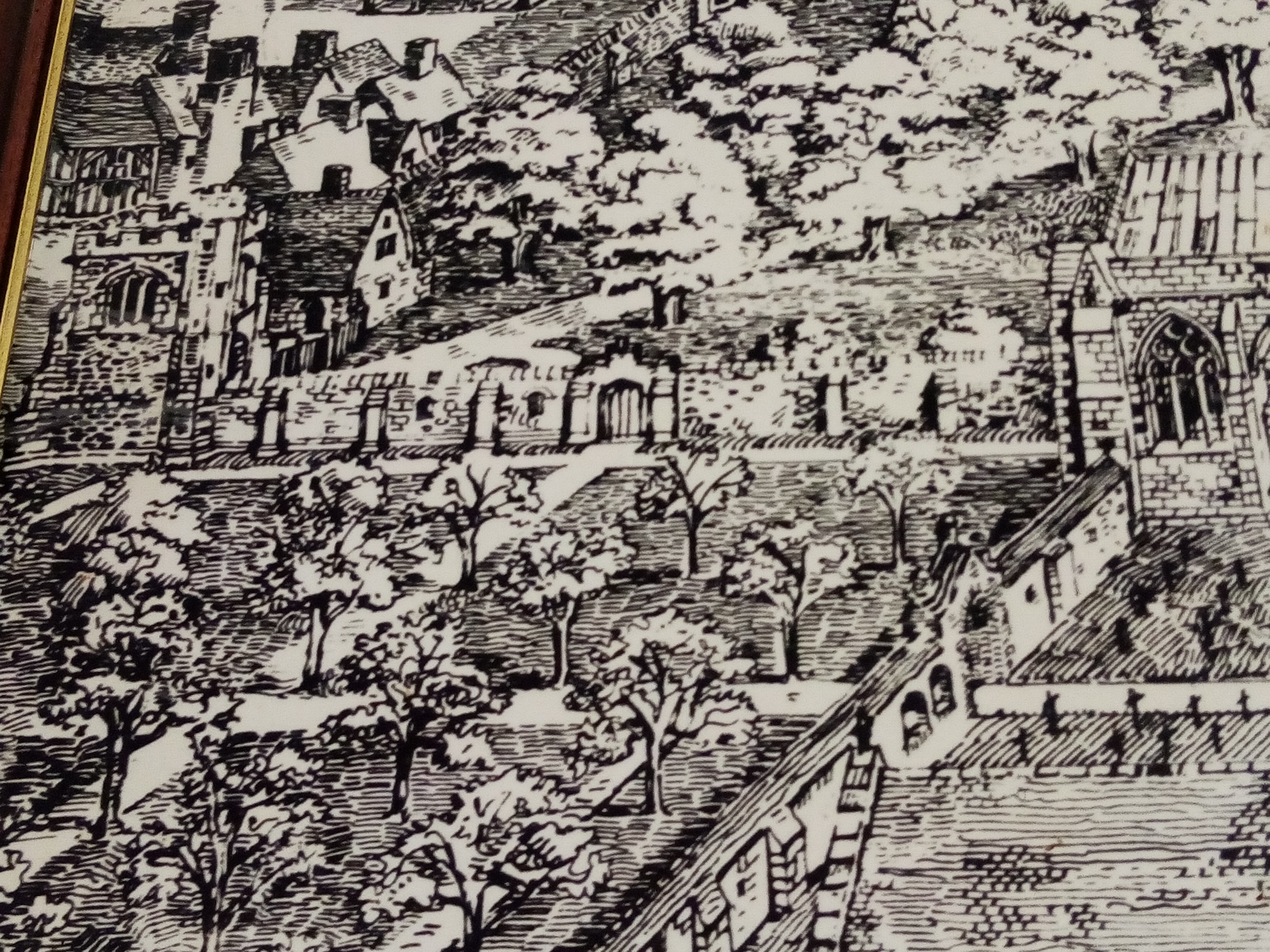
Detail from the above engraving showing Curfew Tower far left-hand side

Remains of the Abbey, not my photo as I visited in half term and there were children playing everywhere on Abbey Green, so I couldn’t risk getting them in the photo! Credit: Wikipedia Commons.

St Clement Danes

Another of Wren’s elegant spires atop St Clement Danes

St Clement Danes stands on an ‘island’ in The Strand, next to the Royal Courts of Justice, just West of the City and just East of Aldwych – ‘old port’. Its origins date back to the 9th century but there are two theories about how it was established and how it got its name. 1. Danish settlers who had married English women remained in the area near to the port and took over an existing Saxon church, dedicating it to St Clement, the patron saint of mariners, hence it became known as St Clement of the Danes. 2. Alfred the Great drove the Danes out of the City of London but then stipulated the building of a church at Aldwych for those of them who had accepted Christianity. In both cases, the Danes being a seafaring nation, the church was named for St Clement. The original wooden church was rebuilt by William the Conqueror and escaped being damaged in the Great Fire, but by the 1600s it was in poor repair so our friend Sir Christopher Wren was invited to rebuild the church in his signature style. However, in May 1941, one of the worst nights of the German Blitz, the church received a direct hit and was almost completely destroyed, apart from the outer walls and the tower. The ruined building lay abandoned until 1958, when it was rebuilt and reconsecrated as the Central Church of the RAF. (more about that in a later post – ‘Military Churches.’) A charming tradition of the church is that several times a day, the bells chime the tune ‘Oranges and Lemons say the Bells of St Clements’, and I was lucky enough to be there at midday to hear it!  

Sources: Wikipedia, St Clement Danes website

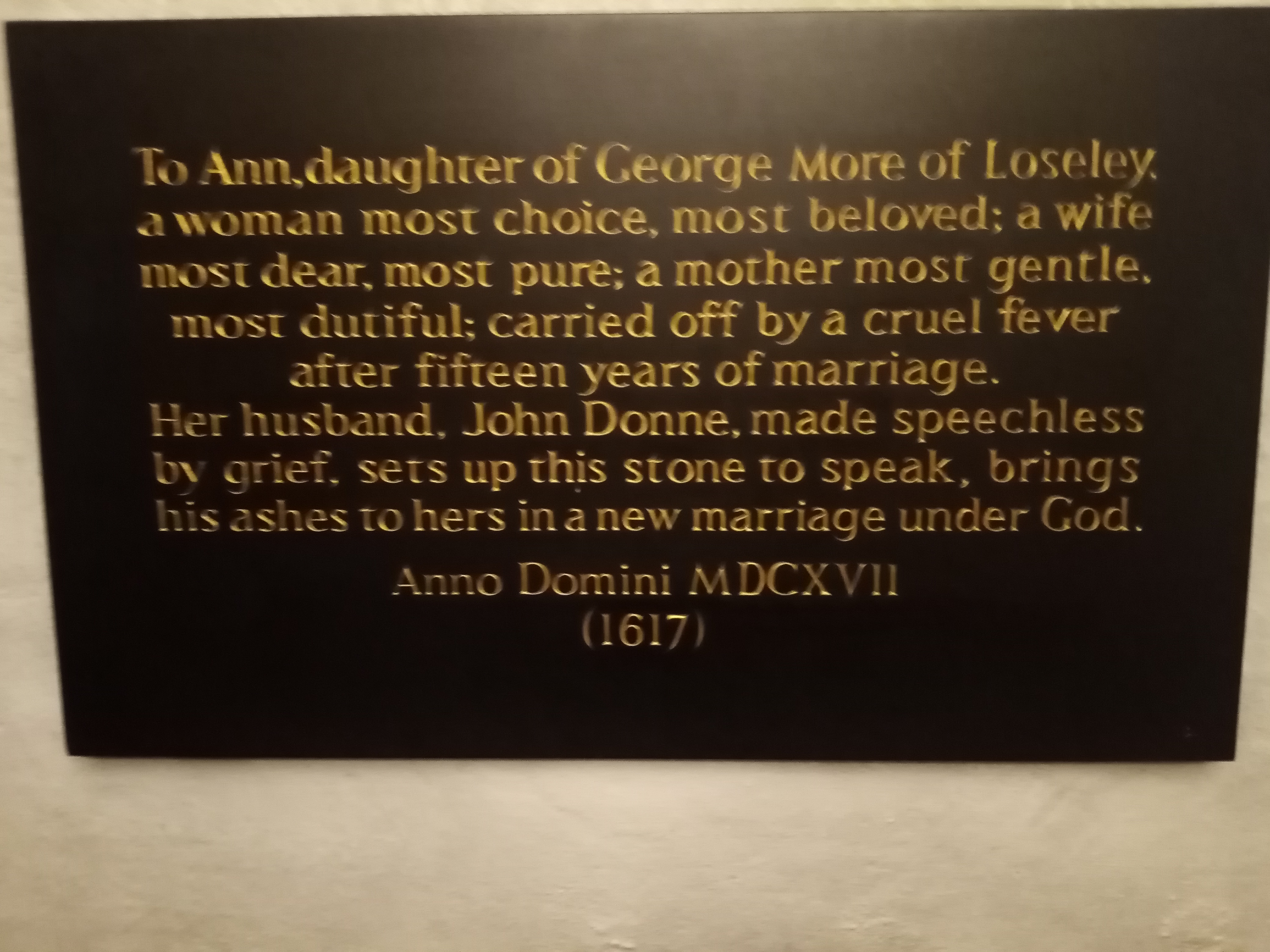
Poignant memorial to poet John Donne’s wife, Ann. The Donnes worshipped at the church.

January – In the beginning….

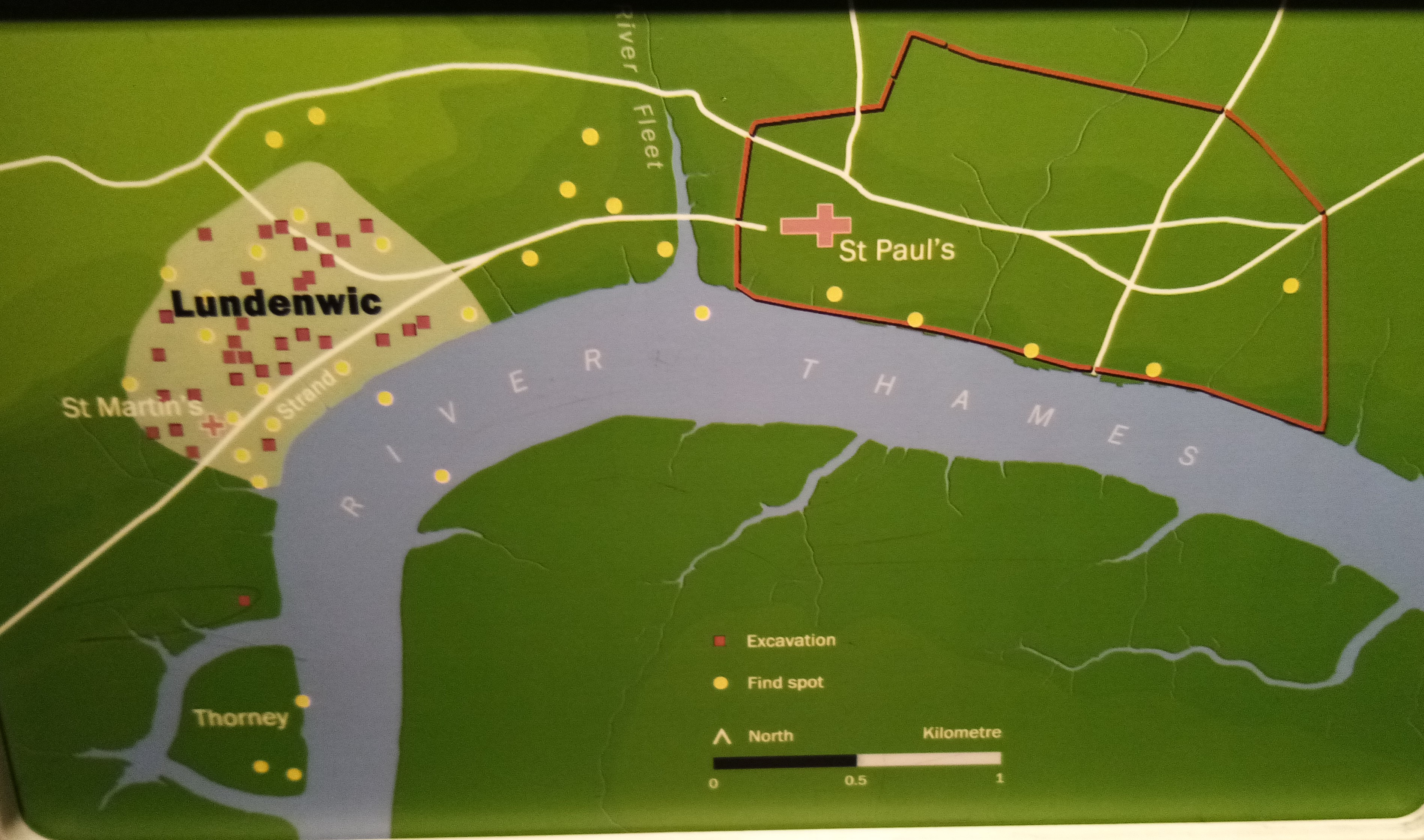
At the start of a new year I’m going to look at the origins of Christianity in London. The earliest site of Christian worship in the capital is actually highly debatable; there are several contenders but these four are some of the oldest, all having been founded before 1,000AD. And that’s pretty ancient! It’s been interesting to explore the earliest foundation of London as a city, first by the Romans (Londinium) followed by the Saxons (Lundenwic), and discover that Christians have been around in London since those earliest times. So I’m going to kick off with possibly the earliest known Christian site…..

St Pancras Old Church

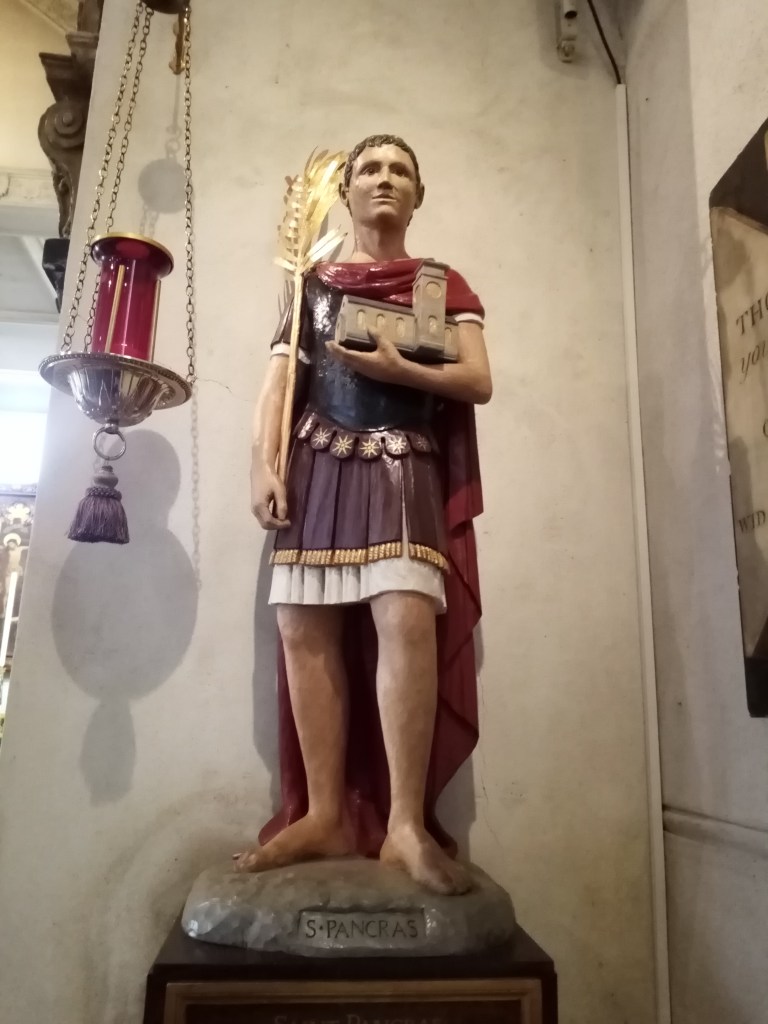
It is believed that the site of the present Victorian church (above) has been a place of Christian worship since 314AD. The church is dedicated to St Pancras, a Roman convert to Christianity, who died when he was just 14 years old. Called before the Emperor Diocletian and commanded to worship Roman gods, Pancras refused to recant his Christian faith and was consequently executed. Pancras never visited this place, as he died in 304, but it is believed that a shrine was established on this little hillock overlooking the River Fleet, and subsequently a church was founded here. We know for certain that there was a church here in 1086 as it was recorded in the Domesday Book. By the 13th century, the church had fallen into disrepair, and being in a very small, rural community outside the boundaries of London, it was primarily used as a burial ground, with no regular church services being held. In 1822, St Pancras New Church was opened and by the 1840s, the Old Church was in ruins. However, with the expansion of London’s population, the church now sat in a fully populated area and in 1847 the church underwent a complete restoration, and further refurbishment in 1888 gives us the church we see today. The picture above, with the River Fleet flowing above ground, is dated 1827.

Sources: Information boards in the church; Wikipedia

St Paul’s Cathedral

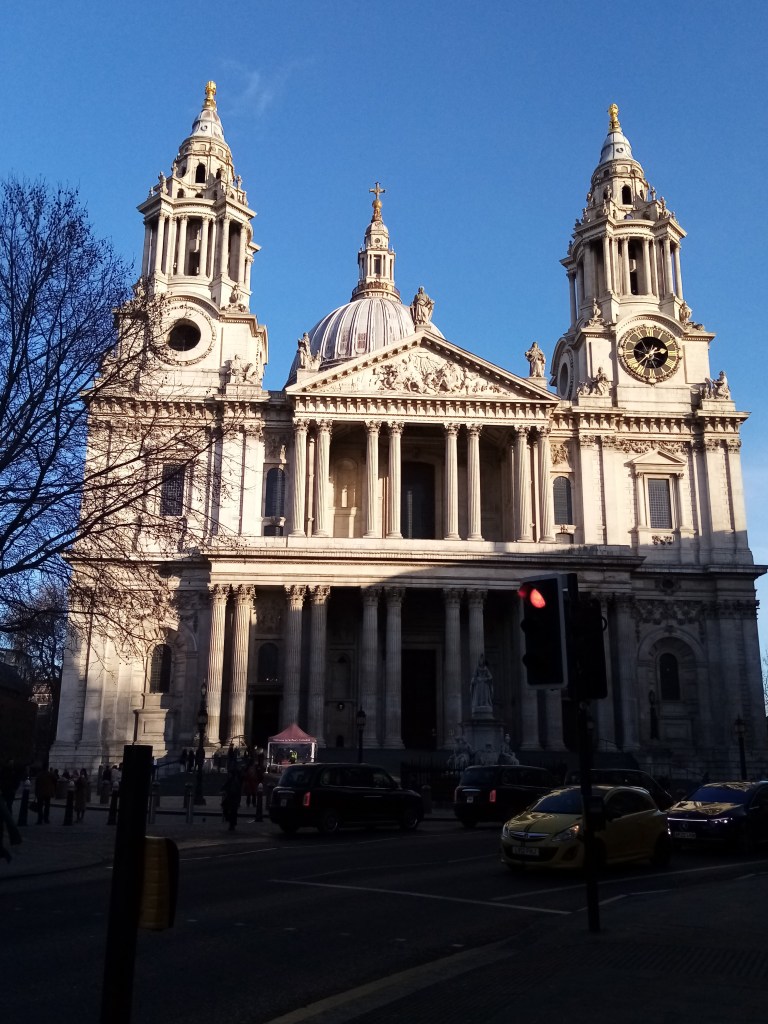
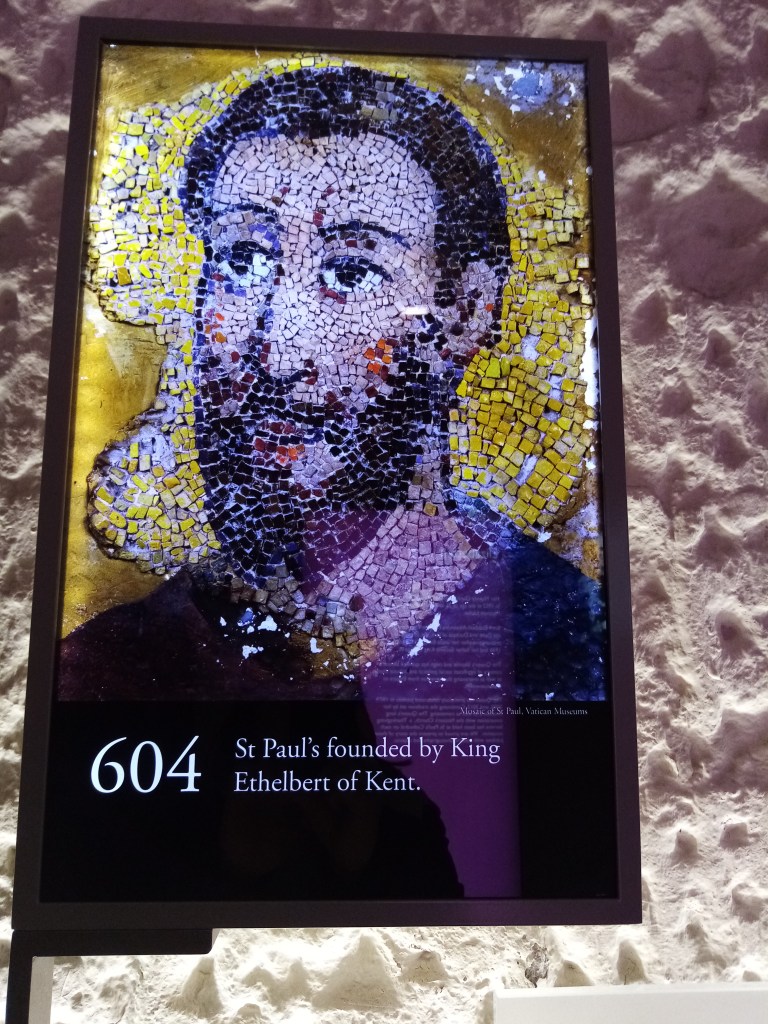
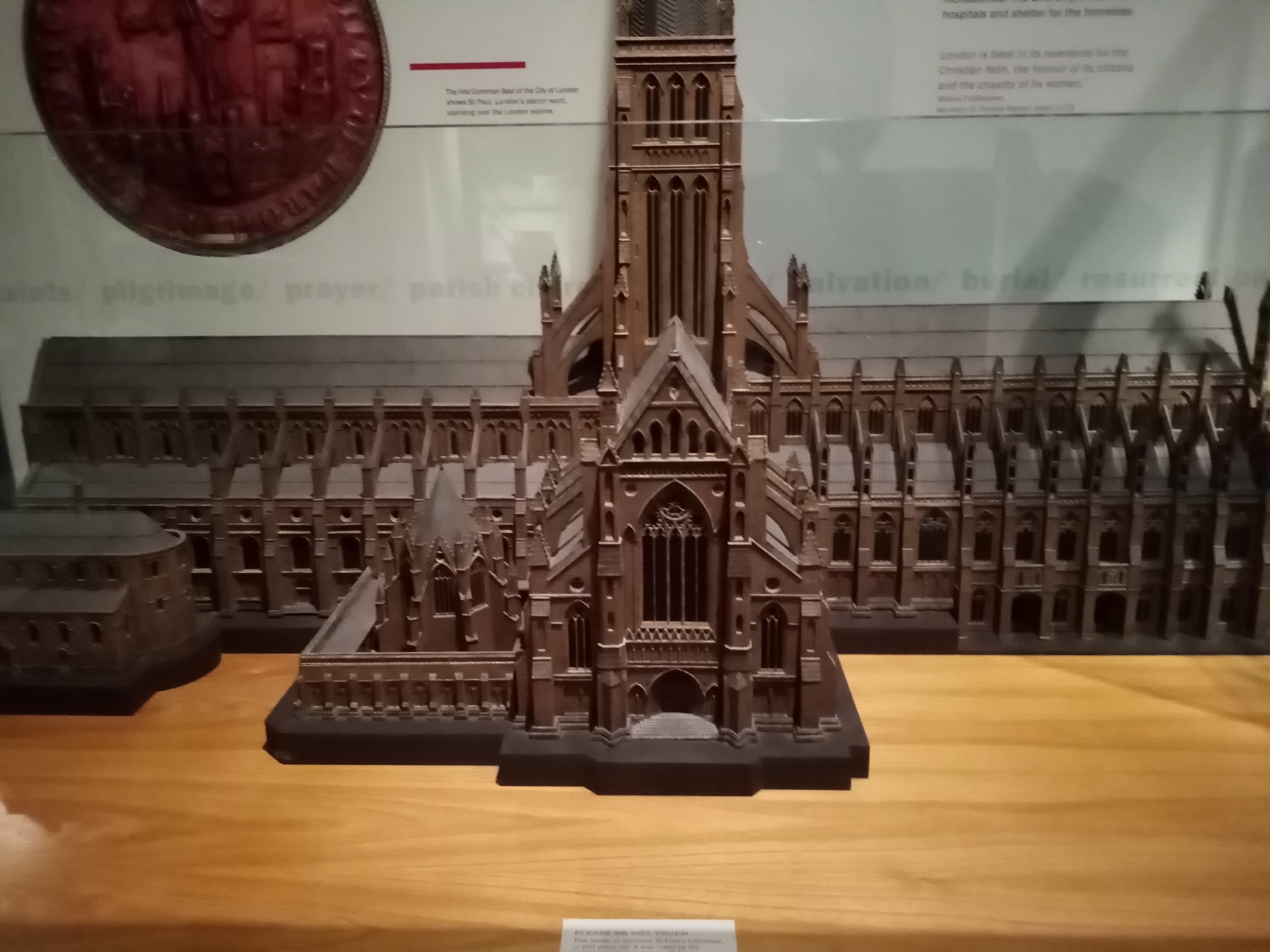
There has been a church on this site since 604AD. The chosen location for the first church was among the ruins of the Roman city, Londinium, at its highest point overlooking the Fleet valley. The Anglo-Saxons built their new city, Lundenwic, to the West of the abandoned Roman settlement, but chose this hill because of its prominent position. In the 7th century, England was divided into a number of Saxon kingdoms and St Paul’s was founded by King Ethelbert of Kent and was the seat of the first Bishop of London, Mellitus. The short-lived first wooden building burnt down in 675, and the second was destroyed by invading Danes in 962. The third building, built of stone and consecrated as a cathedral, was destroyed by fire in 1087. There followed a period of over 150 years when a new building was begun; construction was halted due to financial difficulties, begun again with a change in architectural style from Norman to Gothic, and finally completed in 1240. This building would have dominated the mediaeval London skyline, it was actually larger and longer than the present cathedral. It was altered and enlarged over the next four centuries….and completely destroyed in the Great Fire of 1666. Rising from the ashes for the fifth time was Sir Christopher Wren’s masterpiece, consecrated in 1697, and to me and many others, a work of genius and beauty.

Sources: Official Souvenir Guide; Wikipedia

Map of Lundenwic, showing St Paul’s inside the old walled city.
Mediaeval St Paul’s Cathedral

St Bride’s Fleet Street

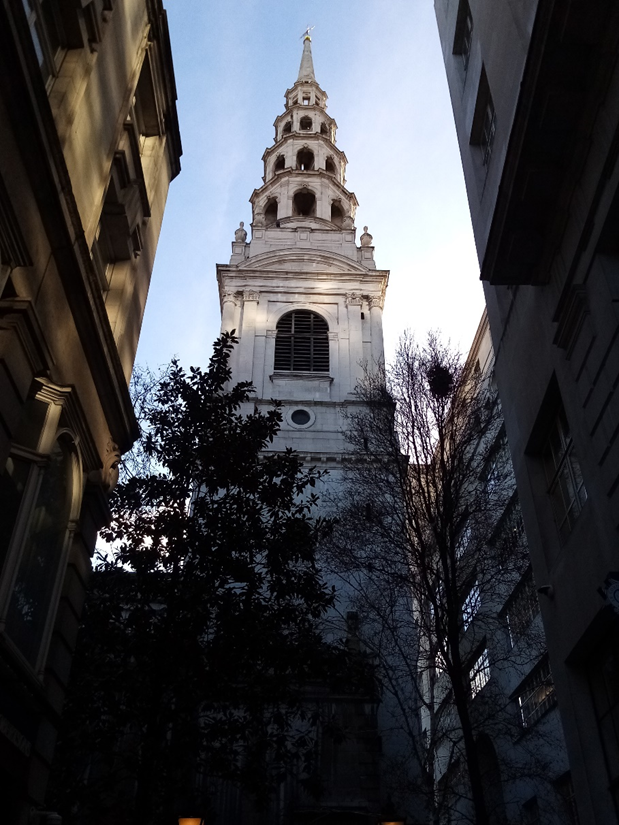
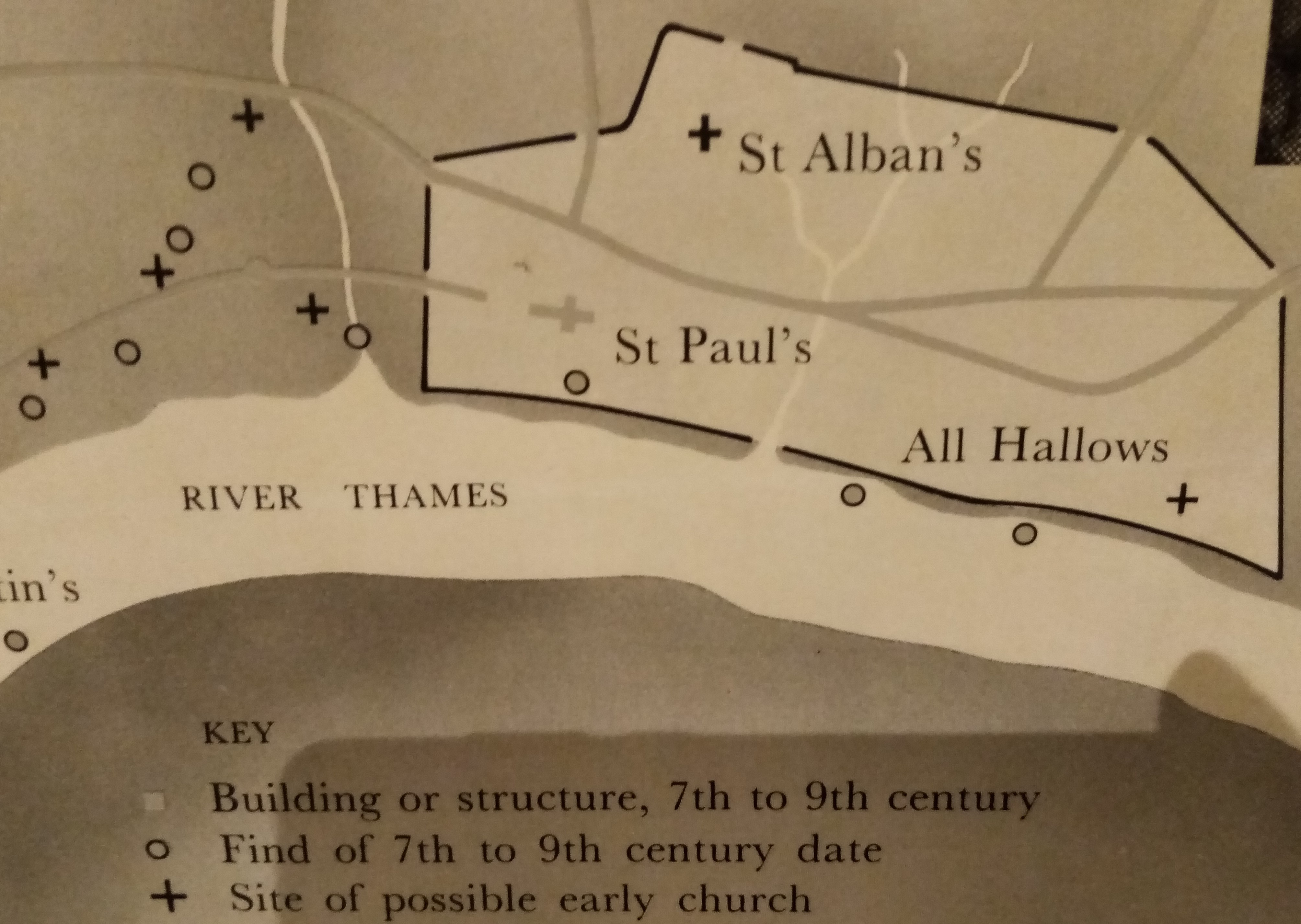
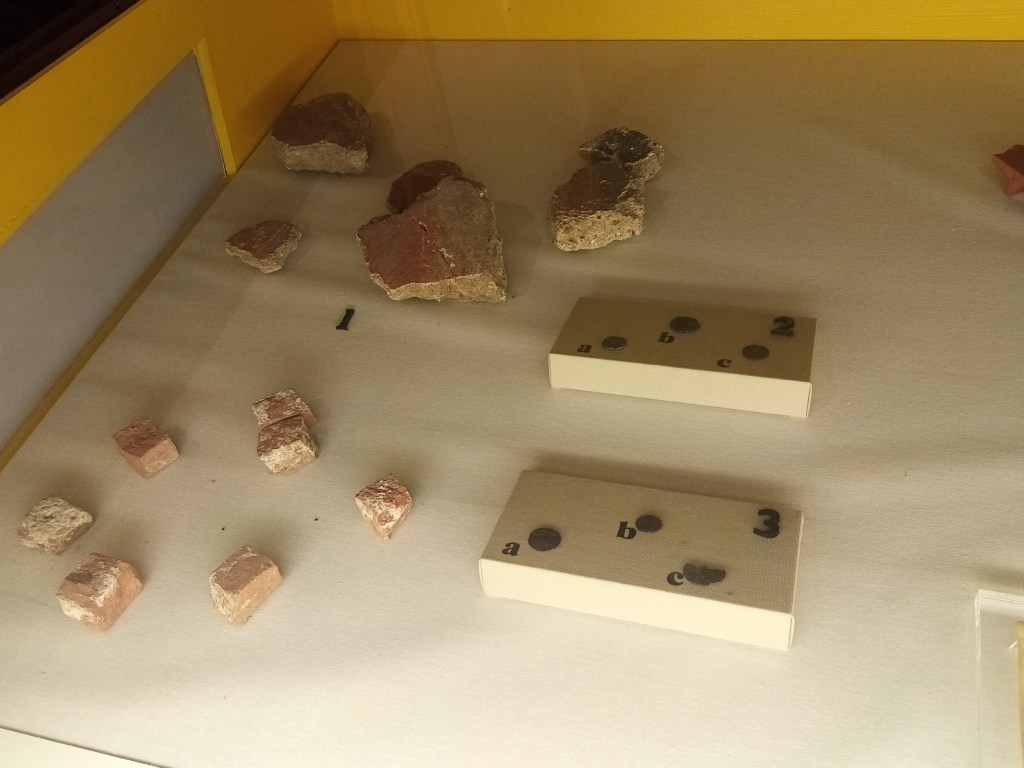
This beautiful church with its ‘wedding cake’ spire was named for St Bridget of Kildare, Ireland, and it is believed that a Celtic Christian community was established here in Roman time; part of a Roman tiled pavement has been discovered in the crypt. While this can’t be definitely confirmed, what’s known for sure is that there was a church on this site in the 7th century serving a community of Saxons who had converted from Paganism to Christianity. It was one of several churches, now long gone, along what is now Fleet Street in the Saxon town of Lundenwic. The church was also the site of a sacred well, long since dried up, which became known as the Bridewell. There have been at least seven churches on the site, and as with St Paul’s, the mediaeval St Bride’s was destroyed by fire in 1666 and rebuilt by Wren, who decided to make it really stand out by erecting its iconic spire. On my visit, I popped down to the crypt with its tiny museum displaying Saxon coins, pottery, gravestones, all found under or near the church. There are also some remaining Saxon walls standing, and I’m the sort of person who can get excited by the sight of a 13 hundred year old wall! St Bride’s other claim to fame is as ‘The Journalists’ Church’; how this came about, I’ve written about in my post from October 2020: Artistic Christian London.

Sources: Information Boards in the Museum; Church website

Map of old Roman London, with Saxon churches on the road out to the West

And a chunk of Saxon wall!

All Hallows by the Tower (aka All Hallows Barking)

All Hallows with the Walkie Talkie peeking over!

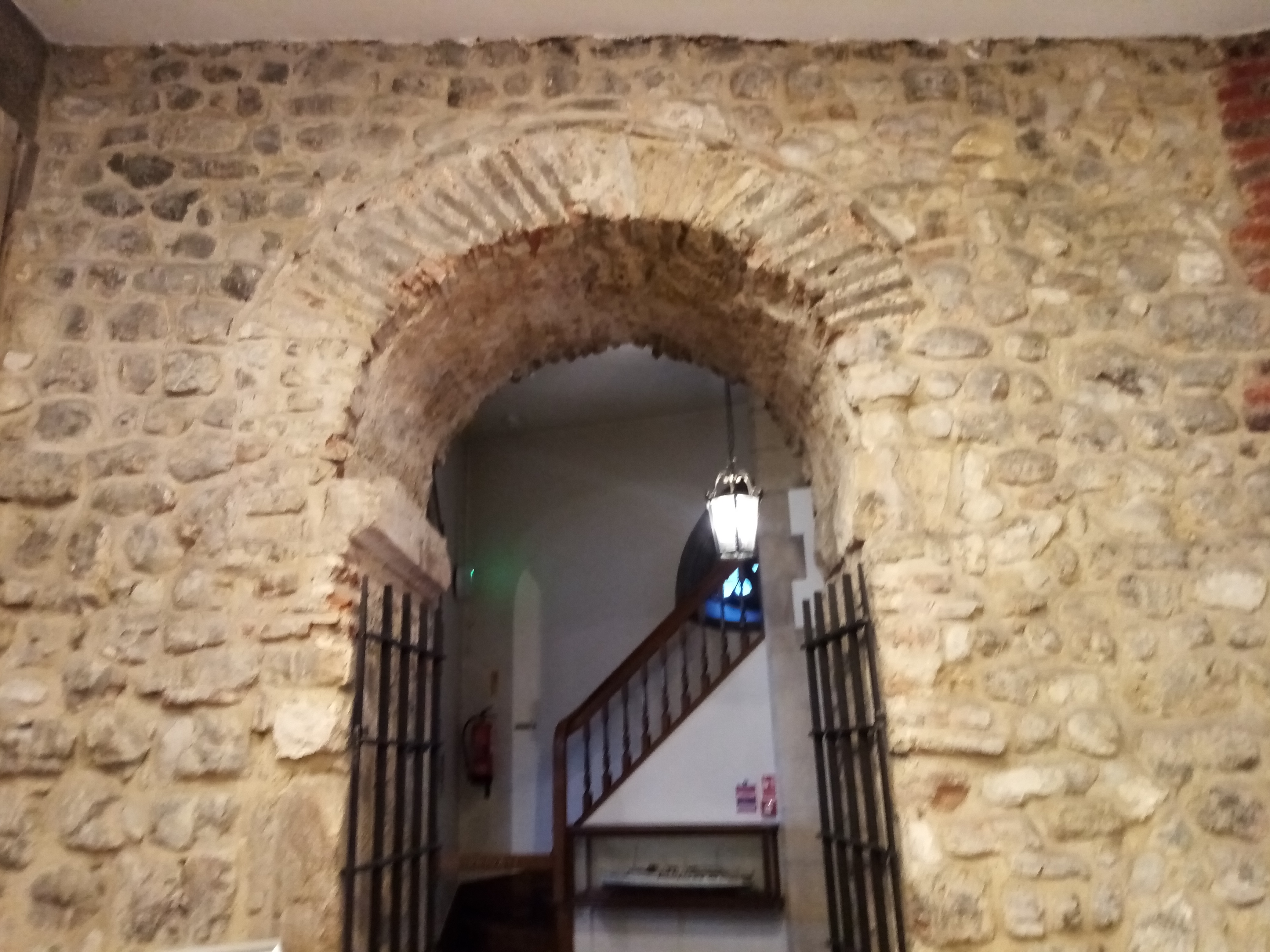
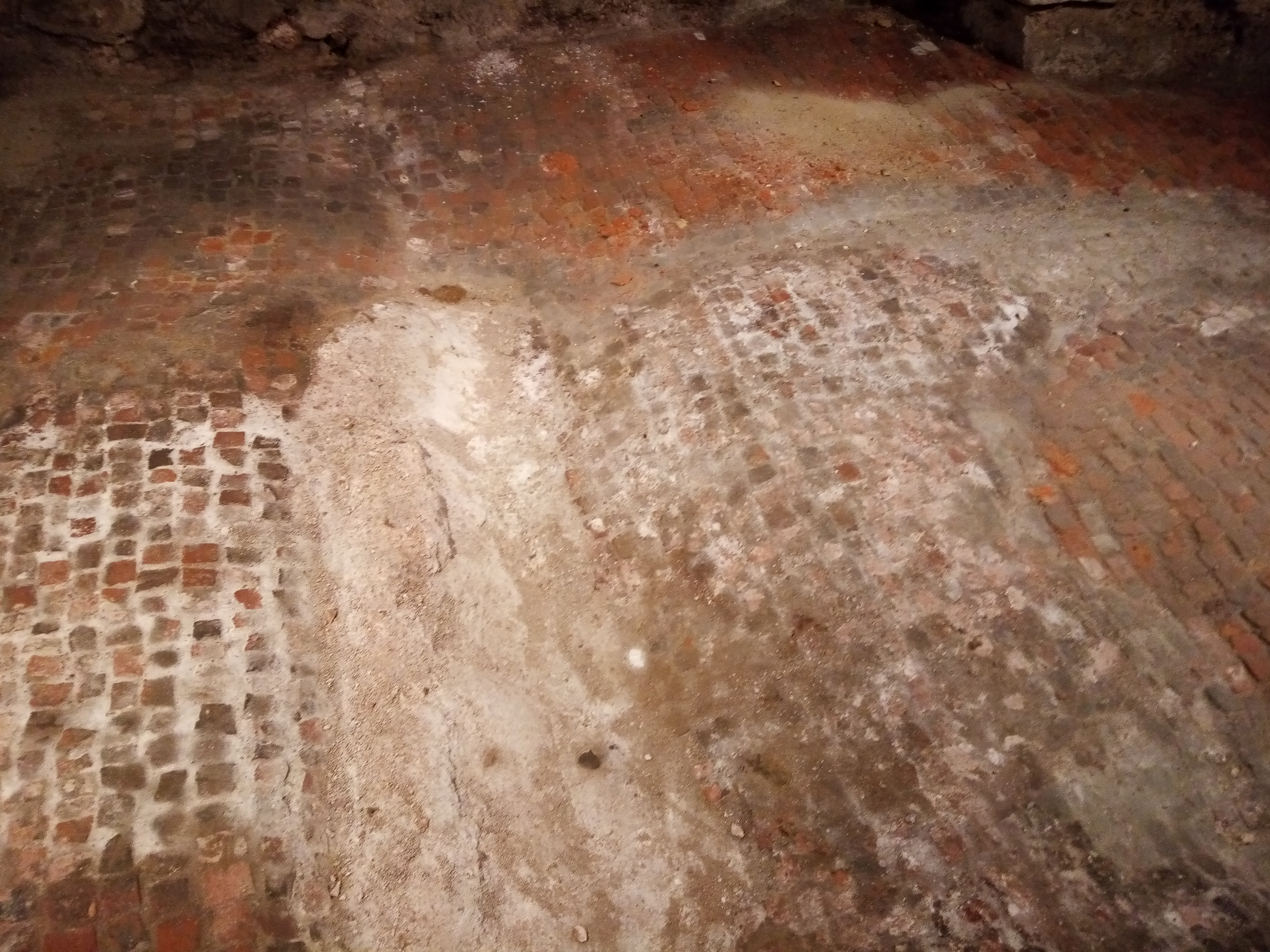
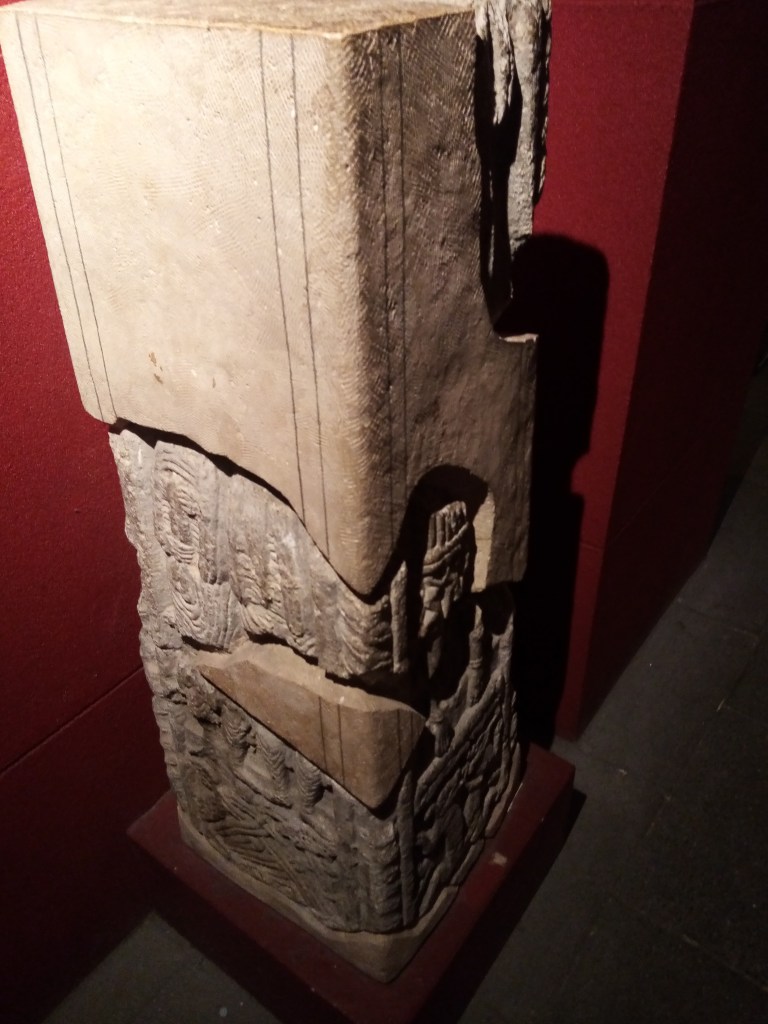
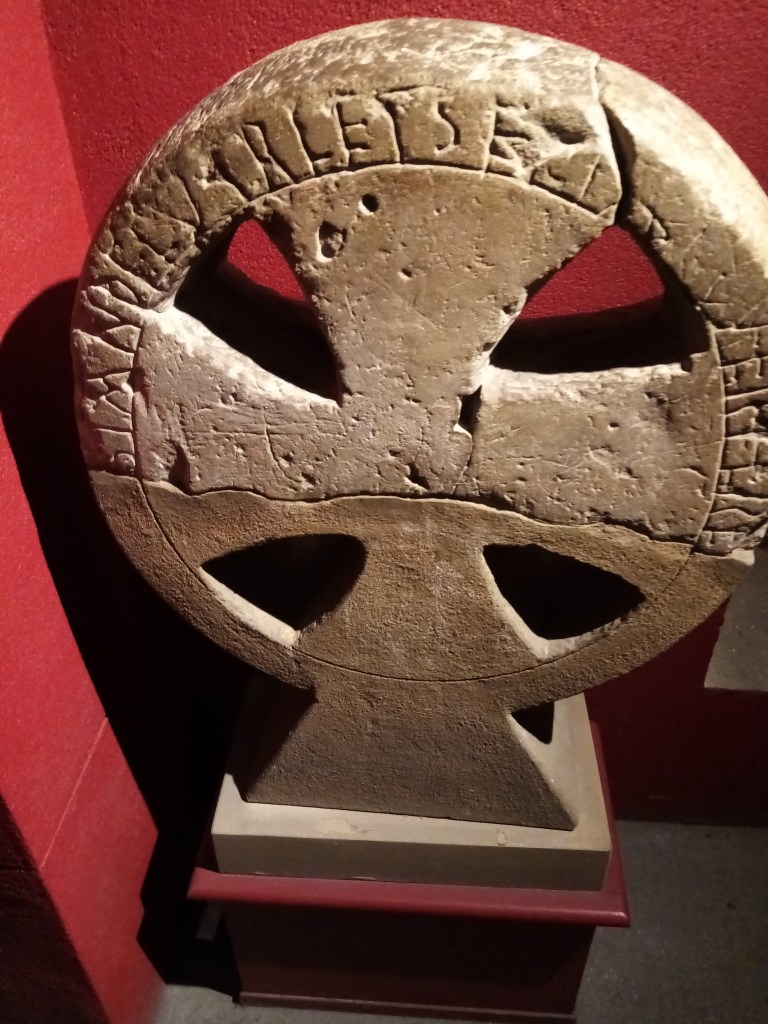
Another church with Roman origins, All Hallows also has Roman pavement tiles in the crypt in what would have been street level in 200AD. The first use of the site as a place of worship is in 675 when Erkenwald was made Bishop of London and founded a chapel of Barking Abbey here. A charter dated to 687 listing properties belonging to the Abbey includes two pieces of land in or near London, but Wikipedia tells me that neither of these accurately describes the location of All Hallows, which is inside the Roman walls. However, part of a Saxon archway (below), built from reused Roman tiles and brickwork, was uncovered in 1940 following bomb damage to the church. The reuse of Roman building materials and the design of the arch suggested that the church probably dated from the 7th century, and the connection with Barking Abbey is that Bishop Erkenwald’s sister was the Abbess. This confirmed the belief that All Hallows was founded as a daughter church of Barking Abbey. The stone arch was part of a church which replaced an even older, wooden building, tentatively suggesting that there was a church here in Roman times, but as with St Bride’s, this is unproven. Also in the crypt are a lovely Wheel Head Cross, a Saxon pillar and some Roman gravestones, all discovered under the present building during extensive bomb damage repair work. 

Sources: Information boards in the church; Wikipedia


Roman tiled pavement

While researching this month’s theme, I discovered some other first-century sites of Christian worship in London, including a famous one. So this will be February’s subject too. 

December: Nativity lV!

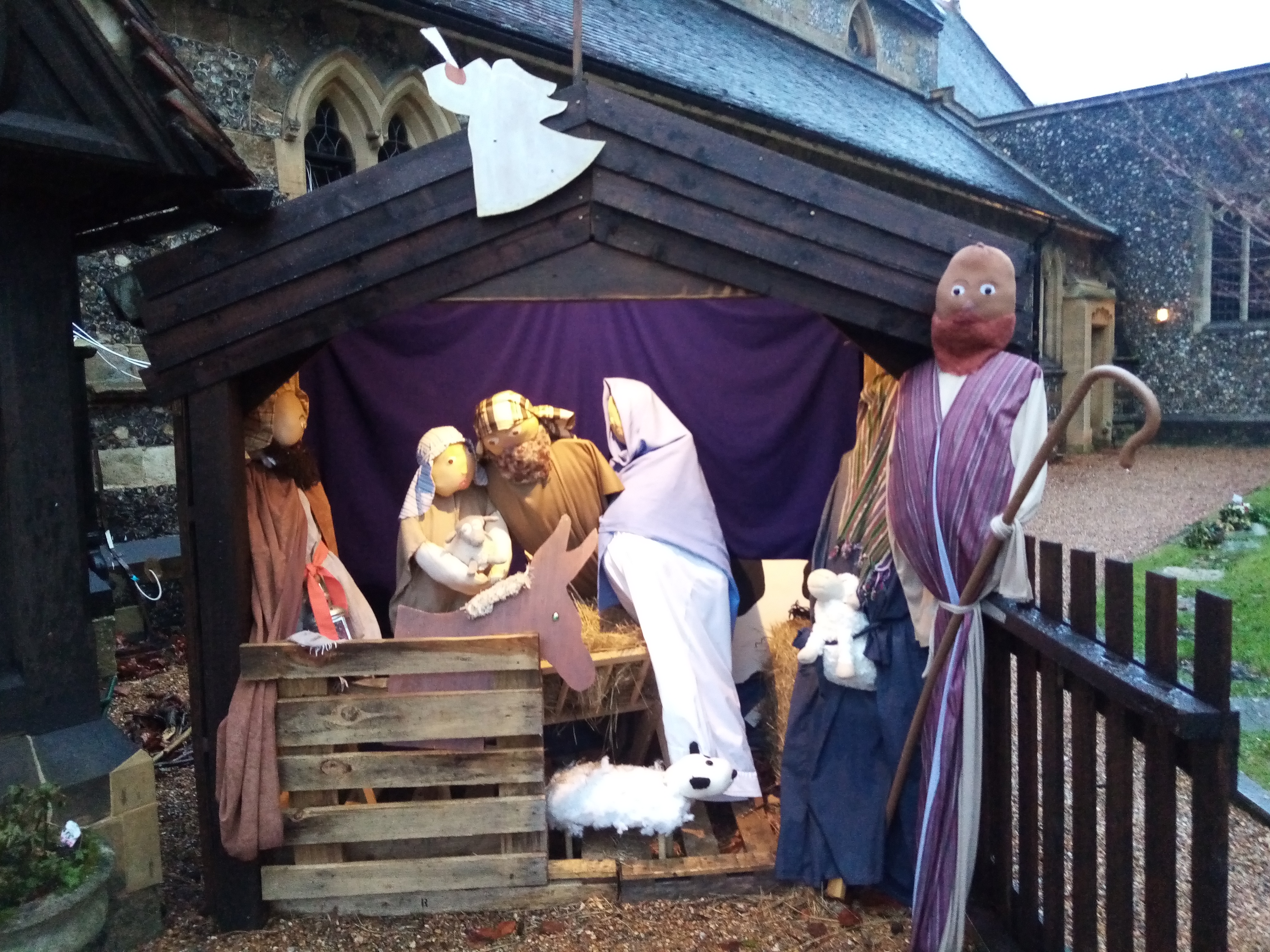
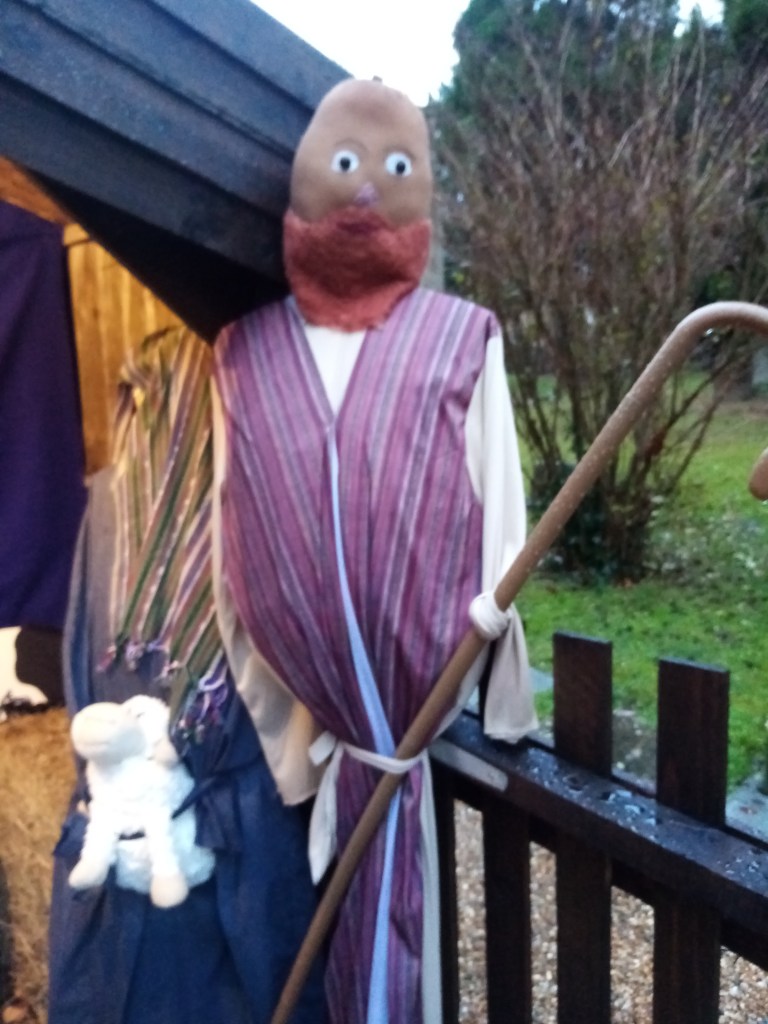
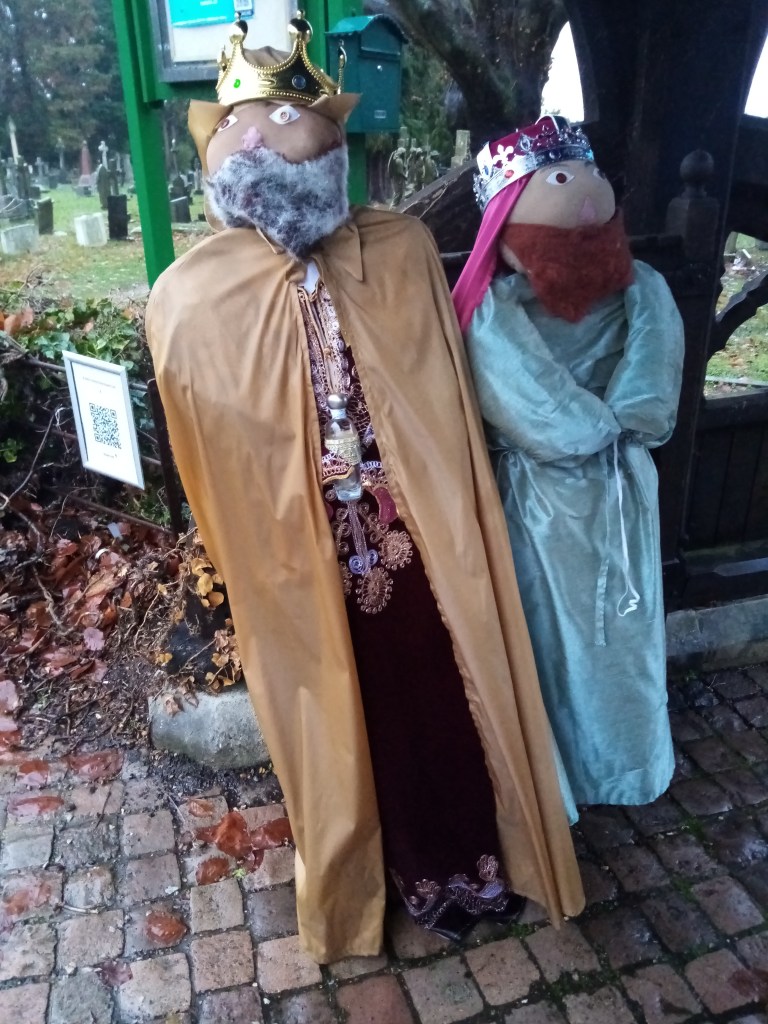
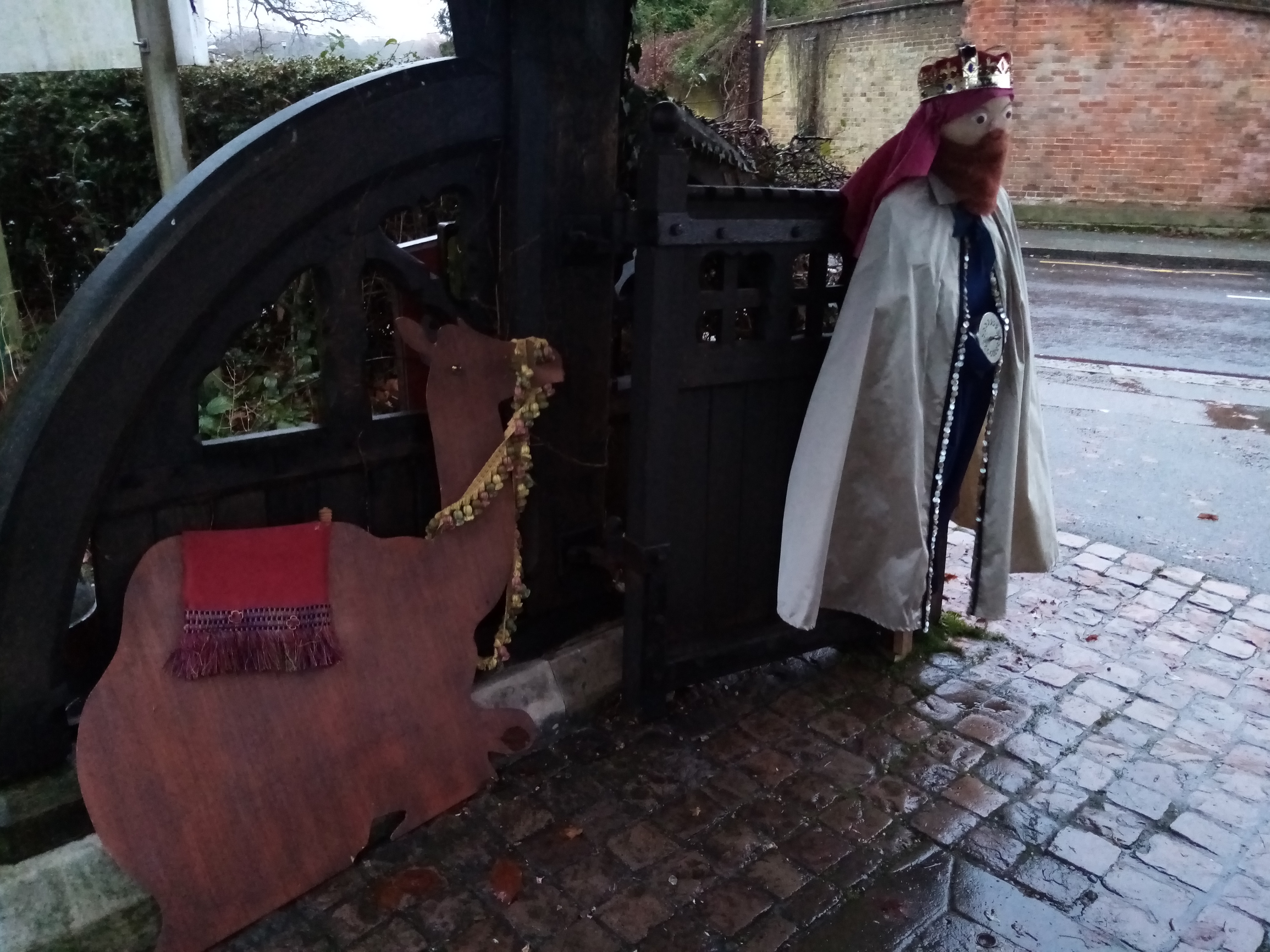
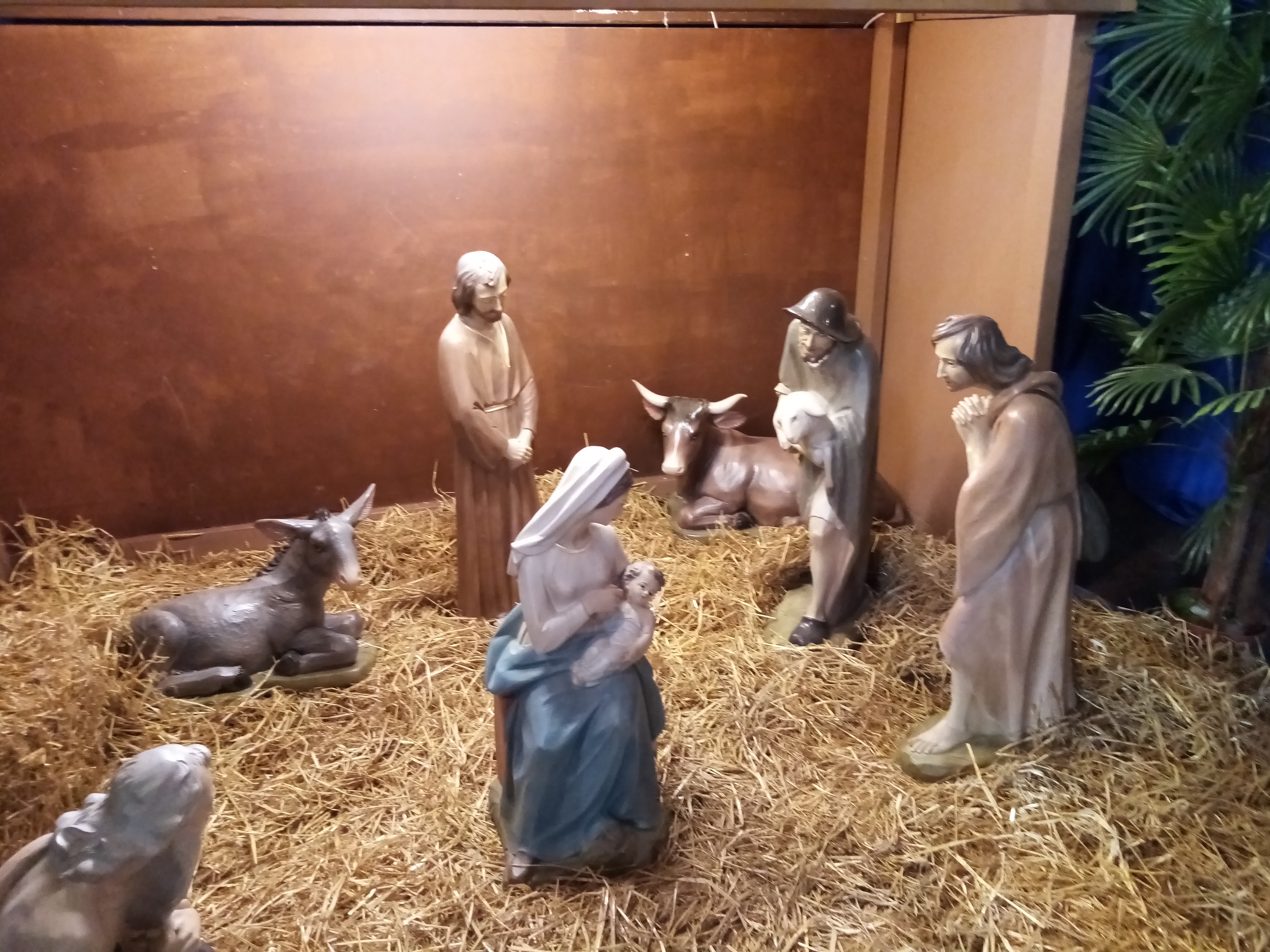
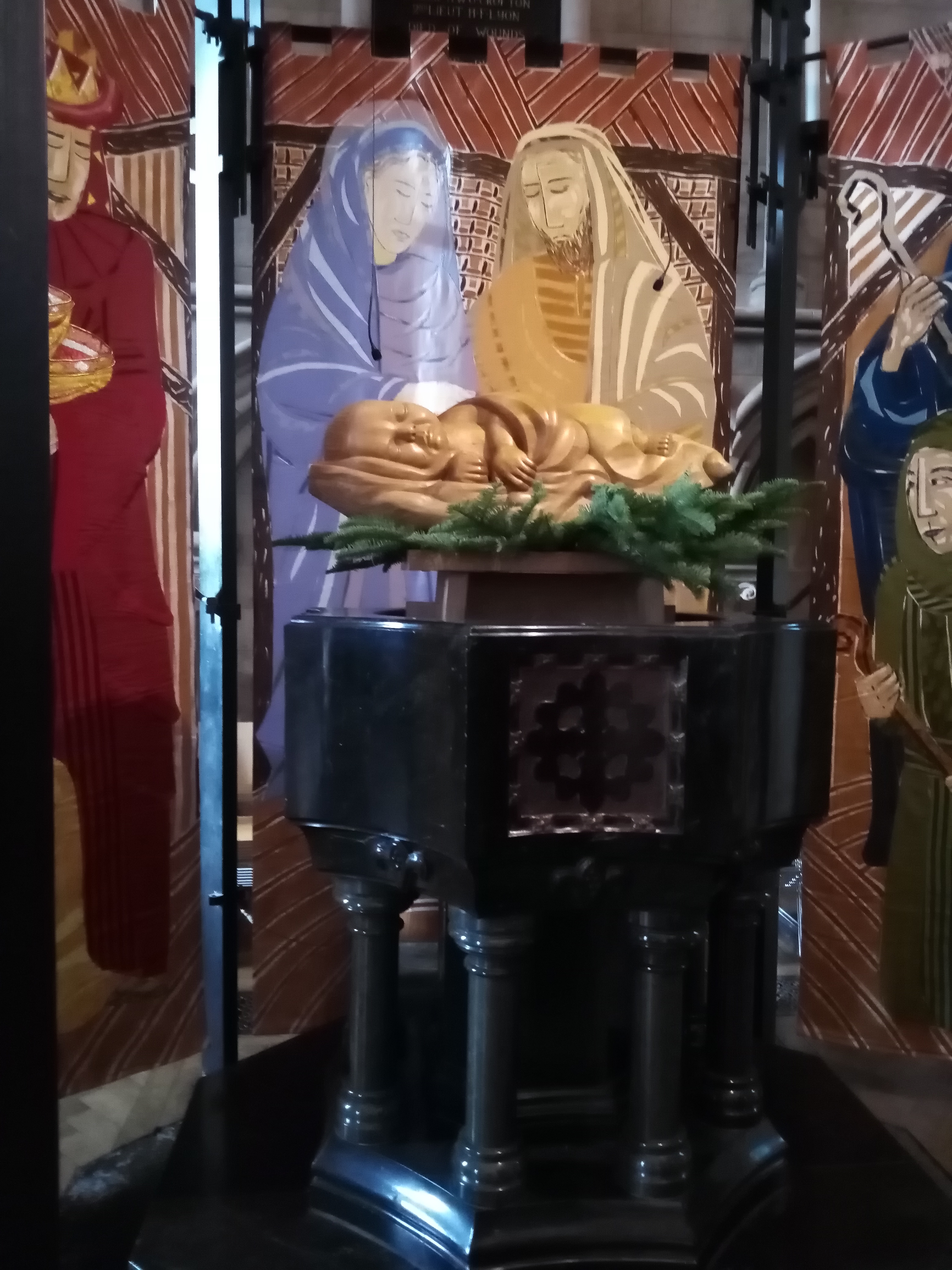
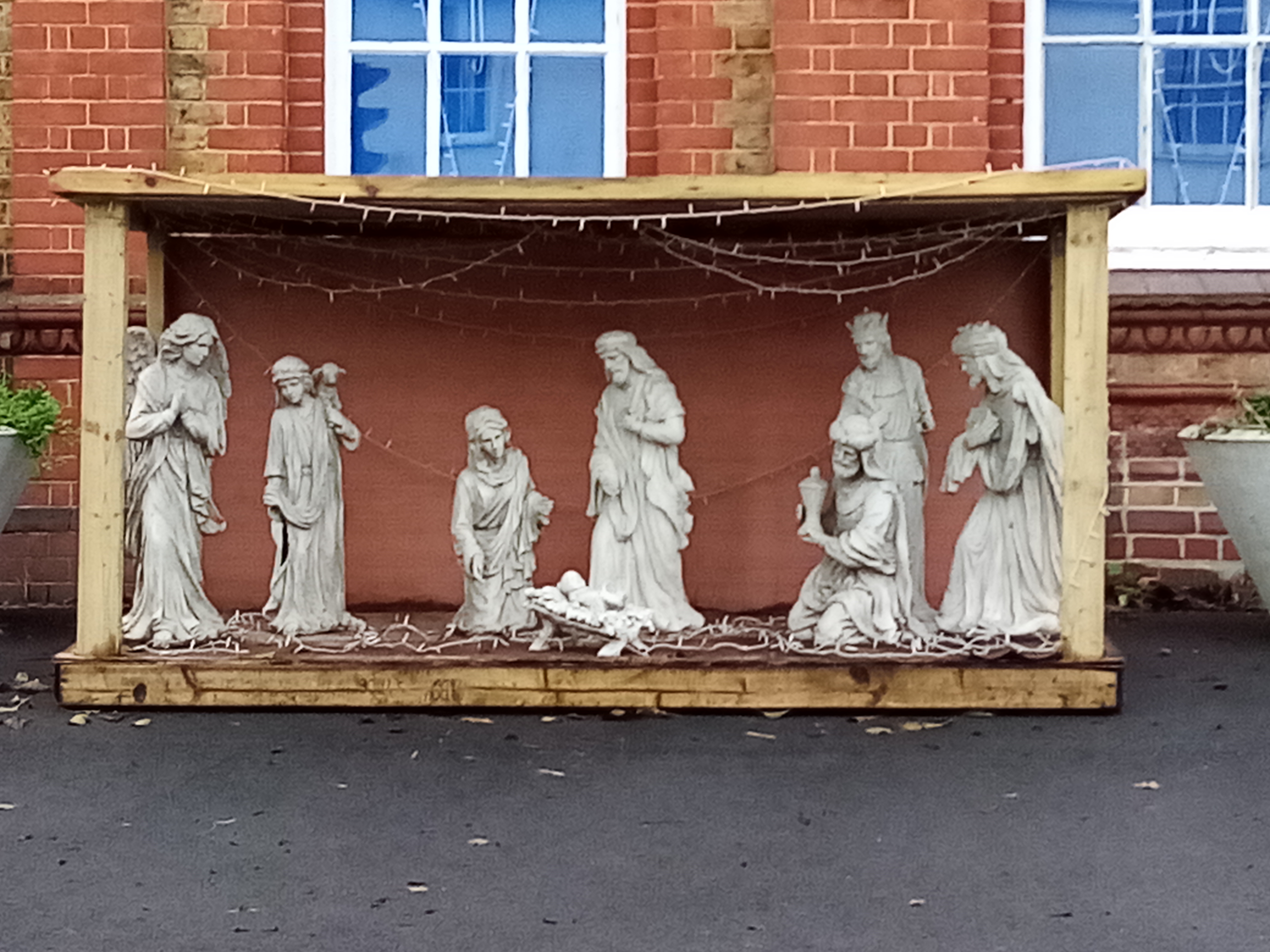
I had decided not to do another post on Nativity displays for December, but then I spotted some new ones – weird and wonderful, beautiful and bizarre, as well as the usual traditional and tasteful; here they are!

St John the Evangelist, Shirley, Croydon

I got quite a shock when I first saw these life-sized figures as I drove up to the church!

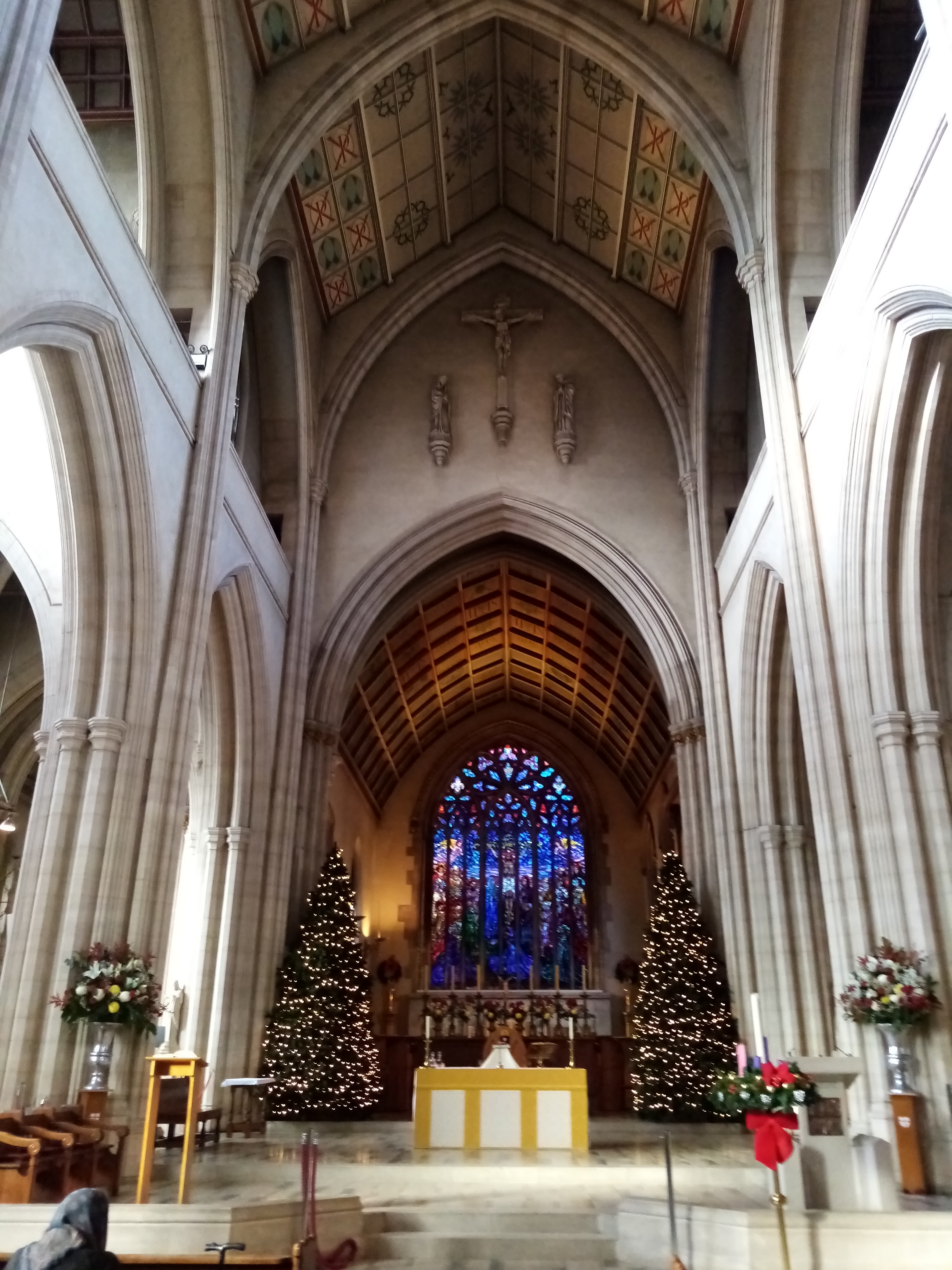
St George’s Cathedral, Lambeth

Beautiful altar of St Georges Cathedral

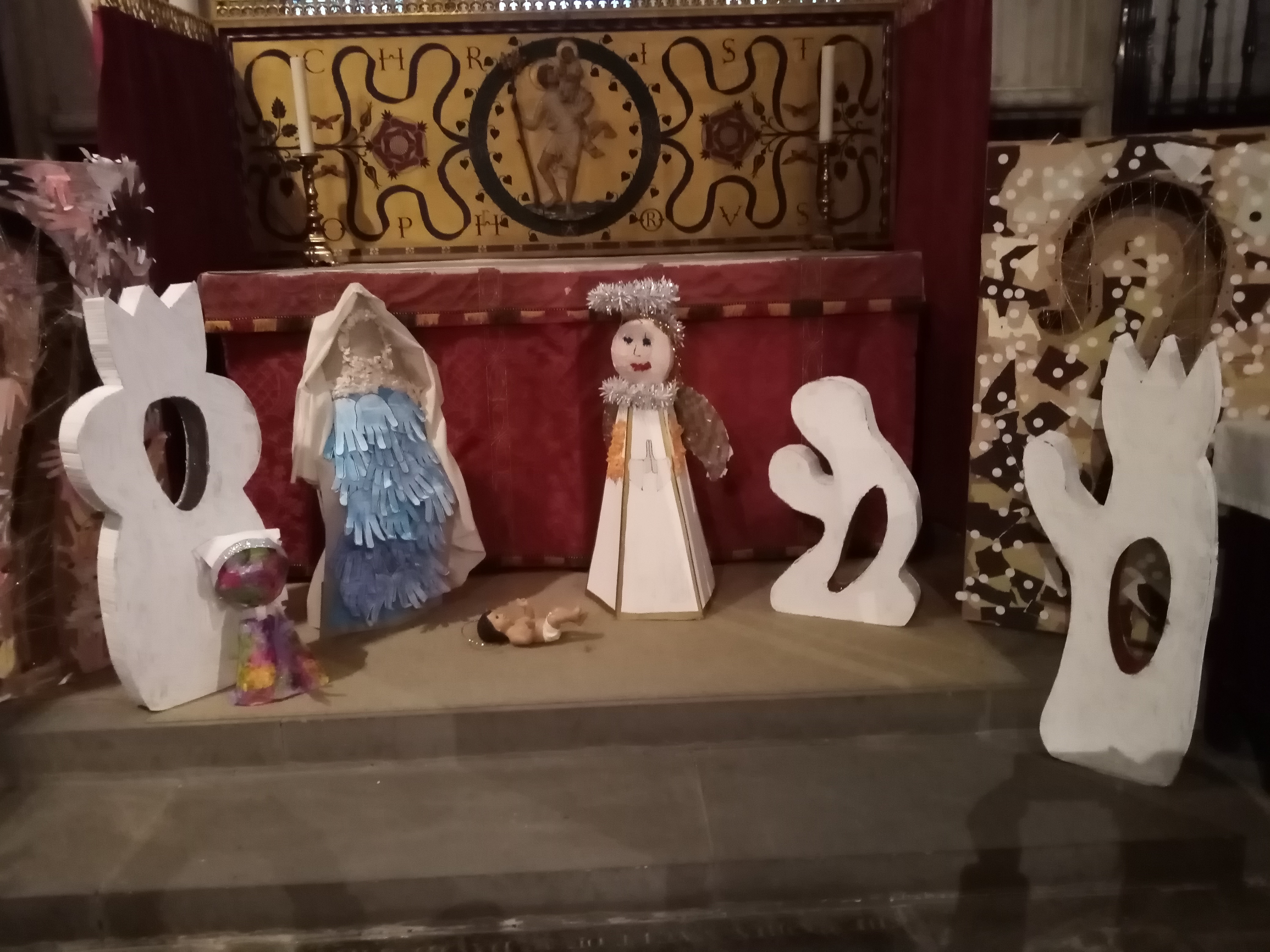
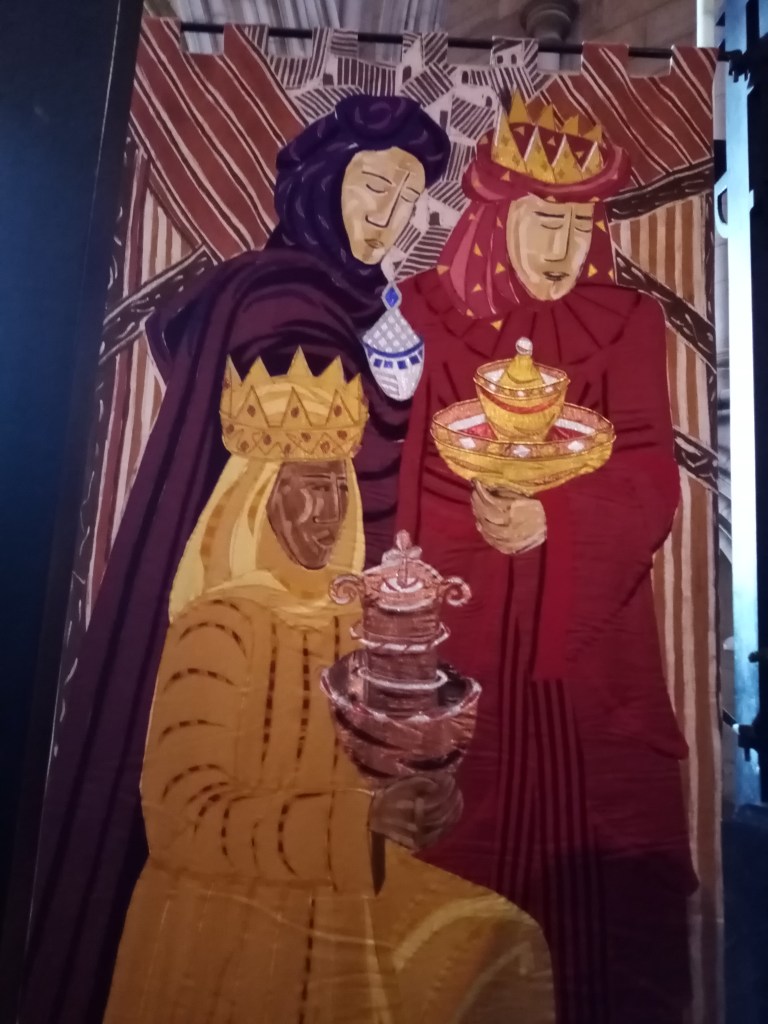
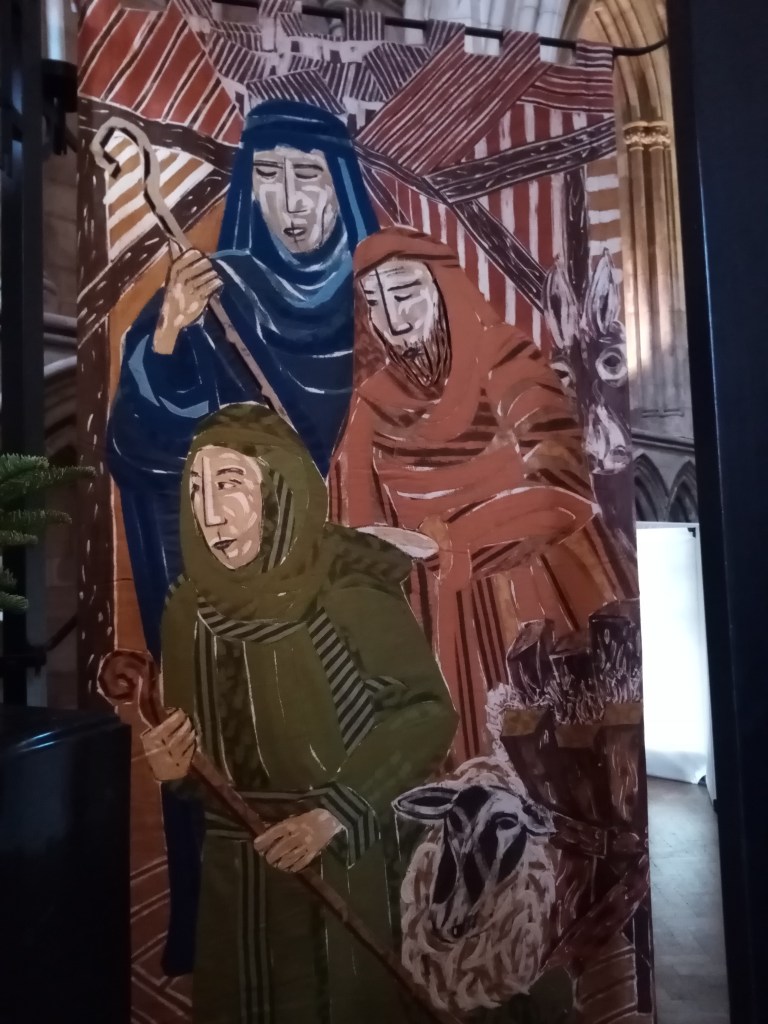
Southwark Cathedral

Unusual Nativity scene at Southwark…..
…..and this stunning triptych at the entrance

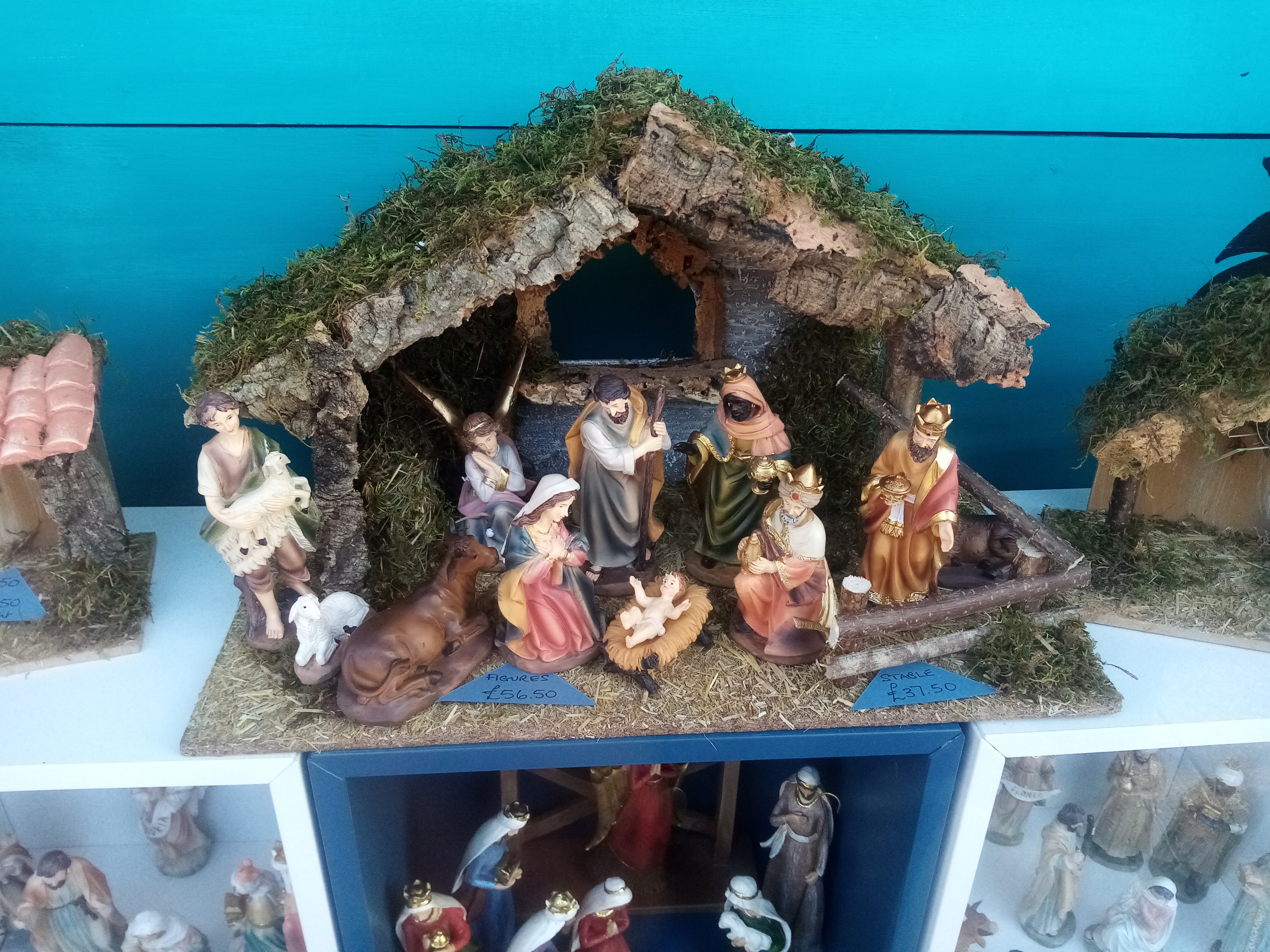
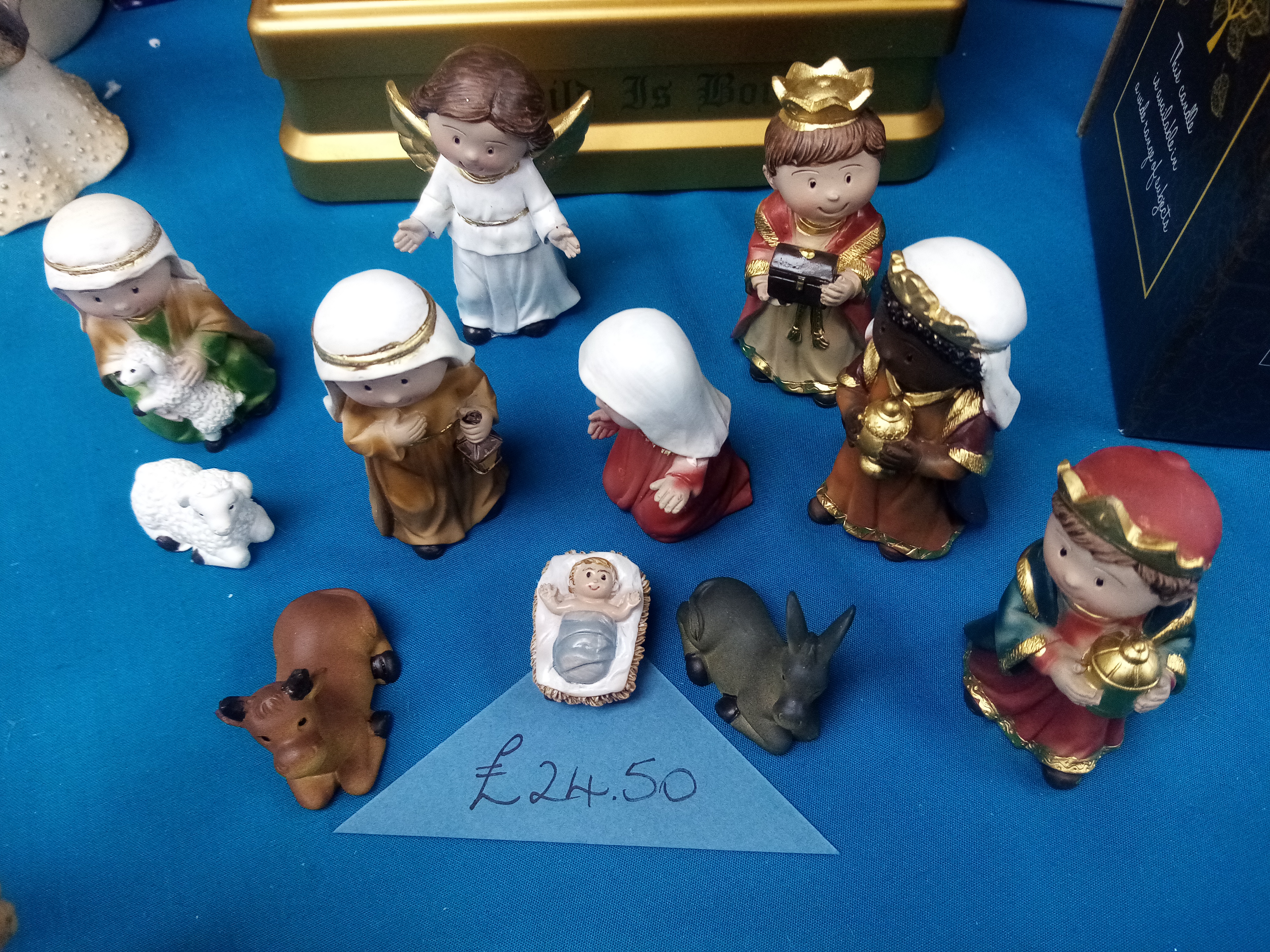
And to finish, a few more nativity scenes and posters:

St Mary’s Primary School, Carshalton
Traditional Nativity Scene in Oasis Christian Bookshop and…..
…cute Nativity Scene
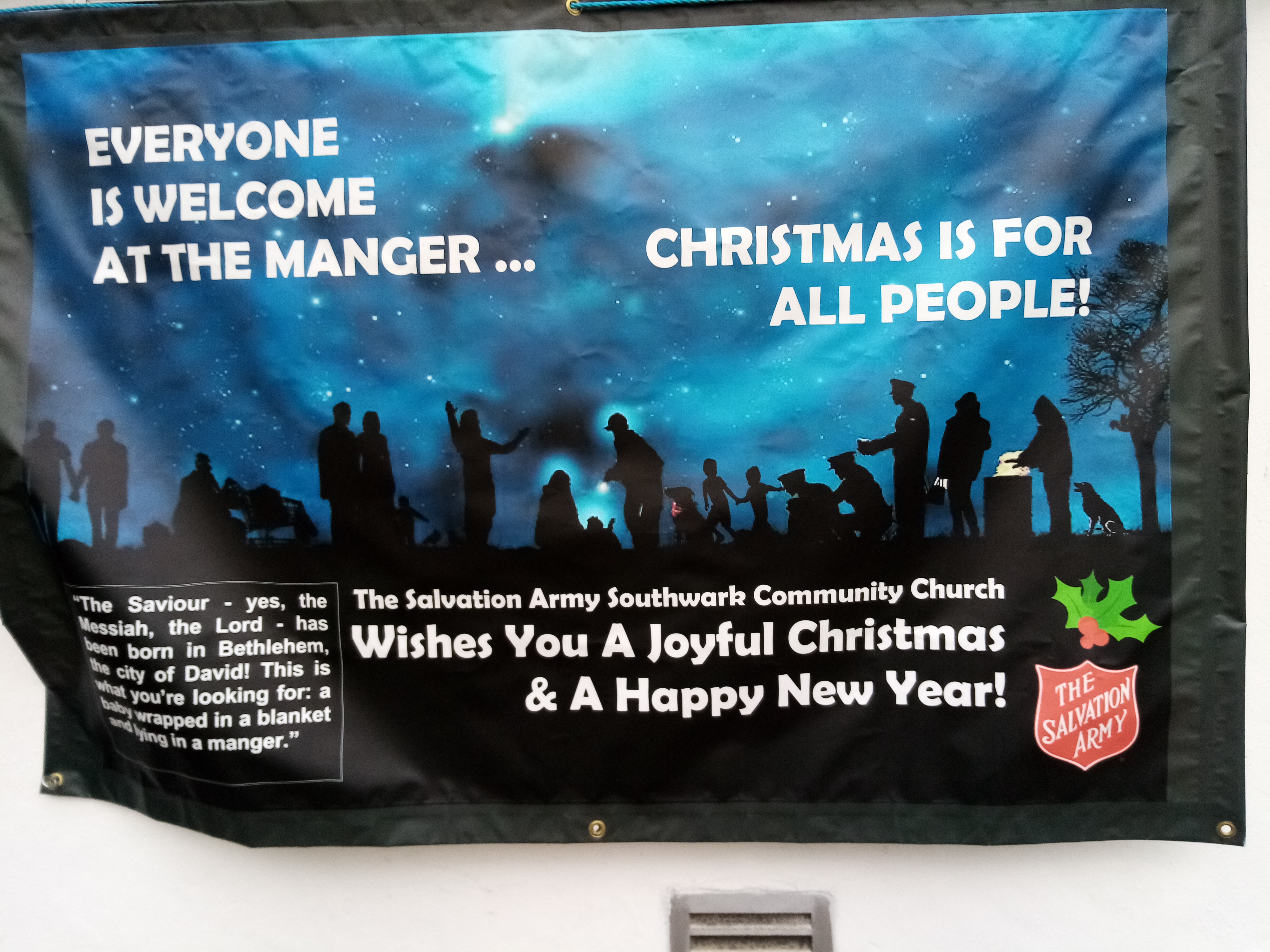
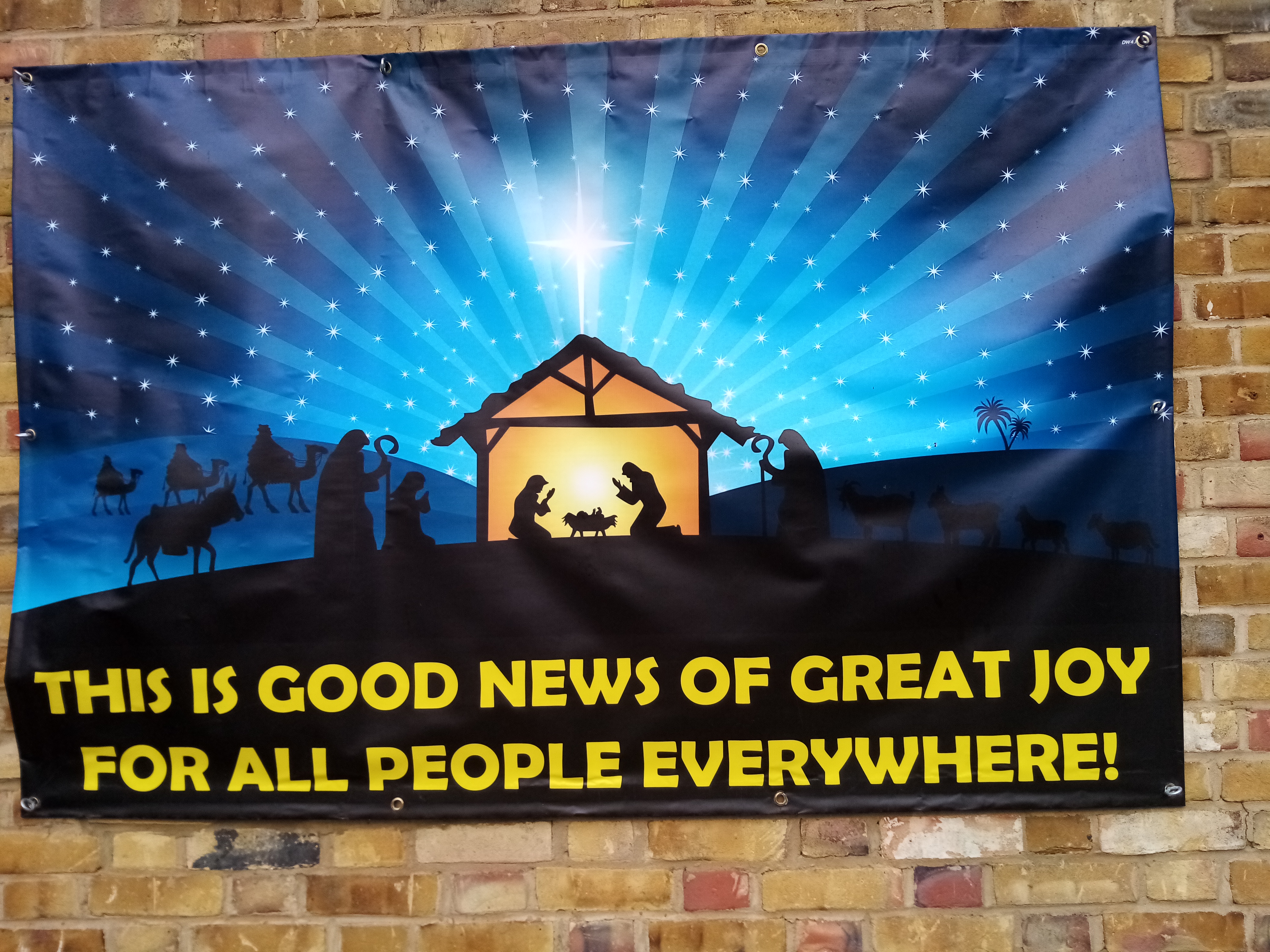
These posters are on the wall of the Salvation Army Church at Southwark. I love the first picture of all the different people coming to the manger – ‘Christmas is for all people’.

This was going to be the last blog post on ‘Christian London’. However, I find that I have collected much more material about Christian London, at least five months’ worth of themes! So 2023 will be the 4th year of exploring, in words and pictures, all things Christian in the 33 boroughs that make up my wonderful city, London. It just remains for me to wish you all a very happy and blessed New Year.
November – East End Churches

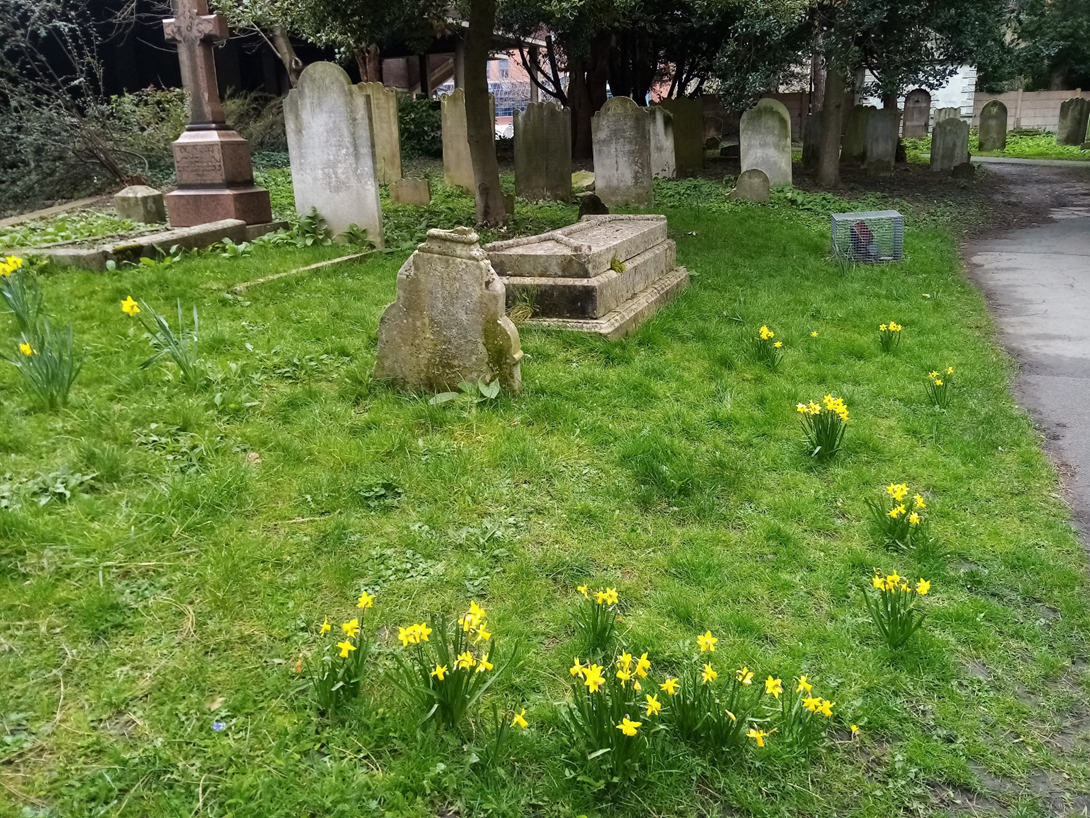
The modern London Borough of Tower Hamlets came into being in 1965 when three metropolitan boroughs merged: Bethnal Green, Poplar and Stepney. But the original tower hamlets were small villages (hamlets) north and east of the Tower of London which were not large enough to have their own town hall and mayor, so came under the governance of the Tower. Although it sounds like a modern name, the Tower Hamlets date back to the 1500s. The borough includes the ‘traditional’ East End, it’s where Walford of EastEnders would be if it was real! And it has expanded to include the Isle of Dogs and the business district of Canary Wharf. This month I visited four churches within the aforementioned metropolitan boroughs.

Source: Wikipedia

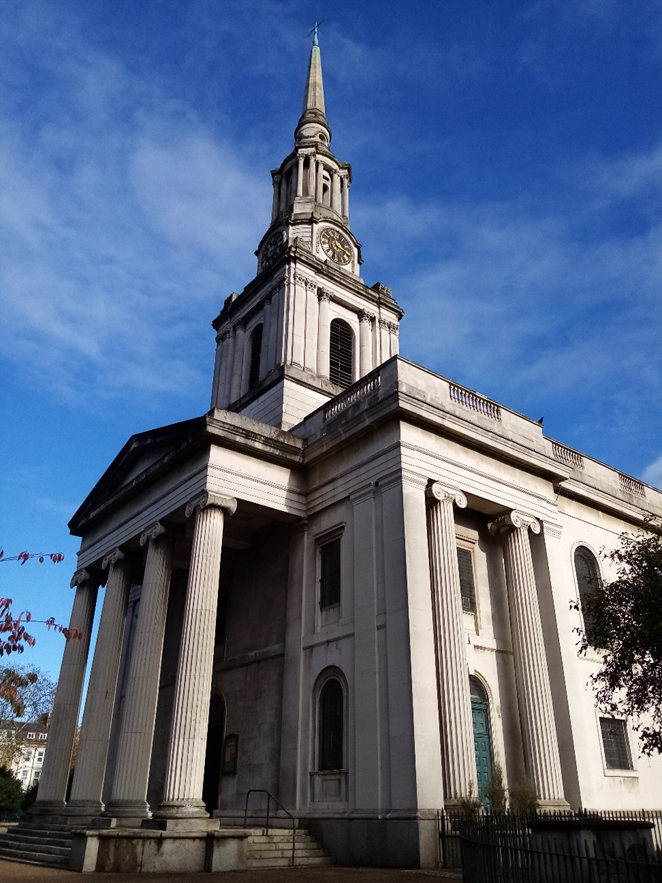
All Saints Church, Poplar

This is the large Victorian church mentioned in ‘Call the Midwife’ by Jennifer Worth: ‘The Sisters and lay staff attended All Saints Church, East India Dock Road for midnight Mass. I was astonished to find the church absolutely packed….it must have held 500 people that night.’ * The church was built in 1821-23 to serve the newly created parish, which at the time included wealthy merchants and professionals connected with the shipping trade. The East and West India Docks had been dug out at the turn of the 19th century and a large development of terraced houses and flats was built to house the huge workforce employed on the ships and in the dockyards. As Jennifer Worth notes in her books, all classes of worker: professionals, management, skilled and unskilled attended All Saints as their local parish church. The London docks were heavily bombed in the 1940s Blitz, when the church was severely damaged and night after night, hundreds of people used the crypt as an air raid shelter. Fast forward to 2022 and the crypt has a very different purpose. Every weekday morning it is open for homeless people as a warm and welcoming space to get hot drinks and snacks, charge their phones and get housing and benefits advice, perhaps watch TV or have a game of snooker. Thanks to Paul and the team from Thisisgrowth.org for chatting to me and showing me around!

Sources: *Call the Midwife, Jennifer Worth, 2002, Phoenix Paperbacks; Wikipedia

A haven for homeless people in the crypt of All Saints

St Anne’s, Limehouse

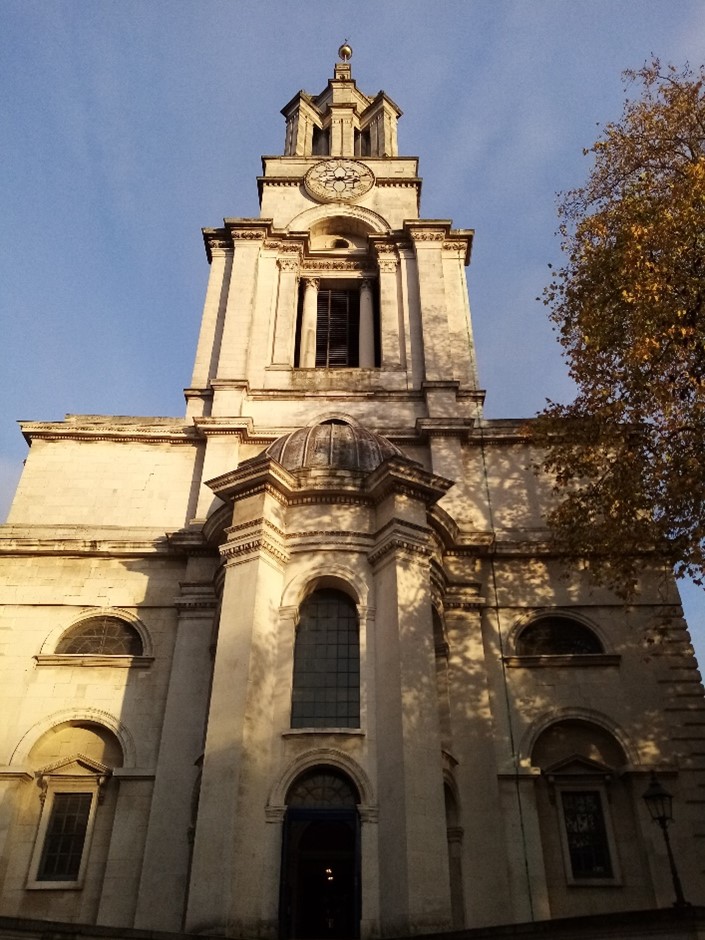
All the churches I visited are fairly large, but St Anne’s Limehouse is huge, towering above all local buildings when seen from the elevated DLR. The current building was designed by Nicholas Hawksmoor and completed in 1730, one of 12 churches built to serve the rapidly expanding population of London in the 18th century. Other supersized Hawksmoor churches are Christchurch Spitalfields and St George-in-the-East. The church may have been named for Queen Anne, who reigned from 1707 to 1714, because she raised the money to build it by taxing the transportation of coal along the River Thames. She decreed that as the church was close to the River it would be an important place for sea captains to register important events taking place at sea and granted to St Anne’s the right to display the Royal Navy’s second most senior ensign, the White Ensign. The Queen’s (or possibly now King’s) Regulations still allow it to be displayed 24 hours a day, 365 days a year. Occupying a site close to the Limehouse Cut and Regent’s Canal Dock (now Limehouse Basin), St Anne’s was another church built to serve the community of ship owners, merchants and dock workers.

Source: Wikipedia

Imposing Entrance to St Annes

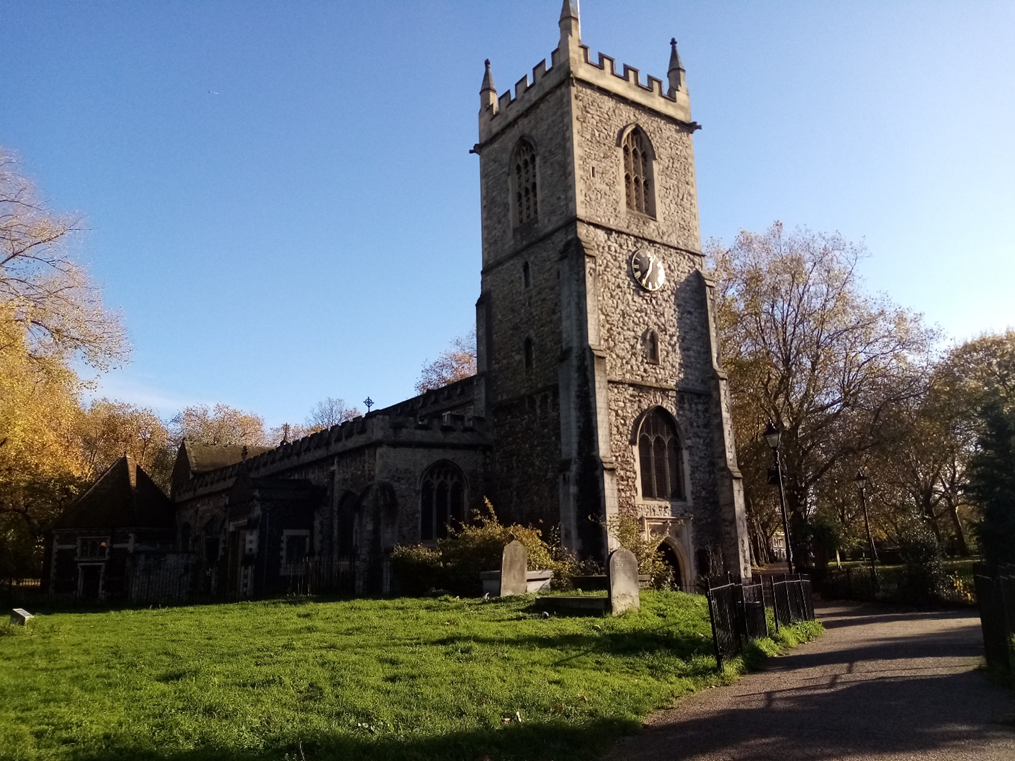
St John on Bethnal Green

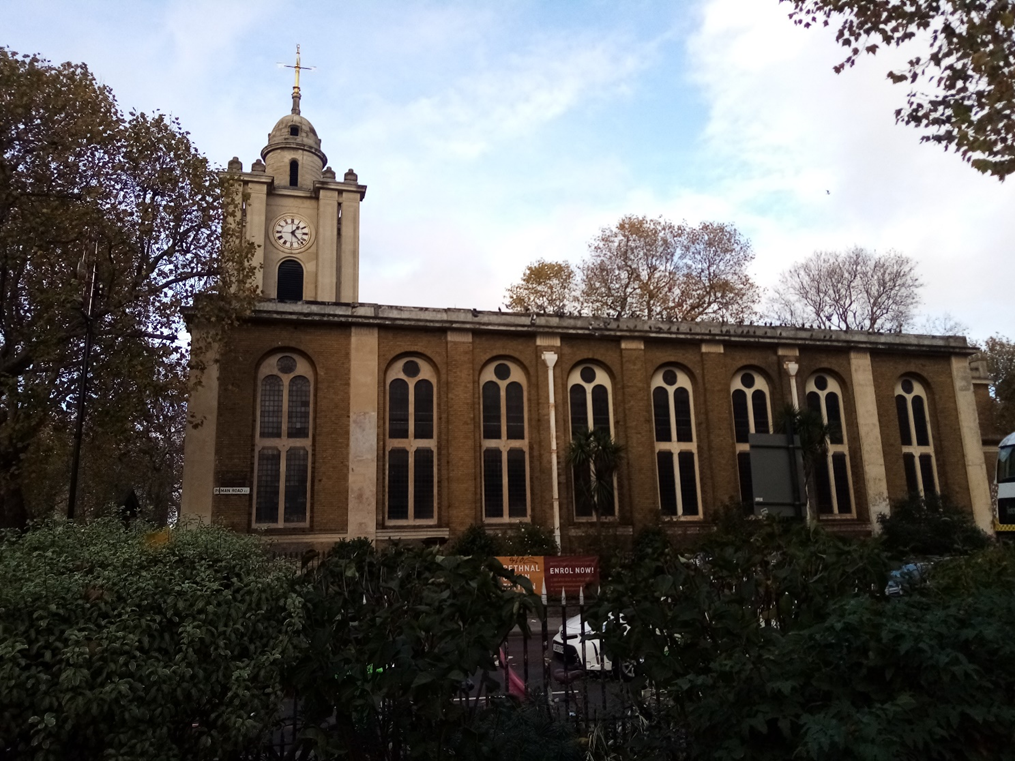
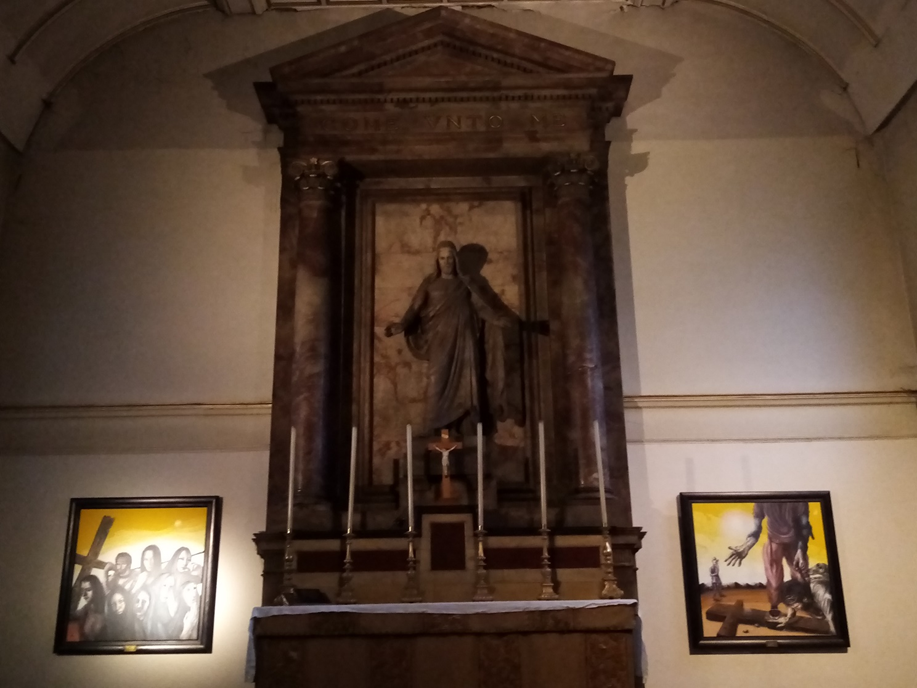
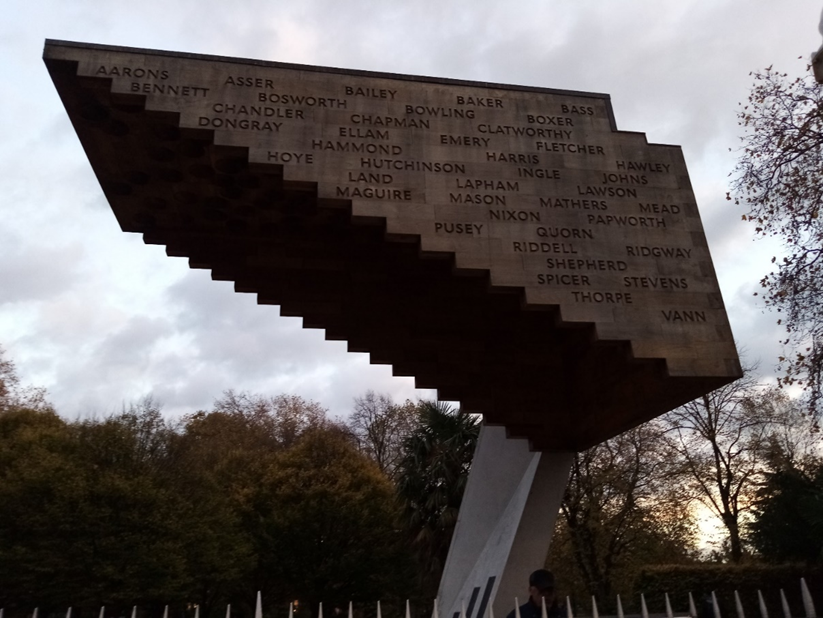
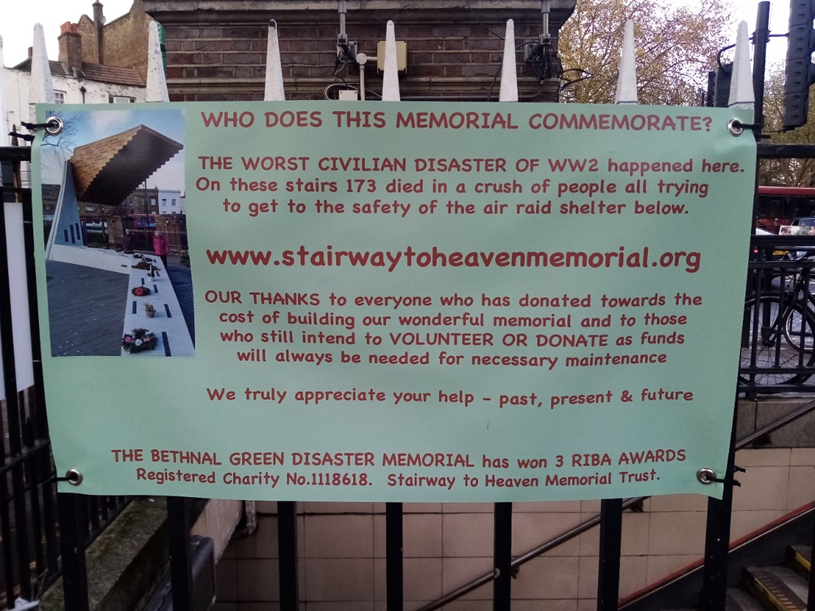
Like All Saints, St John was built is the early 19th century. It was designed by the architect Sir John Soane, most famous for designing the Bank of England, and the church is actually on the Green. What I found interesting about the interior of the church is the specially commissioned Fourteen Stations of the Cross paintings. The artist who was granted the commission by the Church of England in 2000 was a controversial choice because he is not a practising Christian. However, it was agreed that Chris Gollon could produce the designs for the paintings in consultation with Fr Alan Green, the Rector of the church. St John holds regular art, music and film events and has been listed in The Guardian newspaper as one of the top five cultural highlights of the East End because of its mixture of spirituality and art. There was an art exhibition when I visited; dozens of paintings were displayed in the porch and upstairs in the gallery of the church. Directly opposite the church is Bethnal Green Underground Station which has a memorial to the worst civilian disaster of World War ll which happened at the station. As the air raid warning sounded on 30th March 1943, hundreds of people ran to the tube station to take cover. 173 people were killed in the ensuing crush in the entrance and on the staircase. The memorial, unveiled in 2017, lists the names of all the victims.    

Sources: Wikipedia; historic-uk.com

Memorial to the 1943 Bethnal Green Tube Disaster

St Dunstan’s, Stepney Green

There are several churches in the London area dedicated to St Dunstan. He was a first century Bishop of London, Minister of State (an early Prime Minister) to several kings and finally Archbishop of Canterbury. Approaching St Dunstan’s today, for a moment the church and its surroundings look as they have done for hundreds of years. Indeed, the site has been used for Christian worship for over a thousand years. In AD952 Dunstan replaced the wooden structure on the site with a stone building dedicated to ‘All the Saints’. He was probably living at the Manor of Stepney at the time. When Dunstan was made a saint in 1029, the church was rededicated to St Dunstan and All Saints. The current building is 15th century and was added to in the Victorian era. The church is known as The Mother Church of the East End as the parish covered most of what would become inner East London. Inside, the Stations of the Cross are displayed, not as dramatic as those of St John, but unusual because they are in relief. Outside, the churchyard was enlarged in the 17th century to cope with the huge numbers of deaths during the Great Plague; in one 18-month period, 6,583 people died. The churchyard was closed to burials in 1854 and was converted to a garden a few years later by the Metropolitan Public Gardens Association.  It remains a pleasant place to walk and sit- I had my lunch there!

Source: Wikipedia