Credit: Wikimedia Commons
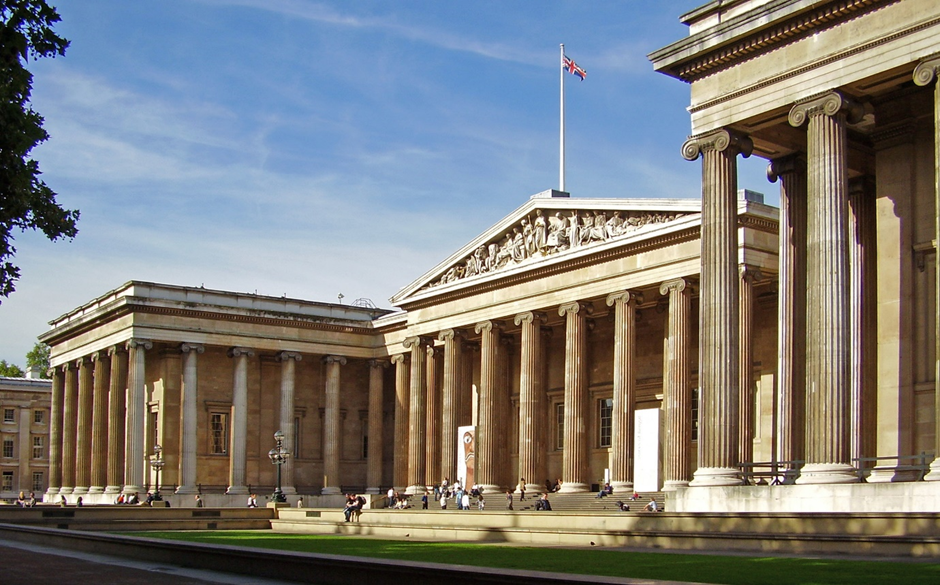
I’ve recently become interested in archaeology, having done a couple of online courses, and while visiting Birdoswald Roman Fort on Hadrian’s Wall last summer, we actually got to see an archaeological dig in progress, which was very exciting. Particularly as this dig was featured this month on BBC 1’s ‘Digging for Britain’! There are lots of items in the British Museum which reference both the Old and New Testament; tablets of writing and illustrations, coins, household murals and ornaments and much more. With the help of ‘Through the British Museum with the Bible’, I’ve explored the galleries and identified some artefacts which reflect the time when Christianity first came to the British Isles. Some of the items in the book were no longer in situ in the Museum, or I simply couldn’t find them, so it wasn’t a successful visit as I would have hoped. However, it was fascinating to see artefacts made 1,700 years ago which would have been in peoples’ homes. Note: these artefacts were not found in London, but most were found in the Southeast of England, where Christianity was introduced to England by the Romans.
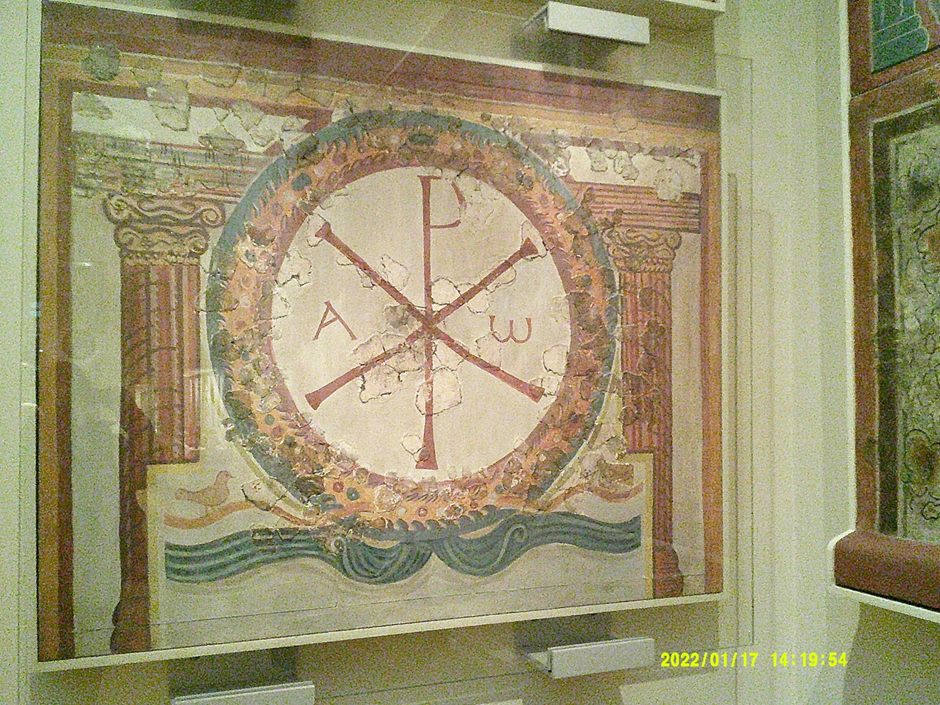
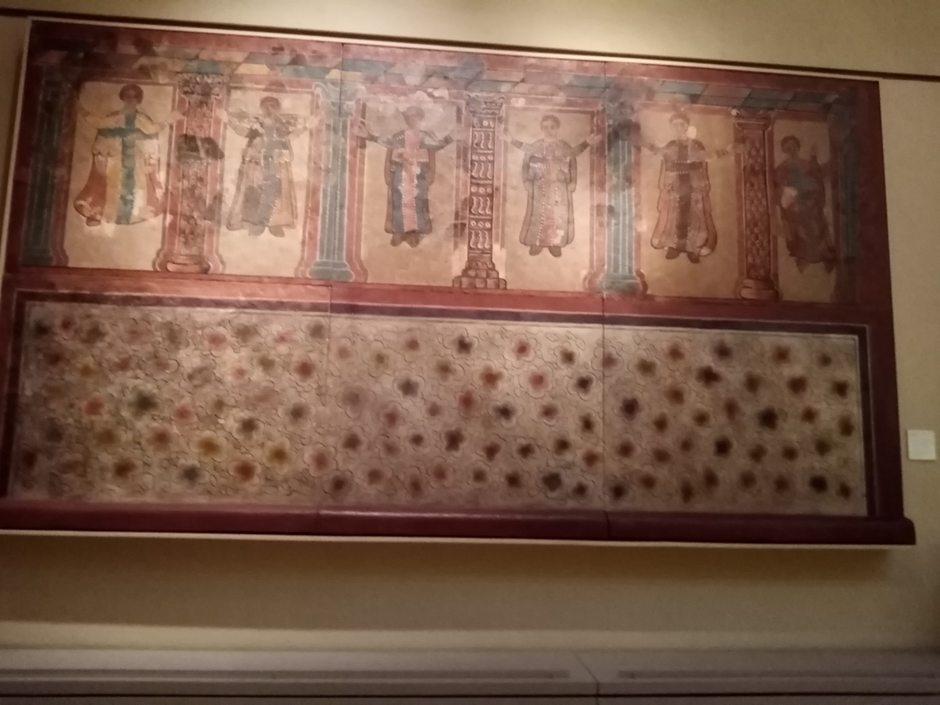
These two pictures are of murals discovered in Lullingstone Villa, an excavated Roman villa in Kent, they are 4th Century Roman wall decorations. The first is of the Christian symbol ‘chi-rho’ (the first two letters of Christ in Greek) and the symbols for Alpha and Omega; the second is a frieze of six figures with their hands raised in the ‘orans’ position of prayer. The room in which these were found was used for Christian worship; the villa was built late in the first century and there is evidence that the first owners practised pagan worship. By the 4th Century the owners had adopted Christianity and built a special room with an external entrance to allow public access – a house church! The conversion of England to Christianity took place over several centuries, and the Gospel wasn’t brought only by Roman citizens who had converted under Emperor Constantine. The Roman Empire was huge and there were merchants and traders, soldiers and civil servants from many different lands who came to English shores, bringing goods and services, along with their faith.
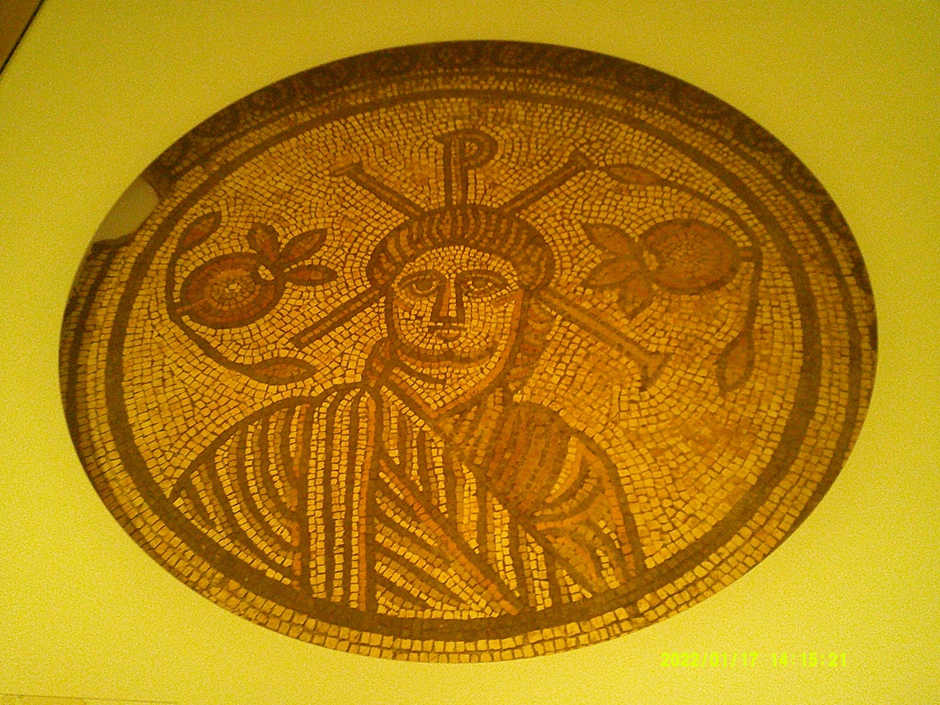
This mosaic is also 4th Century and was excavated from a Roman villa in Hinton St Mary in Dorset. The centre is a representation of Jesus wearing Roman clothing with a chi-rho behind his head and with two pomegranates which symbolise eternal life. This centrepiece is part of a larger mosaic; I’m not sure why the rest of it is covered up, maybe it’s too fragile for display, but the book says that this is a whole floor mosaic featuring the four evangelists in the corners and symbols said to represent victory and eternal life. What’s important about this mosaic is that it’s one of the earliest known representations of Christ, and the only mosaic of Christ found in The British Isles, and indeed, in Roman Europe.

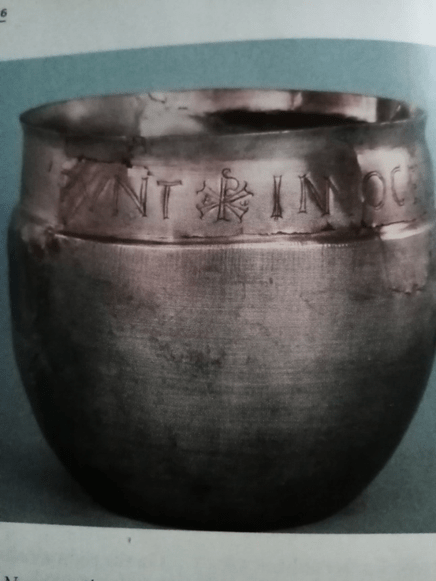
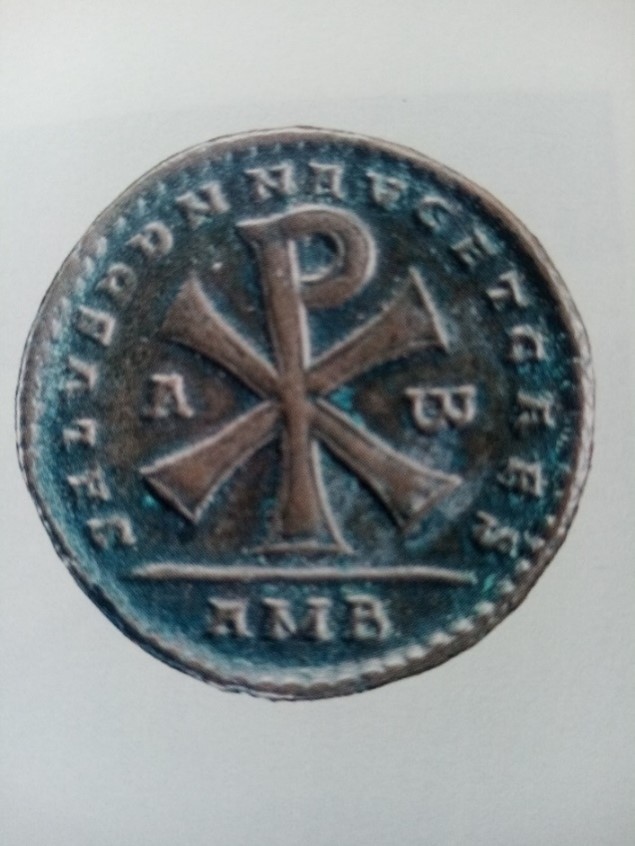
Here are four items featuring the Chi-rho. The top picture shows two plaster moulds for making lamps, these are 4th Century Roman. The Chi-rho monogram features on many household items, perhaps like having a Christian fish motif on items today. The second picture is the ‘Water Newton Treasure’, silverware from the 4th Century discovered at Water Newton near Peterborough. Other items found at the site were a pewter dish and a silver spoon, all inscribed with the Chi-rho and clearly intended for Christian ceremonies. They are the earliest Christian silverware from the Roman Empire. The picture of the coin I actually took from the guidebook, as the coins were too tiny to photograph! This coin is significant because it’s very possibly the earliest use of the Chi-rho officially stamped on a coin. There are other coins on display with Christian ‘messages’; one has the words salus mundi – salvation of the world, and a cross, another has the face of the Christian Emperor Constantine looking towards Heaven. There’s also a coin with the Chi-rho scratched on it. Coins of Constantine and his sons are still being discovered in Britain today.
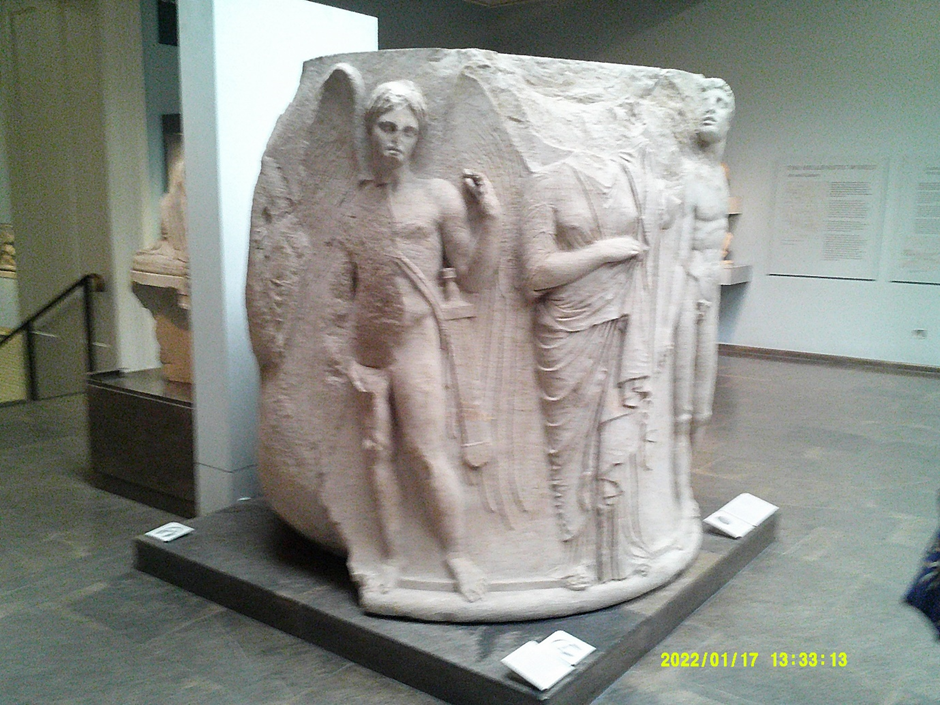
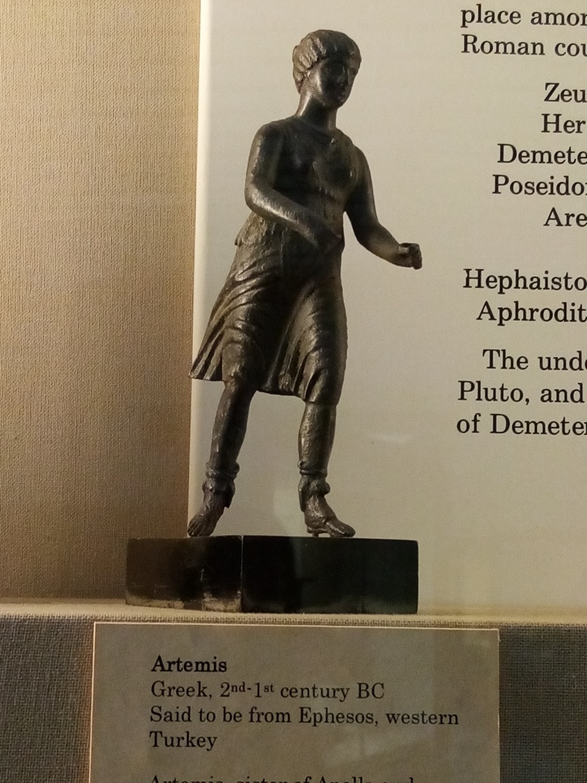
The top picture is the base of a column of the Temple of Diana in Greece, and underneath, a small statue of Diana, the goddess known in Greek mythology as Artemis. So why are these in a blog about Christian London? These are mentioned in the Book of Acts in the New Testament, and I’ll let The Message translation of the Bible explain the story, which happened in the (now) Turkish city of Ephesus: ‘A certain silversmith, Demetrius, conducted a brisk trade in the manufacture of shrines, employing a number of artisans in his business. He rounded up his workers and said “Men, you well know that we have a good thing going here – and you’ve seen how Paul has barged in and discredited what we’re doing by telling people that there’s no such thing as a god made with hands. A lot of people are going along with him, not just here in Ephesus but all through Asia province. Not only is our business in danger of falling apart, but the temple of our famous goddess Artemis will certainly end up a pile of rubble as her glorious reputation fades to nothing. And this is no mere local matter – the whole world worships our Artemis!” This set them off in a frenzy. They ran into the street yelling “Great Artemis of the Ephesians! Great Artemis of the Ephesians.”’ The narrative goes on to say that more people joined the mob and they kept up the chant for two hours, until the town clerk told them to go home quietly, and to take any complaints against Paul to court, reminding them ‘Rome, remember, does not look kindly on rioters.’
Credits: Through the British Museum – with the Bible; Brian Edwards and Clive Anderson, Day One Publications 2004
How Christianity came to Britain and Ireland; Michelle P. Bown, Lion Hudson plc 2006
The Message: The New Testament in Contemporary Language; Eugene H. Peterson, Navpress 1993
 claresimons1