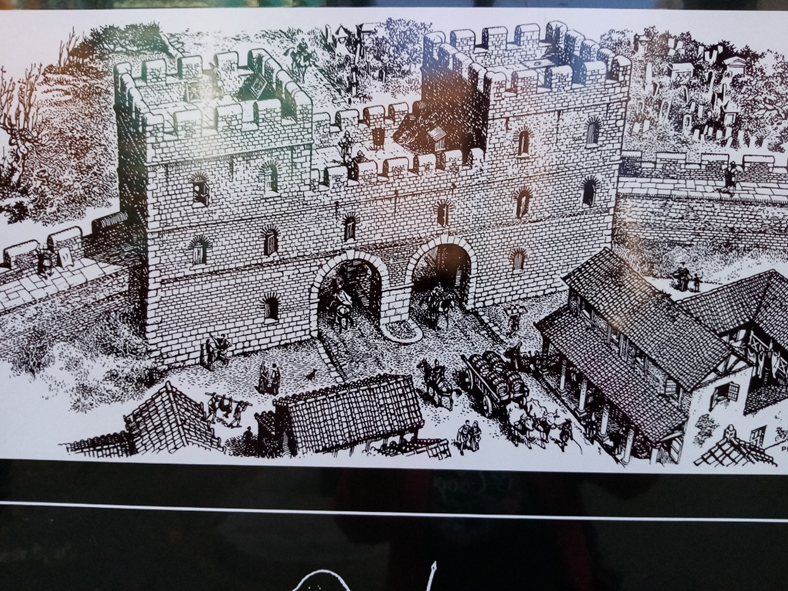
I got the idea for this month’s blog post from a book I started reading during the first lockdown: ‘London: A Travel Guide Through Time’ by historian Dr Matthew Green. The book brings different periods in London’s history vividly to life, drawing the reader into life on the streets. In the chapter on Medieval London, there’s an atmospheric description of the Traveller outside the restored Roman Wall at St Giles Church, Cripplegate: ‘Everything is black. A glacial wind chills you to the bone. You open your eyes to find yourself in a meadow under a moonless, star-speckled sky. Were it not for your flickering horn-sided lanthorn, you’d be able to see very little……Every so often you see a tiny pinprick of light flashing from a great height. You surmise that you are somewhere outside the city walls, and that a watchman is skulking behind the battlements. Perhaps if you go any nearer he will shoot an arrow at you…..In front of you, the medieval city broods, silent and black, rising sheer from a stinking ditch, girdled by its thick walls. Not for the love of God will you, an alien, or anyone, be allowed in. At eight o’clock each night a curfew is sounded……At that point everything grinds to a halt……and the city falls into a deep slumber.’* I have visited all the still standing parts of the Wall and decided I had to visit some of the churches which are situated where the city gates once stood. I’ve put the churches in the order they are situated along the wall going from the Tower of London.
*London: A Travel Guide Through Time, Dr Matthew Green, Michael Joseph/Penguin Books
St Botolph without Aldgate
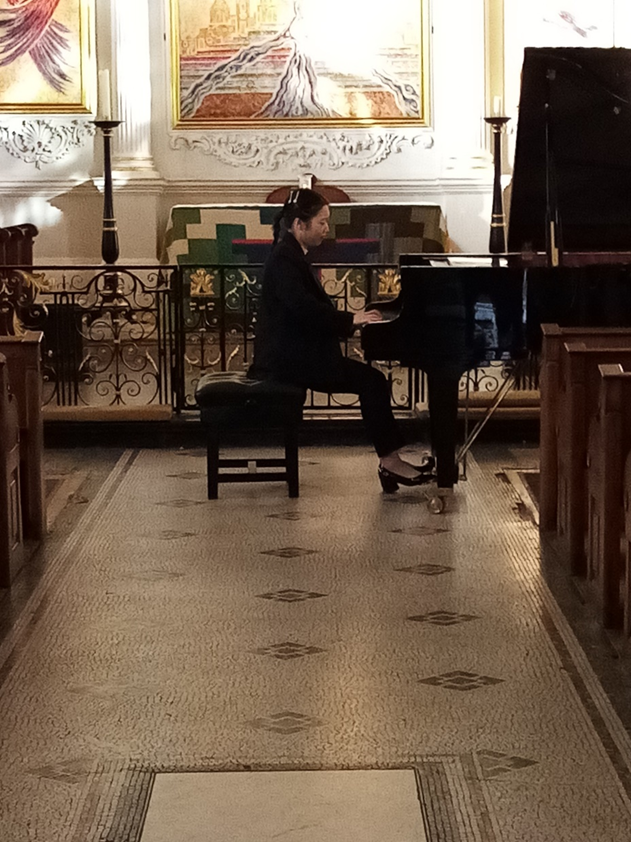
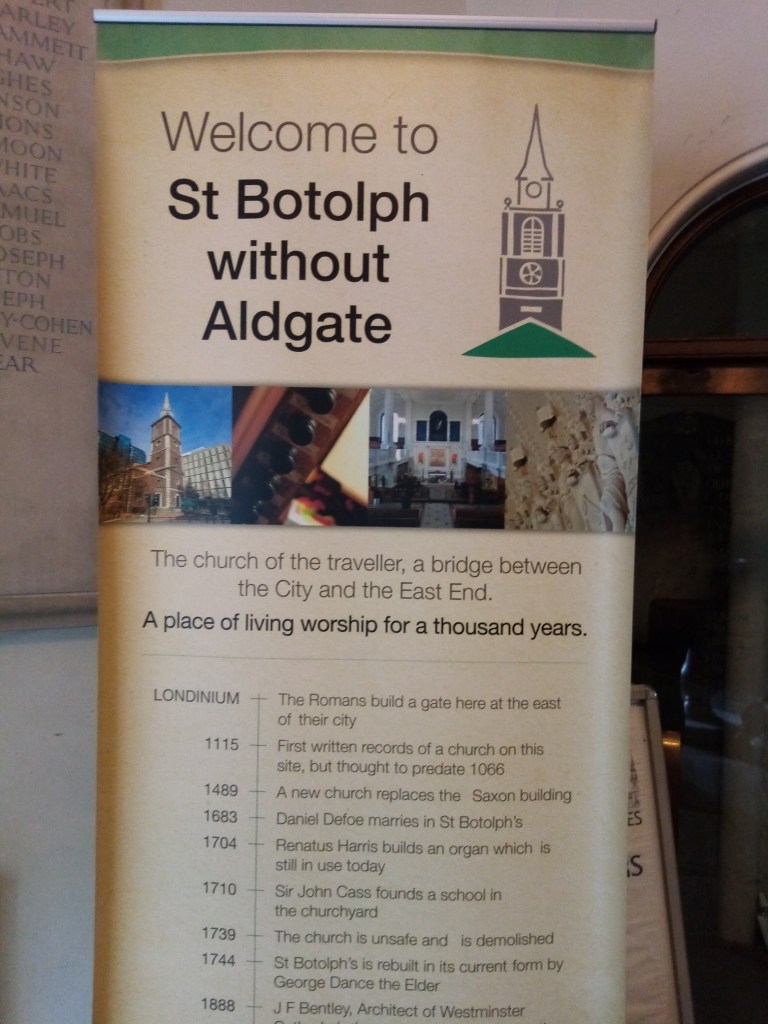
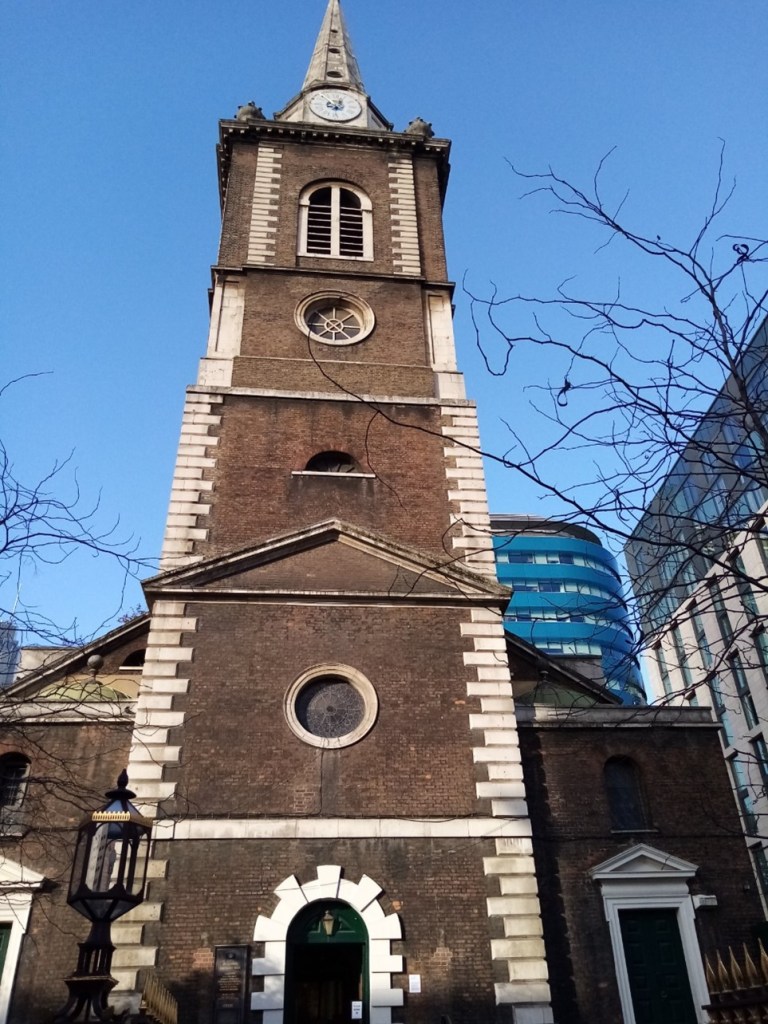
Several of the City gate churches are named for St Botolph, he’s the patron saint of wayfarers as travellers would have had to enter the City through one of its seven gates. ‘Without’ means the church stood just outside the wall. As with so many City churches, there has been a church on the site for over 1000 years; the present building was finished in 1744. St Botolph’s belongs to the Inclusive Church network and its website says ‘The tradition of St Botolph’s being an inclusive church is longer than we realised.’ In 1618 one Thomas Speller ‘a dumbe person’ was married at the church. He had brought to the church the Book of Common Prayer and his marriage licence in one hand, and his bride-to-be in the other and ‘made the best signes he could, to show that he was willing to be married’. It was agreed the marriage could take place. Bearing in mind 400 years ago a person who was dumb was usually considered to be also mentally deficient, this shows respect for disability ahead of its time! When I visited there was a delightful piano recital being performed, so I tiptoed in and out again, rather than exploring the church. There’s a fragment of Roman wall near the site, situated in an office block, so not easily accessible!
Ref: stbotolphs.org.uk
St Botolph without Bishopsgate
Another St Botolph’s, again outside the wall, and yet another lunchtime concert in progress, the City churches are famous for these. It’s believed that the site of this church has been a place of Christian worship since Roman times. The original Saxon church is believed to date from 1212. There are a couple of interesting things in the church’s long history: following suppression of religious buildings by Henry Vlll it was converted to the Bethlehem Hospital for Lunatics, known as Bedlam. St Botolph’s survived the Great Fire with no damage, lost only one window in the Second World War, but on April 24th 1993, it was one of many buildings to be badly damaged by an IRA bomb. The roof was destroyed and most of the doors and windows, and extensive restoration was completed in 1997. This church was the first in the City to have its burial grounds converted to a public garden; as well as a green space for office workers to relax during their lunch hours, there’s a netball and tennis court for the more energetic.
Ref: The Parish and Ward Church of St Botolph-without-Bishopsgate: A Short History
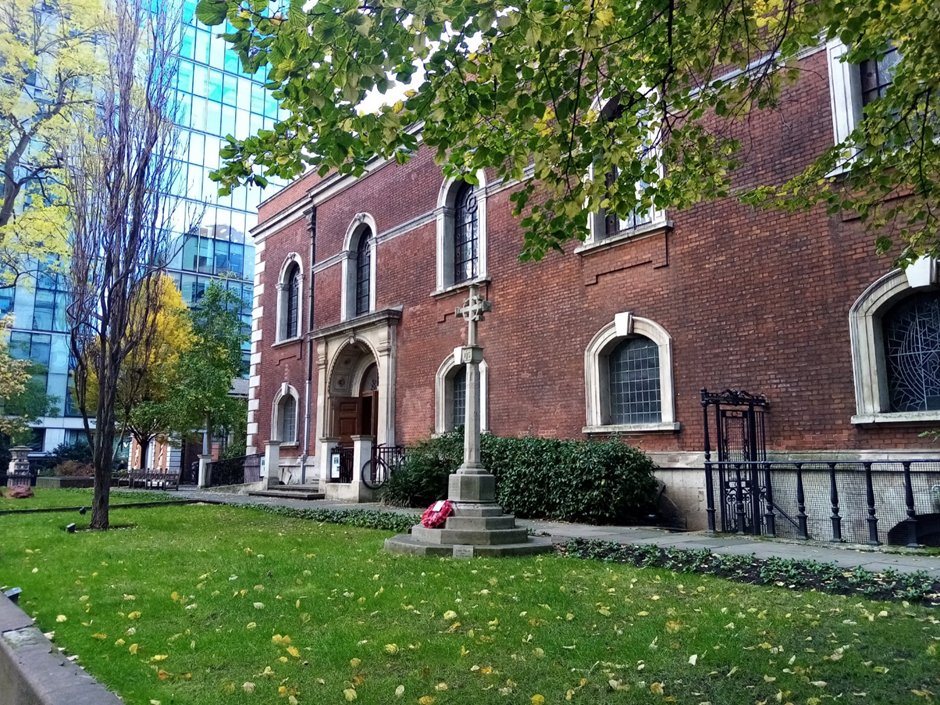
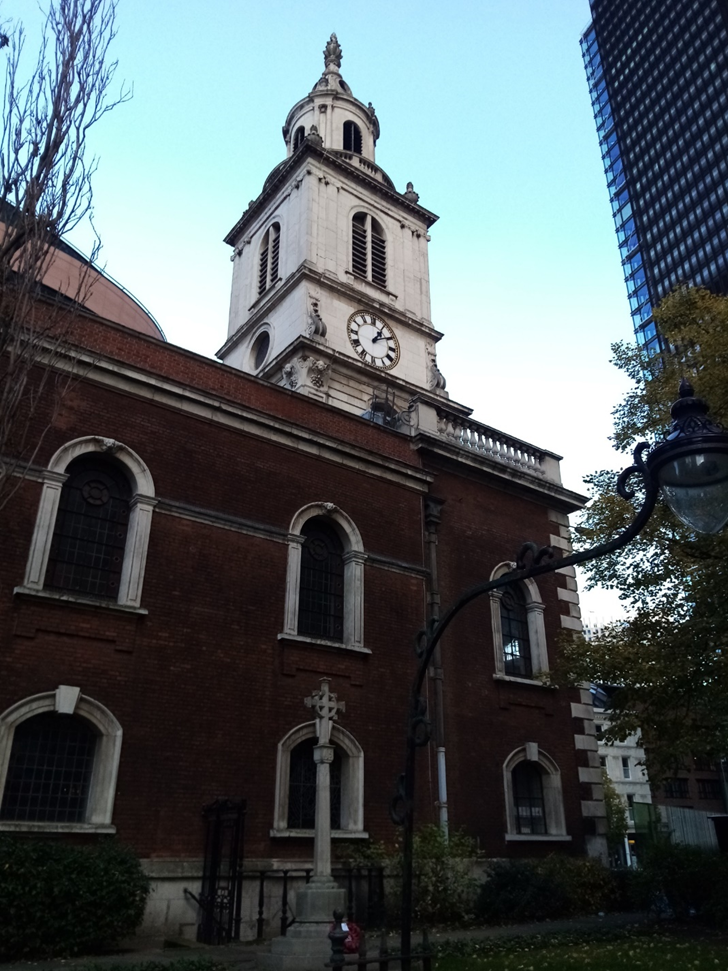
All Hallows on the Wall
The original All Hallows was actually built into a bastion, or fortification, of the wall in the early 12th century. Due to its position in the wall, it escaped destruction in the Great Fire but subsequently fell into dereliction. The present church was constructed by George Dance the Younger in 1767 when he was just 24 years old. English architects at that time often studied in Italy and brought back ideas for classical designs, and All Hallows has construction and decoration themes deriving from temples in Rome. Whilst visiting the church I got chatting with two of the Friends of the City Churches, who told me that usage of the church building is up 60% what it was in the 1970s! The church holds midweek services and has in the past been the headquarters of Christian Aid. It is associated with several other Christian initiatives: the arts festival Greenbelt, the Archbishop of Canterbury’s Millennium Youth event, The Time of our Lives, and in 2017 became the headquarters of the urban youth charity XLP. City Gates Church holds its Sunday morning service there, the first to do so since 1941! This group holds regular music events (like most of the other churches I’ve visited) and supports Christian Aid workers overseas.
Ref: Wikipedia.org/wiki/All Hallows-on-the-wall
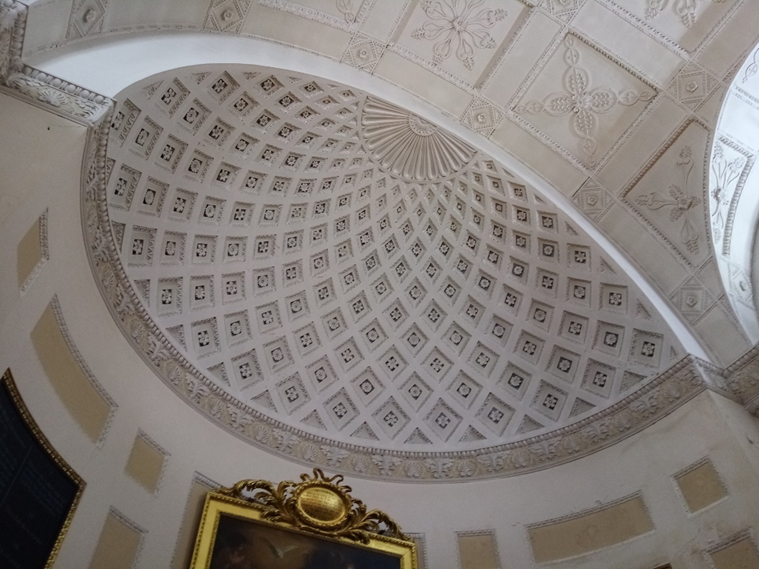

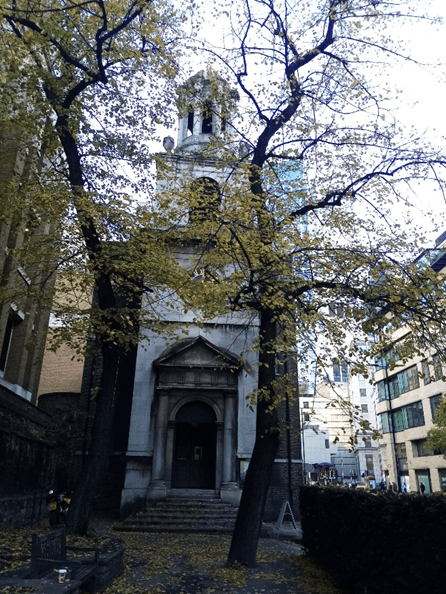

You can see how the church is built into the wall
St Giles without Cripplegate
Another site where the original Saxon church was built outside the city walls. There is no evidence that this city gate was one through which ‘cripples’ entered; the most likely explanation is that the word comes from the Anglo Saxon ‘cruplegate’, the covered way or tunnel which would have run from the Gate to the Barbican, a fortified watchtower on the Wall. The present church is one of the few remaining Medieval structures in the City; it survived the 1666 Fire but it did receive a direct hit during the Second World War and was almost destroyed apart from the walls, but was painstakingly restored both inside and out. However, so much of the surrounding area was devastated by bombing, with hardly any buildings left standing, that plans were made for a housing estate, arts centre and museum: the Barbican. Construction began in the early 1970s, and the museum is the wonderful Museum of London. While excavating the area, parts of the Roman Wall were discovered, these were carefully restored and sit beautifully (I think) alongside the modern buildings and the famous High Walks. When I visited the church there was…not a music recital, but a Book Fair! Always something going on in the City churches! (Needless to say, I bought a book.)
Ref: stgilesnewsite.co.uk/history
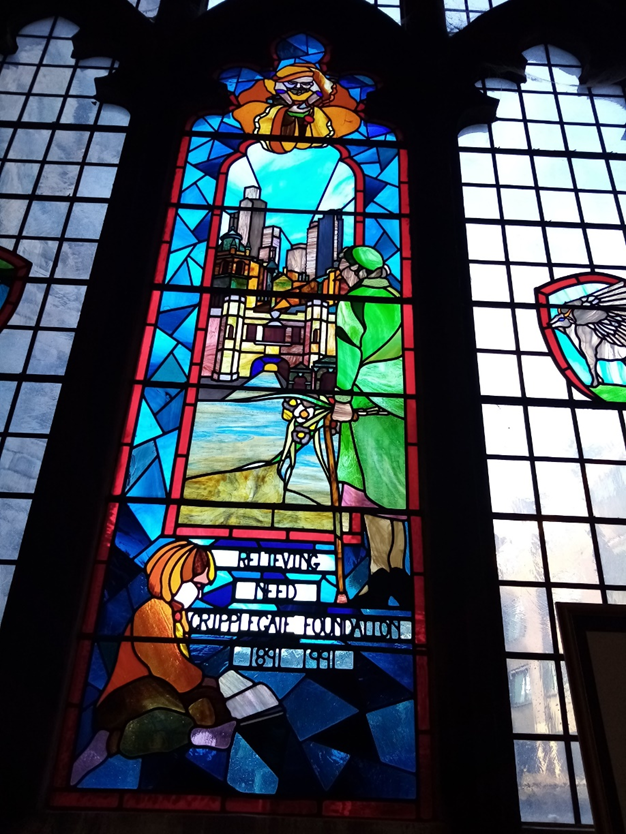
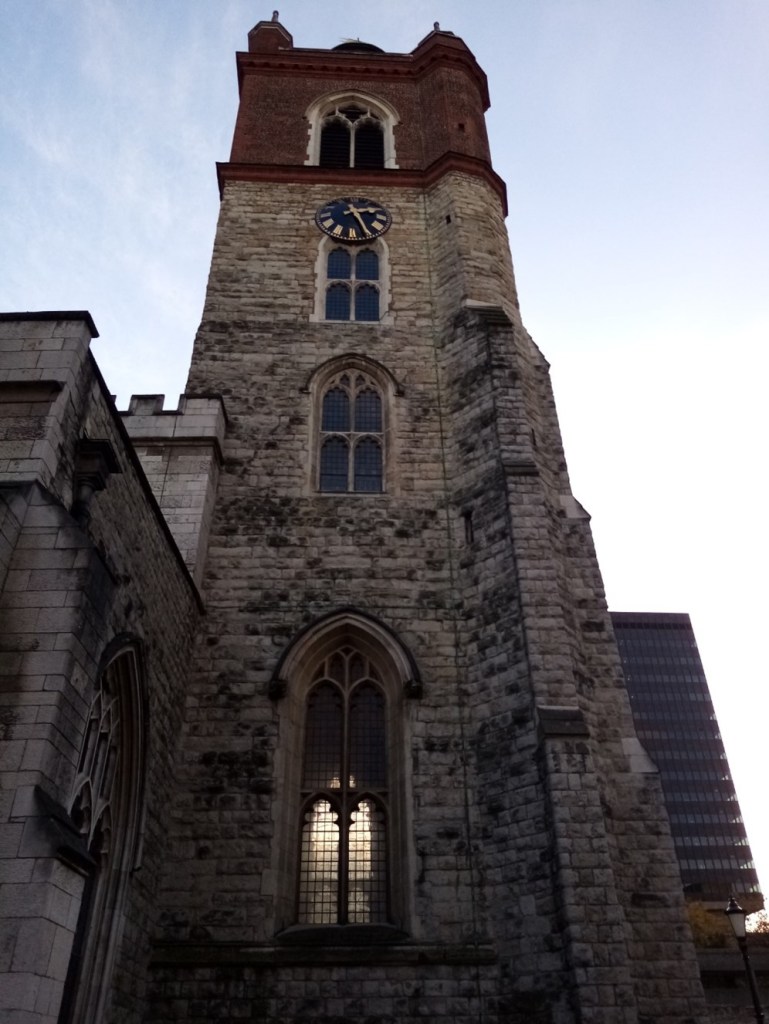
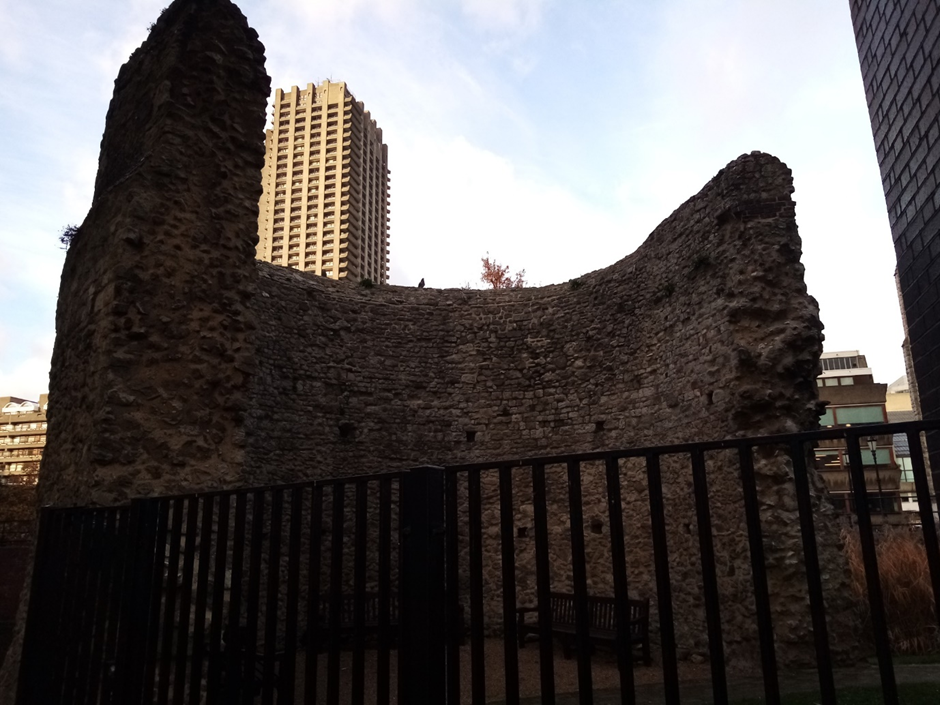
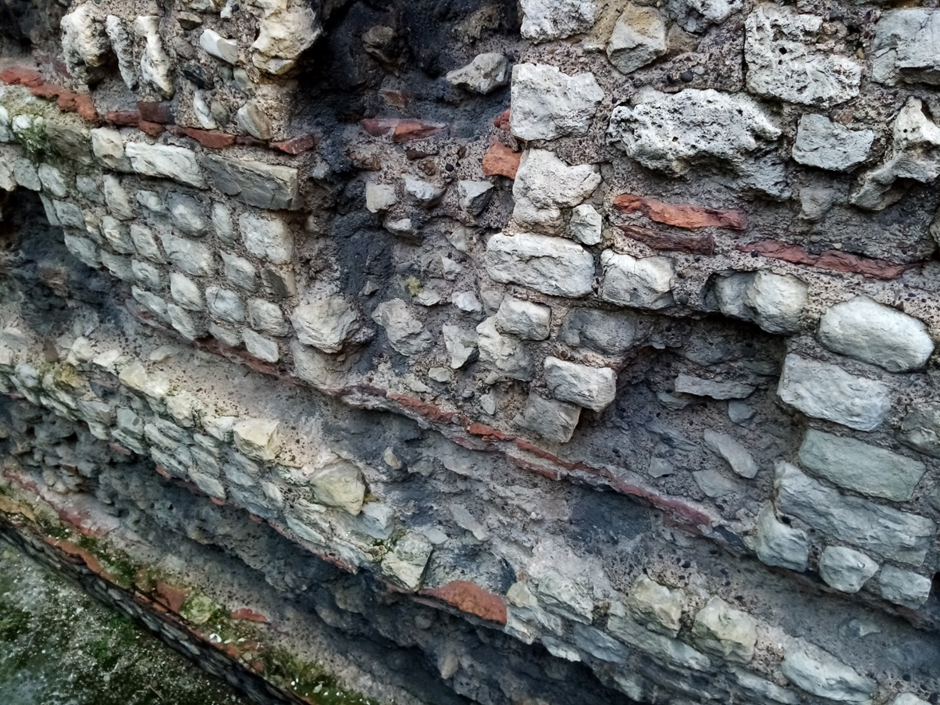
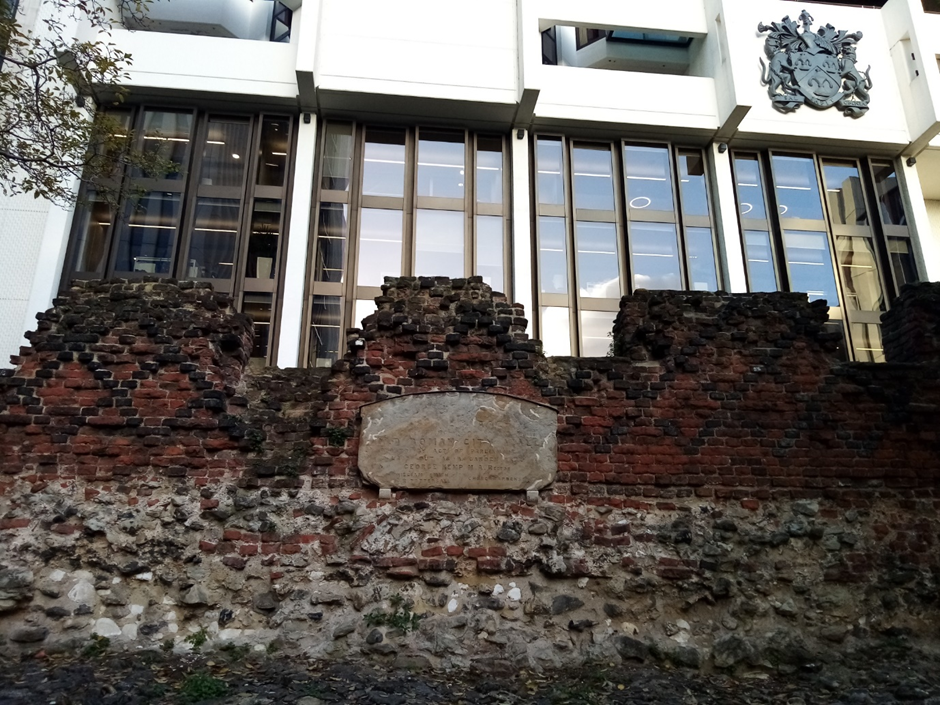
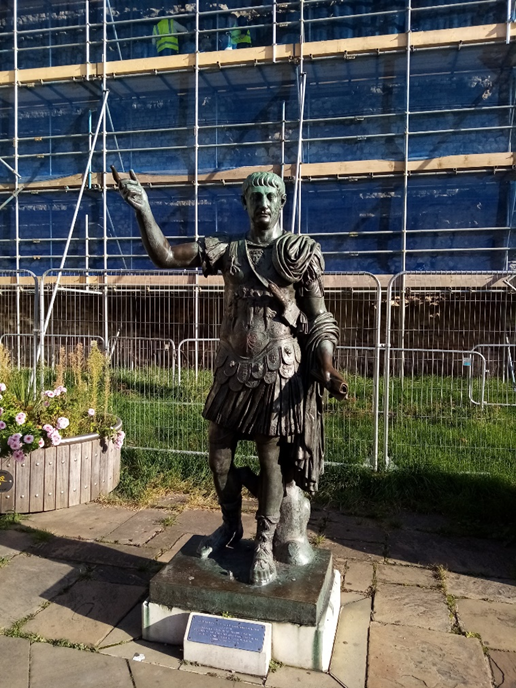
To finish, some random London Wall pics. The red striped parts at the bottom are original Roman, the parts higher up are Medieval, when the walls were built taller as protection for the City.
 claresimons1