
These might not be popular with everyone, but I love these buildings! And most of all, I love the stark contrast between their 21st Century looks and the medieval and classical designs of the city churches. As mentioned in previous posts, I love the way the Walkie Talkie (the squarish one) peeps into my pictures, so, as I still can’t go inside churches yet, I thought I’d try to get some photos of churches with these big boys lurking in the background. It was quite a challenge to get the right shots. Here are four for July, plus a couple of other interesting ones. Information about all the buildings mostly obtained from Wikipedia*
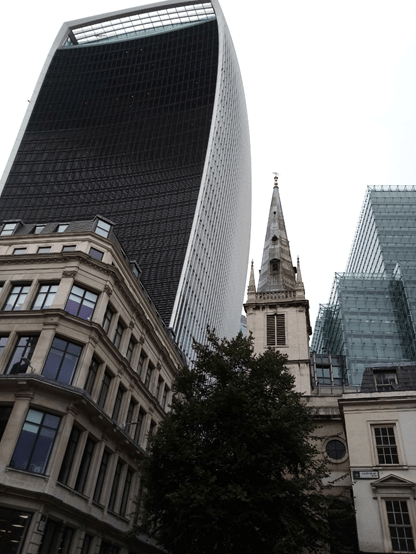
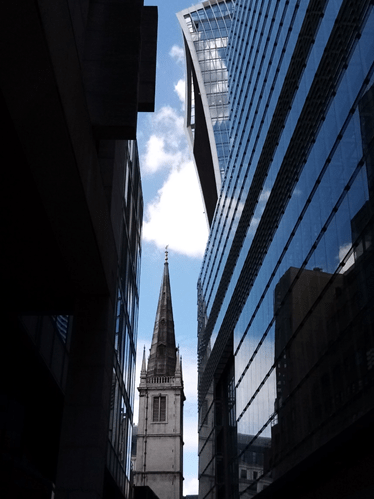
St Margaret Pattens: Founded 1067, rebuilt by Sir Christopher Wren 1686 – 1688. The original church was destroyed in the Great Fire, but this one was not damaged in the Blitz. The name is probably derived from pattens, wooden-soled overshoes which people wore in the muddy London streets. But why name a church after shoes? Because it has associations with the Livery Company, the Worshipful Company of Pattenmakers. The church is designated a Grade 1 listed building as are all the City churches, meaning that they can’t be demolished or altered in any way, inside or out.
The Walkie-talkie: 20 Fenchurch Street, completed 2014, Architect: Rafael Vinoly. Architectural Style: Neo-futurism. Floor Count: 35, plus the 3 storey ‘Sky Garden’ which is free to visit, but you have to book in advance. There’s a restaurant and coffee bars and a lovely garden of tropical plants, plus panoramic views of London. The building was originally proposed to be 200m tall (it’s actually 160m) but there were concerns about its visual impact on St Paul’s and the Tower of London. Even after its height reduction there were complaints from heritage groups, resulting in a public inquiry but this ruled in the developers’ favour and in 2007, full planning permission was granted. In 2015, the Walkie Talkie was awarded the Carbuncle Cup for the worst new building in the previous 12 months. What do you think?
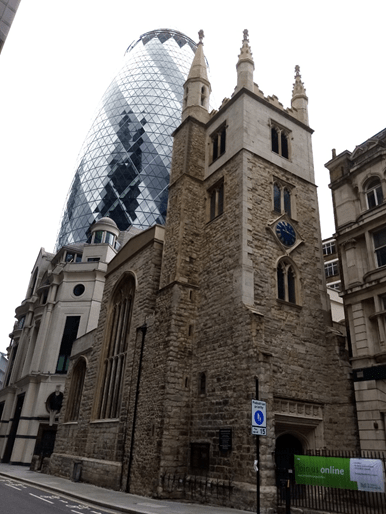
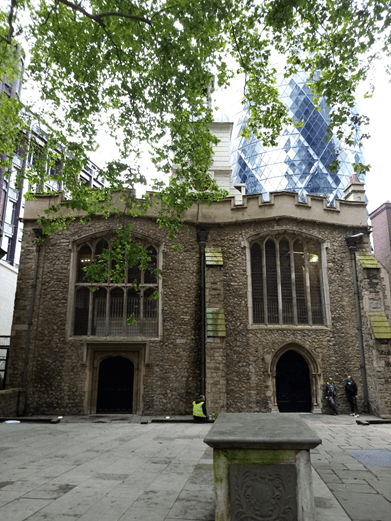
St Andrew Undershaft: founded in 1147, survived both the Great Fire and the 1940s Blitz. The current church was built in 1532, I would LOVE to have seen the surrounding streets in those days! Its name comes from the shaft of the maypole which was set up in Spring each year opposite the church for Mayday revels. It was removed and destroyed in 1547 by a mob who saw it as a ‘pagan idol’.
St Helen Bishopsgate: founded in 1210 as a nunnery, St Helen of the Benedictine Order. The church also survived the Fire and the Blitz but in both 1992 and 1993 the church was badly damaged by IRA bombs set off nearby, including the destruction of all the stained-glass windows. Since then the church has been restored and improved: ‘a more flexible, open space, lighter than ever before and yet retaining all its ancient grandeur.’ So it says on their website, I’ll have to go inside when we’re allowed again!
The Gherkin: 30 St Mary Axe was the former site of the Baltic Exchange which was completely destroyed by that IRA bomb in 1992. Completed in 2003, Architect: Foster + Partners, Architectural style: Neo-futurism. Floor count: 41 storeys. Originally the London Millennium Tower was to occupy the site, which would have been the tallest building in Europe, but Heathrow Airport objected to the disruption that such a tall building would have on their flight paths. A word about the street name: St Mary Axe was a church demolished in 1561 and the name derives from the being associated with the Worshipful Company of Skinners who used axes in their trade. The sign of the Axe was said to have been present over the church. Further interesting fact: true Londoners pronounce the street name ‘Simmery Axe.’!
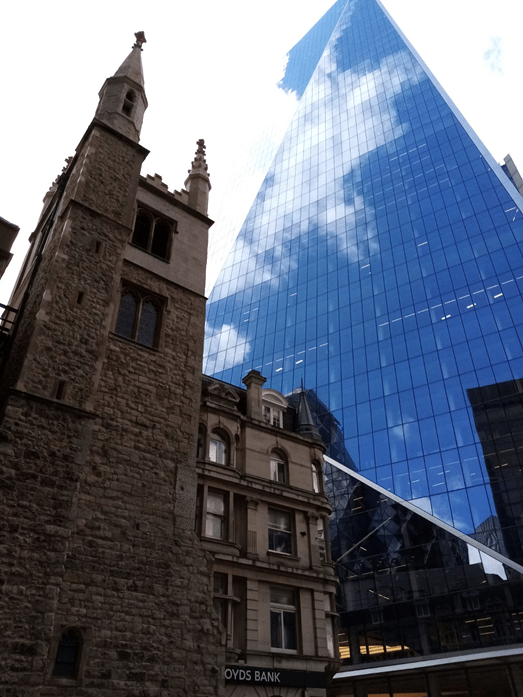
The Scalpel: 52 Lime Street, is built on a site formerly occupied by Prudential House and Alianz Cornhill House. Completed in 2018, the architect was Kohn Pedersen Fox and the floor count is 38. No architectural style cited but I’m guessing neo-futurism. The name ‘Scalpel’ was coined by the Financial Times due to the building’s ‘distinctive angular design’. This building has a pointed top but also a dark triangular roof lower down, which if seen from the train on a sunny day, looks like a ‘play’ button! Lime Street is also home to the distinctive Lloyds of London building (and also it appears, a local Lloyds branch!)
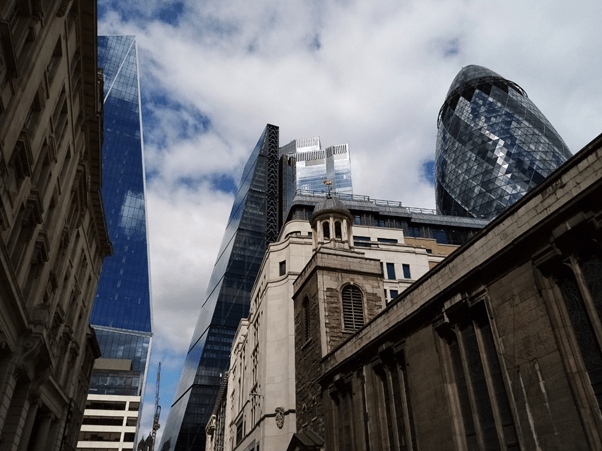
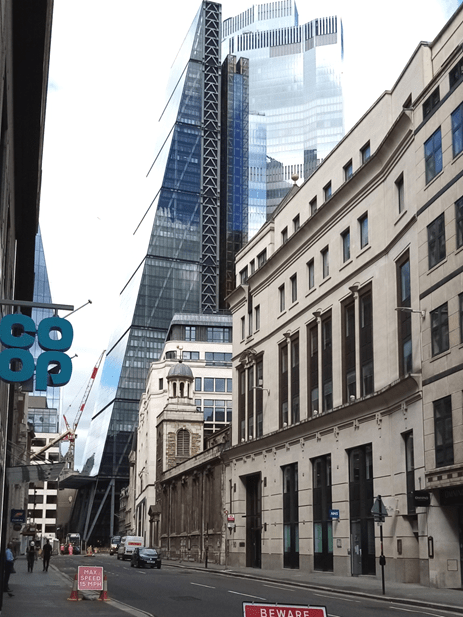
St Katherine Cree: Founded in 1280, replaced by this Jacobean building in 1628, the name derives from ‘Crichurch’, an abbreviation of Christchurch. This is a guild church, rather than a parish church, designated by an Act of Parliament, no less, to ‘serve and minister to the non-resident, daytime population of the City’. There are several of these churches and this one is the Guild Church to Finance, Commerce and Industry, not surprising really. In practice, this means that the church is open on weekdays offering on different days, Holy Communion and prayer for healing, Bible study, talks with church wardens, a ‘Not on a Sunday’ service, and Lloyd’s choir practices. At the present time, some off this is being offered online, according to the notice board.
The Cheesegrater: 122 Leadenhall Street, also known as The Leadenhall Building. I walked right underneath this without realising what it was, easily done. Completed in 2013, architect Rogers Stirk Harbour + Partners. The floor count is 48 and the architectural style is post-modern structural expressionism, looks neo-futurism to me. It is said that the City of London’s Chief Planning Officer, Peter Rees, on seeing a model of the concept ‘told Richard Rogers I could imagine his wife using it to grate parmesan’. Not ordinary cheddar, mind. As the Gherkin and the Shard had already been given nicknames, The Cheesegrater continued the trend. It makes Tower 42 sound boring, doesn’t it?
2 Extras:
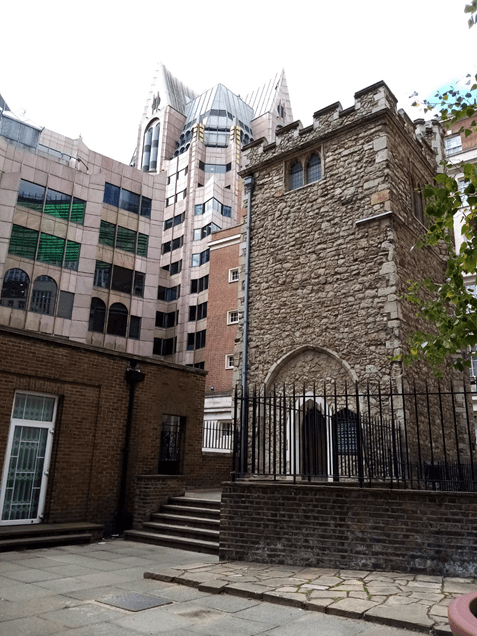
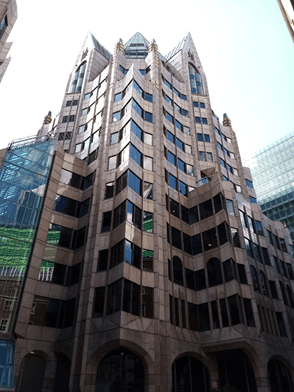
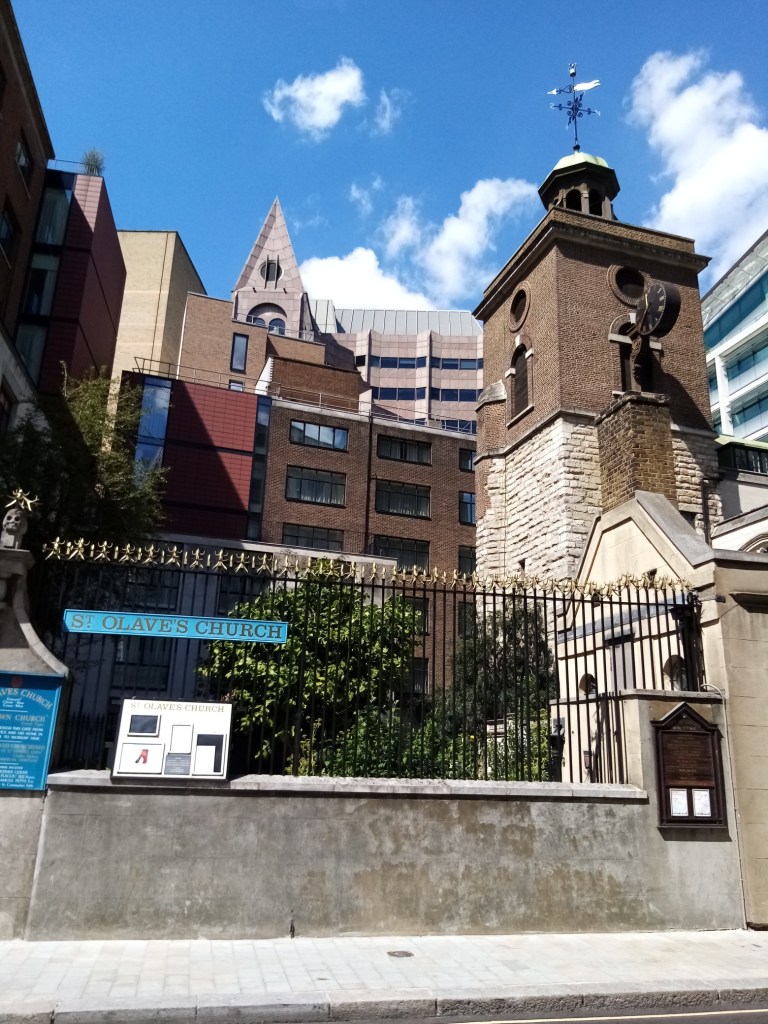
Better views of Minster Court and St Olave’s Church
Minster Court: Three buildings onMincing Lane and Mark Lane. Completed in 1992 and designed by architects GMW Partnership, it has been described as post-modern gothic. Personally, I don’t like it, but it certainly has a dramatic, Gotham City look to it. The exterior was used as Cruella De Vil’s haute couture fashion house in Disney’s 1996 live action remake of 101 Dalmatians, and No 3 Minster Court is the offices of the London Underwriting Centre.
St Olave’s Hart Street: This little church has a literary history, being the burial place of diarist Samuel Pepys and his wife, who worshipped here, and named by Dickens as ‘one of my best beloved churchyards.’ The poet John Betjeman described St Olave’s as ‘a country church in the world of Seething Lane’ (a nearby street.) The present building is 1450 and described as ‘Perpendicular Gothic’, although it doesn’t seem to bear any resemblance to post-modern gothic!
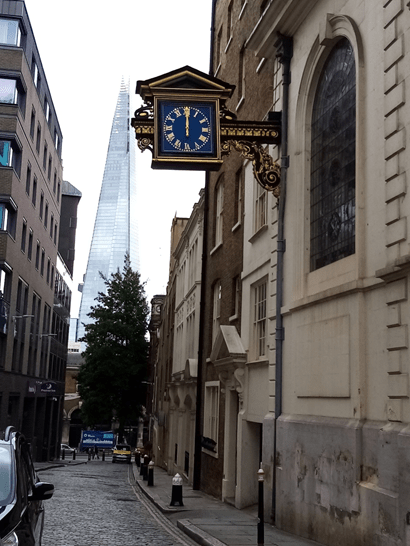
St Mary-at-Hill: Founded in 1336, but there is evidence of a church on the site in 1177, according to ancient documents. The church was severely damaged in the Great Fire, not surprising as the starting point of the Fire was Pudding Lane, two streets away. It was skilfully rebuilt by Christopher Wren who managed to retain the medieval walls. The church serves the Parish of Billingsgate and has strong links with the famous Fish Market, formally situated at Billingsgate Quay down the hill at the waterside. A Fish Harvest Festival is still held annually at the church!
The Shard: Also known as The Shard of Glass and formerly, London Bridge Tower. Situated on the Southbank, it is the tallest building in the UK at 95 floors and was completed in 2012. The architect was Renzo Piano and the style is neo-futurism. The story goes that entrepreneur Irvine Sellar wanted to redevelop the Southwark area and met the Italian architect for lunch in Berlin, to discuss plans for a new building. Piano expressed contempt for conventional tall buildings and sketched a spire-like sculpture emerging from the Thames on the back of a menu. I wonder how many other buildings started as a doodle on a random piece of paper? Probably most of them!
*A Final Word: I’ve loved doing this month’s blog; the challenge of getting the right photos, walking the lately almost deserted streets of the City and marvelling at the contrast of ancient stone and modern glass and steel. Today I donated £10 to Wikipedia, I couldn’t do this without the vast knowledge, seemingly on absolutely every subject, on their site. It’s been fascinating, hope you enjoyed reading it too.
 claresimons1