Walk the Wandle

Wandle Trail Walk

Introduction

Two of my favourite things are walking and rivers.  I love walking because it counts as exercise and you can take time to look around and notice things you wouldn’t see if you were driving or cycling or even jogging. I love rivers because they are natural phenomena, but at the same time, historic, as over the centuries they are used for transport, industry and pleasure. Roads change over time: enlarging to carry more traffic, changing route, falling into disuse, but rivers tend to stay more or less the same.  And because river banks are relatively level, no steep inclines (which I don’t like), they are easy to stroll along in a leisurely fashion.  The downside of river walks is that they are linear rather than circular so you either have to walk all the way back or arrange transport to take you home!

So, to my epic journey along the Wandle Trail!  The Wandle is a fascinating river and thanks to the fabulous Trail you can stroll along its banks for almost all its length. Most of it is accessible for buggies and wheelchairs but there are a few muddy or narrow paths. I’ve divided the Walk into four sections, each taking about 1 hour to walk at a gentle pace.

These are the sections: Waddon Ponds to Wilderness Island

Wilderness Island to Morden Hall Park

Morden Hall Park to Plough Lane

Plough Lane to River Thames

I’m starting at Waddon Ponds, because that’s where you see the ACTUAL River emerge from the pond and begin its journey to the Thames; however, the ‘official’ start of the Wandle Trail is at East Croydon Station (who knew?) and goes down to Wandle Park via Old Palace, but no river to be seen.  I could have started at Wandle Park but THERE’S STILL NO RIVER THERE! There is a manmade channel but the river itself goes under the tram line and the A23, then into Mill Lane, still underground. However, Wandle Park is a very nice green space with a skate park, a wildlife pond and a bandstand on which in July you can see plays performed by CODA*, this year it was Shakespeare’s Much Ado about Nothing. There’s also a London Borough of Croydon sign which claims that this IS the source of the Wandle!

Before I start the sections, here are some interesting facts:

The Wandle flows through 4 London Boroughs: Croydon, Sutton, Merton and Wandsworth.

The Wandle is too shallow to be used for navigation (boats.)

BUT it’s very fast flowing which is why over time there have been more than 90 mills at various places along its banks. That’s a lot of industry.

The mills and other historical buildings have all been documented in other excellent publications** so I won’t be specifically mentioning them, but as my focus is on what can be seen on the Wandle Trail, they do come up from time to time.  So, as Nancy Sinatra said: You ready boots? Start Walking!

*Croydon Operatic and Dramatic Association

**River Wandle Companion and Wandle Trail Guide, Bob Steel and Derek Coleman, Culverhouse Books

The Wandle Guide, The Wandle Group, Sutton Leisure Services

 Words/phrases in bold indicate a photo (on separate page)
Articles 4 and 5: ‘Governments must help families protect children’s rights’

Article 4: Protection of Rights. Governments have a responsibility to take all available measures to make sure children’s rights are respected, protected and fulfilled.  Goes on to say countries should review their provision of social services, legal, health and educational systems, including funding for these services, and ensure the minimum standards of the Convention are met.  Also ‘they must help families protect children’s rights and create an environment where they can grow and reach their potential’.  This is linked with the next Article, so I’m including this in this post:

Article 5: Parental Guidance.  Governments should respect the rights and responsibilities of families to direct and guide their children so, as they grow, they learn to use their rights properly.  Crucially, ‘the Convention does not take responsibility for children away from their parents and give more authority to governments.’  Instead, governments should protect and assist families in their nurturing role.

I’ve put these two together because parents want the best for their children: a happy, healthy, safe and fulfilling life, and they rely on government provision and protection to enable them to do so.

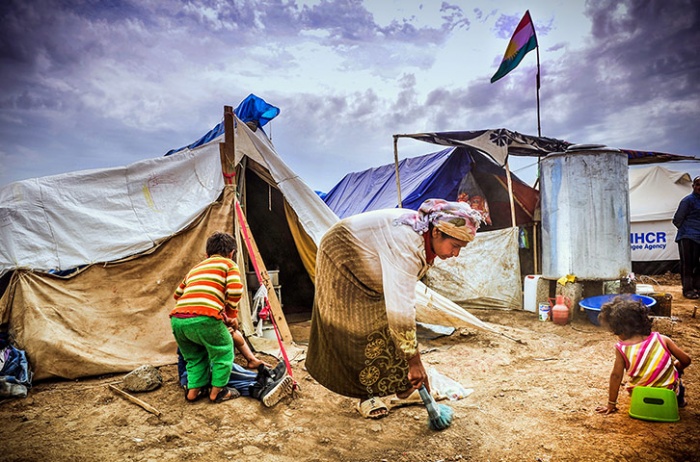
The Guardian newspaper ran a story about a mother and father and their four children who were forced to leave their home in Damascus, Syria because their ground floor apartment was situated in an area of intense fighting.  When their electricity and water supplies were cut off and they started to run out of food, they decided to make a run for it, taking with them only ID cards and money.  They fled to Iraq where they have been living for four years in a refugee camp. The children were terrified as the family escaped and embarked on a dangerous and exhausting journey to a camp accommodating 50,000 people but built for half that number.  They were safe but living conditions were unsanitary, the children desperately missed their home and they had nothing to do except play just outside the tent, as their mother Avine was scared to let them out of her sight.  A mum simply wanting to do the best for her children like millions all over the world, having to watch them grow up in a way far removed from what she hoped for them: ‘They have forgotten all about their home.  It makes me very sad.  I never imagined I’d bring up my children in a refugee camp.  Never.’  About the girls’ education she says: ‘Their lack of education was my biggest fear. I used to watch them playing outside in the mud and worry that they were going to end up illiterate.’

MDG Syrian refugees in Iraq

Four years on, things are much better for the family.  Avine has resumed the bridal salon business she had in Damascus – yes, people get married in refugee camps!   The family managed to pay a labourer to build them a small breezeblock house with their own facilities.  Avine has since had another baby, who has brought joy to the family. The older girls attend school and also had catch up classes for the two years they have missed and they also go to child resilience workshops to help them deal with the trauma they have experienced.   Avine says: ‘It is heartbreaking to have to leave your home….I won’t take my children back until the situation is settled and I do worry endlessly about them growing up in a refugee camp.’

In many ways, they are among the lucky ones.  Avine’s husband has gone to Germany, where they have relatives, to try to get residency for the family, although that is another loss the children have to deal with, albeit temporary.  Their quality of life is better than most.  But what shouts out to me when reading this article is the mother’s feelings of guilt and regret that she couldn’t do the best for her children, and her anguish that even now it might be too late to make up for that.

Not her fault, but that of the war that has torn her country apart.

 MDG-Syrian-refugees-in-Ir-011

Reference: http://www.theguardian.com/global-development/gallery/2013/jul/02/syrian-refugees-iraq-domiz-in-pictures#img-3

What is a Child? (As defined by the UNCRC)

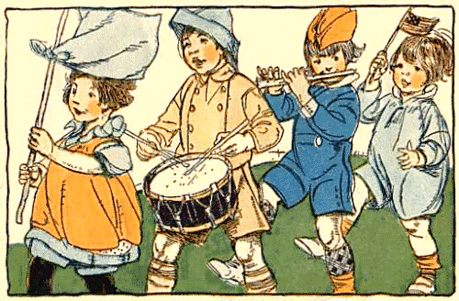
Article 1: Definition of a Child ‘…….a person below the age of 18, unless the laws of a particular country set the legal age of adulthood as younger’.*

normal_little_bugle_corp

For such countries, the Convention encourages them to consider increasing the age of majority to 18, however in practice, the Articles of the Convention apply to anyone under 18, regardless of the laws of their country.

Why is this important?  Because childhood is socially constructed; it is never an absolute.  An example: in certain countries, and historically in the UK, a girl of 12, 13, 14, 15 can be legally married to a man over the age of 18.  Under current UK law, this is not legal and the subsequent sexual relationship would be considered child abuse, resulting in a criminal conviction and possible imprisonment, placement on the Sex Offenders Register, debarment from certain jobs…..you get the picture.  In one country it’s illegal, in another, it’s the norm.  Perhaps in such countries a young female teenager isn’t considered capable of making responsible decisions for herself.  In that case, why is she getting married?  In the UK, those under 18 are protected under the Children Act 1989 (and subsequent Acts) from situations and activities that could potentially harm them; the UNCRC seeks to protect all the world’s children.

Let’s look at another example: my father-in-law started work at 14.  I’m not sure but I assume he worked a full day, though as an apprentice he wouldn’t have earned a ‘living’ wage (no Minimum Wage in those days.)  Considered an adult for the purposes of work, he couldn’t rent or buy a home, get married, drink alcohol, drive a car; and, not least, he couldn’t vote.  He paid Income Tax and National Insurance but played no part in deciding which political party should spend his hard earned contributions.  And he wouldn’t have, until he was 21!  Some people argue that the UK has gone too far the other way.  The age of majority is now 18, an age when some young people are just embarking on their university degrees, so all the responsibilities associated with adulthood (it’s argued) shouldn’t be given to ‘children’ still in full time education who can’t make ‘grown up’ decisions.  In some countries today children are working at 11 or 12, usually combining work with studying at school. There are countries in which full time secondary school education doesn’t finish til age 19.

Furthermore, all over the world there are religious and cultural celebrations of ‘Coming of Age’, for example, the Bar Mitzvah of the Jewish faith for boys aged 13.  Many of these originate thousands of years ago and don’t relate to modern times, but even today there are people groups who in practice set the age of adulthood at below 18.

The point I’m making is that the activities and responsibilities we associate with child/adulthood are flexible on the age to which they apply.  Therefore it’s important that the UNCRC is NOT flexible on its application: it’s everyone under the age of 18 years.  As we’ve seen, this is actually problematic in practice: ‘In many societies children’s births are not registered and they have no idea when they reach eighteen.  In other cultures, boys and girls marry much younger, often at puberty, they work as soon as is necessary and even have their own children, at ages which the UNCRC would still refer to as childhood’. (Understanding Childhood, Martin Woodhead and Heather Montgomery, The Open University, 2003.)  However, this Blog is not intended to apply policy or solve problems…….

*All ‘Article’ quotes are from http://www.unicef.org/arc/files/Rights_overview.pdf